
RBSE Class 10th 2011 Mathematics-S-09-1-2011 Previous Year Papers
You opened the RBSE Class 10th 2011 Mathematics-S-09-1-2011 Previous Year Papers page — a focused place to read the real previous year question paper for that subject and year. RBSE Solution keeps exam-year sets together so you can practise the same cycle your seniors faced.
Previous year papers reward patience: read instructions, note mark distribution, then attempt questions before peeking at solutions elsewhere on the site. This URL always loads the same free previous year papers content for Mathematics-S-09-1-2011 (2011).
Use the details table to confirm class and year, then scroll to the paper images or PDF below. More subjects from 2011 are linked later on this page.
Paper details
Quick reference for this previous year papers page — confirm board, class, and year & subject before you study.
| Board | RBSE |
|---|---|
| Class | Class 10th |
| Exam year | 2011 |
| Subject | Mathematics-S-09-1-2011 |
| Resource type | Previous Year Papers |
| Category | RBSE Previous Year Question Papers |
| Website | RBSE Solution |
The table summarises this Previous Year Papers resource. Confirm RBSE, Class 10th, year 2011, and subject Mathematics-S-09-1-2011 before studying.
RBSE Solution organises previous year papers so each URL carries chapter-specific guidance — better for students and for search engines than one generic paragraph for the whole class.
Turning 2011 papers into insight
One Mathematics-S-09-1-2011 paper reveals style; several from the same year reveal pattern. After this page, open sibling subjects listed below to see whether marks cluster in certain units.
Keep rough work dated in your notebook. Examiners in Class 10th expect clear numbering even in practice sessions.
RBSE Class 10th 2011 Mathematics-S-09-1-2011
Scroll through the Previous Year Papers pages for Mathematics-S-09-1-2011 (2011).
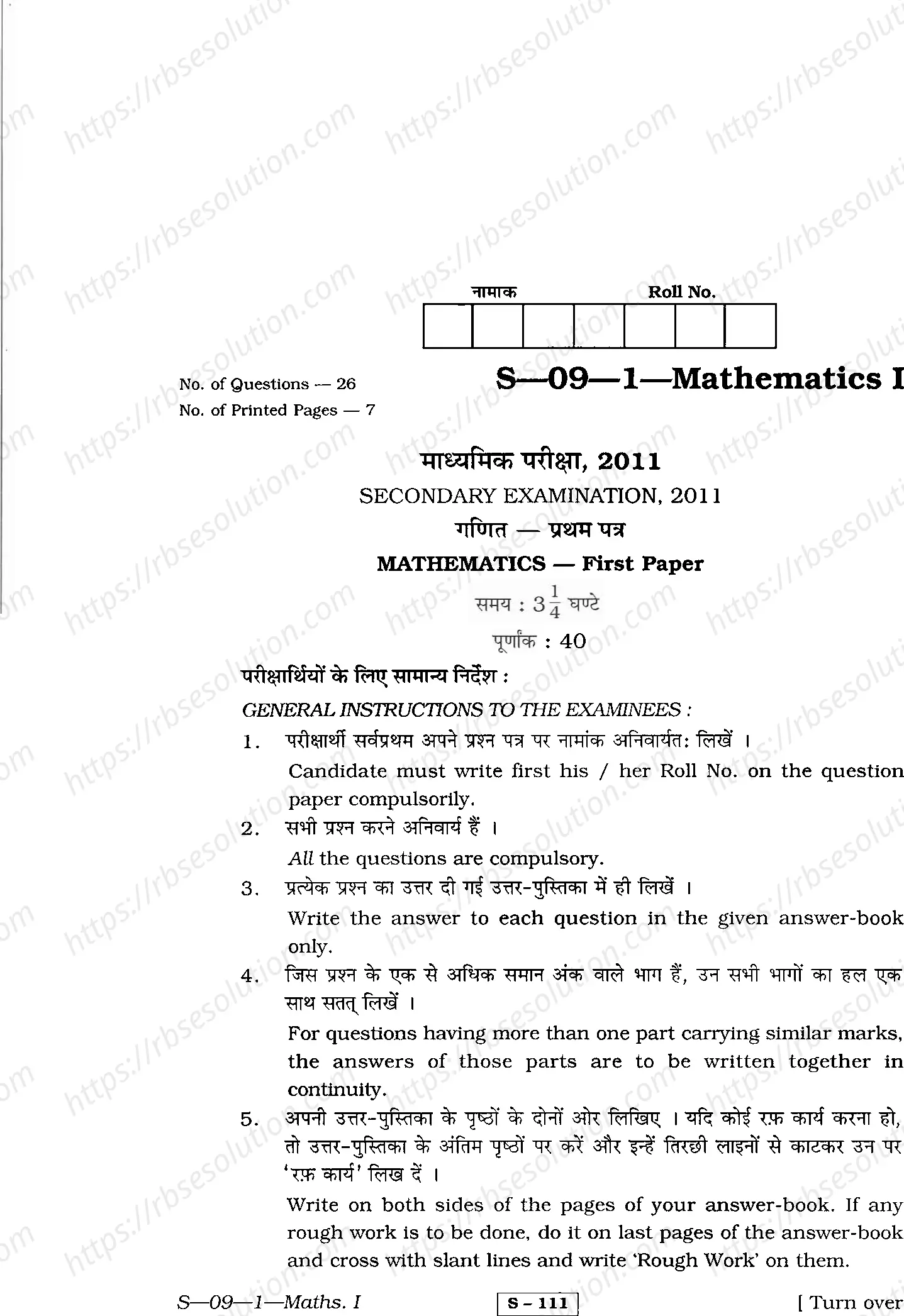


Rajasthan Board Class 10th Mathematics-S-09-1-2011 2011 solved Previous Year Question Papers
माध्यमिक परीक्षा, 2011
SECONDARY EXAMINATION, 2011
गणित — प्रथम पत्र
MATHEMATICS — First Paper
समय : 3 घण्टे | पूर्णांक : 40
परीक्षार्थियों के लिए सामान्य निर्देश :
GENERAL INSTRUCTIONS TO THE EXAMINEES :
- परीक्षार्थी सर्वप्रथम अपने प्रश्न पत्र पर नामांक अनिवार्यतः लिखें ।
Candidate must write first his / her Roll No. on the question paper compulsorily. - सभी प्रश्न करने अनिवार्य हैं ।
All the questions are compulsory. - प्रत्येक प्रश्न का उत्तर दी गई उत्तर-पुस्तिका में ही लिखें ।
Write the answer to each question in the given answer-book only. - जिस प्रश्न के एक से अधिक समान अंक वाले भाग हैं, उन सभी भागों का हल एक साथ सतत् लिखें ।
For questions having more than one part carrying similar marks, the answers of those parts are to be written together in continuity. - अपनी उत्तर-पुस्तिका के पृष्ठों के दोनों ओर लिखिए । यदि कोई रफ कार्य करना हो, तो उत्तर-पुस्तिका के अंतिम पृष्ठों पर करें और इन्हें तिरछी लाइनों से काटकर उन पर ‘Rough Work’ लिख दें ।
Write on both sides of the pages of your answer-book. If any rough work is to be done, do it on last pages of the answer-book and cross with slant lines and write ‘Rough Work’ on them.
—Maths. I [S-22] [ Turn over
प्रश्न संख्या 1 (i)
₹600 का 5% चक्रवृद्धि ब्याज की दर से 2 वर्ष का मिश्रधन है, जबकि ब्याज वार्षिक देय है।
The amount of Rs. 600 for 2 years at the rate of 5% compound interest per annum is:
- ₹600 × (105/100)²
- ₹600 × (100/105)²
- ₹600 × (100/105)²
- ₹600 × (105/100)²
व्याख्या: चक्रवृद्धि ब्याज का सूत्र: मिश्रधन = मूलधन × (1 + दर/100)समय = 600 × (1 + 5/100)² = 600 × (105/100)²
प्रश्न (i)
यदि (x – 2) बहुपद P(x) = x³ – 2x² + 2x – 4 का एक गुणनखण्ड है, तो P(2) का मान है
- (A) 2
- (B) 1
- (C) 0
- (D) -2
If (x – 2) is a factor of the polynomial P(x) = x³ – 2x² + 2x – 4, then the value of P(2) is
- (A) 2
- (B) 1
- (C) 0
- (D) -2
व्याख्या: यदि (x – 2) गुणनखण्ड है, तो शेषफल प्रमेय के अनुसार P(2) = 0 होगा।
प्रश्न (ii)
पिता की आयु उसके पुत्र की आयु की तिगुनी है। यदि पिता की आयु x वर्ष है, तो 7 वर्ष बाद पुत्र की आयु होगी
- (A) 3x + 7
- (B) x/3 + 7
- (C) x/3 + 7
- (D) x + 7
The age of a father is three times the age of his son. If the age of father is x years, then after 7 years age of his son will be
- (A) 3x + 7
- (B) x/3 + 7
- (C) x/3 + 7
- (D) x + 7
व्याख्या: पुत्र की वर्तमान आयु = x/3 वर्ष। 7 वर्ष बाद पुत्र की आयु = x/3 + 7 वर्ष होगी।
प्रश्न (iii)
2, 3, 5, x का समान्तर माध्य 4 है, तो x का मान है
- (A) 4
- (B) 4.5
- (C) 6
- (D) 7
If the arithmetic mean of 2, 3, 5, x is 4 then the value of x is
- (A) 4
- (B) 4.5
- (C) 6
- (D) 7
व्याख्या: समान्तर माध्य = (2 + 3 + 5 + x)/4 = 4 ⇒ 10 + x = 16 ⇒ x = 6
प्रश्न 2
एक गाँव की जनसंख्या एक वर्ष में 20,000 से 30,200 हो गई, तो वृद्धि दर ज्ञात कीजिए।
The population of a village is increased from 20,000 to 30,200 in one year. Find the rate of growth.
हल: जनसंख्या में वृद्धि = 30,200 – 20,000 = 10,200
वृद्धि दर = (वृद्धि / प्रारंभिक जनसंख्या) × 100 = (10,200 / 20,000) × 100 = 51%
अतः वृद्धि दर 51% है।
प्रश्न 3
x³ – 64 के गुणनखण्ड कीजिए।
Factorise x³ – 64.
हल: x³ – 64 = x³ – 4³
सूत्र a³ – b³ = (a – b)(a² + ab + b²) का प्रयोग करने पर:
= (x – 4)(x² + 4x + 16)
अतः अभीष्ट गुणनखण्ड = (x – 4)(x² + 4x + 16)
4. k का वह मान ज्ञात कीजिए जिसके लिए निम्न समीकरण निकाय का कोई हल नहीं है :
3x + ky - 2 = 0
6x + 4y + 2 = 0
Find the value of k for which the following system of equations have no solution :
3x + ky - 2 = 0
6x + 4y + 2 = 0
Solution:
For no solution, the condition is: a₁/a₂ = b₁/b₂ ≠ c₁/c₂
Here, a₁ = 3, b₁ = k, c₁ = -2
a₂ = 6, b₂ = 4, c₂ = 2
So, 3/6 = k/4 ≠ -2/2
From 3/6 = k/4, we get k = 2.
Check: -2/2 = -1, and 3/6 = 1/2 ≠ -1, so condition holds.
Thus, k = 2.
5. समीकरण 3x² - 2 = 0 को हल कीजिए ।
Solve the equation 3x² - 2 = 0.
Solution:
3x² - 2 = 0
⇒ 3x² = 2
⇒ x² = 2/3
⇒ x = ±√(2/3)
Thus, x = √(2/3) or x = -√(2/3).
6. द्विघात समीकरण ज्ञात कीजिए जिसके मूल 3 और -2 हैं ।
Find the quadratic equation whose roots are 3 and -2.
Solution:
Sum of roots = 3 + (-2) = 1
Product of roots = 3 × (-2) = -6
Quadratic equation: x² - (sum of roots)x + (product of roots) = 0
⇒ x² - 1x + (-6) = 0
⇒ x² - x - 6 = 0
Thus, the required quadratic equation is x² - x - 6 = 0.
7. निम्न बंटन की माध्यिका ज्ञात कीजिए : 11, 44, 0, 5, 27
Find the median of the following distribution : 11, 4, 0, 5, 7.
Solution:
Arrange in ascending order: 0, 5, 11, 27, 44 (for Hindi) or 0, 4, 5, 7, 11 (for English).
Number of terms (n) = 5 (odd).
Median = (n+1)/2 th term = (5+1)/2 = 3rd term.
For Hindi data: 3rd term = 11.
For English data: 3rd term = 5.
Thus, median = 11 (Hindi) or 5 (English).
8. सूत्र एकाधिकेन पूर्वेण द्वारा 35 का वर्ग ज्ञात कीजिए ।
Find the square of 35 by the Sutra Ekadhikena Purvena.
Solution:
Ekadhikena Purvena means "one more than the previous one".
For numbers ending in 5: (a5)² = a(a+1) | 25
Here, a = 3, so a(a+1) = 3 × 4 = 12.
Thus, 35² = 1225.
Therefore, 35² = 1225.
9. सूत्र शून्यं साम्य समुच्चये द्वारा समीकरण 3(x-2) = 5(x-2) को हल कीजिए ।
Solve the equation 3(x-2) = 5(x-2) by the Sutra Sunyam Samya Samuccaye.
Solution:
Sunyam Samya Samuccaye states: If the sum of the terms on both sides is equal, then that common factor is zero.
Here, (x-2) is the common factor on both sides.
So, x - 2 = 0 ⇒ x = 2.
Thus, x = 2.
10. 2,000 रु० की एक वस्तु मूल राशि की तीन समान वार्षिक किस्तों पर खरीदना तय किया गया । प्रत्येक किस्त के साथ शेष राशि पर 2% वार्षिक साधारण ब्याज की दर से देय है, तो दूसरी किस्त के साथ देय ब्याज ज्ञात कीजिए ।
It was decided to buy an article of Rs. 2,000 in three equal annual instalments. With each instalment simple interest at the rate of 2% per annum is charged on the remaining amount. Find the interest to be paid with the second instalment.
Solution:
Total amount = Rs. 2000. Three equal instalments, so each instalment principal = 2000/3 ≈ Rs. 666.67.
For the second instalment, the remaining amount after first instalment is paid = 2000 - 666.67 = Rs. 1333.33.
Interest on remaining amount for 1 year at 2% = (1333.33 × 2 × 1)/100 = Rs. 26.67 (approx).
Thus, interest paid with second instalment = Rs. 26.67 (approximately).
11. x³ + y³ + z³ - 3xyz के गुणनखण्ड कीजिए ।
Factorise x³ + y³ + z³ - 3xyz.
Solution:
Using the identity: x³ + y³ + z³ - 3xyz = (x + y + z)(x² + y² + z² - xy - yz - zx)
Thus, the factorised form is (x + y + z)(x² + y² + z² - xy - yz - zx).
12. समीकरण निकाय 2x - y = 3, 4x + y = 3 को हल कीजिए ।
Solve the system of equations 2x - y = 3, 4x + y = 3.
Solution:
Adding both equations: (2x - y) + (4x + y) = 3 + 3
⇒ 6x = 6 ⇒ x = 1
Substitute x = 1 in 2x - y = 3: 2(1) - y = 3 ⇒ 2 - y = 3 ⇒ y = -1
Thus, x = 1, y = -1.
13. द्विघात समीकरण 4x² + 2x + 9 = 0 के मूलों की प्रकृति ज्ञात कीजिए ।
Determine the nature of the roots of the quadratic equation 4x² + 2x + 9 = 0.
Solution:
Here, a = 4, b = 2, c = 9.
Discriminant (D) = b² - 4ac = (2)² - 4(4)(9) = 4 - 144 = -140
Since D < 0, the roots are imaginary (not real).
Thus, the roots are imaginary and complex.
4. बंटन 2, 5, 8, 2, 6 का माध्यिका से माध्य विचलन ज्ञात कीजिए।
Find the mean deviation of the distribution 2, 5, 8, 2, 6 from the median.
हल:
दिए गए बंटन को आरोही क्रम में लिखने पर: 2, 2, 5, 6, 8
पदों की संख्या n = 5 (विषम)
माध्यिका = (n+1)/2 वाँ पद = (5+1)/2 = तीसरा पद = 5
माध्यिका से विचलन: |2-5|=3, |2-5|=3, |5-5|=0, |6-5|=1, |8-5|=3
माध्य विचलन = (3+3+0+1+3)/5 = 10/5 = 2
उत्तर: माध्यिका से माध्य विचलन = 2
5. सूत्र निखिलम द्वारा 02 × 03 का मान ज्ञात कीजिए।
Find the value of 02 × 03 by the Sutra Nikhilam.
हल:
निखिलम सूत्र (आधार 10) द्वारा:
02 और 03 को आधार 10 से विचलन ज्ञात करें:
02 का विचलन = 2 - 10 = -8
03 का विचलन = 3 - 10 = -7
बायाँ भाग = 2 + (-7) = -5 या 3 + (-8) = -5
दायाँ भाग = (-8) × (-7) = 56
चूँकि दायाँ भाग दो अंकों का है, इसे आधार के अनुसार समायोजित करें:
56 में से 50 (5×10) बाएँ भाग में जोड़ें: -5 + 5 = 0, दायाँ भाग = 6
अतः 02 × 03 = 06 = 6
उत्तर: 02 × 03 = 6
6. सुरेन्द्र और नरेन्द्र ने एक व्यापार में समान पूँजी एक वर्ष के लिए लगाई। सुरेन्द्र को सक्रिय साझेदार होने से कुल लाभ का 20% पारिश्रमिक देना तय रहा। वर्ष के अंत में हुए 30,000 रु० के लाभ में से सुरेन्द्र को मिलने वाली राशि ज्ञात कीजिए।
Surendra and Narendra invested equal amounts of money for one year in a business. It was agreed upon to pay 20% of the total profit to Surendra as remuneration for being the active partner. Find the share of Surendra in a profit of Rs. 30,000 at the end of the year.
हल:
कुल लाभ = 30,000 रु०
सुरेन्द्र को पारिश्रमिक = 20% of 30,000 = (20/100) × 30,000 = 6,000 रु०
शेष लाभ = 30,000 - 6,000 = 24,000 रु०
चूँकि दोनों ने समान पूँजी समान समय के लिए लगाई, शेष लाभ बराबर बाँटा जाएगा:
प्रत्येक का हिस्सा = 24,000/2 = 12,000 रु०
सुरेन्द्र को कुल मिली राशि = पारिश्रमिक + लाभ का हिस्सा = 6,000 + 12,000 = 18,000 रु०
उत्तर: सुरेन्द्र को 18,000 रु० मिले।
7. रेखा तथा सीमा ने क्रमशः 60,000 रु० तथा 2,00,000 रु० लगाकर एक व्यापार प्रारम्भ किया। 5 माह बाद रेखा ने 30,000 रु० की राशि व्यापार में और लगाई। यदि वर्ष के अन्त में कुल 92,300 रु० लाभ हुआ हो, तो प्रत्येक के लाभ का हिस्सा ज्ञात कीजिए।
Rekha and Seema started a business by investing Rs. 60,000 and Rs. 2,00,000 respectively. After five months Rekha invested Rs. 30,000 more in the business. If at the end of the year the total profit was Rs. 92,300, then find the share of each in the profit.
हल:
रेखा का निवेश: पहले 5 माह के लिए 60,000 रु०, फिर 7 माह के लिए (60,000+30,000)=90,000 रु०
रेखा का पूँजी-समय गुणनफल = (60,000 × 5) + (90,000 × 7) = 3,00,000 + 6,30,000 = 9,30,000
सीमा का निवेश: 12 माह के लिए 2,00,000 रु०
सीमा का पूँजी-समय गुणनफल = 2,00,000 × 12 = 24,00,000
लाभ का अनुपात = रेखा : सीमा = 9,30,000 : 24,00,000 = 93 : 240 = 31 : 80
अनुपात का योग = 31 + 80 = 111
रेखा का लाभ = (31/111) × 92,300 = 31 × 831.53... = 25,777.48 रु० (लगभग)
सीमा का लाभ = (80/111) × 92,300 = 80 × 831.53... = 66,522.52 रु० (लगभग)
उत्तर: रेखा का लाभ ≈ 25,777 रु०, सीमा का लाभ ≈ 66,523 रु०
8. x² – 7x + 6 के गुणनखण्ड कीजिए।
Factorise x² – 7x + 6.
हल:
x² – 7x + 6
दो संख्याएँ जिनका गुणनफल 6 और योग -7 हो: -1 और -6
अतः x² – 7x + 6 = x² – x – 6x + 6 = x(x – 1) – 6(x – 1) = (x – 1)(x – 6)
उत्तर: (x – 1)(x – 6)
9. व्यंजकों (x² – 9)(x + 3) तथा x² + 6x + 9 का ल.स. ज्ञात कीजिए।
Find the L.C.M. of the expressions (x² – 9)(x + 3) and x² + 6x + 9.
हल:
पहला व्यंजक: (x² – 9)(x + 3) = (x – 3)(x + 3)(x + 3) = (x – 3)(x + 3)²
दूसरा व्यंजक: x² + 6x + 9 = (x + 3)²
ल.स. = प्रत्येक गुणनखंड की अधिकतम घात वाला गुणनफल = (x – 3)(x + 3)²
उत्तर: (x – 3)(x + 3)²
10. आलेखीय विधि से निम्न समीकरण निकाय को हल कीजिए: y = x + 2, y = 2x
Solve the following system of equations graphically: y = x + 2, y = 2x.
हल:
समीकरण y = x + 2 के लिए बिंदु:
यदि x = 0, तो y = 2 → (0, 2)
यदि x = 1, तो y = 3 → (1, 3)
यदि x = -2, तो y = 0 → (-2, 0)
समीकरण y = 2x के लिए बिंदु:
यदि x = 0, तो y = 0 → (0, 0)
यदि x = 1, तो y = 2 → (1, 2)
यदि x = 2, तो y = 4 → (2, 4)
दोनों रेखाओं का प्रतिच्छेदन बिंदु ज्ञात करने पर: x + 2 = 2x ⇒ 2 = x, तब y = 4
अतः प्रतिच्छेदन बिंदु (2, 4) है।
उत्तर: x = 2, y = 4
11. उन दो क्रमागत पूर्णांकों को ज्ञात कीजिए जिनके वर्गों का योग 85 है।
Find two consecutive integers whose squares have the sum 85.
हल:
माना दो क्रमागत पूर्णांक x और x + 1 हैं।
प्रश्नानुसार: x² + (x + 1)² = 85
⇒ x² + x² + 2x + 1 = 85
⇒ 2x² + 2x + 1 – 85 = 0
⇒ 2x² + 2x – 84 = 0
⇒ x² + x – 42 = 0
⇒ x² + 7x – 6x – 42 = 0
⇒ x(x + 7) – 6(x + 7) = 0
⇒ (x + 7)(x – 6) = 0
⇒ x = -7 या x = 6
यदि x = 6, तो पूर्णांक 6 और 7 हैं।
यदि x = -7, तो पूर्णांक -7 और -6 हैं।
उत्तर: अभीष्ट पूर्णांक (6, 7) या (-7, -6) हैं।
22.
निम्नलिखित आँकड़ों से आयु विशिष्ट मृत्यु दर ज्ञात कीजिए :
| आयु वर्ग (वर्षों में) | जनसंख्या | मृतकों की संख्या |
|---|---|---|
| 5 से कम | 6,000 | 20 |
| 5 – 20 | 10,000 | 30 |
| 20 – 60 | 20,000 | 80 |
| 60 से अधिक | 4,000 | 60 |
Find the age specific death rate for the following data :
| Age group in years | Population | Number of deaths |
|---|---|---|
| Under 5 | 6,000 | 20 |
| 5 – 20 | 10,000 | 30 |
| 20 – 60 | 20,000 | 80 |
| Over 60 | 4,000 | 60 |
हल / Solution:
आयु विशिष्ट मृत्यु दर (Age Specific Death Rate) = (मृतकों की संख्या / जनसंख्या) × 1000
- 5 से कम: (20 / 6000) × 1000 = 3.33 प्रति हजार
- 5 – 20: (30 / 10000) × 1000 = 3.00 प्रति हजार
- 20 – 60: (80 / 20000) × 1000 = 4.00 प्रति हजार
- 60 से अधिक: (60 / 4000) × 1000 = 15.00 प्रति हजार
24.
एक कूलर ₹ 2,200 नगद अथवा ₹ 600 तत्काल अदायगी और शेष ₹ 300 की 6 मासिक किश्तों में उपलब्ध है। ब्याज की दर ज्ञात कीजिए।
अथवा
रमेश ने ₹ 18,000 का टेलिविजन ₹ 3,000 नगद एवं शेष राशि दो समान वार्षिक किश्तों में 0% चक्रवृद्धि ब्याज की दर से देने के अनुबन्ध पर खरीदा। प्रत्येक किस्त की राशि निकटतम दस रुपयों में ज्ञात कीजिए।
A cooler is available at Rs. 2,200 cash or for Rs. 600 as cash down payment and 6 monthly instalments of Rs. 300 each. Find the rate of interest.
OR
Ramesh bought a television costing Rs. 18,000 at Rs. 3,000 cash down payment and the rest to be returned in two equal annual instalments with 0% compound interest. Find the amount of each instalment to the nearest rupees ten.
हल / Solution (पहला प्रश्न):
नकद मूल्य = ₹ 2,200
डाउन पेमेंट = ₹ 600
शेष राशि = ₹ 2,200 – ₹ 600 = ₹ 1,600
6 मासिक किश्तें = ₹ 300 प्रति माह
कुल किश्तों में भुगतान = 6 × ₹ 300 = ₹ 1,800
ब्याज = ₹ 1,800 – ₹ 1,600 = ₹ 200
मूलधन (औसत) = ₹ 1,600 (पहले महीने) से घटकर ₹ 0 (अंतिम महीने) तक, औसत मूलधन = (₹ 1,600 + ₹ 0) / 2 = ₹ 800
समय = 6 माह = 0.5 वर्ष
ब्याज दर = (ब्याज × 100) / (मूलधन × समय) = (200 × 100) / (800 × 0.5) = 20000 / 400 = 50% वार्षिक
हल / Solution (दूसरा प्रश्न):
टेलिविजन का मूल्य = ₹ 18,000
नगद भुगतान = ₹ 3,000
शेष राशि = ₹ 15,000
ब्याज दर = 0% (अर्थात कोई ब्याज नहीं)
दो समान वार्षिक किश्तें = ₹ 15,000 / 2 = ₹ 7,500 प्रति किस्त
निकटतम दस रुपयों में = ₹ 7,500 (पहले से ही दस के गुणज में)
25.
₹ 10,000 का 5% वार्षिक ब्याज की दर से 3 वर्ष का चक्रवृद्धि ब्याज ज्ञात कीजिए, जबकि ब्याज वार्षिक देय है।
Find the compound interest on Rs. 10,000 for 3 years at the rate of 5% per annum, when interest is payable annually.
हल / Solution:
मूलधन (P) = ₹ 10,000
दर (R) = 5% वार्षिक
समय (n) = 3 वर्ष
चक्रवृद्धि मिश्रधन (A) = P (1 + R/100)n = 10000 (1 + 5/100)3 = 10000 (1.05)3 = 10000 × 1.157625 = ₹ 11,576.25
चक्रवृद्धि ब्याज (CI) = A – P = ₹ 11,576.25 – ₹ 10,000 = ₹ 1,576.25
25.
निम्न बारम्बारता बंटन का बहुलक ज्ञात कीजिए :
| वर्ग-अन्तराल | 0–10 | 10–20 | 20–30 | 30–40 | 40–50 | 50–60 |
|---|---|---|---|---|---|---|
| बारम्बारता | 3 | 2 | 4 | 10 | 8 | 7 |
हल: सर्वाधिक बारम्बारता 10 है, जो वर्ग 30–40 में है। अतः बहुलक वर्ग = 30–40 है।
बहुलक = L + [(f₁ – f₀) / (2f₁ – f₀ – f₂)] × h
यहाँ, L = 30, f₁ = 10, f₀ = 4, f₂ = 8, h = 10
बहुलक = 30 + [(10 – 4) / (2×10 – 4 – 8)] × 10
= 30 + [6 / (20 – 12)] × 10
= 30 + (6/8) × 10
= 30 + 7.5
= 37.5
अतः बहुलक = 37.5
अथवा
निम्न बारम्बारता बंटन का माध्य ज्ञात कीजिए :
| वर्ग-अन्तराल | 0–10 | 10–20 | 20–30 | 30–40 | 40–50 |
|---|---|---|---|---|---|
| बारम्बारता | 7 | 10 | 15 | 8 | 0 |
हल: माध्य ज्ञात करने के लिए कल्पित माध्य विधि का प्रयोग करते हैं।
| वर्ग-अन्तराल | मध्य मान (x) | बारम्बारता (f) | d = x – A (A = 25) | f × d |
|---|---|---|---|---|
| 0–10 | 5 | 7 | –20 | –140 |
| 10–20 | 15 | 10 | –10 | –100 |
| 20–30 | 25 | 15 | 0 | 0 |
| 30–40 | 35 | 8 | 10 | 80 |
| 40–50 | 45 | 0 | 20 | 0 |
| योग | 40 | –160 |
माध्य = A + (Σfd / Σf) = 25 + (–160 / 40) = 25 – 4 = 21
अतः माध्य = 21
26.
निम्न बारम्बारता बंटन के लिए माध्यिका से लिया गया माध्य विचलन ज्ञात कीजिए :
| x | 3 | 4 | 5 | 6 | 7 | 8 | 9 | 10 |
|---|---|---|---|---|---|---|---|---|
| f | 0 | 8 | 6 | 12 | 3 | 9 | 12 | 4 |
हल: सर्वप्रथम संचयी बारम्बारता सारणी बनाते हैं।
| x | f | cf (संचयी बारम्बारता) |
|---|---|---|
| 3 | 0 | 0 |
| 4 | 8 | 8 |
| 5 | 6 | 14 |
| 6 | 12 | 26 |
| 7 | 3 | 29 |
| 8 | 9 | 38 |
| 9 | 12 | 50 |
| 10 | 4 | 54 |
| योग | 54 |
N = 54, N/2 = 27
27वाँ प्रेक्षण संचयी बारम्बारता 29 में आता है, जो x = 7 के संगत है।
अतः माध्यिका (M) = 7
अब माध्य विचलन ज्ञात करने के लिए |x – M| और f|x – M| ज्ञात करते हैं।
| x | f | |x – 7| | f|x – 7| |
|---|---|---|---|
| 3 | 0 | 4 | 0 |
| 4 | 8 | 3 | 24 |
| 5 | 6 | 2 | 12 |
| 6 | 12 | 1 | 12 |
| 7 | 3 | 0 | 0 |
| 8 | 9 | 1 | 9 |
| 9 | 12 | 2 | 24 |
| 10 | 4 | 3 | 12 |
| योग | 54 | 93 |
माध्य विचलन (माध्यिका से) = Σf|x – M| / Σf = 93 / 54 = 1.722 (लगभग)
अतः माध्यिका से माध्य विचलन = 1.72 (लगभग)