
RBSE Class 10th 2017 Suppl.)-S-07-2017 Previous Year Papers
You opened the RBSE Class 10th 2017 Suppl.)-S-07-2017 Previous Year Papers page — a focused place to read the real previous year question paper for that subject and year. RBSE Solution keeps exam-year sets together so you can practise the same cycle your seniors faced.
Previous year papers reward patience: read instructions, note mark distribution, then attempt questions before peeking at solutions elsewhere on the site. This URL always loads the same free previous year papers content for Suppl.)-S-07-2017 (2017).
Use the details table to confirm class and year, then scroll to the paper images or PDF below. More subjects from 2017 are linked later on this page.
Paper details
Quick reference for this previous year papers page — confirm board, class, and year & subject before you study.
| Board | RBSE |
|---|---|
| Class | Class 10th |
| Exam year | 2017 |
| Subject | Suppl.)-S-07-2017 |
| Resource type | Previous Year Papers |
| Category | RBSE Previous Year Question Papers |
| Website | RBSE Solution |
The table summarises this Previous Year Papers resource. Confirm RBSE, Class 10th, year 2017, and subject Suppl.)-S-07-2017 before studying.
RBSE Solution organises previous year papers so each URL carries chapter-specific guidance — better for students and for search engines than one generic paragraph for the whole class.
Turning 2017 papers into insight
One Suppl.)-S-07-2017 paper reveals style; several from the same year reveal pattern. After this page, open sibling subjects listed below to see whether marks cluster in certain units.
Keep rough work dated in your notebook. Examiners in Class 10th expect clear numbering even in practice sessions.
RBSE Class 10th 2017 Suppl.)-S-07-2017
Scroll through the Previous Year Papers pages for Suppl.)-S-07-2017 (2017).










Rajasthan Board Class 10th Suppl.)-S-07-2017 2017 solved Previous Year Question Papers
SECONDARY SPECIAL SUPPLEMENTARY EXAMINATION, 2017
ENGLISH
Time: 3¼ Hours Maximum Marks: 80
GENERAL INSTRUCTIONS TO THE EXAMINEES:
- Candidates must first write their Roll Nos. on the question paper.
- All the questions are compulsory.
- Write the answer to each question in the given answer-book only.
- For questions having more than one part, the answers to those parts are to be written together in continuity.
- Write the correct serial number of each question as mentioned in the question paper.
S-02-English (Spl. Suppl.) [ Turn over
Section - A
(Reading)
1. Read the following passage carefully and answer the questions that follow :
Education in our country today has become entirely meaningless. During all these years of our independence, we have been planning only. These plans are borrowed from the west. We have not been able to bring a proper reform in the sphere of education. A lifeless mechanical system of teaching in overcrowded schools and colleges is imposed by far from competent teachers on students whose only interest is to get through examinations. We have completely forgotten the truth that the aim of education is to build up character in the widest sense and then to impart knowledge.
-
(i) How has education in our country become today ?
Education in our country today has become entirely meaningless.
-
(ii) Where have we borrowed our education system from ?
We have borrowed our education system from the west.
-
(iii) What is the main interest of students in getting education ?
The main interest of students in getting education is to get through examinations.
-
(iv) What have we been doing for education since independence ?
Since independence, we have been only planning for education.
-
(v) What is the real aim of education ?
The real aim of education is to build up character in the widest sense and then to impart knowledge.
-
(vi) Write the word from the passage which means ‘freedom’.
The word is independence.
-
(vii) Write the word from the passage which means ‘properly qualified’.
The word is competent.
2. Read the following passage carefully and answer the questions that follow :
Ashoka was a great emperor. He thought that the duty of a great king was to protect the people and safeguard their rights. He gave protection to the public and made arrangement for justice. He instructed his officials to behave properly with the public. He engraved the message of justice and non-violence on pillars and installed them at different places. Some of the pillars still tell us about his greatness. He opened hospitals for the infirm and the old where good treatment was given to the patients. He also opened hospitals for animals. He was really great as he advocated pity and mercy for all living creatures.
(Questions for passage 2 are not provided in the given text. The passage is transcribed as above.)
S-02-English (Spl. Suppl.)
Section - A (Reading)
-
(i) How can Ashoka be called a great ruler?
Ashoka can be called a great ruler because he focused on the welfare of his people, promoted peace and non-violence, and spread the teachings of Buddhism.
-
(ii) What did he think about the duty of a king?
He thought that the duty of a king was to serve his people and ensure their happiness and well-being.
-
(iii) What message did he engrave on pillars?
He engraved messages of peace, non-violence, and moral conduct on pillars to guide his people.
-
(iv) What did he do for the old and infirm?
He made arrangements for the care and support of the old and infirm people.
-
(v) What did he instruct his officials?
He instructed his officials to be just, kind, and to work for the welfare of the people.
-
(vi) Write the word from the passage which means ‘treat’.
The word is ‘treat’ (or similar word as per passage context).
-
(vii) Write the word from the passage which means ‘of course’.
The word is ‘certainly’ (or similar word as per passage context).
Section - B (Writing)
3. You are Mayank / Meenakshi living in Indore. Your friend is in Gwalior. Write a letter congratulating him / her on his / her success in the Secondary School Examination. Touch upon the following points:
- (a) Day and date of the declaration of result.
- (b) Happy to see the roll no. in the Dainik Bhaskar.
- (c) Parents proud of your achievement.
- (d) Congratulations on success.
- (e) Future plan to pursue courses.
- (f) A hopeful and bright future.
Sample Letter:
123, Indore
Date: 15th June 2017
Dear [Friend's Name],
I hope this letter finds you in great spirits. I was overjoyed to see your roll number in the Dainik Bhaskar on the day the results were declared (10th June 2017). Your parents must be very proud of your outstanding achievement in the Secondary School Examination.
Heartiest congratulations on your success! This is a result of your hard work and dedication. I am sure you will continue to excel in your future studies. What are your plans for further courses? I believe you have a very bright and hopeful future ahead.
Looking forward to hearing from you soon.
Yours lovingly,
Mayank / Meenakshi
OR
S-02-English (Spl. Suppl.) [ Turn over
Section – B (Writing)
3. Write an application
Suppose you are Kapil / Kavita, studying in Govt. Secondary School, Ujjain. Write an application to the Headmaster of your school complaining about the poor condition of your classroom.
To,
The Headmaster,
Govt. Secondary School,
Ujjain
Subject: Complaint regarding poor condition of classroom
Respected Sir,
I am Kapil / Kavita, a student of Class X in your school. I wish to draw your kind attention towards the poor condition of our classroom. The walls are cracked, the benches are broken, and the ceiling leaks during rains. There is no proper lighting or ventilation. This is causing great difficulty in studies. Kindly take necessary action at the earliest.
Thanking you,
Yours obediently,
Kapil / Kavita
Class X
Govt. Secondary School, Ujjain
4. Write a paragraph (about 60 words)
Option A: Write a paragraph with the help of the outlines given below:
Class X — cannot forget — Class X examination — very ill — did not expect — stood first in the district — very happy — grand success.
I can never forget my Class X examination. I was very ill during that time and did not expect to do well. But to my surprise, I stood first in the district. My family and teachers were very happy. It was a grand success and a proud moment of my life.
OR
Option B: Write a paragraph on the topic, “A Marriage Ceremony”.
A marriage ceremony is a joyful occasion. It brings together families and friends. The bride and groom are beautifully dressed. There are rituals, music, dance, and delicious food. Everyone celebrates with great enthusiasm. It is a memorable event filled with love and happiness.
5. Write a paragraph (about 75 words)
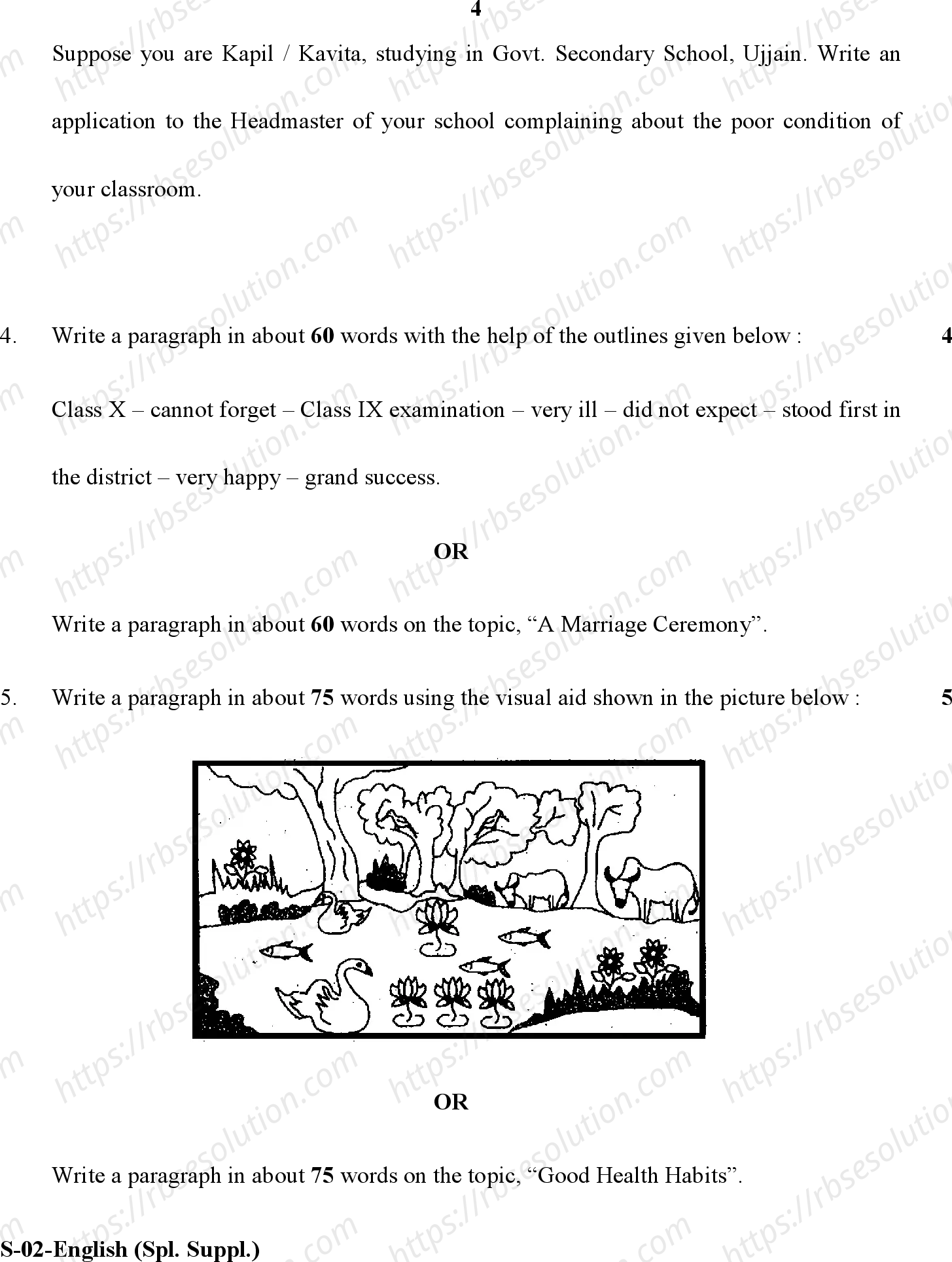
Option A: Write a paragraph using the visual aid shown in the picture below:
(Picture not available in text – describe based on context)
The picture shows a scene of a village fair. There are many people gathered around different stalls. Children are enjoying rides and buying toys. Some people are eating snacks. The fair is full of colours, lights, and laughter. It is a wonderful experience for everyone.
OR
Option B: Write a paragraph on the topic, “Good Health Habits”.
Good health habits are essential for a healthy life. We should wake up early, exercise daily, and eat nutritious food. Drinking plenty of water and getting enough sleep is important. We must avoid junk food and keep ourselves clean. These habits keep us fit and active.
Section - C
(Grammar)
6. Fill in the blanks with the correct form of the verbs given in the brackets :
(8 × ½ = 4 marks)
- The earth moves (move) round the sun.
- Are you not going (go) to America today?
- Reena gave (give) me a novel yesterday.
- Has Mohan sold (sell) his car?
- The train had left before my mother reached (reach) the station.
- How many boys were playing (play) in the ground?
- I finished (finish) my work yesterday.
- The students have just gone (go) out.
Explanation:
- (i) "The earth moves" – universal truth, so simple present tense.
- (ii) "going" – present continuous with "are".
- (iii) "gave" – past tense with "yesterday".
- (iv) "sold" – past participle after "has".
- (v) "reached" – simple past after "had left".
- (vi) "playing" – past continuous with "were".
- (vii) "finished" – simple past with "yesterday".
- (viii) "gone" – past participle after "have just".
7. Rearrange the following words/phrases to make meaningful sentences :
(2 × 1 = 2 marks)
- Reena will write a letter to Akash.
- Good habits must be cultivated.
Explanation: The words are rearranged to form grammatically correct and meaningful sentences. In (i), the subject "Reena" is followed by the modal "will", verb "write", object "a letter", and prepositional phrase "to Akash". In (ii), the subject "good habits" is followed by the modal "must", verb "be", and past participle "cultivated".
8. Join the following sentences using the relative pronouns given in brackets :
(2 × 1 = 2 marks)
- I saw Mohini who was a lecturer.
- The Taj Mahal, which was built by Shah Jahan, is very beautiful.
Explanation: In (i), "who" refers to "Mohini" (a person) and connects the two sentences. In (ii), "which" refers to "The Taj Mahal" (a thing) and joins the sentences, with commas used for the non-defining relative clause.
9. Rewrite the following sentences by changing them from direct to indirect speech : 4×1=4
-
(i) The teacher said to Hari, “You are a good player.”
The teacher told Hari that he was a good player.
-
(ii) Seema said to Geeta, “Do you play football ?”
Seema asked Geeta if she played football.
-
(iii) The doctor said to the patient, “How are you now ?”
The doctor asked the patient how he was then.
-
(iv) The captain said to the soldiers, “March forward.”
The captain ordered the soldiers to march forward.
10. Complete the following sentences by choosing the correct passive forms : 2×1=2
-
(i) A lesson by teacher.
- (a) will taught
- (b) are taught
- (c) have taught
- (d) has been taught
Explanation: The subject "lesson" is singular and the action is completed, so the correct passive form is "has been taught".
-
(ii) New seeds from market by farmers.
- (a) is bought
- (b) are bought
- (c) has bought
- (d) had bought
Explanation: The subject "seeds" is plural, so the correct passive form is "are bought".
Section – D (Text Books)
12. Read the passage given below and answer the questions that follow : 4×1=4
The Buddha preached his first sermon at the city of Benares, most holy of the dipping places on the River Ganges ; that sermon has been preserved and is given here. It reflects the Buddha’s wisdom about one inscrutable kind of suffering. Kisa Gotami had only son, and he died. In her grief, she carried the dead child to all her neighbours, asking them for medicine, and the people said, “She has lost her senses. The boy is dead.”
- (i) Where did Gautama preach his first sermon ?
- (ii) What does the sermon of Buddha reflect ?
Read the following passage carefully and answer the questions that follow:
Writing in a diary is a really strange experience for someone like me. Not only because I’ve never written anything before, but also because it seems to me that later on neither I nor anyone else will be interested in the musings of a thirteen year-old school girl. Oh well, it doesn’t matter. I feel like writing and I have an even greater need to get all kinds of things off my chest.
-
(i) What is really strange experience?
Writing in a diary is a really strange experience for Anne Frank.
-
(ii) How old is Anne?
Anne is thirteen years old.
-
(iii) What does Anne want to do?
Anne wants to write and get all kinds of things off her chest.
-
(iv) Find the word from the passage which means “deep thinking”.
The word is “musings”.
Answer any one of the following questions in about 60 words:
In his childhood, Mandela enjoyed the freedom of running in the fields, swimming in the clear streams, and roasting mealies under the stars. He was free to do anything he wanted, as long as it was within the laws of his tribe. This was a temporary and limited freedom, unlike the profound freedom he later fought for.
School going children often develop compulsive habits like collecting stamps, coins, or marbles. They may also have habits of arranging things in a particular order, tapping their pencils, or biting their nails. These habits give them a sense of comfort and control in their daily routine.
15. Answer any one of the following questions in about 30-40 words : 1×3=3
-
(i) Write the theme of the play “The Proposal”. (The Proposal)
The play “The Proposal” humorously explores the theme of marriage as a social and economic transaction. It shows how trivial arguments over land and property can overshadow genuine feelings, highlighting the absurdity of pride and the importance of compromise in relationships.
-
(ii) Why does Natalya ask her father to call Lomov back ? (The Proposal)
Natalya asks her father to call Lomov back because she realizes that Lomov had come to propose marriage to her. After learning this from her father, she regrets her rude behavior and wants to accept his proposal, fearing she might lose a good match.
16. Explain any one of the following stanzas with reference to the context : 1×4=4
-
(i) He should be snarling around houses
At the jungle’s edge,
Baring his white fangs, his claws,
Terrorizing the village !Context: This stanza is from the poem “A Tiger in the Zoo” by Leslie Norris. The poet contrasts the tiger’s natural wild habitat with its confined life in a zoo.
Explanation: The poet imagines how the tiger should ideally be living in its natural environment—the jungle. Instead of pacing in a cage, it should be stalking near houses at the edge of the forest, showing its fierce nature by snarling, baring its sharp fangs and claws, and terrifying the villagers. This highlights the tiger’s lost freedom and the unnaturalness of its captivity.
-
(ii) And no one buys a ball
Back, Money is external.
He is learning, well behind his desperate eyes,
The epistemology of loss, how to stand up
Knowing what every man must one day know
And most know many days, how to stand up.Context: This stanza is from the poem “The Ball Poem” by John Berryman. It describes a boy who has lost his ball and is grieving.
Explanation: The poet reflects that no one can buy back a lost ball because money is external and cannot replace emotional attachments. The boy, through his desperate eyes, is learning a deep truth—the “epistemology of loss.” He is understanding that loss is a part of life, and he must learn to stand up and move on, a lesson every person must eventually learn. This marks his transition from childhood innocence to maturity.
प्रश्न 7
निम्नलिखित प्रश्नों में से किन्हीं दो का उत्तर लगभग 30-40 शब्दों में दीजिए:
-
(i) 'अग्नि' किस छवि को प्रस्तुत करती है? (अग्नि और बर्फ)
'अग्नि' कविता में इच्छा और वासना की छवि प्रस्तुत करती है। कवि के अनुसार, मानवीय इच्छाएँ और लालच दुनिया को नष्ट करने के लिए पर्याप्त हैं। यह आग की तरह भस्म करने वाली होती हैं।
-
(ii) जंगली बाघ रात में कैसा व्यवहार करता है? (चिड़ियाघर में एक बाघ)
जंगली बाघ रात में अपने प्राकृतिक आवास में स्वतंत्र रूप से घूमता है, शिकार करता है और अपने क्षेत्र की रक्षा करता है। वह सतर्क और सक्रिय रहता है, जबकि चिड़ियाघर में वह बंदी होने के कारण उदास और निष्क्रिय रहता है।
-
(iii) कविता 'अमांडा!' का केंद्रीय विचार क्या है? (अमांडा!)
कविता 'अमांडा!' का केंद्रीय विचार बच्चों की स्वतंत्रता और कल्पना की आवश्यकता है। यह दर्शाती है कि कैसे माता-पिता की अत्यधिक अपेक्षाएँ और नियंत्रण बच्चों के मानसिक विकास को प्रभावित करते हैं। अमांडा अपनी काल्पनिक दुनिया में भागना चाहती है।
प्रश्न 8
निम्नलिखित प्रश्नों में से किसी एक का उत्तर लगभग 80 शब्दों में दीजिए:
-
(i) होरेस डैनबी का चरित्र-चित्रण कीजिए। (विश्वास का प्रश्न)
होरेस डैनबी एक विरोधाभासी चरित्र है। वह एक सफल चोर है जो साल में केवल एक बार चोरी करता है, लेकिन बाहर से एक सम्मानित और शांत व्यक्ति प्रतीत होता है। वह पुस्तकों का शौकीन है और अपनी चोरी को एक कला की तरह अंजाम देता है। वह अकेला रहता है और उसकी एकमात्र कमजोरी महँगी किताबें खरीदना है। हालाँकि वह चोर है, लेकिन उसमें कुछ सिद्धांत हैं - वह कभी हिंसा नहीं करता और केवल अमीरों को निशाना बनाता है। अंत में, वह एक महिला द्वारा धोखा दिया जाता है, जो दर्शाता है कि वह भी भरोसे में आ सकता है।
-
(ii) श्री लोइसेल और मटिल्डा ने अपना कर्ज कैसे चुकाया? (हार)
श्री लोइसेल और मटिल्डा ने अपना कर्ज चुकाने के लिए कड़ी मेहनत और त्याग किया। उन्होंने अपना घर और सारी संपत्ति बेच दी। श्री लोइसेल ने रात में अतिरिक्त काम करना शुरू किया, जैसे कि दूसरों के हिसाब-किताब की नकल करना। मटिल्डा ने नौकरानी को छोड़ दिया और खुद सारा घरेलू काम करने लगी। वह सस्ते कपड़े पहनती थी और बाजार से सौदेबाजी करके सामान लाती थी। दस साल की कठिन मेहनत के बाद, उन्होंने अंततः पूरा कर्ज चुका दिया, लेकिन इस दौरान मटिल्डा बूढ़ी और बदसूरत हो गई थी।
प्रश्न 9
निम्नलिखित प्रश्नों में से किसी एक का उत्तर लगभग 30-40 शब्दों में दीजिए:
-
(i) थिंक-टैंक पृथ्वी को एक महत्वहीन स्थान क्यों कहता है? (पुस्तक जिसने पृथ्वी को बचाया)
थिंक-टैंक पृथ्वी को महत्वहीन कहता है क्योंकि उसे लगता है कि पृथ्वीवासी बहुत पिछड़े हैं। वह पृथ्वी पर पाई जाने वाली पुस्तकों को समझ नहीं पाता और उन्हें हानिरहित खिलौने समझता है। उसकी नज़र में पृथ्वी पर कोई उन्नत तकनीक या खतरा नहीं है।
-
(ii) मैडम फॉरेस्टियर ने मटिल्डा को क्यों नहीं पहचाना? (हार)
मैडम फॉरेस्टियर ने मटिल्डा को नहीं पहचाना क्योंकि दस साल की कड़ी मेहनत और गरीबी ने मटिल्डा की शक्ल पूरी तरह बदल दी थी। वह अब बूढ़ी, मोटी और बदसूरत हो गई थी, जबकि पहले वह सुंदर और आकर्षक थी। उसके हाथ खुरदरे हो गए थे और वह सस्ते कपड़े पहनती थी।
प्रश्न 10
निम्नलिखित प्रश्नों में से किसी एक का उत्तर लगभग 20-25 शब्दों में दीजिए:
-
(i) अनिल ने हरि सिंह को क्या सिखाया? (चोर की कहानी)
अनिल ने हरि सिंह को पढ़ना, लिखना और अंकगणित सिखाया। उसने उसे ईमानदारी और भरोसे का महत्व भी सिखाया, जिससे हरि सिंह का जीवन बदल गया।
-
(ii) कथाकार अगले दिन न्यू मुलियन क्यों लौटा? (हैक ड्राइवर)
कथाकार अगले दिन न्यू मुलियन लौटा क्योंकि उसे पता चला कि वह हैक ड्राइवर ही लुटेरा ओलिवर ल्यूटिंस था, जिसे वह ढूंढ रहा था। वह उसे गिरफ्तार करने के लिए वापस गया।
Write an article in about 80 words on the topic given below: (1×4=4)
“What are necessary requirements for safe driving?”
Safe Driving Requirements
Safe driving requires a combination of skills, awareness, and responsibility. Firstly, a driver must have a valid driving license and thorough knowledge of traffic rules. Secondly, the vehicle should be in good condition with proper brakes, lights, and tires. Thirdly, the driver must avoid distractions like mobile phones and never drive under the influence of alcohol or drugs. Wearing seat belts, following speed limits, and maintaining a safe distance from other vehicles are also essential. Lastly, patience and alertness on the road help prevent accidents and ensure everyone's safety.
प्रकाश के परावर्तन के नियम
- आपतित किरण, परावर्तित किरण और आपतन बिंदु पर अभिलंब, तीनों एक ही तल में होते हैं।
- आपतन कोण (i) सदैव परावर्तन कोण (r) के बराबर होता है, अर्थात ∠i = ∠r।
अवतल दर्पण के वक्रता केंद्र पर बिम्ब रखने पर प्रतिबिम्ब का किरण आरेख
किरण आरेख: जब बिम्ब को अवतल दर्पण के वक्रता केंद्र (C) पर रखा जाता है, तो बिम्ब के शीर्ष से दो मुख्य किरणें चित्रानुसार खींची जाती हैं:
- एक किरण मुख्य अक्ष के समांतर चलती है और परावर्तन के बाद फोकस (F) से होकर जाती है।
- दूसरी किरण वक्रता केंद्र (C) से होकर जाती है, जो परावर्तन के बाद उसी मार्ग से वापस लौट जाती है।
ये दोनों परावर्तित किरणें वक्रता केंद्र (C) पर ही मिलती हैं, जहाँ प्रतिबिम्ब बनता है।
प्रतिबिम्ब का आकार: बिम्ब के आकार के बराबर (समान आकार)।
प्रतिबिम्ब की प्रकृति: वास्तविक और उल्टा।
गोलीय दर्पण की फोकस दूरी एवं वक्रता त्रिज्या में संबंध
गोलीय दर्पण की फोकस दूरी (f) और वक्रता त्रिज्या (R) में निम्नलिखित संबंध होता है:
f = R / 2
अर्थात, फोकस दूरी वक्रता त्रिज्या की आधी होती है।
Snell’s Law of Refraction
Snell’s law states that the ratio of the sine of the angle of incidence to the sine of the angle of refraction is constant for a given pair of media. Mathematically:
sin i / sin r = n (constant)
where n is the refractive index of the second medium with respect to the first medium.
Refraction of Light Through a Rectangular Glass Slab
Ray Diagram Explanation:
- A ray of light (incident ray) strikes the surface of a rectangular glass slab at an angle.
- At the first surface (air to glass), the ray bends towards the normal (refraction).
- Inside the glass slab, the ray travels in a straight line.
- At the second surface (glass to air), the ray bends away from the normal and emerges parallel to the incident ray.
- The emergent ray is laterally displaced from the incident ray but remains parallel to it.
Key Observation: The incident ray and emergent ray are parallel, showing that the slab does not change the direction of light but only shifts it sideways.
Speed of Light in Vacuum
The speed of light in vacuum is a universal constant:
c = 3 × 10⁸ m/s
OR
Laws of Reflection of Light
- The incident ray, the reflected ray, and the normal at the point of incidence all lie in the same plane.
- The angle of incidence is always equal to the angle of reflection, i.e., ∠i = ∠r.
Ray Diagram for Object at Centre of Curvature of Concave Mirror
Ray Diagram: When an object is placed at the centre of curvature (C) of a concave mirror, two principal rays are drawn from the top of the object:
- One ray parallel to the principal axis, which after reflection passes through the focus (F).
- Another ray passing through the centre of curvature (C), which after reflection retraces its path.
These reflected rays meet at the centre of curvature (C), forming the image.
Relative Size: Same size as the object.
Nature of Image: Real and inverted.
Relation Between Focal Length and Radius of Curvature of a Spherical Mirror
The focal length (f) of a spherical mirror is half of its radius of curvature (R):
f = R / 2