
RBSE Class 10th 2019 Mathematics-S-09-2019 Previous Year Papers
Mathematics-S-09-2019 from the 2019 exam year is part of the Class 10th previous year papers archive on RBSE Solution. Many learners start here after finishing the textbook to see how questions were actually framed on the Rajasthan Board of Secondary Education (RBSE) paper.
Treat this question paper as a mock under gentle timing first, then as a marking exercise the second time. The introduction on this page is written only for this subject-and-year pair, not copied from other pages.
Bookmark the link if you coach juniors — the layout stays stable for search engines and classroom sharing.
Paper details
Quick reference for this previous year papers page — confirm board, class, and year & subject before you study.
| Board | RBSE |
|---|---|
| Class | Class 10th |
| Exam year | 2019 |
| Subject | Mathematics-S-09-2019 |
| Resource type | Previous Year Papers |
| Category | RBSE Previous Year Question Papers |
| Website | RBSE Solution |
The table summarises this Previous Year Papers resource. Confirm RBSE, Class 10th, year 2019, and subject Mathematics-S-09-2019 before studying.
RBSE Solution organises previous year papers so each URL carries chapter-specific guidance — better for students and for search engines than one generic paragraph for the whole class.
Turning 2019 papers into insight
One Mathematics-S-09-2019 paper reveals style; several from the same year reveal pattern. After this page, open sibling subjects listed below to see whether marks cluster in certain units.
Keep rough work dated in your notebook. Examiners in Class 10th expect clear numbering even in practice sessions.
RBSE Class 10th 2019 Mathematics-S-09-2019
Scroll through the Previous Year Papers pages for Mathematics-S-09-2019 (2019).
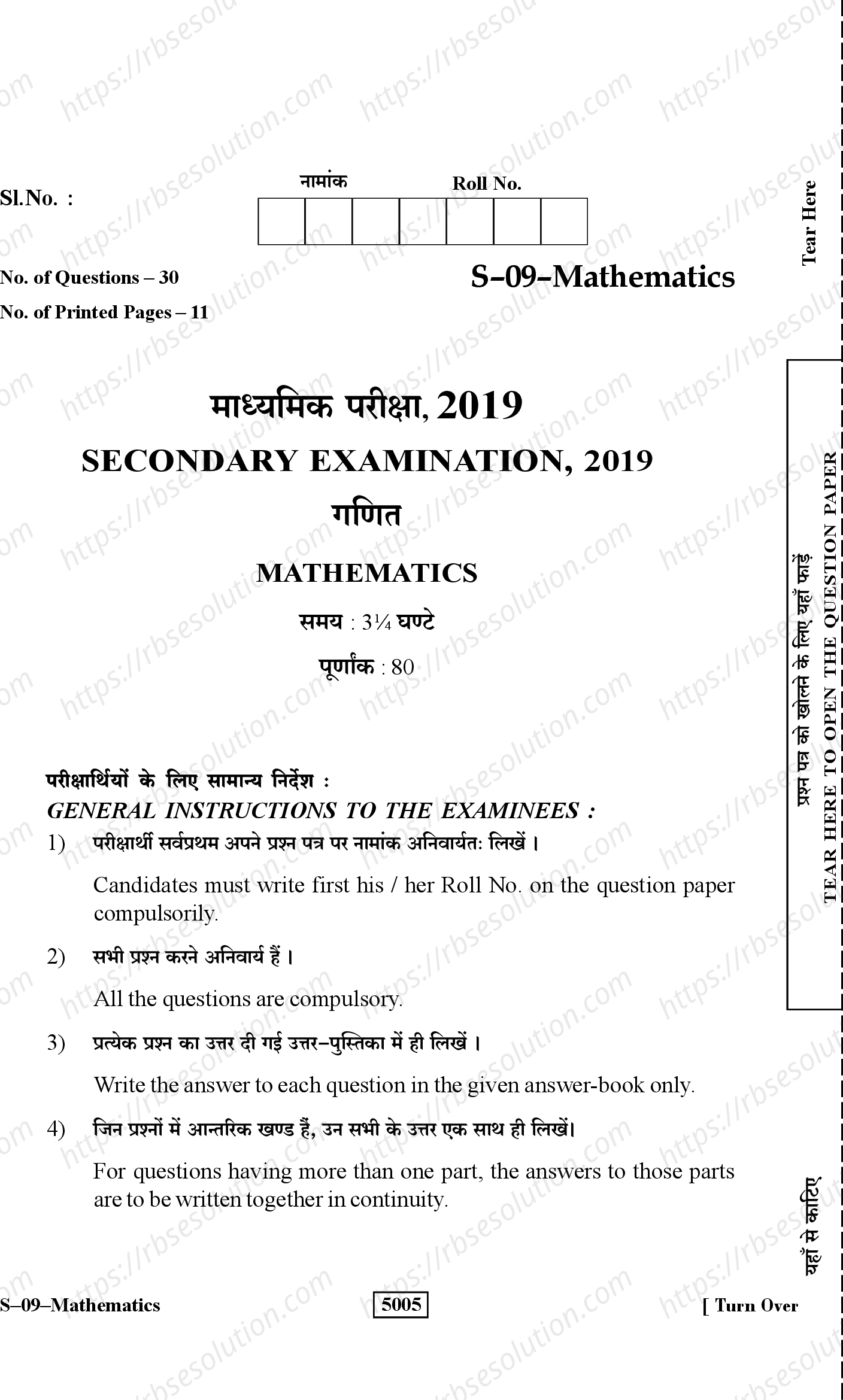


Rajasthan Board Class 10th Mathematics-S-09-2019 2019 solved Previous Year Question Papers
माध्यमिक परीक्षा, 2019
SECONDARY EXAMINATION, 2019
गणित
MATHEMATICS
समय : 3¼ घण्टे पूर्णांक : 80
परीक्षार्थियों के लिए सामान्य निर्देश :
GENERAL INSTRUCTIONS TO THE EXAMINEES :
- परीक्षार्थी सर्वप्रथम अपने प्रश्न पत्र पर नामांक अनिवार्यतः लिखें।
Candidates must write first his/her Roll No. on the question paper compulsorily. - सभी प्रश्न करने अनिवार्य हैं।
All the questions are compulsory. - प्रत्येक प्रश्न का उत्तर दी गई उत्तर-पुस्तिका में ही लिखें।
Write the answer to each question in the given answer-book only. - जिन प्रश्नों में आन्तरिक खण्ड हैं, उन सभी के उत्तर एक साथ ही लिखें।
For questions having more than one part, the answers to those parts are to be written together in continuity.
No. of Questions – 30 S-09-Mathematics
No. of Printed Pages – 1
S—09-Mathematics 5005 [ Turn Over
5) प्रश्नपत्र के हिन्दी व अंग्रेजी संस्करणों में किसी प्रकार की त्रुटि / अन्तर / विरोधाभास होने पर हिन्दी भाषा के प्रश्न को ही सही मानें।
If there is any error / difference / contradiction in Hindi & English versions of the question paper, the question of Hindi version should be treated valid.
6) भाग प्रश्न संख्या अंक प्रत्येक प्रश्न
| भाग | प्रश्न संख्या | अंक प्रत्येक प्रश्न |
|---|---|---|
| क | 1 - 10 | 1 |
| ख | 11 - 15 | 2 |
| ग | 16 - 25 | 3 |
| घ | 26 - 30 | 6 |
| Part | Q. Nos. | Marks per question |
|---|---|---|
| A | 1 - 10 | 1 |
| B | 11 - 15 | 2 |
| C | 16 - 25 | 3 |
| D | 26 - 30 | 6 |
7) प्रश्न क्रमांक 27 व 29 में आन्तरिक विकल्प हैं।
There are internal choices in Question Nos. 27 and 29.
8) अपनी उत्तर-पुस्तिका के पृष्ठों के दोनों ओर लिखिए। यदि कोई रफ कार्य करना हो, तो उत्तर-पुस्तिका के अंतिम पृष्ठों पर करें और इन्हें तिरछी लाइनों से काटकर उन पर 'रफ कार्य' लिख दें।
Write on both sides of the pages of your answer-book. If any rough work is to be done, do it on last pages of the answer-book and cross with slant lines and write 'Rough Work' on them.
9) प्रश्न क्रमांक 26 का लेखाचित्र ग्राफ पेपर पर बनाइए।
Draw the graph of Question No. 26 on graph paper.
S—09-Mathematics 5005
भाग - अ / PART - A
-
द्वंद्व योग विधि से 62 का वर्ग ज्ञात कीजिए।
Find the square of 62 by Dwandwa yoga method.हल: द्वंद्व योग विधि में, संख्या 62 के लिए:
- द्वंद्व (Dwandwa) = 2 × (पहला अंक × दूसरा अंक) = 2 × (6 × 2) = 24
- वर्ग = (पहले अंक का वर्ग) × 100 + द्वंद्व × 10 + (दूसरे अंक का वर्ग)
- = 36 × 100 + 24 × 10 + 4 = 3600 + 240 + 4 = 3844
अतः 62 का वर्ग = 3844
-
हल कीजिए : (x + 1)(x + 2) = (x - 5)(x - 6)
Solve : (x + 1)(x + 2) = (x - 5)(x - 6)हल:
(x + 1)(x + 2) = (x - 5)(x - 6)
⇒ x² + 2x + x + 2 = x² - 6x - 5x + 30
⇒ x² + 3x + 2 = x² - 11x + 30
⇒ 3x + 2 = -11x + 30
⇒ 3x + 11x = 30 - 2
⇒ 14x = 28
⇒ x = 2
अतः x = 2
-
68 तथा 119 का महत्तम समापवर्तक ज्ञात कीजिए।
Find the HCF of 68 and 119.हल: यूक्लिड विभाजन एल्गोरिथ्म द्वारा:
119 = 68 × 1 + 51
68 = 51 × 1 + 17
51 = 17 × 3 + 0
अतः महत्तम समापवर्तक (HCF) = 17
अतः 68 और 119 का HCF = 17
-
tan² 60° + 3cos² 30° का मान ज्ञात कीजिए।
Find the value of tan² 60° + 3cos² 30°.हल:
tan 60° = √3, इसलिए tan² 60° = (√3)² = 3
cos 30° = √3/2, इसलिए cos² 30° = (√3/2)² = 3/4
अतः tan² 60° + 3cos² 30° = 3 + 3 × (3/4) = 3 + 9/4 = (12 + 9)/4 = 21/4
अतः मान = 21/4
-
यदि sin 2A = cos (A - 18°) हो, तो A का मान ज्ञात कीजिए।
If sin 2A = cos (A - 18°), then find the value of A.हल: sin 2A = cos (A - 18°)
⇒ sin 2A = sin [90° - (A - 18°)]
⇒ sin 2A = sin (108° - A)
⇒ 2A = 108° - A
⇒ 3A = 108°
⇒ A = 36°
अतः A = 36°
-
समतल में लुढ़कने वाले वृत्त के केन्द्र का बिन्दुपथ लिखिए।
Write the locus of the centre of a rolling circle in a plane.उत्तर: जब एक वृत्त किसी समतल सतह पर बिना फिसले लुढ़कता है, तो उसके केन्द्र का बिन्दुपथ एक सरल रेखा होती है जो उस सतह के समान्तर होती है। यह रेखा उस सतह से वृत्त की त्रिज्या के बराबर दूरी पर होती है।
अतः बिन्दुपथ: एक सरल रेखा
7) यदि AABC ~ ADEF है जिनमें AB = 1.6 सेमी और DE = 2.4 सेमी हो तो AABC और ADEF के क्षेत्रफलों का अनुपात ज्ञात कीजिए। [1]
If AABC ~ ADEF in which AB = 1.6 cm and DE = 2.4 cm. Find the ratio of the areas of AABC and ADEF.
हल: समरूप त्रिभुजों के क्षेत्रफलों का अनुपात उनकी संगत भुजाओं के वर्गों के अनुपात के बराबर होता है।
क्षेत्रफलों का अनुपात = (AB/DE)² = (1.6/2.4)² = (16/24)² = (2/3)² = 4/9
अतः AABC और ADEF के क्षेत्रफलों का अनुपात 4 : 9 है।
8) दो खिलाड़ी A और B शतरंज का एक मैच खेलते हैं। यह ज्ञात है कि A द्वारा मैच जीतने की प्रायिकता 2/3 है। B के जीतने की प्रायिकता ज्ञात कीजिए। [2]
Two players A and B play a chess match. It is given that probability of winning the match by A is 2/3. Find the probability of winning the match by B.
हल: माना कि मैच में केवल एक विजेता होगा (ड्रॉ नहीं माना गया है)।
P(A जीते) = 2/3
P(B जीते) = 1 - P(A जीते) = 1 - 2/3 = 1/3
अतः B के जीतने की प्रायिकता 1/3 है।
9) यदि एक कार का किराया प्रथम किलोमीटर के लिए 20 रु. तथा इसके बाद प्रति किमी के लिए 11 रु. है तो 5 किमी चलने के लिए कुल किराया ज्ञात कीजिए। [1]
If fare of a car for first kilometer is ₹20 and for after 1 kilometer is ₹11 then find the total fare for 5 kilometers.
हल: पहले किलोमीटर का किराया = ₹20
शेष 4 किलोमीटर का किराया = 4 × ₹11 = ₹44
कुल किराया = ₹20 + ₹44 = ₹64
10) एक पतंग भूमि से 75 मीटर की ऊँचाई पर उड़ रही है। जिसके धागे का भूमि के साथ झुकाव 60° है तो धागे की लम्बाई ज्ञात कीजिए। [1]
A kite is flying at a height of 75 metres from the level of ground attached to a string inclined at 60° to the horizontal. Find the length of the string.
हल: माना धागे की लंबाई L मीटर है।
समकोण त्रिभुज में, sin 60° = लंब / कर्ण = 75 / L
sin 60° = √3/2
अतः √3/2 = 75/L ⇒ L = (75 × 2)/√3 = 150/√3 = (150√3)/3 = 50√3 मीटर
धागे की लंबाई 50√3 मीटर (लगभग 86.6 मीटर) है।
भाग - ब
PART - B
-
उपसूत्र आनुरूप्येण द्वारा 42 का घनफल ज्ञात कीजिए। [2]
Find the cube of 42 by using Upsutra Anurupyena.
हल: उपसूत्र आनुरूप्येण (अनुपात विधि) द्वारा 42 का घन ज्ञात करने के लिए, हम 42 = 4 × 10 + 2 के रूप में लिख सकते हैं।
42³ = (4 × 10 + 2)³ = (4 × 10)³ + 3 × (4 × 10)² × 2 + 3 × (4 × 10) × 2² + 2³
= 64000 + 3 × 1600 × 2 + 3 × 40 × 4 + 8
= 64000 + 9600 + 480 + 8
= 74088
अतः 42 का घनफल 74088 है।
-
सिद्ध कीजिए कि 7√5 एक अपरिमेय संख्या है। [2]
Prove that 7√5 is an irrational number.
हल: मान लीजिए कि 7√5 एक परिमेय संख्या है। तब इसे p/q के रूप में लिखा जा सकता है, जहाँ p और q पूर्णांक हैं, q ≠ 0, और p तथा q सह-अभाज्य हैं।
7√5 = p/q
⇒ √5 = p/(7q)
चूँकि p और q पूर्णांक हैं, p/(7q) एक परिमेय संख्या है। इसलिए √5 भी परिमेय होगा।
लेकिन हम जानते हैं कि √5 एक अपरिमेय संख्या है। यह विरोधाभास हमारी मान्यता को गलत सिद्ध करता है।
अतः 7√5 एक अपरिमेय संख्या है।
-
एक वृत्त की त्रिज्या 9 सेमी और त्रिज्य खण्ड का कोण 70° है। लघु त्रिज्य खण्ड का क्षेत्रफल ज्ञात कीजिए। (π = 22/7 लीजिए) [2]
Radius of a circle is 9 cm and the angle of the sector is 70°. Find the area of the minor sector of the circle. (Take π = 22/7)
हल: त्रिज्यखण्ड का क्षेत्रफल = (θ/360°) × πr²
यहाँ, θ = 70°, r = 9 सेमी, π = 22/7
क्षेत्रफल = (70/360) × (22/7) × 9 × 9
= (7/36) × (22/7) × 81
= (22 × 81) / 36
= (22 × 9) / 4
= 198/4
= 49.5 वर्ग सेमी
अतः लघु त्रिज्यखण्ड का क्षेत्रफल 49.5 वर्ग सेमी है।
-
एक बेलन की ऊँचाई 21 सेमी तथा उसका वक्र पृष्ठीय क्षेत्रफल 924 वर्ग सेमी है। बेलन की त्रिज्या ज्ञात कीजिए। [2]
The height of a cylinder is 21 cm and its curved surface area is 924 cm². Find the radius of the cylinder.
हल: बेलन का वक्र पृष्ठीय क्षेत्रफल = 2πrh
यहाँ, h = 21 सेमी, वक्र पृष्ठीय क्षेत्रफल = 924 वर्ग सेमी, π = 22/7
2 × (22/7) × r × 21 = 924
⇒ 2 × 22 × r × 3 = 924
⇒ 132r = 924
⇒ r = 924/132
⇒ r = 7 सेमी
अतः बेलन की त्रिज्या 7 सेमी है।
प्रश्न 15 (Question 15)
हिंदी: A और B के मध्य की दूरी 25 किमी. है तथा इसके मध्य 8 यातायात सिग्नल मिलते हैं। यदि एक कार 50 किमी प्रति घंटा की समान गति से सभी हरे सिग्नलों को पार करते हुए वह B बिन्दु पर 2 घण्टे 30 मिनट पर पहुँच जाती है। लेकिन अन्य दिन भारी यातायात के कारण निम्नानुसार रूकना पड़ता है: प्रथम यातायात सिग्नल 1 मिनट, द्वितीय यातायात सिग्नल 2 मिनट, ......... 8 वें सिग्नल तक ...... 8 मिनट। उसी कार द्वारा लिये गये कुल समय की गणना कीजिए, यदि वह सभी यातायात सिग्नलों की अनुपालना करती है। [2]
English: The distance between A and B is 25 km and there are eight (8) traffic signals in between A and B. If a car at 50 km/h speed reaches point B crossing all green signals in 2 hours and 30 minutes, but on other days due to heavy traffic it happens to stop as follows: First Traffic Signal - 1 minute, Second Traffic Signal - 2 minutes, and up to the Eighth (8th) signal - 8 minutes. Calculate the total time taken by that car if it follows all the traffic signals.
हल (Solution):
सामान्य स्थिति में कार द्वारा लिया गया समय = 2 घंटे 30 मिनट = 150 मिनट।
भारी यातायात के कारण रुकने का समय:
पहले सिग्नल पर 1 मिनट, दूसरे पर 2 मिनट, ..., आठवें पर 8 मिनट।
यह एक समांतर श्रेणी (AP) है जिसमें पहला पद a = 1, अंतिम पद l = 8, और पदों की संख्या n = 8 है।
कुल रुकने का समय = n/2 × (a + l) = 8/2 × (1 + 8) = 4 × 9 = 36 मिनट।
अतः कुल लिया गया समय = यात्रा का समय + रुकने का समय = 150 मिनट + 36 मिनट = 186 मिनट।
186 मिनट = 3 घंटे 6 मिनट।
उत्तर: कार द्वारा लिया गया कुल समय 3 घंटे 6 मिनट (186 मिनट) है।
भाग - B (PART - B)
प्रश्न 6 (Question 6)
हिंदी: गुणन खण्ड विधि से समीकरण 1/(x-2) + 2/(x-1) = 6/x को हल कीजिए, जहाँ x ≠ 0, 1, 2। [3]
English: Solve the equation 1/(x-2) + 2/(x-1) = 6/x where x ≠ 0, 1, 2 by factorisation method.
हल (Solution):
दिया गया समीकरण: 1/(x-2) + 2/(x-1) = 6/x
हरों का लघुत्तम समापवर्त्य (LCM) = x(x-1)(x-2) लेने पर:
[x(x-1) + 2x(x-2)] / [x(x-1)(x-2)] = 6/x
⇒ [x² - x + 2x² - 4x] / [x(x-1)(x-2)] = 6/x
⇒ [3x² - 5x] / [x(x-1)(x-2)] = 6/x
दोनों पक्षों को x से गुणा करने पर (x ≠ 0):
[3x² - 5x] / [(x-1)(x-2)] = 6
⇒ 3x² - 5x = 6(x-1)(x-2)
⇒ 3x² - 5x = 6(x² - 3x + 2)
⇒ 3x² - 5x = 6x² - 18x + 12
⇒ 0 = 6x² - 18x + 12 - 3x² + 5x
⇒ 0 = 3x² - 13x + 12
⇒ 3x² - 13x + 12 = 0
अब गुणनखंड विधि से: 3x² - 9x - 4x + 12 = 0
⇒ 3x(x - 3) - 4(x - 3) = 0
⇒ (x - 3)(3x - 4) = 0
अतः x - 3 = 0 या 3x - 4 = 0
⇒ x = 3 या x = 4/3
उत्तर: x = 3 या x = 4/3
प्रश्न 7 (Question 7)
हिंदी: 2 और 101 के मध्य 5 से विभाजित (भाज्य) होने वाली सभी प्राकृत संख्याओं का योग फल ज्ञात कीजिए। [3]
English: Find the sum of all the natural numbers divisible by 5 between 2 and 101.
हल (Solution):
2 और 101 के बीच 5 से विभाज्य संख्याएँ: 5, 10, 15, ..., 100
यह एक समांतर श्रेणी (AP) है जिसमें पहला पद a = 5, सार्व अंतर d = 5, और अंतिम पद l = 100 है।
पदों की संख्या ज्ञात करने के लिए: l = a + (n-1)d
⇒ 100 = 5 + (n-1) × 5
⇒ 95 = (n-1) × 5
⇒ n - 1 = 19
⇒ n = 20
अब योगफल S = n/2 × (a + l) = 20/2 × (5 + 100) = 10 × 105 = 1050
उत्तर: 2 और 101 के बीच 5 से विभाज्य सभी प्राकृत संख्याओं का योग 1050 है।
प्रश्न 8 (Question 8)
हिंदी: किसी अपूर्ण मीनार के आधार से 20 मीटर दूर किसी बिन्दु से मीनार के शिखर का उन्नयन कोण 30° है। ज्ञात कीजिए कि मीनार को कितना ऊँचा बनाया जाये जिससे उसी स्थान पर उसका उन्नयन कोण 60° हो जाये? [3]
English: From a point on the ground which is 20 m away from the foot of the unfinished tower, the angle of elevation of the top of the tower is found to be 30°. Find how much height of tower have to be increased so that its angle of elevation at the same point becomes 60°?
हल (Solution):
माना मीनार की वर्तमान ऊँचाई = h मीटर, और बढ़ाई गई ऊँचाई = x मीटर है।
आधार से दूरी = 20 मीटर।
पहली स्थिति में (उन्नयन कोण 30°):
tan 30° = h/20
⇒ 1/√3 = h/20
⇒ h = 20/√3 मीटर
दूसरी स्थिति में (उन्नयन कोण 60°):
tan 60° = (h + x)/20
⇒ √3 = (h + x)/20
⇒ h + x = 20√3 मीटर
अतः x = 20√3 - h = 20√3 - 20/√3
= 20(√3 - 1/√3) = 20[(3 - 1)/√3] = 20(2/√3) = 40/√3 मीटर
परिमेयकरण करने पर: x = (40√3)/3 मीटर
उत्तर: मीनार को (40√3)/3 मीटर (लगभग 23.09 मीटर) और ऊँचा बनाया जाना चाहिए।
9) सिद्ध कीजिए कि यदि दो समरूप त्रिभुजों के क्षेत्रफल समान हो, तो दोनों त्रिभुज सर्वागसम होते हैं।
Prove that if area of two similar triangles are equal, then they are congruent.
हल: मान लीजिए दो समरूप त्रिभुज ΔABC और ΔDEF हैं, जिनमें ΔABC ~ ΔDEF है।
समरूप त्रिभुजों के क्षेत्रफलों के प्रमेय के अनुसार,
(ΔABC का क्षेत्रफल) / (ΔDEF का क्षेत्रफल) = (AB² / DE²) = (BC² / EF²) = (CA² / FD²)
दिया है कि दोनों त्रिभुजों के क्षेत्रफल समान हैं, अतः
(ΔABC का क्षेत्रफल) / (ΔDEF का क्षेत्रफल) = 1
इसलिए, AB² / DE² = 1 ⇒ AB² = DE² ⇒ AB = DE
इसी प्रकार, BC = EF और CA = FD
अतः तीनों भुजाएँ समान हैं, इसलिए ΔABC ≅ ΔDEF (SSS सर्वांगसमता नियम से)।
अतः यदि दो समरूप त्रिभुजों के क्षेत्रफल समान हों, तो वे सर्वांगसम होते हैं।
20) आकृति में AOB वृत्त का व्यास है तथा C, D और E अर्धवृत्त पर स्थित कोई तीन बिन्दु हैं। ∠ACD + ∠BED का मान ज्ञात कीजिए?
In fig. AOB is the diameter of a circle and C, D and E are three points situated on semi circle. Find the value of ∠ACD + ∠BED.
हल: चूँकि AOB वृत्त का व्यास है, अतः अर्धवृत्त में बना कोण समकोण होता है।
बिन्दु C, D और E अर्धवृत्त पर स्थित हैं, इसलिए:
- ∠ACB = 90° (अर्धवृत्त में बना कोण)
- ∠ADB = 90°
- ∠AEB = 90°
अब, चक्रीय चतुर्भुज ACDB में,
∠ACD + ∠ABD = 180° (सम्मुख कोणों का योग)
इसी प्रकार, चक्रीय चतुर्भुज AEDB में,
∠BED + ∠BAD = 180°
दोनों को जोड़ने पर:
(∠ACD + ∠BED) + (∠ABD + ∠BAD) = 360°
त्रिभुज ABD में, ∠ABD + ∠BAD + ∠ADB = 180°
⇒ ∠ABD + ∠BAD + 90° = 180°
⇒ ∠ABD + ∠BAD = 90°
अतः ∠ACD + ∠BED + 90° = 360°
⇒ ∠ACD + ∠BED = 360° - 90° = 270°
अतः ∠ACD + ∠BED का मान 270° है।
21) एक O केन्द्र वाला वृत्त चतुर्भुज ABCD की चारों भुजाओं को अन्तः स्पर्श करता है। यदि AB को स्पर्श बिन्दु 3:1 के अनुपात में विभाजित करे तथा AB = 2 सेमी है, तो वृत्त की त्रिज्या ज्ञात कीजिए जब कि OA = √5 सेमी है।
A circle with centre 'O' touches all the four sides of a quadrilateral ABCD internally in such a way that it divides AB in 3:1 and AB = 2 cm, then find the radius of circle where OA = √5 cm.
हल: माना वृत्त AB को बिन्दु P पर स्पर्श करता है।
दिया है: AB = 2 सेमी और AP : PB = 3 : 1
अतः AP = (3/4) × 2 = 1.5 सेमी, PB = (1/4) × 2 = 0.5 सेमी
चूँकि वृत्त का केन्द्र O है और OA = √5 सेमी दिया है।
स्पर्श बिन्दु P पर OP त्रिज्या है, अतः OP ⊥ AB
समकोण त्रिभुज OAP में, पाइथागोरस प्रमेय से:
OA² = OP² + AP²
⇒ (√5)² = OP² + (1.5)²
⇒ 5 = OP² + 2.25
⇒ OP² = 5 - 2.25 = 2.75
⇒ OP = √2.75 = √(11/4) = √11 / 2 सेमी
अतः वृत्त की त्रिज्या √11/2 सेमी है।
22. Construct an incircle of an equilateral triangle with side 5 cm.
Steps of Construction:
- Draw an equilateral triangle ABC with each side = 5 cm.
- Draw the angle bisectors of ∠A and ∠B. Let them intersect at point O.
- From O, draw a perpendicular to side BC, meeting BC at point D.
- With O as centre and OD as radius, draw a circle. This is the required incircle.
Note: The incircle touches all three sides of the triangle. The radius of the incircle for an equilateral triangle of side 5 cm is approximately 1.44 cm.
23. Find the area of the square inscribed in a circle of radius 10 cm.
Solution:
Given: Radius of circle, r = 10 cm.
For a square inscribed in a circle, the diagonal of the square = diameter of the circle = 2r = 20 cm.
Let side of square = a cm.
Diagonal of square = a√2 = 20 cm
⇒ a = 20 / √2 = 10√2 cm
Area of square = a² = (10√2)² = 100 × 2 = 200 cm²
Answer: Area of the square = 200 cm².
24. A sphere of 6 cm diameter is dropped into a cylindrical vessel of diameter 2 cm. Find the rise in water in the vessel.
Solution:
Given: Diameter of sphere = 6 cm ⇒ Radius of sphere, R = 3 cm.
Diameter of cylindrical vessel = 2 cm ⇒ Radius of cylinder, r = 1 cm.
When the sphere is dropped into water, the volume of water displaced = volume of sphere.
Volume of sphere = (4/3)πR³ = (4/3)π × 3³ = (4/3)π × 27 = 36π cm³
Let the rise in water level be h cm.
Volume of water displaced = πr²h = π × 1² × h = πh cm³
Equating: πh = 36π ⇒ h = 36 cm
Answer: The water rises by 36 cm.
25. A bag contains 5 cards with numbers 1, 2, 3, 4, 5 printed on them. A card is drawn at random. Find the probability that the number on the card is:
(i) a prime number
(ii) a number divisible by 2
Solution:
Total number of cards = 5.
(i) Prime numbers from 1 to 5: 2, 3, 5 (3 numbers)
Probability (prime number) = Number of favourable outcomes / Total outcomes = 3/5
(ii) Numbers divisible by 2 from 1 to 5: 2, 4 (2 numbers)
Probability (divisible by 2) = 2/5
Answers:
- (i) Probability of prime number = 3/5
- (ii) Probability of number divisible by 2 = 2/5
भाग - द
PART - D
26) निम्न रैखिक समीकरण युग्म को आलेखीय विधि द्वारा हल कीजिए। [6]
3x - 5y = 5
2x - y = -3
इसकी सहायता से संबंध (x + y)² = A में A का मान ज्ञात कीजिए।
Solve the following pair of linear equations by graphical method:
3x - 5y = 5
2x - y = -3
Thus find the value of A in the relation (x + y)² = A.
हल (Solution):
चरण 1: प्रत्येक समीकरण के लिए तालिका बनाएं।
समीकरण 1: 3x - 5y = 5 ⇒ y = (3x - 5)/5
| x | 0 | 5 | -5 |
|---|---|---|---|
| y | -1 | 2 | -4 |
समीकरण 2: 2x - y = -3 ⇒ y = 2x + 3
| x | 0 | -1 | 1 |
|---|---|---|---|
| y | 3 | 1 | 5 |
चरण 2: ग्राफ पेपर पर बिंदुओं को अंकित करें और रेखाएँ खींचें। दोनों रेखाएँ बिंदु (-2, -1) पर प्रतिच्छेद करती हैं।
अतः हल: x = -2, y = -1
चरण 3: (x + y)² = A में मान रखने पर:
(-2 + (-1))² = (-3)² = 9
अतः A = 9
उत्तर: x = -2, y = -1, A = 9
27) सिद्ध कीजिए। [6]
(i) \(\frac{1+\sec A}{\sec A} = \frac{\sin^2 A}{1-\cos A}\)
(ii) \(\frac{2}{3} \sin^3 \theta + \sin \theta \cos^2 \theta = 1 + \sin \theta \cos \theta\)
या
\(\frac{1-\tan \theta}{\sin \theta - \cos \theta} = ?\)
हल (Solution):
(i) बायाँ पक्ष: \(\frac{1+\sec A}{\sec A} = \frac{1}{\sec A} + \frac{\sec A}{\sec A} = \cos A + 1\)
दायाँ पक्ष: \(\frac{\sin^2 A}{1-\cos A} = \frac{1-\cos^2 A}{1-\cos A} = \frac{(1-\cos A)(1+\cos A)}{1-\cos A} = 1 + \cos A\)
अतः बायाँ पक्ष = दायाँ पक्ष। सिद्ध हुआ।
(ii) बायाँ पक्ष: \(\frac{2}{3} \sin^3 \theta + \sin \theta \cos^2 \theta\)
= \(\sin \theta \left( \frac{2}{3} \sin^2 \theta + \cos^2 \theta \right)\)
= \(\sin \theta \left( \frac{2}{3} \sin^2 \theta + 1 - \sin^2 \theta \right)\)
= \(\sin \theta \left( 1 - \frac{1}{3} \sin^2 \theta \right)\)
यहाँ प्रश्न में दिया गया दायाँ पक्ष \(1 + \sin \theta \cos \theta\) है, जो सामान्यतः सत्य नहीं है। संभवतः प्रश्न में त्रुटि है। सही सर्वसमिका के लिए कृपया पुनः जाँच करें।
या (Alternative): \(\frac{1-\tan \theta}{\sin \theta - \cos \theta} = \frac{1 - \frac{\sin \theta}{\cos \theta}}{\sin \theta - \cos \theta} = \frac{\frac{\cos \theta - \sin \theta}{\cos \theta}}{\sin \theta - \cos \theta} = \frac{-(\sin \theta - \cos \theta)}{\cos \theta (\sin \theta - \cos \theta)} = -\frac{1}{\cos \theta} = -\sec \theta\)
S—09-Mathematics 5005
सिद्ध कीजिए। [6]
-
\(\frac{\sin \theta}{1+\cos \theta} + \frac{1+\cos \theta}{\sin \theta} = 2 \csc \theta\)
हल:
LHS = \(\frac{\sin \theta}{1+\cos \theta} + \frac{1+\cos \theta}{\sin \theta}\)
= \(\frac{\sin^2 \theta + (1+\cos \theta)^2}{\sin \theta (1+\cos \theta)}\)
= \(\frac{\sin^2 \theta + 1 + 2\cos \theta + \cos^2 \theta}{\sin \theta (1+\cos \theta)}\)
= \(\frac{(\sin^2 \theta + \cos^2 \theta) + 1 + 2\cos \theta}{\sin \theta (1+\cos \theta)}\)
= \(\frac{1 + 1 + 2\cos \theta}{\sin \theta (1+\cos \theta)}\)
= \(\frac{2(1+\cos \theta)}{\sin \theta (1+\cos \theta)}\)
= \(\frac{2}{\sin \theta} = 2 \csc \theta\) = RHS
-
\(\frac{\sin \theta - 2\sin^3 \theta}{2\cos^3 \theta - \cos \theta} = \tan \theta\)
हल:
LHS = \(\frac{\sin \theta - 2\sin^3 \theta}{2\cos^3 \theta - \cos \theta}\)
= \(\frac{\sin \theta (1 - 2\sin^2 \theta)}{\cos \theta (2\cos^2 \theta - 1)}\)
= \(\frac{\sin \theta (1 - 2\sin^2 \theta)}{\cos \theta (2(1-\sin^2 \theta) - 1)}\)
= \(\frac{\sin \theta (1 - 2\sin^2 \theta)}{\cos \theta (2 - 2\sin^2 \theta - 1)}\)
= \(\frac{\sin \theta (1 - 2\sin^2 \theta)}{\cos \theta (1 - 2\sin^2 \theta)}\)
= \(\frac{\sin \theta}{\cos \theta} = \tan \theta\) = RHS
अथवा
सिद्ध कीजिए:
-
\(\frac{1+\sec A}{\sec A} = \frac{\sin^2 A}{1-\cos A}\)
हल:
LHS = \(\frac{1+\sec A}{\sec A} = \frac{1}{\sec A} + 1 = \cos A + 1\)
RHS = \(\frac{\sin^2 A}{1-\cos A} = \frac{1-\cos^2 A}{1-\cos A}\)
= \(\frac{(1-\cos A)(1+\cos A)}{1-\cos A} = 1+\cos A\)
अतः LHS = RHS
-
\(\frac{\cos \theta}{1-\tan \theta} + \frac{\sin \theta}{1-\cot \theta} = \sin \theta + \cos \theta\)
हल:
LHS = \(\frac{\cos \theta}{1-\tan \theta} + \frac{\sin \theta}{1-\cot \theta}\)
= \(\frac{\cos \theta}{1-\frac{\sin \theta}{\cos \theta}} + \frac{\sin \theta}{1-\frac{\cos \theta}{\sin \theta}}\)
= \(\frac{\cos \theta}{\frac{\cos \theta - \sin \theta}{\cos \theta}} + \frac{\sin \theta}{\frac{\sin \theta - \cos \theta}{\sin \theta}}\)
= \(\frac{\cos^2 \theta}{\cos \theta - \sin \theta} + \frac{\sin^2 \theta}{\sin \theta - \cos \theta}\)
= \(\frac{\cos^2 \theta}{\cos \theta - \sin \theta} - \frac{\sin^2 \theta}{\cos \theta - \sin \theta}\)
= \(\frac{\cos^2 \theta - \sin^2 \theta}{\cos \theta - \sin \theta}\)
= \(\frac{(\cos \theta - \sin \theta)(\cos \theta + \sin \theta)}{\cos \theta - \sin \theta}\)
= \(\cos \theta + \sin \theta\) = RHS
28) किसी समतल में चार बिन्दु P(2, -1), Q(3, 4), R(-2, 3) और S(-3, -2) है तो सिद्ध कीजिए कि PQRS वर्ग नहीं एक समचतुर्भुज है। [6]
हल:
दिए गए बिन्दु: P(2, -1), Q(3, 4), R(-2, 3), S(-3, -2)
भुजाओं की लंबाई ज्ञात करते हैं:
PQ = \(\sqrt{(3-2)^2 + (4+1)^2} = \sqrt{1^2 + 5^2} = \sqrt{1+25} = \sqrt{26}\)
QR = \(\sqrt{(-2-3)^2 + (3-4)^2} = \sqrt{(-5)^2 + (-1)^2} = \sqrt{25+1} = \sqrt{26}\)
RS = \(\sqrt{(-3+2)^2 + (-2-3)^2} = \sqrt{(-1)^2 + (-5)^2} = \sqrt{1+25} = \sqrt{26}\)
SP = \(\sqrt{(2+3)^2 + (-1+2)^2} = \sqrt{5^2 + 1^2} = \sqrt{25+1} = \sqrt{26}\)
चूँकि सभी चारों भुजाएँ बराबर हैं, अतः PQRS एक समचतुर्भुज है।
अब विकर्णों की लंबाई ज्ञात करते हैं:
PR = \(\sqrt{(-2-2)^2 + (3+1)^2} = \sqrt{(-4)^2 + 4^2} = \sqrt{16+16} = \sqrt{32} = 4\sqrt{2}\)
QS = \(\sqrt{(-3-3)^2 + (-2-4)^2} = \sqrt{(-6)^2 + (-6)^2} = \sqrt{36+36} = \sqrt{72} = 6\sqrt{2}\)
चूँकि विकर्ण PR ≠ QS, अतः PQRS एक वर्ग नहीं है।
अतः सिद्ध हुआ कि PQRS एक समचतुर्भुज है, वर्ग नहीं।
प्रश्न 29
सिद्ध कीजिए कि चक्रीय चतुर्भुज के सम्मुख कोण युग्म सम्पूरक या उनका योग 180° होता है। [6]
हल:
माना ABCD एक चक्रीय चतुर्भुज है, जो एक वृत्त में स्थित है।
सिद्ध करना है: ∠A + ∠C = 180° और ∠B + ∠D = 180°
उपपत्ति:
चूँकि चक्रीय चतुर्भुज के सभी शीर्ष वृत्त पर स्थित होते हैं, इसलिए प्रत्येक कोण वृत्त के चाप द्वारा अंतरित होता है।
∠A वृत्त के चाप BCD (बड़े चाप) द्वारा अंतरित होता है।
∠C वृत्त के चाप BAD (शेष चाप) द्वारा अंतरित होता है।
चूँकि पूर्ण वृत्त का केंद्र पर कोण 360° होता है, इसलिए चाप BCD और चाप BAD मिलकर पूरा वृत्त बनाते हैं।
अतः ∠A + ∠C = ½ (चाप BCD + चाप BAD) = ½ × 360° = 180°
इसी प्रकार, ∠B + ∠D = 180°
अतः चक्रीय चतुर्भुज के सम्मुख कोण सम्पूरक होते हैं।
अथवा
सिद्ध कीजिए कि यदि एक वृत्त की स्पर्श रेखा से एक जीवा खींची जाए तो इस जीवा द्वारा दी गई स्पर्श रेखा से बनाए गए कोण क्रमश: उसी जीवा द्वारा एकान्तर वृत्तखण्डों में बने कोणों के बराबर होते हैं। [6]
हल:
माना O केंद्र वाले वृत्त की स्पर्श रेखा XY है, जो वृत्त को बिंदु P पर स्पर्श करती है। P से एक जीवा PQ खींची गई है।
सिद्ध करना है: ∠QPY = ∠PRQ (जहाँ R जीवा PQ द्वारा बने एकान्तर वृत्तखण्ड का कोई बिंदु है)
और ∠QPX = ∠PSQ (जहाँ S दूसरे एकान्तर वृत्तखण्ड का बिंदु है)
उपपत्ति:
बिंदु P पर स्पर्श रेखा XY और त्रिज्या OP है।
चूँकि स्पर्श रेखा स्पर्श बिंदु पर त्रिज्या पर लंब होती है, इसलिए OP ⊥ XY
अतः ∠OPY = 90°
माना ∠QPY = θ, तो ∠OPQ = 90° - θ
त्रिभुज OPQ में, OP = OQ (त्रिज्याएँ), अतः ∠OQP = ∠OPQ = 90° - θ
त्रिभुज OPQ में कोण योग गुण से:
∠POQ = 180° - (90° - θ + 90° - θ) = 2θ
अब, केंद्र पर बना कोण ∠POQ = 2θ, और वृत्त की परिधि पर बना कोण ∠PRQ उसी चाप PQ द्वारा अंतरित होता है।
अतः ∠PRQ = ½ ∠POQ = ½ × 2θ = θ
इसलिए ∠QPY = ∠PRQ
इसी प्रकार, ∠QPX = 180° - ∠QPY = 180° - θ
और ∠PSQ = 180° - ∠PRQ = 180° - θ (चक्रीय चतुर्भुज PRQS में सम्मुख कोण सम्पूरक होते हैं)
अतः ∠QPX = ∠PSQ
इस प्रकार सिद्ध होता है कि स्पर्श रेखा और जीवा के बीच का कोण एकान्तर वृत्तखण्ड के कोण के बराबर होता है।
प्रश्न 30
निम्न बारंबारता बंटन के माध्यक व बहुलक ज्ञात कीजिए। [6]
(प्रश्न में बारंबारता बंटन तालिका उपलब्ध नहीं है। कृपया पूर्ण प्रश्न देखें।)
Page content could not be transcribed.