
RBSE Class 10th 2020 Mathematics-S-09-2020 Previous Year Papers
Mathematics-S-09-2020 from the 2020 exam year is part of the Class 10th previous year papers archive on RBSE Solution. Many learners start here after finishing the textbook to see how questions were actually framed on the Rajasthan Board of Secondary Education (RBSE) paper.
Treat this question paper as a mock under gentle timing first, then as a marking exercise the second time. The introduction on this page is written only for this subject-and-year pair, not copied from other pages.
Bookmark the link if you coach juniors — the layout stays stable for search engines and classroom sharing.
Paper details
Quick reference for this previous year papers page — confirm board, class, and year & subject before you study.
| Board | RBSE |
|---|---|
| Class | Class 10th |
| Exam year | 2020 |
| Subject | Mathematics-S-09-2020 |
| Resource type | Previous Year Papers |
| Category | RBSE Previous Year Question Papers |
| Website | RBSE Solution |
The table summarises this Previous Year Papers resource. Confirm RBSE, Class 10th, year 2020, and subject Mathematics-S-09-2020 before studying.
RBSE Solution organises previous year papers so each URL carries chapter-specific guidance — better for students and for search engines than one generic paragraph for the whole class.
How to practise with this question paper
Stage one: read the Mathematics-S-09-2020 question paper from 2020 without a timer and highlight command words — explain, prove, calculate, discuss. Stage two: attempt selected questions closed-book. Stage three: compare with solutions or teacher feedback.
Previous Year Papers work best when you log mistakes by topic, not only by question number. That log becomes your revision index before pre-boards.
RBSE Class 10th 2020 Mathematics-S-09-2020
Scroll through the Previous Year Papers pages for Mathematics-S-09-2020 (2020).
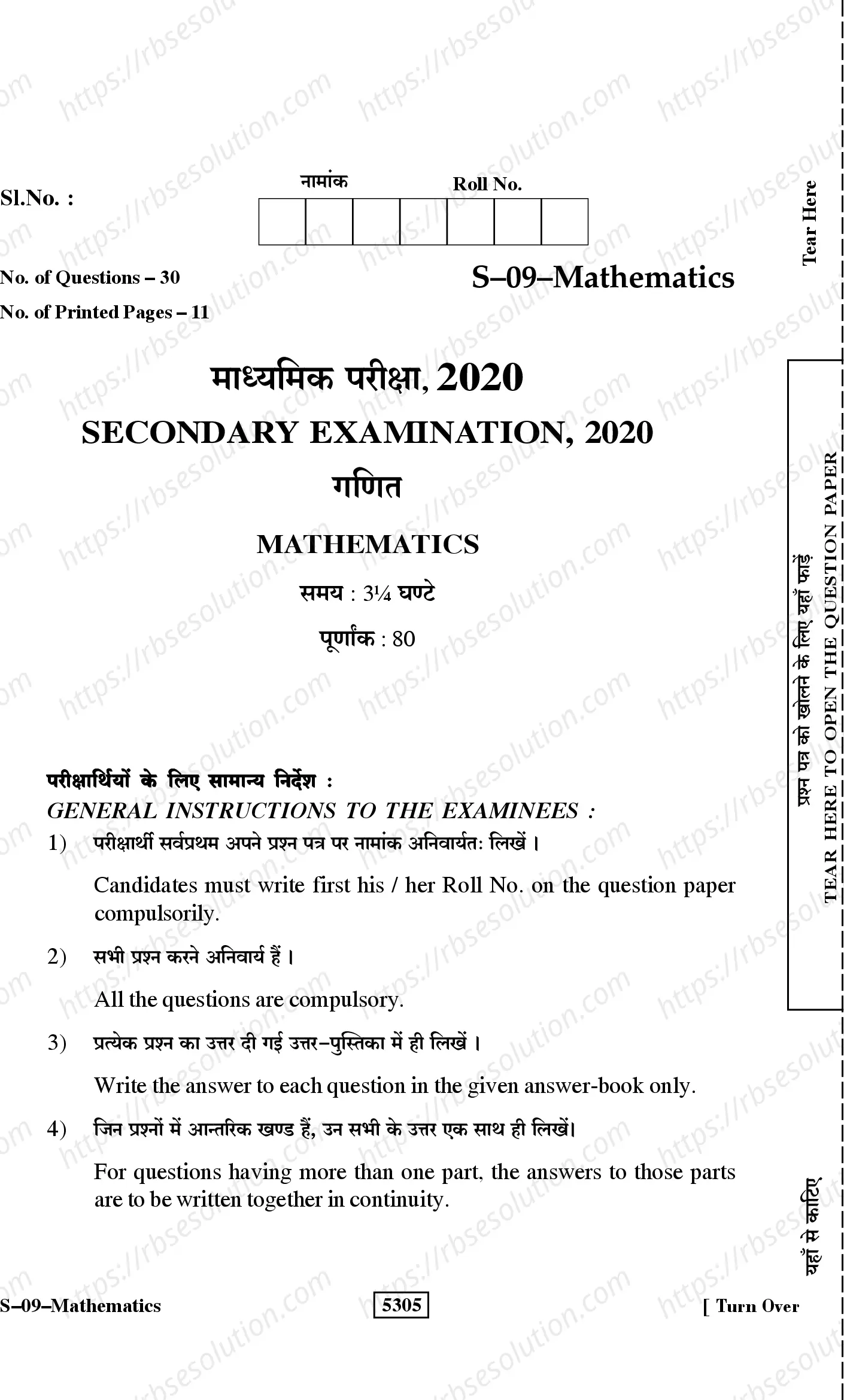


Rajasthan Board Class 10th Mathematics-S-09-2020 2020 solved Previous Year Question Papers
माध्यमिक परीक्षा, 2020
SECONDARY EXAMINATION, 2020
गणित
MATHEMATICS
समय : 3¼ घण्टे पूर्णांक : 80
परीक्षार्थियों के लिए सामान्य निर्देश :
GENERAL INSTRUCTIONS TO THE EXAMINEES :
- परीक्षार्थी सर्वप्रथम अपने प्रश्न पत्र पर नामांक अनिवार्यत: लिखें।
Candidates must write first his / her Roll No. on the question paper compulsorily. - सभी प्रश्न करने अनिवार्य हैं।
All the questions are compulsory. - प्रत्येक प्रश्न का उत्तर दी गई उत्तर-पुस्तिका में ही लिखें।
Write the answer to each question in the given answer-book only. - जिन प्रश्नों में आन्तरिक खण्ड हैं, उन सभी के उत्तर एक साथ ही लिखें।
For questions having more than one part, the answers to those parts are to be written together in continuity.
No. of Questions – 30 S—09—Mathematics
No. of Printed Pages : 8
Page content could not be transcribed.
परीक्षा निर्देश (Exam Instructions)
5) प्रश्नपत्र के हिन्दी व अंग्रेजी संस्करणों में किसी प्रकार की त्रुटि / अन्तर / विरोधाभास होने पर हिन्दी भाषा के प्रश्न को ही सही मानें।
If there is any error / difference / contradiction in Hindi & English versions of the question paper, the question of Hindi version should be treated valid.
6) भाग, प्रश्न संख्या एवं अंक विभाजन:
| भाग (Part) | प्रश्न संख्या (Q. Nos.) | प्रत्येक प्रश्न के अंक (Marks per question) |
|---|---|---|
| अ (A) | 1 – 10 | 1 |
| ब (B) | 11 – 15 | 2 |
| स (C) | 16 – 25 | 3 |
| द (D) | 26 – 30 | 6 |
7) प्रश्न क्रमांक 27 व 29 में आन्तरिक विकल्प हैं।
There are internal choices in Question Nos. 27 and 29.
8) अपनी उत्तर-पुस्तिका के पृष्ठों के दोनों ओर लिखिए। यदि कोई रफ कार्य करना हो, तो उत्तर-पुस्तिका के अंतिम पृष्ठों पर करें और इन्हें तिरछी लाइनों से काटकर उन पर ‘रफ कार्य’ लिख दें।
Write on both sides of the pages of your answer-book. If any rough work is to be done, do it on last pages of the answer-book and cross with slant lines and write ‘Rough Work’ on them.
9) प्रश्न क्रमांक 26 का लेखाचित्र ग्राफ पेपर पर बनाइए।
Draw the graph of Question No. 26 on graph paper.
S—09-Mathematics 5305
भाग - अ / PART - A
-
सूत्र निखिलम् का प्रयोग कर 05 का वर्ग ज्ञात कीजिए।
Find the square of 05 by using 'Sutra Nikhilam'.
हल / Solution:
निखिलम् सूत्र के अनुसार, आधार 10 लेते हैं। 05 का आधार से विचलन = 05 - 10 = -5 है।
वर्ग ज्ञात करने की विधि:
- संख्या में विचलन जोड़ें: 05 + (-5) = 0 (बायाँ भाग)
- विचलन का वर्ग: (-5)² = 25 (दायाँ भाग)
- चूँकि आधार 10 है, दायाँ भाग एक अंक का होना चाहिए, अतः 25 को 2 और 5 में बाँटते हैं। बायाँ भाग 0 + 2 = 2 हो जाता है, दायाँ भाग 5 रहता है।
अतः 05 का वर्ग = 25 है।
उत्तर / Answer: 25
-
निम्न समीकरण का हल ज्ञात कीजिए।
Solve the following equation:
2(x + 2) = 7(x + 2)
हल / Solution:
दिया गया समीकरण: 2(x + 2) = 7(x + 2)
दोनों पक्षों में (x + 2) समान है। इसे एक तरफ लाने पर:
2(x + 2) - 7(x + 2) = 0
(x + 2)(2 - 7) = 0
(x + 2)(-5) = 0
अतः x + 2 = 0 ⇒ x = -2
उत्तर / Answer: x = -2
-
दो संख्याओं का गुणनफल 2960 है तथा महत्तम समापवर्तक 8 हो तो लघुत्तम समापवर्त्य ज्ञात कीजिए।
If product of two numbers is 2960 and HCF is 8 then find their LCM.
हल / Solution:
हम जानते हैं कि दो संख्याओं का गुणनफल = HCF × LCM
दिया है: गुणनफल = 2960, HCF = 8
अतः LCM = गुणनफल / HCF = 2960 / 8 = 370
उत्तर / Answer: 370
-
मान ज्ञात कीजिए: 3 cos 30° - 4 cos³ 30°
Find the value: 3 cos 30° - 4 cos³ 30°
हल / Solution:
cos 30° = √3/2
अतः cos³ 30° = (√3/2)³ = (3√3)/8
अब, 3 cos 30° - 4 cos³ 30° = 3(√3/2) - 4(3√3/8)
= (3√3)/2 - (12√3)/8
= (3√3)/2 - (3√3)/2 = 0
उत्तर / Answer: 0
-
sec 36° / cosec 54° - sec 54° / cosec 36° का मान ज्ञात कीजिए।
Find the value of: sec 36° / cosec 54° - sec 54° / cosec 36°
हल / Solution:
हम जानते हैं कि sec θ = cosec (90° - θ) और cosec θ = sec (90° - θ)
अतः sec 36° = cosec (90° - 36°) = cosec 54°
sec 54° = cosec (90° - 54°) = cosec 36°
अब व्यंजक: sec 36° / cosec 54° - sec 54° / cosec 36°
= cosec 54° / cosec 54° - cosec 36° / cosec 36°
= 1 - 1 = 0
उत्तर / Answer: 0
6. किसी त्रिभुज के शीषों से समदूरस्थ बिन्दु लिखिए।
Write the point equidistant from the vertices of the triangle.
7. 5 सेमी. त्रिज्या वाले वृत्त के केन्द्र से 3 सेमी. दूरी पर स्थित बिन्दु से खींची गई स्पर्श रेखा की लम्बाई ज्ञात कीजिए।
Find the length of tangent of circle with radius 5 cm drawn from the point 3 cm away from the centre of the circle.
समकोण त्रिभुज OTP में (OT ⟂ PT), पाइथागोरस प्रमेय से:
PT² = OP² - OT² = (3)² - (5)² = 9 - 25 = -16
यहाँ OP = 3 सेमी, OT = 5 सेमी है। चूँकि OP < OT, इसलिए बिंदु वृत्त के अंदर है और स्पर्श रेखा संभव नहीं है।
अतः स्पर्श रेखा की लंबाई ज्ञात नहीं की जा सकती।
8. एक पासे को फेंकने पर “4' से छोटा अंक आने की प्रायिकता ज्ञात कीजिए।
In a throw of a dice, find the probability of getting a number less than ‘4’.
4 से छोटे अंक = 1, 2, 3 (कुल 3 अनुकूल परिणाम)
प्रायिकता = अनुकूल परिणामों की संख्या / कुल संभावित परिणाम = 3/6 = 1/2
उत्तर: 1/2
9. वाहनों के लिये आवश्यक पी. यू. सी. का पूरा नाम लिखिए।
Write the full name of P.U.C. which is essential for vehicles.
10. एक कार 3 मिनट में पहला, 6 मिनट में दूसरा, 9 मिनट में तीसरा यातायात सिग्नल पार करती है, तो वह 3 सिग्नल कितने समय में पार करेगी ?
A car passes through first signal in 3 minutes, second in 6 minutes, third in 9 minutes. In how much time it passes through 3rd signal?
तीसरा सिग्नल पार करने में लगा समय = 9 मिनट (जैसा कि दिया गया है)।
उत्तर: 9 मिनट
भाग - ब
PART - B
-
सूत्र परावर्त्य आधारित विधि से निम्न को हल कीजिए। [2]
4885 ÷ 23
Solve the following by using 'Sutra Paravartya'.
4885 ÷ 23
हल / Solution:
सूत्र परावर्त्य (Paravartya Yojayet) के अनुसार, भाजक (23) के अंकों को उल्टा करके (परावर्तित करके) घटाया जाता है।
भाजक = 23, परावर्तित अंक = 3 (इकाई का अंक), 2 (दहाई का अंक) को उल्टा करने पर -2 (ऋणात्मक) लेते हैं।
भाज्य = 4885
चरण 1: पहला अंक 4 लिखें। 4 × (-2) = -8, अगले अंक 8 में जोड़ें: 8 + (-8) = 0।
चरण 2: 0 × (-2) = 0, अगले अंक 8 में जोड़ें: 8 + 0 = 8।
चरण 3: 8 × (-2) = -16, अगले अंक 5 में जोड़ें: 5 + (-16) = -11।
अब भागफल = 212 (पहले तीन अंक) और शेषफल = -11 (ऋणात्मक) आता है। इसे सामान्य रूप में लाने के लिए भागफल में से 1 घटाएँ और शेषफल में भाजक जोड़ें:
भागफल = 212 - 1 = 211, शेषफल = -11 + 23 = 12
अतः भागफल = 211, शेषफल = 12
उत्तर: 4885 ÷ 23 = 211 शेष 12 (या 211 12/23)
-
परिमेय संख्या 7/30 का दशमलव प्रसार सांत है या असांत आवर्ती। बिना विभाजन प्रक्रिया का उपयोग कर ज्ञात कीजिए। [2]
State whether the decimal expansion of a rational number 7/30 is terminating or non-terminating recurring. Without performing the long division method.
हल / Solution:
किसी परिमेय संख्या का दशमलव प्रसार सांत होता है यदि उसके हर (सरलतम रूप में) के अभाज्य गुणनखंड केवल 2 या 5 हों।
यहाँ संख्या = 7/30 (पहले से सरलतम रूप में है, क्योंकि 7 और 30 का कोई उभयनिष्ठ गुणनखंड नहीं है)।
30 के अभाज्य गुणनखंड = 2 × 3 × 5
चूँकि हर में 3 भी है (जो 2 या 5 नहीं है), अतः दशमलव प्रसार असांत आवर्ती होगा।
उत्तर: असांत आवर्ती (Non-terminating recurring)
-
4 सेमी. त्रिज्या वाले वृत्त के त्रिज्यखण्ड द्वारा केन्द्र पर अन्तरित कोण 90° है। वृत्त के लघु त्रिज्यखण्ड के चाप की लम्बाई ज्ञात कीजिए। [2]
Angle subtended at the centre by the sector of a circle with radius 4 cm is 90°. Find the length of the arc of the minor sector of the circle.
हल / Solution:
दिया है: त्रिज्या (r) = 4 सेमी, केन्द्रीय कोण (θ) = 90°
चाप की लम्बाई (l) का सूत्र: l = (θ/360°) × 2πr
l = (90°/360°) × 2 × π × 4
l = (1/4) × 8π
l = 2π सेमी
यदि π = 3.14 लें, तो l = 2 × 3.14 = 6.28 सेमी
उत्तर: चाप की लम्बाई = 2π सेमी (लगभग 6.28 सेमी)
4) एक शंकु के आधार का व्यास 4 मीटर और तिर्यक ऊँचाई 25 मीटर है तो शंकु का सम्पूर्ण पृष्ठीय क्षेत्रफल ज्ञात कीजिए। [2]
Find the total surface area of cone whose diameter of base is 4 m and slant height is 25 meter.
हल:
दिया है: आधार का व्यास = 4 मीटर, अतः त्रिज्या (r) = 2 मीटर; तिर्यक ऊँचाई (l) = 25 मीटर।
शंकु का सम्पूर्ण पृष्ठीय क्षेत्रफल = πr(l + r)
= π × 2 × (25 + 2) = 2π × 27 = 54π वर्ग मीटर।
यदि π = 3.14 लें, तो क्षेत्रफल = 54 × 3.14 = 169.56 वर्ग मीटर।
5) एक सीधे व 8 मीटर ऊँचे खम्भे के शीर्ष पर सी सी टी वी कैमरा इस प्रकार लगाया गया है कि 0 मीटर दूर दृष्टि रेखा के आगे यातायात देखा जा सकता है। खम्भे के चारों ओर परछाई द्वारा निर्मित वृत्ताकार क्षेत्र का क्षेत्रफल ज्ञात कीजिए। (π = 3.4) [2]
A CCTV camera has installed on the top of a straight pole of 8 meter height such that forward traffic can be seen from the line of sight of 0 meter. Find the area of circular path formed by shadow around the pole. (π = 3.4)
हल:
दिया है: खम्भे की ऊँचाई = 8 मीटर, दृष्टि रेखा की दूरी = 0 मीटर (अर्थात कैमरा सीधे नीचे देखता है)।
परछाई द्वारा निर्मित वृत्ताकार क्षेत्र की त्रिज्या = खम्भे की ऊँचाई = 8 मीटर (क्योंकि कैमरा ऊर्ध्वाधर नीचे देखता है, परछाई खम्भे के चारों ओर 8 मीटर तक बनेगी)।
क्षेत्रफल = πr² = 3.4 × (8)² = 3.4 × 64 = 217.6 वर्ग मीटर।
भाग - C / PART - C
6) द्विघात बहुपद x² - 2x - 5 के शून्यक ज्ञात कीजिए और इस बहुपद के शून्यकों तथा गुणांकों के मध्य सम्बन्ध की सत्यता की जाँच कीजिए। [3]
Find the zeros of a quadratic polynomial x² - 2x - 5 and verify the relationship between the zeros and the coefficients of this polynomial.
हल:
दिया गया बहुपद: x² - 2x - 5
शून्यक ज्ञात करने के लिए: x² - 2x - 5 = 0
द्विघात सूत्र से: x = [2 ± √(4 + 20)] / 2 = [2 ± √24] / 2 = [2 ± 2√6] / 2 = 1 ± √6
अतः शून्यक: α = 1 + √6, β = 1 - √6
सम्बन्ध की जाँच:
शून्यकों का योग = α + β = (1 + √6) + (1 - √6) = 2 = -(-2)/1 = - (x का गुणांक) / (x² का गुणांक)
शून्यकों का गुणनफल = αβ = (1 + √6)(1 - √6) = 1 - 6 = -5 = अचर पद / (x² का गुणांक)
अतः सम्बन्ध सत्य है।
7) यदि किसी समान्तर श्रेढ़ी के दूसरे और तीसरे पद क्रमश: 24 तथा 28 हों तो, श्रेढ़ी के पहले 6 पदों का योगफल ज्ञात कीजिए। [3]
If second and third terms of an A.P. are 24 and 28 respectively, then find the sum of first 6 terms.
हल:
माना समान्तर श्रेढ़ी का प्रथम पद a और सार्वअंतर d है।
दूसरा पद: a + d = 24 ...(i)
तीसरा पद: a + 2d = 28 ...(ii)
(ii) - (i) से: d = 4
समीकरण (i) में d = 4 रखने पर: a + 4 = 24 ⇒ a = 20
पहले 6 पदों का योग: S₆ = (6/2)[2a + (6-1)d] = 3[2×20 + 5×4] = 3[40 + 20] = 3×60 = 180
8) एक 2 मीटर ऊँचा पेड़ तेज हवा से इस प्रकार टूट जाता है कि उसका शीर्ष जमीन को छूने लगता है और जमीन के साथ 30° का कोण बनाता है। तेज हवा से पेड़, जमीन से कितनी ऊँचाई से टूटा, ज्ञात कीजिए। [3]
A vertical straight tree 2 meter high is broken by strong wind in such a way that its top touches the ground and makes an angle of 30° with the ground. Find at what height from the ground did the tree break.
हल:
माना पेड़ जमीन से h मीटर ऊँचाई से टूटा। तब टूटा हुआ भाग = (2 - h) मीटर।
टूटने के बाद, टूटा हुआ भाग जमीन पर झुक जाता है और जमीन से 30° का कोण बनाता है।
समकोण त्रिभुज में: sin 30° = लंब / कर्ण = h / (2 - h)
⇒ 1/2 = h / (2 - h)
⇒ 2 - h = 2h
⇒ 2 = 3h
⇒ h = 2/3 मीटर
अतः पेड़ जमीन से 2/3 मीटर (लगभग 0.67 मीटर) ऊँचाई से टूटा।
प्रश्न 9
एक ही आधार BC पर दो त्रिभुज ΔABC एवं ΔDBC बने हैं। यदि AD व BC परस्पर O पर प्रतिच्छेद करें तो सिद्ध कीजिए कि:
ar(ΔABC) / ar(ΔDBC) = AO / DO
ΔABC and ΔDBC are on the same base BC. If AD and BC intersect each other at O, then prove that:
area of ΔABC / area of ΔDBC = AO / DO
हल / Solution:
माना कि त्रिभुज ABC और DBC एक ही आधार BC पर स्थित हैं। AD और BC परस्पर बिंदु O पर प्रतिच्छेद करते हैं।
त्रिभुज ABC का क्षेत्रफल = (1/2) × BC × (A से BC पर लंब) = (1/2) × BC × h₁
त्रिभुज DBC का क्षेत्रफल = (1/2) × BC × (D से BC पर लंब) = (1/2) × BC × h₂
अब, A और D से BC पर लंब क्रमशः AL और DM खींचते हैं। चूंकि त्रिभुज AOL और DOM समरूप हैं (कोण-कोण समरूपता से), इसलिए:
AL / DM = AO / DO
अतः, ar(ΔABC) / ar(ΔDBC) = [(1/2) × BC × AL] / [(1/2) × BC × DM] = AL / DM = AO / DO
इस प्रकार सिद्ध होता है कि ar(ΔABC) / ar(ΔDBC) = AO / DO
प्रश्न 20
दी गई आकृति में चतुर्भुज ABCD में AB = AC = AD हो, तो सिद्ध कीजिए कि:
∠BAD = 2(∠BDC + ∠CBD)
In the given figure, a quadrilateral ABCD has AB = AC = AD, then prove that:
∠BAD = 2(∠BDC + ∠CBD)
हल / Solution:
दिया है: चतुर्भुज ABCD में AB = AC = AD
इसलिए, बिंदु B, C, D केंद्र A वाले एक वृत्त पर स्थित हैं (क्योंकि AB, AC, AD त्रिज्याएँ हैं)।
अब, वृत्त में:
- ∠BDC केंद्र पर कोण ∠BAC का आधा है (चाप BC द्वारा) ⇒ ∠BAC = 2∠BDC
- ∠CBD केंद्र पर कोण ∠CAD का आधा है (चाप CD द्वारा) ⇒ ∠CAD = 2∠CBD
चूंकि ∠BAD = ∠BAC + ∠CAD, इसलिए:
∠BAD = 2∠BDC + 2∠CBD = 2(∠BDC + ∠CBD)
इस प्रकार सिद्ध होता है कि ∠BAD = 2(∠BDC + ∠CBD)
21. A circle touches the side BC of ΔABC at point P externally and touches the other two sides AB and AC when produced at points Q and R respectively. Prove that AQ = ½ (AB + BC + CA).
Solution:
Let the circle touch side BC at P, extended side AB at Q, and extended side AC at R.
From the property of tangents drawn from an external point to a circle, we have:
- From point B: BQ = BP …(1)
- From point C: CR = CP …(2)
- From point A: AQ = AR …(3)
Now, perimeter of ΔABC = AB + BC + CA.
We can write:
AB = AQ – BQ (since Q lies on extension of AB beyond B)
AC = AR – CR (since R lies on extension of AC beyond C)
BC = BP + PC
Adding these:
AB + BC + CA = (AQ – BQ) + (BP + PC) + (AR – CR)
= AQ + AR + (BP – BQ) + (PC – CR)
Using (1) and (2): BP – BQ = 0 and PC – CR = 0
So, AB + BC + CA = AQ + AR
From (3): AQ = AR, therefore:
AB + BC + CA = 2 AQ
Hence, AQ = ½ (AB + BC + CA).
22. Construct a circumcircle of ΔABC, such that BC = 6 cm, AB = 5 cm and ∠B = 60°.
Steps of Construction:
- Draw a line segment BC = 6 cm.
- At point B, construct an angle of 60° using a protractor or compass.
- On the ray of this angle, cut an arc of length AB = 5 cm to locate point A.
- Join A to C to complete ΔABC.
- Draw the perpendicular bisectors of sides AB and BC. Let them intersect at point O.
- With O as centre and radius equal to OA (or OB or OC), draw a circle. This is the required circumcircle of ΔABC.
23. Radius of a circle is 2 cm and angle subtended by a chord at the centre is 90°. Find the area of the minor segment formed by this chord.
Solution:
Given: Radius (r) = 2 cm, central angle (θ) = 90°.
Area of sector = (θ/360°) × πr² = (90/360) × π × 2² = (1/4) × 4π = π cm².
Area of triangle formed by the two radii and the chord = ½ × r² × sin θ = ½ × 2² × sin 90° = ½ × 4 × 1 = 2 cm².
Area of minor segment = Area of sector – Area of triangle = π – 2 cm².
Using π = 3.14, area = 3.14 – 2 = 1.14 cm² (approx).
Answer: Area of minor segment = (π – 2) cm² ≈ 1.14 cm².
24. How many cylinders of radius 3 cm and height 6 cm can be formed by melting a sphere whose radius is 9 cm?
Solution:
Volume of sphere = (4/3)πR³ = (4/3)π × 9³ = (4/3)π × 729 = 972π cm³.
Volume of one cylinder = πr²h = π × 3² × 6 = π × 9 × 6 = 54π cm³.
Number of cylinders = Volume of sphere / Volume of one cylinder = 972π / 54π = 18.
Answer: 18 cylinders can be formed.
प्रश्न 25
एक थैले में 5 सफेद, 2 लाल व 3 काली गेंदे हैं। इस थैले में से एक गेंद यादृच्छया निकाली जाती है। इसकी क्या प्रायिकता है कि निकाली गई गेंद निम्नलिखित होगी? [3]
- सफेद
- लाल
- काली
A bag contains 5 white, 2 red and 3 black balls. From this bag one ball is drawn randomly. What is the probability that the drawn ball is
- White
- Red
- Black
हल:
थैले में कुल गेंदों की संख्या = 5 (सफेद) + 2 (लाल) + 3 (काली) = 10
कुल संभावित परिणाम = 10
- सफेद गेंद: अनुकूल परिणाम = 5
प्रायिकता = 5/10 = 1/2 - लाल गेंद: अनुकूल परिणाम = 2
प्रायिकता = 2/10 = 1/5 - काली गेंद: अनुकूल परिणाम = 3
प्रायिकता = 3/10
सही उत्तर:
- सफेद: 1/2
- लाल: 1/5
- काली: 3/10
प्रश्न 26
निम्न रैखिक समीकरण युग्म को आलेखीय विधि द्वारा हल कीजिए। [6]
4x – 5y = 20
3x + 5y = 5
इसकी सहायता से m का मान ज्ञात कीजिए जबकि 4x + 3y = m
Solve the following pair of linear equation by graphical method
4x – 5y = 20
3x + 5y = 5
With the help of this find the value of ‘m’ while 4x + 3y = m.
हल:
चरण 1: प्रत्येक समीकरण के लिए तालिका बनाएं
समीकरण 1: 4x – 5y = 20
इसे y के रूप में लिखें: 5y = 4x – 20 ⇒ y = (4x – 20)/5
| x | 0 | 5 | 10 |
|---|---|---|---|
| y = (4x – 20)/5 | -4 | 0 | 4 |
बिंदु: (0, -4), (5, 0), (10, 4)
समीकरण 2: 3x + 5y = 5
इसे y के रूप में लिखें: 5y = 5 – 3x ⇒ y = (5 – 3x)/5
| x | 0 | 5 | -5 |
|---|---|---|---|
| y = (5 – 3x)/5 | 1 | -2 | 4 |
बिंदु: (0, 1), (5, -2), (-5, 4)
चरण 2: ग्राफ खींचें
एक ग्राफ पेपर पर x-अक्ष और y-अक्ष बनाएं। दोनों रेखाओं को उपरोक्त बिंदुओं की सहायता से खींचें।
रेखा 1: (0, -4) और (5, 0) से गुजरती है।
रेखा 2: (0, 1) और (5, -2) से गुजरती है।
दोनों रेखाएं एक बिंदु पर प्रतिच्छेद करती हैं।
चरण 3: प्रतिच्छेद बिंदु ज्ञात करें
समीकरणों को जोड़ें:
(4x – 5y) + (3x + 5y) = 20 + 5
7x = 25
x = 25/7 ≈ 3.57
अब x का मान पहले समीकरण में रखें:
4(25/7) – 5y = 20
100/7 – 5y = 20
–5y = 20 – 100/7 = (140 – 100)/7 = 40/7
y = –8/7 ≈ –1.14
प्रतिच्छेद बिंदु: (25/7, –8/7)
चरण 4: m का मान ज्ञात करें
दिया है: 4x + 3y = m
x = 25/7 और y = –8/7 रखें:
m = 4(25/7) + 3(–8/7)
m = 100/7 – 24/7
m = 76/7
अतः, m = 76/7
27) सिद्ध कीजिए। [6]
i) \(\frac{1 - \sin A}{1 + \sin A} = (\sec A - \tan A)^2\)
ii) \((\sin \theta + \csc \theta)^2 + (\cos \theta + \sec \theta)^2 = 7 + \tan^2 \theta + \cot^2 \theta\)
हल (i):
बायाँ पक्ष = \(\frac{1 - \sin A}{1 + \sin A}\)
अंश और हर में \((1 - \sin A)\) से गुणा करने पर:
\(= \frac{(1 - \sin A)^2}{1 - \sin^2 A} = \frac{(1 - \sin A)^2}{\cos^2 A}\)
\(= \left(\frac{1 - \sin A}{\cos A}\right)^2 = \left(\frac{1}{\cos A} - \frac{\sin A}{\cos A}\right)^2\)
\(= (\sec A - \tan A)^2\) = दायाँ पक्ष। सिद्ध हुआ।
हल (ii):
बायाँ पक्ष = \((\sin \theta + \csc \theta)^2 + (\cos \theta + \sec \theta)^2\)
\(= \sin^2 \theta + \csc^2 \theta + 2\sin\theta\csc\theta + \cos^2 \theta + \sec^2 \theta + 2\cos\theta\sec\theta\)
\(= (\sin^2 \theta + \cos^2 \theta) + (\csc^2 \theta + \sec^2 \theta) + 2(1 + 1)\)
\(= 1 + (1 + \cot^2 \theta + 1 + \tan^2 \theta) + 4\)
\(= 1 + 2 + \tan^2 \theta + \cot^2 \theta + 4\)
\(= 7 + \tan^2 \theta + \cot^2 \theta\) = दायाँ पक्ष। सिद्ध हुआ।
अथवा
i) \(\cos^4 \theta + \sin^4 \theta = 1 - 2\cos^2 \theta \sin^2 \theta\)
ii) \(\cot A - \tan A = \frac{2\cos^2 A - 1}{\sin A \cos A}\)
हल (i):
बायाँ पक्ष = \(\cos^4 \theta + \sin^4 \theta\)
\(= (\cos^2 \theta)^2 + (\sin^2 \theta)^2\)
\(= (\cos^2 \theta + \sin^2 \theta)^2 - 2\cos^2 \theta \sin^2 \theta\)
\(= 1 - 2\cos^2 \theta \sin^2 \theta\) = दायाँ पक्ष। सिद्ध हुआ।
हल (ii):
बायाँ पक्ष = \(\cot A - \tan A\)
\(= \frac{\cos A}{\sin A} - \frac{\sin A}{\cos A}\)
\(= \frac{\cos^2 A - \sin^2 A}{\sin A \cos A}\)
\(= \frac{\cos^2 A - (1 - \cos^2 A)}{\sin A \cos A}\)
\(= \frac{2\cos^2 A - 1}{\sin A \cos A}\) = दायाँ पक्ष। सिद्ध हुआ।
28) i) x-अक्ष पर वह बिन्दु ज्ञात कीजिए जो बिन्दुओं (-2, 3) और (-3, 4) से समान दूरी पर स्थित है। [6]
Find the point on x-axis which is equidistant from the points (-2, 3) and (-3, 4).
हल: माना x-अक्ष पर बिन्दु P(x, 0) है।
प्रश्नानुसार, PA = PB
\(\sqrt{(x + 2)^2 + (0 - 3)^2} = \sqrt{(x + 3)^2 + (0 - 4)^2}\)
दोनों पक्षों का वर्ग करने पर:
\((x + 2)^2 + 9 = (x + 3)^2 + 16\)
\(x^2 + 4x + 4 + 9 = x^2 + 6x + 9 + 16\)
\(4x + 13 = 6x + 25\)
\(4x - 6x = 25 - 13\)
\(-2x = 12\)
\(x = -6\)
अतः अभीष्ट बिन्दु (-6, 0) है।
ii) बिन्दुओं (5, 8) और (3, 3) को मिलाने वाली रेखा को बिन्दु (7, 6) किस अनुपात में विभाजित करता है? [6]
In which ratio, point (7, 6) divides the line joining the points (5, 8) and (3, 3)?
हल: माना बिन्दु P(7, 6) रेखाखंड AB को m : n के अनुपात में विभाजित करता है, जहाँ A(5, 8) और B(3, 3) हैं।
विभाजन सूत्र से:
\(x = \frac{m x_2 + n x_1}{m + n}\) और \(y = \frac{m y_2 + n y_1}{m + n}\)
\(7 = \frac{m(3) + n(5)}{m + n}\)
\(7(m + n) = 3m + 5n\)
\(7m + 7n = 3m + 5n\)
\(7m - 3m = 5n - 7n\)
\(4m = -2n\)
\(\frac{m}{n} = \frac{-2}{4} = -\frac{1}{2}\)
चूँकि अनुपात ऋणात्मक है, अतः बिन्दु P रेखाखंड AB को बाह्य रूप से 1 : 2 के अनुपात में विभाजित करता है।
या, बिन्दु P, AB को 1 : 2 के अनुपात में बाह्यतः विभाजित करता है।
प्रश्न 29
सिद्ध कीजिए कि एक चाप द्वारा वृत्त के केन्द्र पर अन्तरित कोण वृत्त के शेष भाग के किसी बिन्दु पर अन्तरित कोण का दोगुना होता है। [6]
Prove that the angle formed by an arc on the centre of the circle is twice the angle formed at any point of remaining part of the circle.
हल:
माना O वृत्त का केंद्र है और AB एक चाप है। माना ∠AOB केंद्र पर बना कोण है और ∠ACB वृत्त के शेष भाग पर स्थित किसी बिंदु C पर बना कोण है।
सिद्ध करना है: ∠AOB = 2∠ACB
रचना: CO को बढ़ाकर D तक ले जाएँ।
उपपत्ति: त्रिभुज AOC में, OA = OC (एक ही वृत्त की त्रिज्याएँ)
∴ ∠OAC = ∠OCA (समान भुजाओं के सम्मुख कोण)
बहिष्कोण ∠AOD = ∠OAC + ∠OCA = 2∠OCA ...(1)
इसी प्रकार, त्रिभुज BOC में, OB = OC
∴ ∠OBC = ∠OCB
बहिष्कोण ∠BOD = ∠OBC + ∠OCB = 2∠OCB ...(2)
समीकरण (1) और (2) को जोड़ने पर:
∠AOD + ∠BOD = 2(∠OCA + ∠OCB)
⇒ ∠AOB = 2∠ACB
अतः सिद्ध हुआ कि केंद्र पर बना कोण शेष भाग पर बने कोण का दोगुना होता है।
अथवा
सिद्ध कीजिए कि किसी चतुर्भुज की एक भुजा बढ़ाने पर बनने वाला बहिष्कोण अपने अन्तराभिमुख कोण के बराबर हो, तो वह एक चक्रीय चतुर्भुज होता है। [6]
Prove that an exterior angle formed by increasing side of a quadrilateral is equal to the interior opposite angle, then it is a cyclic quadrilateral.
हल:
माना ABCD एक चतुर्भुज है जिसकी भुजा AB को बढ़ाकर E तक ले जाया गया है। बहिष्कोण ∠CBE = अन्तराभिमुख कोण ∠ADC दिया है।
सिद्ध करना है: ABCD एक चक्रीय चतुर्भुज है।
उपपत्ति: ∠CBE + ∠CBA = 180° (रैखिक युग्म)
परंतु ∠CBE = ∠ADC (दिया है)
∴ ∠ADC + ∠CBA = 180°
अतः चतुर्भुज के सम्मुख कोणों का योग 180° है।
इसलिए, ABCD एक चक्रीय चतुर्भुज है। (यदि किसी चतुर्भुज के सम्मुख कोणों का योग 180° हो, तो वह चक्रीय होता है)
प्रश्न 30
निम्न बारम्बारता बंटन के माध्य व बहुलक ज्ञात कीजिए। [6]
Find the mean and mode of the following frequency distribution -
| वर्ग (Class) | 0-10 | 10-20 | 20-30 | 30-40 | 40-50 |
|---|---|---|---|---|---|
| बारम्बारता (f) | 6 | 10 | 13 | 7 | 4 |
हल:
माध्य (Mean) ज्ञात करना:
सर्वप्रथम वर्गों के मध्य बिंदु (xi) ज्ञात करेंगे:
| वर्ग | मध्य बिंदु (xi) | बारम्बारता (fi) | fi × xi |
|---|---|---|---|
| 0-10 | 5 | 6 | 30 |
| 10-20 | 15 | 10 | 150 |
| 20-30 | 25 | 13 | 325 |
| 30-40 | 35 | 7 | 245 |
| 40-50 | 45 | 4 | 180 |
| योग | Σfi = 40 | Σfixi = 930 |
माध्य = Σfixi / Σfi = 930 / 40 = 23.25
बहुलक (Mode) ज्ञात करना:
सर्वाधिक बारम्बारता 13 है, जो वर्ग 20-30 में है। अतः बहुलक वर्ग = 20-30
बहुलक वर्ग की निम्न सीमा (l) = 20
बहुलक वर्ग की बारम्बारता (f1) = 13
बहुलक वर्ग से पहले वर्ग की बारम्बारता (f0) = 10
बहुलक वर्ग के बाद वाले वर्ग की बारम्बारता (f2) = 7
वर्ग अंतराल (h) = 10
बहुलक = l + [(f1 - f0) / (2f1 - f0 - f2)] × h
= 20 + [(13 - 10) / (2×13 - 10 - 7)] × 10
= 20 + [3 / (26 - 17)] × 10
= 20 + (3/9) × 10
= 20 + (1/3) × 10
= 20 + 3.33
= 23.33
अतः माध्य = 23.25 और बहुलक = 23.33