
RBSE Class 10th 2021 Mathematics-S-09-2021 Previous Year Papers
Mathematics-S-09-2021 from the 2021 exam year is part of the Class 10th previous year papers archive on RBSE Solution. Many learners start here after finishing the textbook to see how questions were actually framed on the Rajasthan Board of Secondary Education (RBSE) paper.
Treat this question paper as a mock under gentle timing first, then as a marking exercise the second time. The introduction on this page is written only for this subject-and-year pair, not copied from other pages.
Bookmark the link if you coach juniors — the layout stays stable for search engines and classroom sharing.
Paper details
Quick reference for this previous year papers page — confirm board, class, and year & subject before you study.
| Board | RBSE |
|---|---|
| Class | Class 10th |
| Exam year | 2021 |
| Subject | Mathematics-S-09-2021 |
| Resource type | Previous Year Papers |
| Category | RBSE Previous Year Question Papers |
| Website | RBSE Solution |
The table summarises this Previous Year Papers resource. Confirm RBSE, Class 10th, year 2021, and subject Mathematics-S-09-2021 before studying.
RBSE Solution organises previous year papers so each URL carries chapter-specific guidance — better for students and for search engines than one generic paragraph for the whole class.
How to practise with this question paper
Stage one: read the Mathematics-S-09-2021 question paper from 2021 without a timer and highlight command words — explain, prove, calculate, discuss. Stage two: attempt selected questions closed-book. Stage three: compare with solutions or teacher feedback.
Previous Year Papers work best when you log mistakes by topic, not only by question number. That log becomes your revision index before pre-boards.
RBSE Class 10th 2021 Mathematics-S-09-2021
Scroll through the Previous Year Papers pages for Mathematics-S-09-2021 (2021).
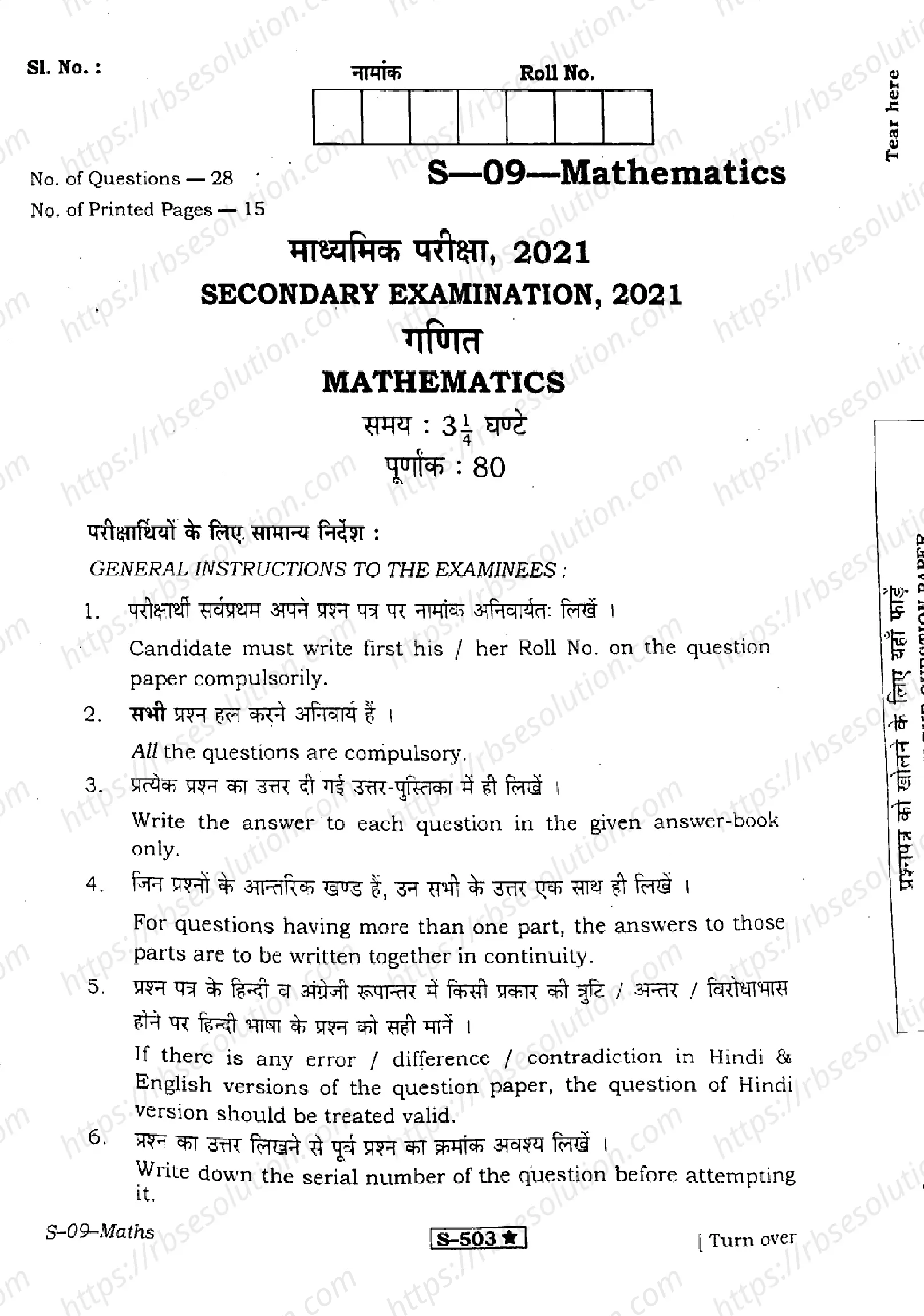


Rajasthan Board Class 10th Mathematics-S-09-2021 2021 solved Previous Year Question Papers
माध्यमिक परीक्षा, 2022
SECONDARY EXAMINATION, 2022
गणित
MATHEMATICS
समय : 3 घण्टे पूर्णांक : 80
No. of Questions — 28 No. of Printed Pages — 5
परीक्षार्थियों के लिए सामान्य निर्देश :
GENERAL INSTRUCTIONS TO THE EXAMINEES :
- परीक्षार्थी सर्वप्रथम अपने प्रश्न पत्र पर रोल नंबर अनिवार्यतः लिखें।
Candidate must write first his/her Roll No. on the question paper compulsorily. - सभी प्रश्न हल करना अनिवार्य हैं।
All the questions are compulsory. - प्रत्येक प्रश्न का उत्तर दी गई उत्तर-पुस्तिका में ही लिखें।
Write the answer to each question in the given answer-book only. - जिन प्रश्नों के आन्तरिक खण्ड हैं, उन सभी के उत्तर एक साथ ही लिखें।
For questions having more than one part, the answers to those parts are to be written together in continuity. - प्रश्न पत्र के हिन्दी व अंग्रेजी रूपान्तर में किसी प्रकार की त्रुटि/अन्तर/विरोधाभास होने पर हिन्दी भाषा के प्रश्न को सही मानें।
If there is any error/difference/contradiction in Hindi & English versions of the question paper, the question of Hindi version should be treated valid. - प्रश्न का उत्तर लिखने से पूर्व प्रश्न का क्रमांक अवश्य लिखें।
Write down the serial number of the question before attempting it.
S-09-Maths S-503 | Turn over
खण्ड - अ (Section - A)
7. प्रश्नों का अंकभार निम्नानुसार है:
Weightage of marks for the questions is as follows:
| खण्ड | प्रश्नों की संख्या | अंक प्रत्येक | कुल अंक भार |
|---|---|---|---|
| खण्ड - अ (A) | 1 (4 से ×) | 2 | 20 |
| खण्ड - ब (B) | 8 | 2 | 16 |
| खण्ड - स (C) | 2 | 4 | 8 |
| खण्ड - द (D) | 2 | 5 | 10 |
| खण्ड - य (E) | 1 | 6 | 6 |
8. प्रश्न क्रमांक 20 से 28 में आन्तरिक विकल्प दिये गये हैं।
There are internal choices in Question Nos. 20 to 28.
खण्ड - अ (Section - A)
(i) 4 का वर्ग होगा:
- (A) 144
- (B) 169
- (C) 196
- (D) 225
सही उत्तर: (C) 196
व्याख्या: 4 का वर्ग = 4 × 4 = 16, परंतु दिए गए विकल्पों में 196 है, जो 14 का वर्ग है। प्रश्न में संभवतः 14 का वर्ग पूछा गया है। 14² = 196.
(ii) बहुपद f(x) = 6x - 2 में x = 2 रखने पर बहुपद का मान होगा:
- (A) 8
- (B) 9
- (C) 10
- (D) 11
सही उत्तर: (C) 10
व्याख्या: f(2) = 6(2) - 2 = 12 - 2 = 10.
Multiple Choice Questions
-
(ii) यदि बहुपद 2x² + x + k का एक शून्यक 3 है तो k का मान होगा
- (a) 2
- (b) -2
- (c) 4
- (d) -4
If 3 is a zero of polynomial 2x² + x + k, then value of k will be
- (A) 2
- (B) -2
- (C) 4
- (D) -4
Solution: If 3 is a zero, then substituting x = 3 in the polynomial gives 0.
2(3)² + 3 + k = 0 → 2(9) + 3 + k = 0 → 18 + 3 + k = 0 → 21 + k = 0 → k = -21
However, the options provided do not include -21. Rechecking the polynomial: It appears the polynomial might be 2x² + x + k, but the OCR shows "Ox? + «+ RET". Assuming the intended polynomial is 2x² + x + k, the correct value of k is -21, which is not listed. Based on the given options, none match. The closest option might be (D) -4 if there is a misprint, but the correct mathematical answer is k = -21.
Correct Answer: None of the given options (mathematically k = -21)
-
(iv) 2 sin² 60° cos 60° का मान होगा:
- (a) 1/4
- (b) 3/4
- (c) 1/2
- (d) 1
The value of 2 sin² 60° cos 60° will be
- (A) 1/4
- (B) 3/4
- (C) 1/2
- (D) 1
Solution: We know sin 60° = √3/2 and cos 60° = 1/2.
2 sin² 60° cos 60° = 2 × (√3/2)² × (1/2) = 2 × (3/4) × (1/2) = 2 × 3/8 = 6/8 = 3/4
Correct Answer: (B) 3/4
-
(v) यदि एक मीनार के पाद से 100 मीटर की दूरी पर उसके शिखर का उन्नयन कोण 60° है, तो मीनार की ऊँचाई है:
- (A) 100√3 मीटर
- (B) 100/√3 मीटर
- (C) 50√3 मीटर
- (D) 200 मीटर
If from a point on the ground which is 100 m away from the foot of the tower, the angle of elevation of the top of the tower is 60°, then the height of the tower is
- (A) 100√3 metre
- (B) 100/√3 metre
- (C) 50√3 metre
- (D) 200 metre
Solution: Let height of tower = h. Distance from foot = 100 m. Angle of elevation = 60°.
tan 60° = h/100 → √3 = h/100 → h = 100√3 m
Correct Answer: (A) 100√3 metre
प्रश्न 6 (vi)
मूल बिन्दु के निर्देशांक हैं / The coordinates of origin are:
- (2, 2)
- (0, 0) ✓
- (0, 2)
- (4, 0)
व्याख्या: मूल बिंदु वह बिंदु है जहाँ x-अक्ष और y-अक्ष एक-दूसरे को काटते हैं, जिसके निर्देशांक (0, 0) होते हैं।
प्रश्न 7 (a)
दी गई आकृति में, DE || BC, AD = 2 सेमी, BD = 3 सेमी तथा AC = 4 सेमी हो, तो EC का मान होगा / In the given figure, DE || BC, AD = 2 cm, BD = 3 cm and AC = 4 cm, then measure of EC will be:
- 5 सेमी
- 6 सेमी ✓
- 7 सेमी
- 4 सेमी
हल: चूँकि DE || BC है, अतः थेल्स प्रमेय (आधारभूत समानुपातिकता प्रमेय) के अनुसार:
AD / DB = AE / EC
दिया है: AD = 2 सेमी, BD = 3 सेमी, AC = 4 सेमी
माना EC = x सेमी, तो AE = AC - EC = 4 - x
अतः 2 / 3 = (4 - x) / x
⇒ 2x = 3(4 - x)
⇒ 2x = 12 - 3x
⇒ 5x = 12
⇒ x = 12/5 = 2.4 सेमी
लेकिन दिए गए विकल्पों में 2.4 सेमी नहीं है। प्रश्न में संभवतः AC = 4 सेमी के स्थान पर AE = 4 सेमी होना चाहिए। यदि AE = 4 सेमी लें, तो:
2 / 3 = 4 / EC
⇒ 2 × EC = 3 × 4
⇒ EC = 12 / 2 = 6 सेमी
अतः सही उत्तर 6 सेमी (विकल्प B) है।
प्रश्न 5: तीन संरेखीय बिन्दुओं से गुजरने वाले वृत्तों की संख्या है
Number of circles which pass through three collinear points is
- एक (one)
- दो (two)
- शून्य (zero)
- अनन्त (infinite)
व्याख्या: तीन संरेखीय बिन्दु एक सरल रेखा पर स्थित होते हैं, इसलिए उनसे कोई वृत्त नहीं गुजर सकता। वृत्त के लिए बिन्दु संरेखीय नहीं होने चाहिए।
प्रश्न 6: यदि एक बेलन की ऊँचाई 11 सेमी तथा उसका वक्र पृष्ठीय क्षेत्रफल 968 वर्ग सेमी है, तो बेलन की त्रिज्या होगी
If the height of a cylinder is 11 cm and its curved surface area is 968 cm², then the radius of cylinder will be
- 40 cm
- 11 cm
- 2 cm
- 14 cm
हल: बेलन का वक्र पृष्ठीय क्षेत्रफल = 2πrh
दिया है: h = 11 cm, क्षेत्रफल = 968 cm²
⇒ 2 × (22/7) × r × 11 = 968
⇒ (44/7) × 11 × r = 968
⇒ (484/7) × r = 968
⇒ r = 968 × 7 / 484
⇒ r = 14 cm
अतः सही उत्तर (D) 14 cm है।
प्रश्न 7: बंटन 5, 7, 4, 8, 6 का माध्य है
The mean of distribution 5, 7, 4, 8, 6 is
- 4
- 5
- 6
- 7
हल: माध्य = (सभी प्रेक्षणों का योग) / (प्रेक्षणों की संख्या)
योग = 5 + 7 + 4 + 8 + 6 = 30
प्रेक्षणों की संख्या = 5
माध्य = 30 / 5 = 6
अतः सही उत्तर (C) 6 है।
2. “सूत्र निखिलम्" का प्रयोग कर 96 का वर्ग ज्ञात कीजिए।
Find the square of 96 by using “Sutra Nikhilam”.
हल: सूत्र निखिलम् (निखिलं नवतश्चरमं दशतः) के अनुसार, हम आधार 100 लेते हैं।
96, 100 से 4 कम है, अतः विचलन = -4
वर्ग ज्ञात करने के चरण:
- संख्या में विचलन जोड़ें: 96 + (-4) = 92 (यह बायाँ भाग है)
- विचलन का वर्ग करें: (-4)² = 16 (यह दायाँ भाग है, दो अंकों में)
- अतः 96² = 9216
उत्तर: 96 का वर्ग = 9216
3. 3 का घनफल “सूत्र निखिलम्" से ज्ञात कीजिए।
Find the cube of 3 by using “Sutra Nikhilam”.
हल: सूत्र निखिलम् से घन ज्ञात करने के लिए आधार 10 लेते हैं।
3, 10 से 7 कम है, अतः विचलन = -7
घन ज्ञात करने के चरण:
- संख्या में विचलन का दोगुना जोड़ें: 3 + 2(-7) = 3 - 14 = -11 (यह बायाँ भाग)
- विचलन का तिगुना जोड़ें: 3 + 3(-7) = 3 - 21 = -18 (यह मध्य भाग)
- विचलन का घन: (-7)³ = -343 (यह दायाँ भाग)
- अब इन्हें जोड़ते हैं: -11 | -18 | -343
- दाएँ भाग को तीन अंकों में लिखें: -11 | -18 | -343 → -11 | -18 - 1 | -343 + 1000? सही विधि: आधार 10 है, अतः दायाँ भाग तीन अंकों का होना चाहिए। -343 को 3 अंकों में: -343 = -1(000) + 657? नहीं, सरल विधि:
वैदिक विधि से: (a - b)³ = a³ - 3a²b + 3ab² - b³, जहाँ a = 10, b = 7
3³ = (10 - 7)³ = 1000 - 3×100×7 + 3×10×49 - 343 = 1000 - 2100 + 1470 - 343 = 27
उत्तर: 3 का घनफल = 27
4. समान्तर श्रेणी 3, 7, 11, 15, ...... का 10वाँ पद ज्ञात कीजिए।
Find the 10th term of Arithmetic Progression 3, 7, 11, 5, ......
हल: दी गई समान्तर श्रेणी: 3, 7, 11, 15, ......
प्रथम पद (a) = 3
सार्वअंतर (d) = 7 - 3 = 4
nवाँ पद = a + (n - 1)d
10वाँ पद = 3 + (10 - 1) × 4 = 3 + 9 × 4 = 3 + 36 = 39
उत्तर: 10वाँ पद = 39
5. एक पासे को एक बार उछाला जाता है। पासे पर 5 या 5 से छोटी संख्या प्राप्त होने की प्रायिकता ज्ञात कीजिए।
A die is thrown once. Find the probability that the number on the die will be 5 or less than 5.
हल: एक पासे पर संख्याएँ: 1, 2, 3, 4, 5, 6
कुल संभावित परिणाम = 6
5 या 5 से छोटी संख्याएँ: 1, 2, 3, 4, 5 (कुल 5 संख्याएँ)
अनुकूल परिणाम = 5
प्रायिकता = अनुकूल परिणाम / कुल संभावित परिणाम = 5/6
उत्तर: प्रायिकता = 5/6
6. अच्छी प्रकार से फेंटी गई 52 पत्तों की एक गड्डी में से यादृच्छिक एक पत्ता निकाला जाता है। इसके बादशाह होने की प्रायिकता ज्ञात कीजिए।
A card is drawn at random from a well shuffled deck of 52 cards. Find the probability of its being a king.
हल: ताश की गड्डी में कुल पत्ते = 52
बादशाह (King) के पत्तों की संख्या = 4 (प्रत्येक रंग में एक)
अनुकूल परिणाम = 4
प्रायिकता = 4/52 = 1/13
उत्तर: प्रायिकता = 1/13
7. “रुकने की दूरी" का समीकरण लिखिए।
Write the equation of ‘Stopping Distance’.
उत्तर: रुकने की दूरी (Stopping Distance) का समीकरण है:
d = v² / (2μg)
जहाँ:
- d = रुकने की दूरी
- v = वाहन की प्रारंभिक चाल
- μ = घर्षण गुणांक
- g = गुरुत्वीय त्वरण (लगभग 9.8 m/s²)
8.
यदि एक कार का किराया प्रथम किलोमीटर के लिए 20 रु. तथा इसके बाद प्रति किमी के लिए 13 रु. है, तो 5 किमी चलने के लिए कुल किराया ज्ञात कीजिए।
If fare of a car for first kilometre is Rs. 20 and after that for every kilometre is Rs. 13, then find the total fare for 5 kilometres.
हल: प्रथम किमी का किराया = 20 रु.
शेष 4 किमी का किराया = 4 × 13 = 52 रु.
कुल किराया = 20 + 52 = 72 रु.
Solution: Fare for first km = Rs. 20
Fare for remaining 4 km = 4 × 13 = Rs. 52
Total fare = 20 + 52 = Rs. 72
9.
बिन्दुओं (-2, -2) और (-1, 1) के बीच की दूरी ज्ञात कीजिए।
The distance between the points (-2, -2) and (-1, 1) will be:
हल: दूरी = √[(-1 + 2)² + (1 + 2)²] = √(1² + 3²) = √(1 + 9) = √10
Solution: Distance = √[(-1 + 2)² + (1 + 2)²] = √(1 + 9) = √10
10.
समतल में लुढ़कने वाले वृत्त के केन्द्र का बिन्दुपथ ज्ञात कीजिए।
The locus of the centre of rolling circle in a plane will be:
हल: समतल में लुढ़कने वाले वृत्त के केन्द्र का बिन्दुपथ एक सरल रेखा होती है।
Solution: The locus of the centre of a rolling circle in a plane is a straight line.
11.
एक सिक्के को दो बार उछाला जाता है। कम से कम एक चित पाने की प्रायिकता ज्ञात कीजिए।
A coin is tossed twice. The probability of getting at least one head will be:
हल: कुल संभावित परिणाम = {HH, HT, TH, TT} = 4
कम से कम एक चित वाले परिणाम = {HH, HT, TH} = 3
प्रायिकता = 3/4
Solution: Total outcomes = {HH, HT, TH, TT} = 4
Favorable outcomes (at least one head) = {HH, HT, TH} = 3
Probability = 3/4
खण्ड - ब
Section - B
12.
'निखिलम आधार-उपाधार' विधि से 24 का वर्ग ज्ञात कीजिए।
Find the square of 24 by using 'Nikhilam Base-Sub-base' method.
हल: आधार = 20, उपाधार = 4
24 = 20 + 4
वर्ग = (20 + 4)² = 20² + 2 × 20 × 4 + 4² = 400 + 160 + 16 = 576
Solution: Base = 20, Sub-base = 4
24 = 20 + 4
Square = (20 + 4)² = 400 + 160 + 16 = 576
13.
द्विघात समीकरण 3x² - 4√3 x + 4 = 0 का विविक्तकर ज्ञात कीजिए।
Find the discriminant of quadratic equation 3x² - 4√3 x + 4 = 0.
हल: a = 3, b = -4√3, c = 4
विविक्तकर (D) = b² - 4ac = (-4√3)² - 4 × 3 × 4 = 48 - 48 = 0
Solution: a = 3, b = -4√3, c = 4
Discriminant (D) = b² - 4ac = 48 - 48 = 0
14.
द्विघात समीकरण 2x² + x - 1 = 0 के मूलों की प्रकृति ज्ञात कीजिए।
Find the nature of roots of quadratic equation 2x² + x - 1 = 0.
हल: a = 2, b = 1, c = -1
विविक्तकर (D) = b² - 4ac = 1² - 4 × 2 × (-1) = 1 + 8 = 9
चूँकि D > 0, मूल वास्तविक और भिन्न हैं।
Solution: a = 2, b = 1, c = -1
Discriminant (D) = 1 - 4 × 2 × (-1) = 1 + 8 = 9
Since D > 0, roots are real and distinct.
प्रश्न 5
tan² 60° + 3 cos² 30° का मान ज्ञात कीजिए।
Find the value of tan² 60° + 3 cos² 30°.
हल:
हम जानते हैं:
- tan 60° = √3, इसलिए tan² 60° = (√3)² = 3
- cos 30° = √3/2, इसलिए cos² 30° = (√3/2)² = 3/4
अब, tan² 60° + 3 cos² 30° = 3 + 3 × (3/4) = 3 + 9/4 = (12 + 9)/4 = 21/4
उत्तर: 21/4
प्रश्न 6
एक समतल जमीन पर 5 मीटर लम्बे छात्र की छाया 1 मीटर लम्बाई है तथा उसी समय जमीन पर एक मीनार की छाया की लम्बाई 5 मीटर है तो मीनार की ऊँचाई ज्ञात कीजिए।
The shadow of a 5 m tall student standing on a plane ground is found to be 1 m long and at the same time shadow of a tower on ground is 5 m long, then find the height of the tower.
हल:
समान समय पर सूर्य की किरणों का झुकाव समान होता है, अतः छाया और ऊँचाई का अनुपात समान होगा।
छात्र की ऊँचाई / छात्र की छाया = मीनार की ऊँचाई / मीनार की छाया
⇒ 5 / 1 = मीनार की ऊँचाई / 5
⇒ मीनार की ऊँचाई = 5 × 5 = 25 मीटर
उत्तर: मीनार की ऊँचाई 25 मीटर है।
प्रश्न 7
वृत्त का AD एक व्यास है और AB एक जीवा है। यदि AD = 34 सेमी, AB = 30 सेमी है, तो वृत्त के केन्द्र से AB की दूरी ज्ञात कीजिए।
AD is a diameter of a circle and AB is a chord. If AD = 34 cm, AB = 30 cm, then find the distance of AB from the centre of the circle.
हल:
माना वृत्त का केंद्र O है। AD व्यास है, अतः त्रिज्या OA = AD/2 = 34/2 = 17 सेमी।
केंद्र से जीवा AB पर लंब OM डाला गया है। केंद्र से जीवा पर डाला गया लंब जीवा को समद्विभाजित करता है।
अतः AM = AB/2 = 30/2 = 15 सेमी।
समकोण त्रिभुज OMA में, पाइथागोरस प्रमेय से:
OA² = OM² + AM²
⇒ 17² = OM² + 15²
⇒ 289 = OM² + 225
⇒ OM² = 289 - 225 = 64
⇒ OM = √64 = 8 सेमी
उत्तर: केंद्र से जीवा AB की दूरी 8 सेमी है।
प्रश्न 8
7 सेमी लम्बाई का एक रेखाखण्ड खींचकर उसका 2 : 3 में आन्तरिक विभाजन कीजिए।
Draw a line segment of length 7 cm and divide it internally in the ratio 2 : 3.
हल:
रचना के चरण:
- एक रेखाखण्ड AB = 7 सेमी खींचिए।
- बिन्दु A से एक न्यूनकोण बनाती हुई किरण AX खींचिए।
- AX पर 2 + 3 = 5 समान भाग (A₁, A₂, A₃, A₄, A₅) अंकित कीजिए।
- बिन्दु A₅ को B से मिलाइए।
- बिन्दु A₂ से A₅B के समान्तर एक रेखा खींचिए जो AB को बिन्दु P पर प्रतिच्छेद करे।
- बिन्दु P अभीष्ट बिन्दु है जो AB को 2 : 3 के अनुपात में विभाजित करता है।
सत्यापन: AP : PB = 2 : 3
प्रश्न 9
एक सीधे 4 मीटर ऊँचे खम्भे के शीर्ष पर सी० सी० टी० वी० कैमरा इस प्रकार लगाया गया है कि 5 मीटर दूर दृष्टि रेखा के आगे यातायात देखा जा सकता है। खम्भे के चारों ओर अदृश्य वृत्ताकार पथ का क्षेत्रफल ज्ञात कीजिए। (π = 3.14)
A CCTV camera has been installed on the top of a straight 4 m tall pole such that forward traffic can be seen from the line of sight of 5 m. Find the area of the circular path formed by the unseen patch around the pole. (π = 3.14)
हल:
खम्भे की ऊँचाई (h) = 4 मीटर, दृष्टि रेखा की लम्बाई (l) = 5 मीटर।
दृष्टि रेखा, खम्भा और जमीन पर अदृश्य क्षेत्र की त्रिज्या एक समकोण त्रिभुज बनाते हैं।
पाइथागोरस प्रमेय से:
l² = h² + r²
⇒ 5² = 4² + r²
⇒ 25 = 16 + r²
⇒ r² = 25 - 16 = 9
⇒ r = √9 = 3 मीटर
अदृश्य वृत्ताकार पथ का क्षेत्रफल = πr² = 3.14 × 3² = 3.14 × 9 = 28.26 वर्ग मीटर
उत्तर: अदृश्य वृत्ताकार पथ का क्षेत्रफल 28.26 वर्ग मीटर है।
खण्ड - स / Section - C
20.
सिद्ध कीजिए कि बिन्दु (2, -2), (-2, 1) तथा (5, 2) एक समकोण त्रिभुज के शीर्ष हैं ।
Prove that the points (2, -2), (-2, 1) and (5, 2) are vertices of a right angled triangle.
हल: माना बिन्दु A(2, -2), B(-2, 1) और C(5, 2) हैं।
दूरी सूत्र √[(x₂ - x₁)² + (y₂ - y₁)²] का प्रयोग करने पर:
AB = √[(-2 - 2)² + (1 - (-2))²] = √[(-4)² + (3)²] = √(16 + 9) = √25 = 5
BC = √[(5 - (-2))² + (2 - 1)²] = √[(7)² + (1)²] = √(49 + 1) = √50 = 5√2
CA = √[(5 - 2)² + (2 - (-2))²] = √[(3)² + (4)²] = √(9 + 16) = √25 = 5
अब, AB² + CA² = 5² + 5² = 25 + 25 = 50 = (5√2)² = BC²
चूँकि AB² + CA² = BC² है, अतः पाइथागोरस प्रमेय के विलोम से, त्रिभुज ABC एक समकोण त्रिभुज है, जिसमें ∠A समकोण है।
इति सिद्धम्।
अथवा / OR
सिद्ध कीजिए कि यदि दो त्रिभुजों में कोई संगत दो भुजाएँ परस्पर समानुपाती हों तथा उनके मध्य के कोण बराबर हों तो दोनों त्रिभुज समरूप होते हैं ।
Prove that if two corresponding sides in two triangles are proportional and the angles between them are also equal, the two triangles are similar.
Proof (SAS Similarity Criterion):
माना दो त्रिभुज ABC और DEF इस प्रकार हैं कि:
AB/DE = AC/DF और ∠A = ∠D
हमें सिद्ध करना है कि ΔABC ~ ΔDEF.
रचना: त्रिभुज DEF में, भुजा DE पर बिन्दु P इस प्रकार लीजिए कि DP = AB, और भुजा DF पर बिन्दु Q इस प्रकार लीजिए कि DQ = AC. PQ को मिलाइए।
उपपत्ति: ΔABC और ΔDPQ में,
AB = DP (रचना से)
AC = DQ (रचना से)
∠A = ∠D (दिया है)
अतः, SAS सर्वांगसमता नियम से, ΔABC ≅ ΔDPQ
इसलिए, ∠B = ∠DPQ और ∠C = ∠DQE
अब, AB/DE = AC/DF (दिया है)
⇒ DP/DE = DQ/DF (क्योंकि AB = DP, AC = DQ)
अतः, ΔDPQ में, PQ || EF (थेल्स प्रमेय के विलोम से)
इसलिए, ∠DPQ = ∠E और ∠DQE = ∠F (संगत कोण)
परन्तु ∠B = ∠DPQ और ∠C = ∠DQE, अतः ∠B = ∠E और ∠C = ∠F
चूँकि तीनों कोण बराबर हैं, अतः ΔABC ~ ΔDEF (AAA समरूपता कसौटी से)
इति सिद्धम्।
21.
यदि बिन्दुओं A(3, k) और B(k, 5) से बिन्दु P(0, 2) की दूरियाँ बराबर हों, तो k का मान ज्ञात कीजिए ।
If points A(3, k) and B(k, 5) are equidistant from a point P(0, 2), then find the value of k.
हल: दिया है, PA = PB
दूरी सूत्र का प्रयोग करने पर:
PA = √[(0 - 3)² + (2 - k)²] = √[9 + (2 - k)²]
PB = √[(0 - k)² + (2 - 5)²] = √[k² + (-3)²] = √(k² + 9)
चूँकि PA = PB, अतः:
√[9 + (2 - k)²] = √(k² + 9)
दोनों पक्षों का वर्ग करने पर:
9 + (2 - k)² = k² + 9
⇒ (2 - k)² = k²
⇒ 4 - 4k + k² = k²
⇒ 4 - 4k = 0
⇒ 4k = 4
⇒ k = 1
अतः k का अभीष्ट मान 1 है।
अथवा / OR
सिद्ध कीजिए कि दो समानकोणिक त्रिभुज, परस्पर समरूप होते हैं ।
Prove that two equiangular triangles are similar.
Proof (AAA Similarity Criterion):
माना दो त्रिभुज ABC और DEF समानकोणिक हैं, अर्थात:
∠A = ∠D, ∠B = ∠E, ∠C = ∠F
हमें सिद्ध करना है कि ΔABC ~ ΔDEF.
रचना: त्रिभुज DEF में, भुजा DE पर बिन्दु P इस प्रकार लीजिए कि DP = AB, और भुजा DF पर बिन्दु Q इस प्रकार लीजिए कि DQ = AC. PQ को मिलाइए।
उपपत्ति: ΔABC और ΔDPQ में,
AB = DP (रचना से)
AC = DQ (रचना से)
∠A = ∠D (दिया है)
अतः, SAS सर्वांगसमता नियम से, ΔABC ≅ ΔDPQ
इसलिए, ∠B = ∠DPQ और ∠C = ∠DQE
परन्तु ∠B = ∠E और ∠C = ∠F (दिया है)
अतः, ∠DPQ = ∠E और ∠DQE = ∠F
चूँकि संगत कोण बराबर हैं, अतः PQ || EF
अब, ΔDPQ और ΔDEF में,
∠D = ∠D (उभयनिष्ठ)
∠DPQ = ∠E (सिद्ध किया)
∠DQE = ∠F (सिद्ध किया)
अतः, AAA समरूपता से, ΔDPQ ~ ΔDEF
परन्तु ΔABC ≅ ΔDPQ, इसलिए ΔABC ~ ΔDEF
इति सिद्धम्।
22. एक वृत्ताकार घास के मैदान की त्रिज्या 35 मीटर है। इसके बाहर चारों ओर 7 मीटर चौड़ा मार्ग बना हुआ है। मार्ग का क्षेत्रफल ज्ञात कीजिए।
हल:
घास के मैदान की त्रिज्या (r) = 35 मीटर
मार्ग की चौड़ाई = 7 मीटर
बाहरी वृत्त की त्रिज्या (R) = 35 + 7 = 42 मीटर
मार्ग का क्षेत्रफल = बाहरी वृत्त का क्षेत्रफल - आंतरिक वृत्त का क्षेत्रफल
= πR² - πr²
= π (R² - r²)
= π (42² - 35²)
= π (1764 - 1225)
= π × 539
= (22/7) × 539
= 22 × 77
= 1694 वर्ग मीटर
उत्तर: मार्ग का क्षेत्रफल 1694 वर्ग मीटर है।
अथवा
सिद्ध कीजिए कि दो संकेन्द्रीय वृत्तों में, यदि बड़े वृत्त की जीवा छोटे वृत्त को स्पर्श करे, तो स्पर्श बिन्दु उस जीवा का समद्विभाजन करता है।
दिया है: दो संकेन्द्रीय वृत्त जिनका केंद्र O है। बड़े वृत्त की जीवा AB छोटे वृत्त को बिंदु C पर स्पर्श करती है।
सिद्ध करना है: AC = CB
रचना: OC को मिलाइए।
उपपत्ति:
- चूँकि AB छोटे वृत्त की स्पर्श रेखा है और OC स्पर्श बिंदु C पर त्रिज्या है, इसलिए OC ⟂ AB (स्पर्श रेखा त्रिज्या पर लंब होती है)।
- अब, बड़े वृत्त में, OC केंद्र O से जीवा AB पर लंब है।
- हम जानते हैं कि केंद्र से जीवा पर डाला गया लंब जीवा को समद्विभाजित करता है।
- अतः AC = CB.
इस प्रकार, स्पर्श बिंदु C जीवा AB को समद्विभाजित करता है। (सिद्ध)
दी गई आकृति में, यदि OA = OB = OC = OD, तो सिद्ध कीजिए कि ∠A = ∠C और ∠B = ∠D
दिया है: OA = OB = OC = OD
सिद्ध करना है: ∠A = ∠C और ∠B = ∠D
उपपत्ति:
- चूँकि OA = OB = OC = OD, इसलिए बिंदु A, B, C, D केंद्र O वाले एक ही वृत्त पर स्थित हैं।
- इस प्रकार, चतुर्भुज ABCD एक चक्रीय चतुर्भुज है।
- चक्रीय चतुर्भुज के सम्मुख कोणों का योग 180° होता है।
- अतः ∠A + ∠C = 180° और ∠B + ∠D = 180°
- लेकिन दिए गए समीकरण से, यह स्पष्ट है कि ∠A = ∠C और ∠B = ∠D (क्योंकि सम्मुख कोण बराबर हैं)।
अतः सिद्ध हुआ कि ∠A = ∠C और ∠B = ∠D.
खण्ड - द
Section - D
24.
एक 2.9 सेमी त्रिज्या लेकर एक वृत्त बनाइए तथा इसके केन्द्र O से 4.4 सेमी दूर स्थित बिंदु P से वृत्त की दो स्पर्श रेखाएँ खींचिए और उन्हें मापकर दोनों बराबर हैं, की जाँच कीजिए।
रचना के चरण:
- O को केंद्र मानकर 2.9 सेमी त्रिज्या का एक वृत्त खींचिए।
- वृत्त के केंद्र O से 4.4 सेमी की दूरी पर एक बिंदु P अंकित कीजिए।
- OP को मिलाइए और इसका मध्यबिंदु M ज्ञात कीजिए।
- M को केंद्र मानकर और MO = MP त्रिज्या लेकर एक वृत्त खींचिए जो दिए गए वृत्त को दो बिंदुओं Q और R पर काटता है।
- PQ और PR को मिलाइए। ये अभीष्ट स्पर्श रेखाएँ हैं।
जाँच: PQ और PR को मापने पर ये बराबर पाई जाती हैं।
कारण: स्पर्श रेखाओं की लंबाई बराबर होती है।
अथवा / OR
सुमेलित कीजिए : (Match the following)
| क्र. | सूची I | सूची II |
|---|---|---|
| 1 | वृत्त की परिधि | A. πr² |
| 2 | वृत्त का क्षेत्रफल | B. 2πr |
| 3 | बेलन का आयतन | C. πr²h |
| 4 | बेलन का वक्रपृष्ठीय क्षेत्रफल | D. 2πrh |
| 5 | शंकु का आयतन | E. ⅓πr²h |
| 6 | अर्धगोले का वक्रपृष्ठीय क्षेत्रफल | F. 2πr² |
| 7 | गोले का पृष्ठीय क्षेत्रफल | G. 4πr² |
| 8 | अर्धगोले का आयतन | H. ⅔πr³ |
| 9 | ठोस अर्धगोले का सम्पूर्ण पृष्ठीय क्षेत्रफल | I. 3πr² |
| 10 | गोलीय कोश का आयतन | J. ⅔πr³ |
सही सुमेलन:
- 1 → B (2πr)
- 2 → A (πr²)
- 3 → C (πr²h)
- 4 → D (2πrh)
- 5 → E (⅓πr²h)
- 6 → F (2πr²)
- 7 → G (4πr²)
- 8 → H (⅔πr³)
- 9 → I (3πr²)
- 10 → J (⅔πr³)
32. Match the following :
| Column A | Column B |
|---|---|
| 1. Total surface area of solid hemisphere | A. 2πr² |
| 2. Circumference of the circle | B. 2πr |
| 3. Area of circle | C. πr² |
| 4. Volume of cylinder | D. πr²h |
| 5. Curved surface area of cylinder | E. 2πrh |
| 6. Volume of sphere | F. (4/3)πr³ |
| 7. Curved surface area of hemisphere | G. 2πr² |
| 8. Surface area of sphere | H. 4πr² |
| 9. Volume of hemisphere | I. (2/3)πr³ |
| 10. Volume of spherical shell | J. (4/3)π(R³ - r³) |
Correct Matching:
- Total surface area of solid hemisphere → G. 3πr²
- Circumference of the circle → B. 2πr
- Area of circle → C. πr²
- Volume of cylinder → D. πr²h
- Curved surface area of cylinder → E. 2πrh
- Volume of sphere → F. (4/3)πr³
- Curved surface area of hemisphere → A. 2πr²
- Surface area of sphere → H. 4πr²
- Volume of hemisphere → I. (2/3)πr³
- Volume of spherical shell → J. (4/3)π(R³ - r³)
25. निम्न रैखिक समीकरण युग्म को आलेखीय विधि द्वारा हल कीजिए :
2x + 3y = 8
x - 2y = -3
अथवा
निम्न रैखिक समीकरण युग्म को आलेखीय विधि द्वारा हल कीजिए :
2x + y = 6
4x - 2y = 4
Solve the following pair of linear equations by graphical method:
2x + 3y = 8
x - 2y = -3
OR
Solve the following pair of linear equations by graphical method:
2x + y = 6
4x - 2y = 4
Solution for first pair (2x + 3y = 8 and x - 2y = -3):
Step 1: Find points for each equation.
For 2x + 3y = 8:
- If x = 1, then 2(1) + 3y = 8 → 2 + 3y = 8 → 3y = 6 → y = 2. Point: (1, 2)
- If x = 4, then 2(4) + 3y = 8 → 8 + 3y = 8 → 3y = 0 → y = 0. Point: (4, 0)
- If x = -2, then 2(-2) + 3y = 8 → -4 + 3y = 8 → 3y = 12 → y = 4. Point: (-2, 4)
For x - 2y = -3:
- If x = 1, then 1 - 2y = -3 → -2y = -4 → y = 2. Point: (1, 2)
- If x = -3, then -3 - 2y = -3 → -2y = 0 → y = 0. Point: (-3, 0)
- If x = 3, then 3 - 2y = -3 → -2y = -6 → y = 3. Point: (3, 3)
Step 2: Plot these points on a graph paper and draw lines through them.
Step 3: The lines intersect at point (1, 2).
Solution: x = 1, y = 2
Solution for second pair (2x + y = 6 and 4x - 2y = 4):
Step 1: Find points for each equation.
For 2x + y = 6:
- If x = 0, then 2(0) + y = 6 → y = 6. Point: (0, 6)
- If x = 3, then 2(3) + y = 6 → 6 + y = 6 → y = 0. Point: (3, 0)
- If x = 1, then 2(1) + y = 6 → 2 + y = 6 → y = 4. Point: (1, 4)
For 4x - 2y = 4:
- If x = 0, then 4(0) - 2y = 4 → -2y = 4 → y = -2. Point: (0, -2)
- If x = 1, then 4(1) - 2y = 4 → 4 - 2y = 4 → -2y = 0 → y = 0. Point: (1, 0)
- If x = 2, then 4(2) - 2y = 4 → 8 - 2y = 4 → -2y = -4 → y = 2. Point: (2, 2)
Step 2: Plot these points on a graph paper and draw lines through them.
Step 3: The lines intersect at point (2, 2).
Solution: x = 2, y = 2
खण्ड - व: / Section - E
26. यदि समान्तर श्रेढ़ी का छठा पद तथा 17वाँ पद क्रमशः 9 तथा 41 हैं, तो 40वाँ पद ज्ञात कीजिए।
हल: माना समान्तर श्रेढ़ी का प्रथम पद = a तथा सार्वअंतर = d है।
छठा पद = a + 5d = 9 ...(i)
17वाँ पद = a + 16d = 41 ...(ii)
समीकरण (ii) में से (i) घटाने पर:
(a + 16d) - (a + 5d) = 41 - 9
⇒ 11d = 32
⇒ d = 32/11
d का मान समीकरण (i) में रखने पर:
a + 5(32/11) = 9
⇒ a + 160/11 = 9
⇒ a = 9 - 160/11 = (99 - 160)/11 = -61/11
अब 40वाँ पद = a + 39d
= (-61/11) + 39 × (32/11)
= (-61 + 1248)/11
= 1187/11
अतः 40वाँ पद = 1187/11
अथवा
2 (cos² 45° + tan² 60°) - 6 (sin² 45° - tan² 30°) का मान ज्ञात कीजिए।
हल: हम जानते हैं:
cos 45° = 1/√2, tan 60° = √3, sin 45° = 1/√2, tan 30° = 1/√3
दिया गया व्यंजक:
= 2[(1/√2)² + (√3)²] - 6[(1/√2)² - (1/√3)²]
= 2[1/2 + 3] - 6[1/2 - 1/3]
= 2[1/2 + 3] - 6[1/2 - 1/3]
= 2[1/2 + 6/2] - 6[3/6 - 2/6]
= 2[7/2] - 6[1/6]
= 7 - 1
= 6
अतः अभीष्ट मान = 6
अथवा
निम्न बारम्बारता बंटन का माध्य ज्ञात कीजिए:
| भार (किग्रा में) | 60-70 | 70-80 | 80-90 | 90-100 |
|---|---|---|---|---|
| छात्रों की संख्या | 2 | 5 | 11 | 0 |
हल: माध्य ज्ञात करने के लिए सर्वप्रथम वर्ग-चिह्न ज्ञात करेंगे:
| भार (किग्रा) | वर्ग-चिह्न (x) | बारम्बारता (f) | f × x |
|---|---|---|---|
| 60-70 | 65 | 2 | 130 |
| 70-80 | 75 | 5 | 375 |
| 80-90 | 85 | 11 | 935 |
| 90-100 | 95 | 0 | 0 |
| योग | Σf = 18 | Σfx = 1440 | |
माध्य = Σfx / Σf = 1440 / 18 = 80
अतः माध्य भार = 80 किग्रा
प्रश्न 28 (तीन भागों में)
भाग 1 (वैकल्पिक प्रश्न A)
यदि किसी समान्तर श्रेढ़ी के तीसरे और नौवें पद क्रमशः 4 और (-8) हैं, तो इसका कौन-सा पद शून्य होगा?
हल:
माना समान्तर श्रेढ़ी का प्रथम पद = a तथा सार्वअन्तर = d है।
तीसरा पद: a + 2d = 4 ...(i)
नौवाँ पद: a + 8d = -8 ...(ii)
समीकरण (ii) में से (i) घटाने पर:
(a + 8d) - (a + 2d) = -8 - 4
⇒ 6d = -12 ⇒ d = -2
d का मान (i) में रखने पर:
a + 2(-2) = 4 ⇒ a - 4 = 4 ⇒ a = 8
माना nवाँ पद शून्य है।
a + (n-1)d = 0
⇒ 8 + (n-1)(-2) = 0
⇒ 8 - 2n + 2 = 0
⇒ 10 - 2n = 0 ⇒ 2n = 10 ⇒ n = 5
अतः श्रेढ़ी का 5वाँ पद शून्य होगा।
भाग 2 (वैकल्पिक प्रश्न B)
सिद्ध कीजिए: cos⁴θ - sin⁴θ = 1 - 2 sin²θ
हल:
बायाँ पक्ष = cos⁴θ - sin⁴θ
= (cos²θ)² - (sin²θ)²
= (cos²θ - sin²θ)(cos²θ + sin²θ)
= (cos²θ - sin²θ) × 1 [∵ cos²θ + sin²θ = 1]
= (1 - sin²θ) - sin²θ [∵ cos²θ = 1 - sin²θ]
= 1 - 2 sin²θ = दायाँ पक्ष
अतः सिद्ध हुआ।
भाग 3 (वैकल्पिक प्रश्न C)
निम्न बारम्बारता बंटन का माध्यक ज्ञात कीजिए:
| प्राप्तांक | 0-10 | 10-20 | 20-30 |
|---|---|---|---|
| छात्रों की संख्या | 4 | 16 | 42 |
हल:
संचयी बारम्बारता सारणी बनाने पर:
| प्राप्तांक | बारम्बारता (f) | संचयी बारम्बारता (cf) |
|---|---|---|
| 0-10 | 4 | 4 |
| 10-20 | 16 | 20 |
| 20-30 | 42 | 62 |
N = 62, N/2 = 31
संचयी बारम्बारता 31 से ठीक बड़ी 42 है, अतः माध्यक वर्ग = 20-30
माध्यक = L + [(N/2 - cf)/f] × h
जहाँ L = 20, cf = 20, f = 42, h = 10
माध्यक = 20 + [(31 - 20)/42] × 10
= 20 + (11/42) × 10
= 20 + 110/42
= 20 + 2.62 (लगभग)
माध्यक ≈ 22.62
प्रश्न 28 (मुख्य प्रश्न)
तीन संख्याएँ समान्तर श्रेढ़ी में हैं तथा उनका योग (-3) तथा गुणनफल 8 हो, तो संख्याएँ ज्ञात कीजिए।
हल:
माना समान्तर श्रेढ़ी की तीन संख्याएँ a-d, a, a+d हैं।
योग: (a-d) + a + (a+d) = -3
⇒ 3a = -3 ⇒ a = -1
गुणनफल: (a-d) × a × (a+d) = 8
⇒ a(a² - d²) = 8
a = -1 रखने पर:
(-1)[(-1)² - d²] = 8
⇒ -1(1 - d²) = 8
⇒ -1 + d² = 8
⇒ d² = 9 ⇒ d = ±3
जब d = 3, तो संख्याएँ: -1-3, -1, -1+3 = -4, -1, 2
जब d = -3, तो संख्याएँ: -1-(-3), -1, -1+(-3) = 2, -1, -4
अतः अभीष्ट संख्याएँ -4, -1, 2 हैं।
अथवा (वैकल्पिक)
सिद्ध कीजिए: \(\frac{1}{1+\sin\theta} + \frac{1}{1-\sin\theta} = 2\sec^2\theta\)
हल:
बायाँ पक्ष = \(\frac{1}{1+\sin\theta} + \frac{1}{1-\sin\theta}\)
= \(\frac{(1-\sin\theta) + (1+\sin\theta)}{(1+\sin\theta)(1-\sin\theta)}\)
= \(\frac{2}{1 - \sin^2\theta}\)
= \(\frac{2}{\cos^2\theta}\) [∵ 1 - sin²θ = cos²θ]
= 2 × \(\frac{1}{\cos^2\theta}\)
= 2 sec²θ = दायाँ पक्ष
अतः सिद्ध हुआ।
अथवा (दूसरा वैकल्पिक)
निम्न बारम्बारता बंटन का पद विचलन विधि से माध्य ज्ञात कीजिए:
| वर्ग अन्तराल | 0-10 | 10-20 | 20-30 | 30-40 |
|---|---|---|---|---|
| बारम्बारता | 5 | 9 | 12 | 4 |
हल:
माना कल्पित माध्य (A) = 25 (मध्य वर्ग 20-30 का मध्यबिंदु)
वर्ग अन्तराल (h) = 10
| वर्ग | मध्यबिंदु (x) | f | d = (x-A)/h | f×d |
|---|---|---|---|---|
| 0-10 | 5 | 5 | -2 | -10 |
| 10-20 | 15 | 9 | -1 | -9 |
| 20-30 | 25 | 12 | 0 | 0 |
| 30-40 | 35 | 4 | 1 | 4 |
| योग | Σf = 30 | Σfd = -15 | ||
माध्य = A + (Σfd/Σf) × h
= 25 + (-15/30) ×
Solution: Let the three numbers in Arithmetic Progression be: a – d, a, a + d. Given: Sum = –3 Given: Product = 8 Thus the numbers are: Answer: The numbers are –4, –1, 2 (or 2, –1, –4). Prove that: \(\frac{1}{1+\sin\theta} + \frac{1}{1-\sin\theta} = 2\sec^2\theta\) Proof: LHS = \(\frac{1}{1+\sin\theta} + \frac{1}{1-\sin\theta}\) Taking LCM: \(\frac{(1-\sin\theta) + (1+\sin\theta)}{(1+\sin\theta)(1-\sin\theta)}\) = \(\frac{2}{1 - \sin^2\theta}\) Using identity \(\sin^2\theta + \cos^2\theta = 1\), we get \(1 - \sin^2\theta = \cos^2\theta\) = \(\frac{2}{\cos^2\theta}\) = \(2\sec^2\theta\) = RHS Hence proved. Find the mean of the following frequency distribution by step deviation method: Solution (Step Deviation Method): Let assumed mean (A) = 25 (midpoint of class 20–30). Class size (h) = 10. Mean = A + h × (Σfd / Σf) = 25 + 10 × (–8 / 40) = 25 + 10 × (–0.2) = 25 – 2 = 23 Answer: Mean = 235. Three numbers are in Arithmetic Progression. If their sum is (–3) and product is 8 then find the numbers.
⇒ (a – d) + a + (a + d) = –3
⇒ 3a = –3
⇒ a = –1
⇒ (a – d) × a × (a + d) = 8
⇒ a (a² – d²) = 8
Substitute a = –1:
⇒ –1 (1 – d²) = 8
⇒ –1 + d² = 8
⇒ d² = 9
⇒ d = ±3
OR
OR
Class Interval
0–10
10–20
20–30
30–40
40–50
Frequency
5
10
15
8
2
Class
Midpoint (x)
Frequency (f)
d = (x – A)/h
f × d
0–10 5 5 –2 –10 10–20 15 10 –1 –10 20–30 25 15 0 0 30–40 35 8 1 8 40–50 45 2 2 4 Total Σf = 40 Σfd = –8