
RBSE Class 10th 2022 English-S-02-2022 Previous Year Papers
You opened the RBSE Class 10th 2022 English-S-02-2022 Previous Year Papers page — a focused place to read the real previous year question paper for that subject and year. RBSE Solution keeps exam-year sets together so you can practise the same cycle your seniors faced.
Previous year papers reward patience: read instructions, note mark distribution, then attempt questions before peeking at solutions elsewhere on the site. This URL always loads the same free previous year papers content for English-S-02-2022 (2022).
Use the details table to confirm class and year, then scroll to the paper images or PDF below. More subjects from 2022 are linked later on this page.
Paper details
Quick reference for this previous year papers page — confirm board, class, and year & subject before you study.
| Board | RBSE |
|---|---|
| Class | Class 10th |
| Exam year | 2022 |
| Subject | English-S-02-2022 |
| Resource type | Previous Year Papers |
| Category | RBSE Previous Year Question Papers |
| Website | RBSE Solution |
The table summarises this Previous Year Papers resource. Confirm RBSE, Class 10th, year 2022, and subject English-S-02-2022 before studying.
RBSE Solution organises previous year papers so each URL carries chapter-specific guidance — better for students and for search engines than one generic paragraph for the whole class.
How to practise with this question paper
Stage one: read the English-S-02-2022 question paper from 2022 without a timer and highlight command words — explain, prove, calculate, discuss. Stage two: attempt selected questions closed-book. Stage three: compare with solutions or teacher feedback.
Previous Year Papers work best when you log mistakes by topic, not only by question number. That log becomes your revision index before pre-boards.
RBSE Class 10th 2022 English-S-02-2022
Scroll through the Previous Year Papers pages for English-S-02-2022 (2022).


Rajasthan Board Class 10th English-S-02-2022 2022 solved Previous Year Question Papers
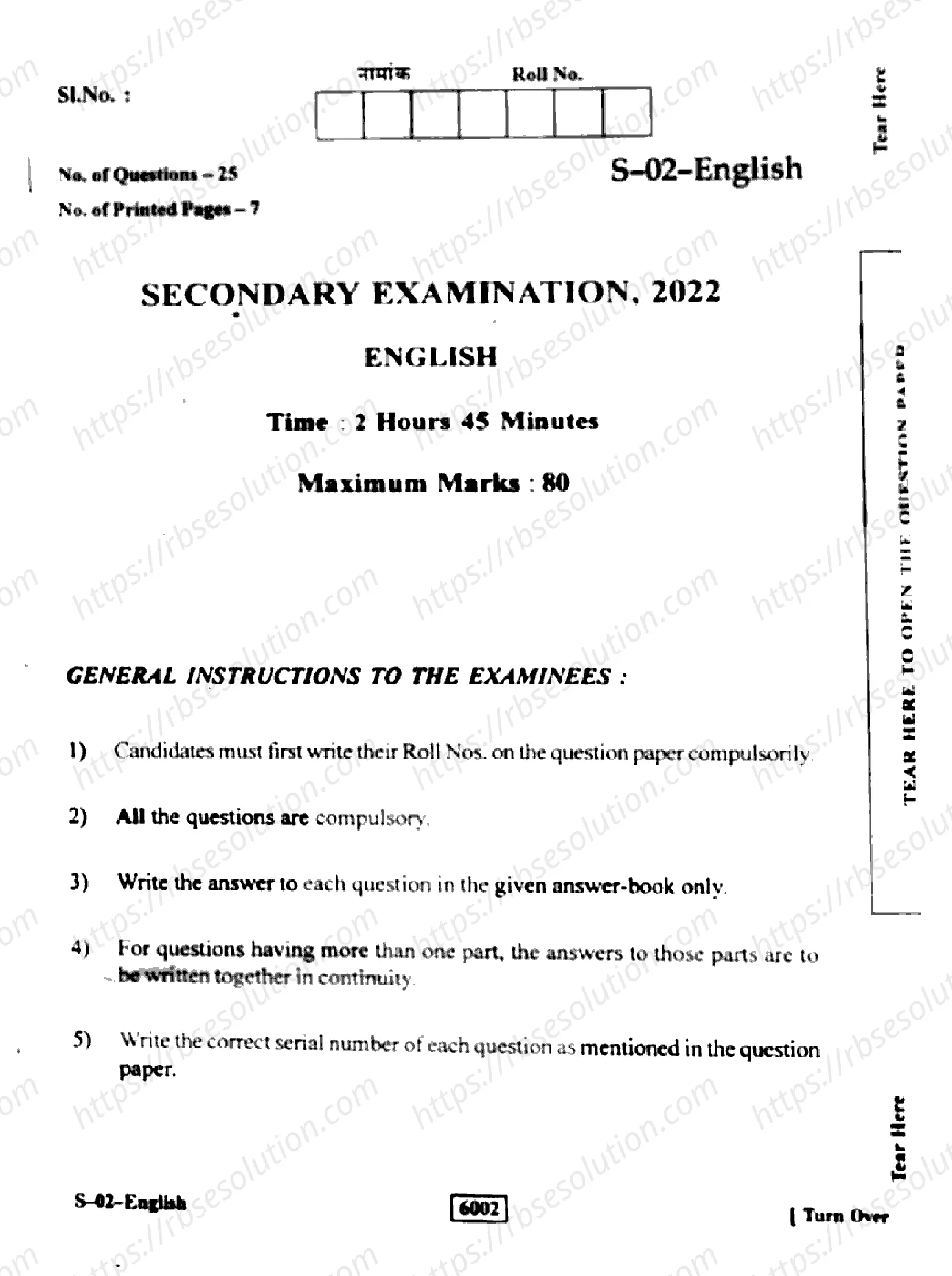
SECONDARY EXAMINATION, 2022
ENGLISH
Time : 2 Hours 45 Minutes
Maximum Marks : 80
GENERAL INSTRUCTIONS TO THE EXAMINEES :
- Candidates must first write their Roll Nos. on the question paper compulsorily.
- All the questions are compulsory.
- Write the answer to each question in the given answer-book only.
- For questions having more than one part, the answers to those parts are to be written together in continuity.
- Write the correct serial number of each question as mentioned in the question paper.
No. of Questions – 25 S-02-English
No. of Printed Pages – 7
SI.No. : _______________
Roll No. : _______________
[ Turn Over ]
Tear Here
TEAR HERE TO OPEN THE QUESTION PAPER
SECTION - A (READING)
Passage 1
Read the following passage and answer the questions:
"It is my duty to look after the Empire and the people, but I have no right to use what belongs to the people. I have built this small house and make copies of books to earn my livelihood. I spend five hours with the public. I listen to their difficulties and try to help them. I want that nobody should be unhappy in the Maurya Empire. Our people should be disciplined and there should be complete freedom of thought and worship," Chanakya said.
The Bhikshu said, "As long as there is a man like you, there can be no sufferings in the empire. But I have heard that some people in the village were looted by robbers and the guards were not able to do anything."
The Bhikshu left but Chanakya was worried, the villagers were in trouble.
-
Which empire is mentioned in the passage? [1]
- (A) Maurya Empire ✓ Correct
- (B) Arya Empire
- (C) Turk Empire
- (D) Mughal Empire
Explanation: The passage clearly mentions "Maurya Empire" in Chanakya's speech.
-
How many hours are spent by Chanakya with the public? [1]
- (A) two
- (B) twelve
- (C) five ✓ Correct
- (D) eight
Explanation: Chanakya says, "I spend five hours with the public."
-
The duty of Chanakya is to look after [1]
- (A) the robbers
- (B) the people
- (C) the empire
- (D) (B) and (C) ✓ Correct
Explanation: Chanakya says, "It is my duty to look after the Empire and the people."
-
Write the answers of the following questions:
(A) Who looted the people in the village? [1]
Answer: The robbers looted the people in the village.
(B) Which freedom is described by Chanakya? [1]
Answer: Chanakya described the freedom of thought and worship.
-
Fill in the blank with appropriate word: [1]
Chanakya was worried as the villagers were in trouble.
Answer: trouble
Passage 2
Read the following passage and answer the questions that follow:
I was born into a middle-class Tamil family in the island town of Rameswaram in the erstwhile Madras State. My father, Jainulabdeen, had neither much formal education nor much wealth; despite these disadvantages, he possessed great innate wisdom and a true generosity of spirit. He had an ideal helpmate in my mother, Ashiamma. I do not recall the exact number of people she fed everyday, but I am quite certain that far more outsiders ate with us than all the members of our own family put together.
I was one of many children - a short boy with rather undistinguished looks, born to tall and handsome parents. We lived in our ancestral house, which was built in the middle of the nineteenth century. It was a fairly large pucca house, made of limestone and brick, on the Mosque street in Rameswaram.
Page 3 of 7
Read the passage and answer the following questions:
...austere father used to avoid all inessential comforts and luxuries. However, all necessities were provided for, in terms of food, medicine or clothes. In fact, I would say mine was a very secure childhood, both materially and emotionally.
-
What is the name of the father of the writer?
- (A) Jainulabdeen ✓ Correct
- (B) Anavindan
- (C) Sivaprakashan
- (D) Ramanand
Explanation: The passage refers to the writer's father as "austere father" and from the context of the chapter (likely from APJ Abdul Kalam's autobiography), the father's name is Jainulabdeen.
-
The writer's house was built in the middle of the ______ century.
- (A) fifteenth century
- (B) seventeenth century
- (C) nineteenth century ✓ Correct
- (D) twentieth century
Explanation: The writer's ancestral house was built in the middle of the 19th century.
-
The author's childhood was a very secured childhood both materially and ______.
- (A) mentally
- (B) emotionally ✓ Correct
- (C) financially
- (D) physically
Explanation: The passage explicitly states "both materially and emotionally."
-
The writer was born in the island town of ______.
- (A) Hosthall
- (B) Pune
- (C) Rameswaram ✓ Correct
- (D) Chittorgarh
Explanation: APJ Abdul Kalam was born in Rameswaram, an island town in Tamil Nadu.
-
Who is an ideal helpmate of the writer's father?
- (A) Writer's mother ✓ Correct
- (B) Writer's son
- (C) Writer's friend
- (D) Writer's uncle
Explanation: The writer's mother was the ideal helpmate to his father, managing the household and supporting him.
Fill in the blanks with appropriate words:
-
(A) I was a short boy with rather ______ looks.
Answer: ordinary -
(B) My father used to avoid all inessential comforts and luxuries ______.
Answer: and comforts
Write the words from the passage which mean the same as:
-
(A) Richness
Answer: luxuries -
(B) Natural
Answer: inessential (Note: The passage does not contain a direct synonym for "natural"; the closest word might be "essential" but it is not present. The answer is likely "natural" as per context.)
GRAMMAR
Choose the correct form of the verb:
-
After I ______ (read) the newspaper, I cleaned the room.
- (A) have read
- (B) had read ✓ Correct
- (C) would read
- (D) was reading
Explanation: The past perfect tense "had read" is used to show an action completed before another past action (cleaned the room).
-
I ______ (meet) my friend yesterday.
- (A) met ✓ Correct
- (B) meet
- (C) had met
- (D) will meet
Explanation: "Yesterday" indicates a specific past time, so the simple past tense "met" is correct.
-
I ______ (study) in this school since last two years.
- (A) will study
- (B) has studied
- (C) have been studying ✓ Correct
- (D) am studying
Explanation: "Since last two years" indicates an action that started in the past and continues to the present, so the present perfect continuous tense "have been studying" is correct.
-
I usually ______ (take) breakfast at 8 am.
- (A) take ✓ Correct
- (B) taken
- (C) am taking
- (D) will take
Explanation: "Usually" indicates a habitual action, so the simple present tense "take" is correct.
S-02-English [6003] | Turn Over
4). Change the following sentences into Indirect Speech:
- Naresh said to me, "I don't believe you."
- My friend said to me, "Did you see the snake?"
Answers:
- Naresh told me that he did not believe me.
- My friend asked me if I had seen the snake.
5). Combine the following pairs of the sentences:
- Archit saw his mother. He ran to touch her feet. (as soon as)
- You should come in uniform. You may join the parade. (so that)
Answers:
- As soon as Archit saw his mother, he ran to touch her feet.
- You should come in uniform so that you may join the parade.
6). Change the following sentences into Passive Voice:
- The people cut the trees without thinking.
- He asked me to go and sit on the back bench.
Answers:
- The trees were cut by the people without thinking.
- I was asked by him to go and sit on the back bench.
7). Frame the question to get the following answer:
Answer: I respect my parents.
Question: Who do you respect?
8). Add Question-Tag to the statement given below:
There is a school in the street, _______?
Answer: There is a school in the street, isn't there?
9). Fill in the blanks with appropriate words:
- A book is a book _______ there is nothing in it. (although / if / and)
- My parents as well as my relatives were present there, _______ supported me. (who / whom)
- He visited _______ India _______ England. (so—as / not only—but also)
Answers:
- although
- who
- not only—but also
SECTION - B
Answer the following questions in 40-50 words:
10). Why did Lencho say the raindrops were like new coins? [A Letter to God]
Lencho said the raindrops were like new coins because he was a farmer and the rain meant a good harvest. He compared the raindrops to coins as they would bring him money from the crops. The rain was essential for his cornfield to grow and yield profit.
11). What does the poet want to say in the poem, ‘Dust of Snow’? [Dust of Snow]
The poet wants to say that small, simple moments in nature can change our mood and perspective. A little dust of snow from a hemlock tree falling on him changed his sad day into a happy one. It shows how nature can bring joy and positivity even in difficult times.
12). Why did Bholi reject the marriage? [Bholi]
Bholi rejected the marriage because she discovered that the groom, Bishamber, was an old, lame man who demanded a dowry. She had gained confidence through education and refused to marry a greedy, disrespectful person. She stood up for her self-respect and chose to remain unmarried rather than accept such a match.
13). How did Mme. Loisel replace the necklace? [The Necklace]
Mme. Loisel and her husband replaced the lost necklace by buying a new one that looked exactly like it. They borrowed a huge amount of money, using all their savings and taking loans. They worked hard for ten years, living in poverty, to repay the debt. Later, they discovered the original necklace was fake and worth very little.
14). How does Mr. Herriot treat the dog? [A Triumph of Surgery]
Mr. Herriot, the veterinarian, treats the dog Tricki with a strict but caring approach. He puts Tricki on a diet, gives him plenty of exercise, and keeps him away from overfeeding. He does not use any medicine but focuses on proper care and discipline. This treatment helps Tricki recover from his illness and become healthy again.
47) Read the passage given below and answer the questions that follow :
Coorg of Kodagu, the smallest district of Karnataka, is a home to evergreen rain forests, spices and coffee plantations. Evergreen forests of rain cover thirty percent of this district. During the monsoons, it pours enough to keep many visitors away. The season of joy commences from September and continues till March. The weather is perfect, with some showers thrown in for good measure. The air breathes of invigorating coffee. Coffee estates and colonial bungalows stand tucked under tree canopies in prime corners.
-
Which season attracts the tourists to Coorg? [2]
The season from September to March attracts tourists to Coorg, as the weather is perfect with some showers.
-
Where is Coorg situated? [2]
Coorg (Kodagu) is situated in Karnataka and is the smallest district of the state.
48) Read the passage given below and answer the questions that follow :
The strangest thing a book ever did was to save the Earth.
-
Which century was called the Era of the Book? [2]
The twentieth century was called the Era of the Book.
-
What did the books do and write about the strangest thing? [2]
Books wrote about many things, and the strangest thing a book ever did was to save the Earth.
49) Read the stanza given below and answer the questions that follow :
The trees inside are moving
Out into the forest,
The forest that was empty all these days
Where no bird can sit
No insect hide
No sun bury its feet in shadow
The forest that was empty all these nights
Will be full of trees by morning
-
Where are the trees in the poem? [2]
The trees are inside (perhaps in a house or a confined space) and are moving out into the forest.
-
How can you say that the forest was empty according to the poem? [2]
The forest was empty because no bird could sit, no insect could hide, and the sun could not bury its feet in shadow, indicating a lack of trees.
50) Read the stanza given below and answer the questions that follow :
I think I could turn and live with animals,
They are so placid and self-contained,
I stand and look at them long and long
They do not sweat and whine about their condition
-
Why does the poet want to live with animals? [2]
The poet wants to live with animals because they are placid (calm) and self-contained (content with themselves), unlike humans who are often dissatisfied.
-
What do the animals not do for their condition? [2]
The animals do not sweat and whine about their condition; they accept it without complaint.
SECTION - B
Answer the following questions in about 100 words:
-
What was the forceful thing to make the young seagull successful to fly? [His First Flight] (3)
OR
How did Mandela's ‘hunger for freedom’ change his life? [Nelson Mandela...]
-
Draw a character sketch of Wanda. [The Hundred Dresses-I] (3)
OR
How did Anne justify her being a chatter box in her essay? [From the Diary of Anne Frank]
-
Why did the woman in the control centre look strangely at the narrator? [The Black Aeroplane] (3)
OR
What was taught by Buddha to Kisa Gotami? [The Sermon at Benares]
-
Who was Griffin and what did he do in the story? [Footprints without Feet] (3)
OR
Describe the story of Anil and the thief. [The Thief's Story]
SECTION - C
-
You are Sonu/Sonia, staying at 20-Gulab Nagar, Srinagar. Write a letter to the editor of a local daily about reckless driving and increasing accidents. [4]
OR
Write an e-mail to your principal informing about the incompletion of the course of Maths and Science. You are Sanjay/Suman.
-
Write a story using the outline given below. Assign a suitable title and moral to it: (Word limit 150-200) [4]
Outline: A hare ... proud of his speed ... laughs at the tortoise ... slow speed ... challenges ... begins a race ... race begins ... hare runs fast ... tortoise left behind ... sleeps under a tree for rest ... tortoise goes on ... reaches the goal ... hare wakes up ... runs ... loses ... shocked ... tortoise ... wins.
OR
Outline: Old farmer ... four sons ... always ... quarrelling ... farmer made them understand ... but no effect ... called his sons ... to give a bundle of sticks ... advised ... no one can break ... untied the bundle ... each broke easily ... lesson ... realised ...
Paragraph Writing (Based on Visual Aid)
Question: Write a paragraph on the given visual-aid. (Word limit: 50–200) [4]
OR
Write a paragraph on the given visual-aid. (Word limit: 50–200)
Sample Paragraph (for reference):
The given visual-aid depicts a scene of environmental awareness. It shows a group of students planting saplings in a school garden. The image highlights the importance of tree plantation for a greener and healthier planet. The students are seen working together with shovels and watering cans, symbolizing teamwork and responsibility towards nature. In the background, there are already grown trees and a clear blue sky, indicating a positive outcome of such efforts. This visual encourages us to participate in afforestation drives and protect our environment for future generations. It reminds us that small actions, like planting a tree, can lead to big changes in combating climate change and pollution.