
RBSE Class 10th 2023 English-S-02-2023 Previous Year Papers
You opened the RBSE Class 10th 2023 English-S-02-2023 Previous Year Papers page — a focused place to read the real previous year question paper for that subject and year. RBSE Solution keeps exam-year sets together so you can practise the same cycle your seniors faced.
Previous year papers reward patience: read instructions, note mark distribution, then attempt questions before peeking at solutions elsewhere on the site. This URL always loads the same free previous year papers content for English-S-02-2023 (2023).
Use the details table to confirm class and year, then scroll to the paper images or PDF below. More subjects from 2023 are linked later on this page.
Paper details
Quick reference for this previous year papers page — confirm board, class, and year & subject before you study.
| Board | RBSE |
|---|---|
| Class | Class 10th |
| Exam year | 2023 |
| Subject | English-S-02-2023 |
| Resource type | Previous Year Papers |
| Category | RBSE Previous Year Question Papers |
| Website | RBSE Solution |
The table summarises this Previous Year Papers resource. Confirm RBSE, Class 10th, year 2023, and subject English-S-02-2023 before studying.
RBSE Solution organises previous year papers so each URL carries chapter-specific guidance — better for students and for search engines than one generic paragraph for the whole class.
How to practise with this question paper
Stage one: read the English-S-02-2023 question paper from 2023 without a timer and highlight command words — explain, prove, calculate, discuss. Stage two: attempt selected questions closed-book. Stage three: compare with solutions or teacher feedback.
Previous Year Papers work best when you log mistakes by topic, not only by question number. That log becomes your revision index before pre-boards.
RBSE Class 10th 2023 English-S-02-2023
Scroll through the Previous Year Papers pages for English-S-02-2023 (2023).
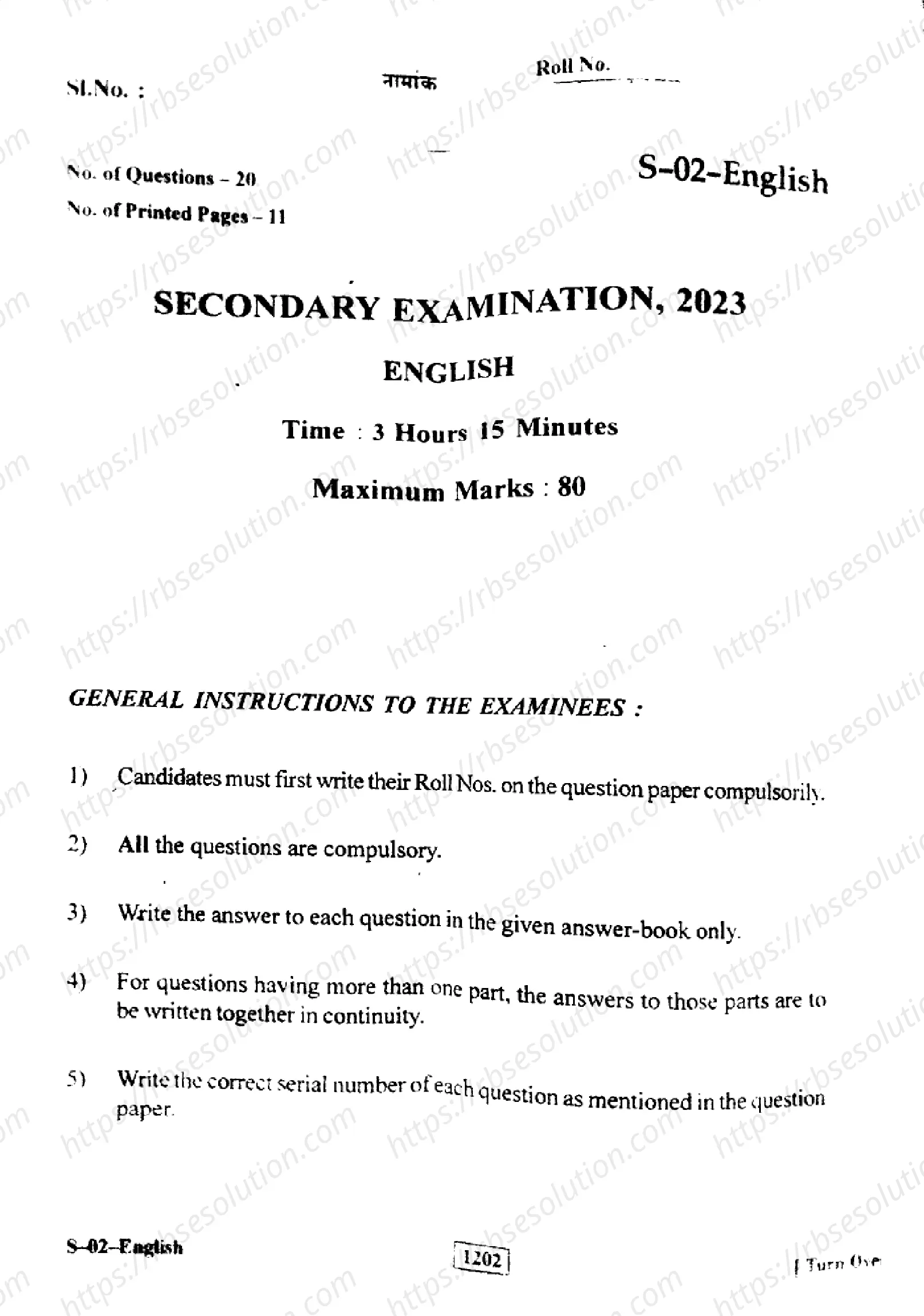


Rajasthan Board Class 10th English-S-02-2023 2023 solved Previous Year Question Papers
SECONDARY EXAMINATION, 2023
ENGLISH
Time: 3 Hours 15 Minutes
Maximum Marks: 80
GENERAL INSTRUCTIONS TO THE EXAMINEES:
- Candidates must first write their Roll Nos. on the question paper compulsorily.
- All the questions are compulsory.
- Write the answer to each question in the given answer-book only.
- For questions having more than one part, the answers to those parts are to be written together in continuity.
- Write the correct serial number of each question as mentioned in the question paper.
Page content could not be transcribed.
Read the following passage and answer the questions that follow:
The people of Gujarat were mostly farmers. They reared cattle but remained poor, despite their hard work, they always remained in want. The poor plight of these farmers moved the heart of the Iron Man of India, Sardar Vallabhbhai Patel. He was determined to bring prosperity into their lives. So, he decided to organise them into a co-operative force and provide them with a steady source of income. This task was assigned to Mr. Tribhuvandas Patel. He united the disorganised farmers and started a co-operative dairy unit. This system of co-operative effort eliminated the middlemen who harassed and exploited the ignorant farmers.
-
Who was determined to bring prosperity into Gujarat farmers’ lives?
- (A) Mr. Tribhuvandas
- (B) British dairy
- (C) Sardar Vallabhbhai Patel
- (D) Government
Explanation: The passage clearly states that Sardar Vallabhbhai Patel was determined to bring prosperity into the lives of Gujarat farmers.
-
What was started by Tribhuvandas Patel?
- (A) Co-operative dairy unit
- (B) Farming
- (C) Industry
- (D) None of them
Explanation: According to the passage, Tribhuvandas Patel started a co-operative dairy unit.
-
What did the system of co-operative effort do?
The system of co-operative effort eliminated the middlemen who harassed and exploited the ignorant farmers.
-
Why did the heart of the Iron Man of India move?
The heart of the Iron Man of India moved because of the poor plight of the farmers of Gujarat, who despite their hard work remained poor and always in want.
-
Find a similar word of the following from the passage: Removed!
The word "eliminated" in the passage means "removed".
-
Write the opposite word of the following from the passage: Sotttan
The opposite of "ignorant" (likely intended word) is "educated" or "knowledgeable". However, from the passage, the opposite of "poor" (implied by context) is "prosperity" or "rich". The passage uses "prosperity" as a positive state.
Read the following passage and answer the questions that follow:
At the age of six, Bismillah Khan moved to Varanasi (earlier known as Banaras), where his maternal uncle, Ali Baksh 'Vilayatu' was the official Shehnai player at the famous Vishwanath Temple. Ali Baksh noticed that Bismillah was a keen music learner, so he took him under his tutelage. Thus Bismillah Khan started to play the 'Shehnai' from his uncle. Ali Baksh played 'Shehnai' at the Vishwanath Temple and practised in one of the temple rooms at Balaji Ghat. Bismillah Khan's routine was to follow his uncle the whole day to both the temples, and practise for hours together - without any play time, school and sometimes even regular meals.
Bismillah Khan religiously practised the 'Shehnai' and attained perfection in a very short time. The flowing waters of the River Ganga inspired him to improvise and invent 'ragas' that were earlier considered to be beyond the range of 'Shehnai'. He often played the 'Shehnai' at the Vishwanath Temple on the banks of River Ganga. He was also a devotee of Saraswati, the Hindu goddess of wisdom and arts.
Ustad Bismillah Khan was perhaps single-handedly responsible for making the 'Shehnai' a famous and popular musical instrument and bringing it into the mainstream Indian classical music. His concert at the All India Music Conference (1937) in Calcutta brought 'Shehnai' into the limelight, and was hugely appreciated by music lovers.
Questions:
-
Varanasi earlier known as:
- (A) Prayag
- (B) Varanas
- (C) Kaushal
- (D) Banaras
Explanation: The passage states that Varanasi was earlier known as Banaras.
-
Who was the official Shehnai player at the famous Vishwanath Temple?
- (A) Ustad Bismillah Khan
- (B) Ali Baksh
- (C) Paigambar Khan
- (D) Mitthan
Explanation: The passage mentions that Ali Baksh 'Vilayatu' was the official Shehnai player at the Vishwanath Temple.
4.
Read the passage and answer the following questions:
(iii) At the age of ____, Bismillah Khan moved to Varanasi.
- (A) six
- (B) eight
- (C) seven
- (D) eight
Explanation: The passage states that Bismillah Khan moved to Varanasi at the age of seven.
(iv) Who was Ali Baksh 'Vilayati'?
Ali Baksh 'Vilayati' was Bismillah Khan's maternal grandfather (or a famous shehnai player from the passage).
(v) What inspired Bismillah Khan to improvise and invent 'ragas'?
The passage mentions that the river Ganga (or the natural surroundings of Varanasi) inspired Bismillah Khan to improvise and invent new ragas.
(vi) What do you know about Saraswati on the basis of the passage?
Saraswati is the goddess of learning and music, as mentioned in the passage.
(vii) Write the similar word of the following from the passage: 'Guardianship'
The similar word for 'guardianship' in the passage is custody (or a synonym like 'care' if present).
(viii) Write the opposite word of the following from the passage: 'dull'
The opposite word for 'dull' in the passage is bright (or 'sharp' if present).
SECTION - B (WRITING)
5.
Imagine that you are Sachin/Sakshi. Your sister's marriage will be held next month. Write a letter to your friend Vivek/Vaishnavi to invite him/her on this occasion.
OR
You are Ajay/Anita, studying in Govt. S.B. School Chomu (Jaipur) in X class Section A. Your sister is also studying in the same school in X class Section B. You have only one set of books. There is a problem to change books after every period. Write an application to your principal requesting him to change either your section or your sister's section.
6.
Write a story with the help of given outlines in about 80 words. Give the title and moral to it.
Outlines: A capseller sells caps. He soon falls asleep. Monkeys on the tree take caps. Capseller awakes, missing caps. Each monkey wears a cap. Capseller throws his cap. Monkeys throw caps. Capseller collects caps. He goes away.
Title: The Capseller and the Monkeys
Moral: Presence of mind can solve any problem.
OR
Outlines: A hungry fox sees a crow with a piece of bread. The fox wants the bread. The fox tells the crow to sing a sweet song. The crow opens its mouth. The bit of bread falls down. The fox takes the bread and runs away.
Title: The Fox and the Crow
Moral: Do not trust flatterers.
SECTION - C (GRAMMAR)
Choose the correct form of the verbs:
- Once there (be) a king.
- (A) be
- (B) was ✓ Correct
- (C) are
- (D) were
Explanation: The sentence refers to a past event ("once"), so the past tense "was" is correct. "Was" is used with singular subjects like "a king."
[4]
[ Turn Over ]
Question 1: Fill in the blanks with the correct option.
(i) Ram always ____.
- (A) attends
- (B) is attending
- (C) are attending
- (D) tend
Correct Answer: (A) attends
Explanation: The sentence uses "always" which indicates a habitual action, so the simple present tense "attends" is correct.
(ii) We had gone to our house before father ____.
- (A) had come
- (B) have come
- (C) came
- (D) comes
Correct Answer: (C) came
Explanation: The past perfect tense "had gone" is used for the earlier action, and the simple past tense "came" is used for the later action.
(iii) He ____ here since 1st January, 2020.
- (A) had lived
- (B) have lived
- (C) has lived
- (D) has been living
Correct Answer: (D) has been living
Explanation: "Since" indicates a point in time in the past continuing to the present, so the present perfect continuous tense "has been living" is appropriate.
Question 2: Change the following sentences into Indirect speech.
(i) He said to me, "Please give me your pen."
Answer: He requested me to give him my pen.
Explanation: The reporting verb "said to" changes to "requested" because the sentence is a request. The pronoun "me" changes to "him" and "your" changes to "my".
(ii) He said to me, "Where are you going?"
Answer: He asked me where I was going.
Explanation: The reporting verb "said to" changes to "asked" for a question. The question word "where" remains. The pronoun "you" changes to "I" and the verb "are going" changes to "was going" (past tense).
Question 3: Rewrite the following sentences using connectives given in the brackets.
(i) He is a teacher. He is a writer. (not only – but also)
Answer: He is not only a teacher but also a writer.
Explanation: The connective "not only – but also" is used to join two similar ideas, emphasizing both.
(ii) Ram is my friend. Shyam is my friend. (both – and)
Answer: Both Ram and Shyam are my friends.
Explanation: The connective "both – and" is used to join two subjects, making the verb plural.
(iii) Ramu is a thief. Shyamu is a thief. (either – or)
Answer: Either Ramu or Shyamu is a thief.
Explanation: The connective "either – or" is used to present two alternatives, and the verb agrees with the subject closest to it (Shyamu is singular).
Join the following sentences using the relative pronoun given in the brackets:
- The book which has a white wrapper is on the table.
- You met the man yesterday whom was my father.
Change the following sentences into passive voice:
- Cricket will be played by Pratibha tomorrow.
- A house has been built by them.
Frame a question of the following sentence:
He is going to Jaipur today.
Where is he going today?
Add a question tag to the statement given below:
Ram will play cricket, won't he?
SECTION - D (TEXT BOOK)
Read the passage given below and answer the questions that follow:
The young seagull was alone on his ledge. His two brothers and his sister had already flown away the day before. He had been afraid to fly with them. Somehow when he had taken a little run forward to the brink of the ledge and attempted to flap his wings he became afraid. The great expanse of sea stretched down beneath, and it was such a long way down - miles down. He felt certain that his wings would never support him; so he bent his head and ran away back to the little hole under the ledge where he slept at night.
i) How many brothers and sisters did the young seagull have?
- (A) two brothers and one sister
- (B) two brothers and two sisters
- (C) one brother and two sisters
- (D) one brother and one sister
Explanation: The passage states, "His two brothers and his sister had already flown away," meaning he had two brothers and one sister.
Read the following passage and answer the questions that follow:
There was a girl named Valliammai who was called Valli for short. She was eight years old and very curious about things. Her favourite pastime was standing in the front doorway of her house, watching what was happening in the street outside. There were no playmates of her own age on her street, and this was about all she had to do. But for Valli, standing at the front door was every bit as enjoyable as any of the elaborate games other children played. Watching the street gave her many new unusual experiences.
Questions:
-
i) Who had been afraid?
- (A) Seagull's brothers
- (B) Seagull's sisters
- (C) Seagull's sister
- (D) Young seagull
Explanation: In the story "His First Flight," the young seagull was afraid to fly, while his brothers and sisters had already flown.
-
ii) Who had already flown away the day before?
The young seagull's brothers and sisters had already flown away the day before.
-
iii) Where did the young seagull run away back?
The young seagull ran away back to his ledge (the narrow shelf on the cliff face where he was born).
-
iv) Find out the word from the passage which means: 'edge'
The word is "ledge".
-
v) Find out the word from the passage which has opposite meaning of 'fearless'
The opposite word is "afraid".
-
vi) What was the short name of the girl?
- (A) Valliammai
- (B) Valli
- (C) Sweet girl
- (D) Amma
Explanation: The passage clearly states, "There was a girl named Valliammai who was called Valli for short."
Page 9 of 11
Questions from the Passage
-
i) What was the age of Valli?
- (A) fourteen
- (B) eight
- (C) eight
- (D) seven
Correct Answer: (B) eight
Explanation: The passage states that Valli was eight years old.
-
ii) Why did Valliammai not play with her playmates?
Valliammai did not play with her playmates because she was deeply fascinated by the bus that passed through her street every day. She spent most of her time watching the bus and dreaming about riding it, which made her uninterested in playing with other children.
-
iv) What was Valliammai's favourite pastime?
Valliammai's favourite pastime was standing at the front door of her house and watching the bus that passed by every hour. She would observe the bus and its passengers with great curiosity and excitement.
-
२) Write the similar word of the following, from the passage: 'anterior'
Answer: The similar word for 'anterior' from the passage is 'previous' or 'earlier' (depending on the context in the passage).
-
vi) Write the opposite word of the following, from the passage: 'usual'
Answer: The opposite word for 'usual' from the passage is 'unusual' or 'strange' (depending on the context in the passage).
4) Answer any one of the following questions in about 80 words: [5]
Why does the postmaster send money to Lencho? Why does he sign the letter 'God'? [A Letter to God]
The postmaster sends money to Lencho because he is deeply moved by Lencho's unwavering faith in God. Lencho had written a letter to God asking for 100 pesos after his crop was destroyed by a hailstorm. The postmaster, wanting to preserve Lencho's faith, collects money from his employees and contributes part of his own salary. He signs the letter as 'God' because Lencho had addressed the letter to God, and the postmaster wants to maintain the illusion that God himself has answered Lencho's prayer. This act shows the postmaster's kindness and his desire to not break Lencho's innocent faith.
OR
Why is Maddie embarrassed by the questions Peggy asks Wanda? Is she also like Wanda, or is she different? [The Hundred Dresses - I]
Maddie is embarrassed by Peggy's questions because she knows that Wanda is poor and cannot afford new dresses. Peggy repeatedly asks Wanda about her hundred dresses, which is a cruel way to mock her. Maddie feels guilty but is too afraid to stand up to Peggy. Maddie is different from Wanda because she is not poor like Wanda, but she is also different from Peggy because she feels sympathy for Wanda and is ashamed of the teasing. However, Maddie is similar to Wanda in that she is also an outsider in some ways, as she is poor herself and fears becoming the next target of Peggy's teasing.
5) Answer any one of the following questions in about 20 words: [2]
Draw a character sketch of Natalya. [The Proposal]
Natalya is a young, argumentative, and proud woman. She is quick-tempered and loves to quarrel over trivial matters, especially about land and dogs. Despite this, she is also eager to get married.
OR
Can you now imagine what these characters will quarrel about next? [The Proposal]
After their marriage, Lomov and Natalya will likely quarrel about household matters, such as who will manage the house, how to spend money, or even about trivial things like whose relatives are better.
[203] S—02—English [2] [Turn Over
Read any one of the following extracts and answer the questions that follow:
Extract 1:
But if it had to perish twice,
I think I know enough of hate
To say that for destruction
Ice is also great
- Write rhyme scheme and rhyming words.
- Which thing is also great for destruction?
OR
I am an orphan, roaming the street.
I pattern soft dust with my hushed, bare feet.
The silence is golden, the freedom is sweet.
- Write the rhyme scheme and rhyming words.
- What is golden and what is sweet?
Answer any two of the following questions in about 20 words: (2×2=4)
- What colour is the young woman's hair? What does she say she can change it to? (For Anne Gregory)
- Why is the boy very upset? (The Ball Poem)
- Why does the poet tell us that he feels more at home with animals than humans? (Animals)
Solutions (for reference):
Extract 1:
- Rhyme scheme: abab (twice – hate – ice – great). Rhyming words: twice/ice, hate/great.
- Ice is also great for destruction.
OR (Extract 2):
- Rhyme scheme: aaa (street – feet – sweet). Rhyming words: street/feet/sweet.
- Silence is golden and freedom is sweet.
Short answers (any two):
- The young woman's hair is yellow (or gold). She says she can change it to black, brown, or red.
- The boy is very upset because he has lost his ball, which was precious to him and cannot be replaced.
- The poet feels more at home with animals because they are honest, calm, and do not complain or pretend like humans.
Choose the correct answer:
-
____ is the writer of ‘The Necklace’.
- (A) H.G. Wells
- (B) Guy De Maupassant
- (C) Ruskin Bond
- (D) Victor Canning
Explanation: ‘The Necklace’ is a famous short story written by French author Guy de Maupassant.
-
Name the book that saved the Earth.
- (A) Mother Goose
- (B) Mother Mary
- (C) Mother Poem
- (D) Mother Teresa
Explanation: In the play ‘The Book that Saved the Earth’, the book ‘Mother Goose’ saves Earth from an alien invasion.
Answer any one of the following questions in about 60 words: [1×4=4]
-
With what do Mr. and Mme. Loisel replace ‘the necklace’? [The Necklace]
Mr. and Mme. Loisel replace the lost necklace with a new one that looks exactly like the original. They buy it from a jewelry shop for thirty-six thousand francs. To afford this, they use all their savings, borrow money, and spend the next ten years working hard to repay the debt.
-
Who helped the narrator? Why did narrator arrive at New Mullion? [The Hack Driver]
The hack driver, Bill, helped the narrator. The narrator arrived at New Mullion to serve a summons on Oliver Lutkins. He was a junior lawyer clerk sent by his firm to find Lutkins. Bill pretended to help him but actually tricked him, as Bill himself was Lutkins in disguise.
Answer any two out of three following questions in about 20 words: [2×2=4]
-
What was Ebright's project? [The Making of a Scientist]
Ebright's project was to find out why monarch butterflies have more gold spots on their pupa than others. He discovered that these spots produce a hormone necessary for full development.
-
Why was Bholi glad and what did she hope? [Bholi]
Bholi was glad because she was going to school. She hoped that she would learn to read and write, and that her life would change for the better.
-
Who surged round the narrator? [A Triumph of Surgery]
Mrs. Pumphrey and her servants surged round the narrator (the veterinary surgeon) when he returned Tricki to her. They were overjoyed to see the dog healthy again.