
RBSE Class 10th 2024 English-S-02-2024 Previous Year Papers
Class 10th students hunting authentic previous year papers for English-S-02-2024 (2024) land here for a reason: the paper below matches how RBSE assessments are remembered from that year. RBSE Solution does not mix years on one page; each combination gets its own notes.
Skim the overview sections, then work through the scanned pages. Pair this practice with RBSE books and solutions when you need to relearn a concept a question exposed.
Paper details
Quick reference for this previous year papers page — confirm board, class, and year & subject before you study.
| Board | RBSE |
|---|---|
| Class | Class 10th |
| Exam year | 2024 |
| Subject | English-S-02-2024 |
| Resource type | Previous Year Papers |
| Category | RBSE Previous Year Question Papers |
| Website | RBSE Solution |
The table summarises this Previous Year Papers resource. Confirm RBSE, Class 10th, year 2024, and subject English-S-02-2024 before studying.
RBSE Solution organises previous year papers so each URL carries chapter-specific guidance — better for students and for search engines than one generic paragraph for the whole class.
How to practise with this question paper
Stage one: read the English-S-02-2024 question paper from 2024 without a timer and highlight command words — explain, prove, calculate, discuss. Stage two: attempt selected questions closed-book. Stage three: compare with solutions or teacher feedback.
Previous Year Papers work best when you log mistakes by topic, not only by question number. That log becomes your revision index before pre-boards.
RBSE Class 10th 2024 English-S-02-2024
Scroll through the Previous Year Papers pages for English-S-02-2024 (2024).


Rajasthan Board Class 10th English-S-02-2024 2024 solved Previous Year Question Papers
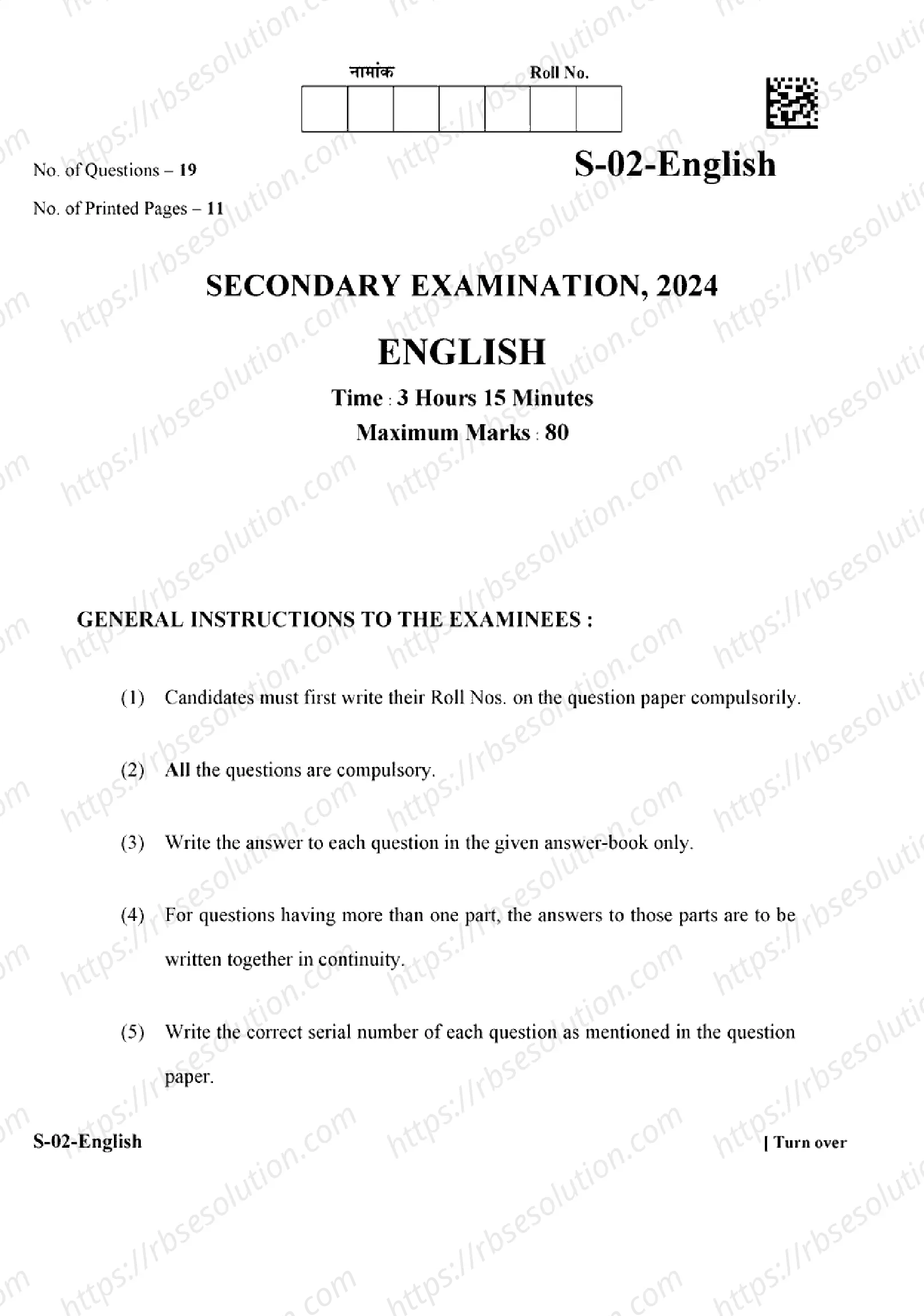
नामांक / Roll No.
मा
No. of Questions – 19 S-02-English
No. of Printed Pages – 1
SECONDARY EXAMINATION, 2024
ENGLISH
Time : 3 Hours 5 Minutes Maximum Marks : 80
GENERAL INSTRUCTIONS TO THE EXAMINEES :
- Candidates must first write their Roll Nos. on the question paper compulsorily.
- All the questions are compulsory.
- Write the answer to each question in the given answer-book only.
- For questions having more than one part, the answers to those parts are to be written together in continuity.
- Write the correct serial number of each question as mentioned in the question paper.
S-02-English | Turn over
Section—A (Reading)
Read the following passage and answer the questions that follow : 1×6=6
Dr. A.P.J. Kalam has three goals that he would like India to achieve. All the three goals are related to each other. Freedom and Independence will have real meaning if we develop economically. Economic development will help us to be strong and will make other countries respect us. But we the people of India are responsible for the development of our country and for making it one of the leading nations of the world. Each one of us needs to do whatever is necessary to make Dr. Kalam’s Vision come true. It is time to stop complaining about the problems in our country and to start doing something about them. We have learnt to evaluate and reflect on our contributions towards the development of India.
-
(i) Three goals for India are :
- (A) Freedom
- (B) Independence
- (C) Economic Development
- (D) All of these
Explanation: The passage states that Dr. Kalam has three goals: Freedom, Independence, and Economic Development, which are all related to each other.
-
(ii) Who has three goals to be achieved for India?
- (A) Public
- (B) Indians
- (C) Dr. A.P.J. Kalam
- (D) World
Explanation: The passage begins with "Dr. A.P.J. Kalam has three goals that he would like India to achieve."
-
(iii) What will help Indians to get respect of other countries?
- (A) Love for country
- (B) Economic Development
- (C) Responsibility
- (D) Individual Development
Explanation: The passage says, "Economic development will help us to be strong and will make other countries respect us."
-
(iv) Who is responsible for the development of India?
- (A) Government
- (B) Indians
- (C) Both
- (D) Prime Minister
Explanation: The passage clearly states, "But we the people of India are responsible for the development of our country."
Comprehension Questions (Based on Passage)
Question (v)
Choose the similar word of the following from the passage: ‘Power of Sight’
- (A) Necessary
- (B) Vision
- (C) Responsible
- (D) Reflect
Explanation: ‘Vision’ is the closest synonym for ‘Power of Sight’ as both refer to the ability to see.
Question (vi)
Choose the opposite word of the following from the passage: ‘Hinder’
- (A) Contribute
- (B) Problem
- (C) Disturb
- (D) Evaluate
Explanation: ‘Hinder’ means to obstruct or delay, while ‘Contribute’ means to help or add to, making it the opposite.
Passage for Question 2
I walked along the street of Delhi. I wondered what the history of my country meant to me. Here was a land where man had achieved greatness on every plane — Astronomy, Algebra, Architecture, even Poetry, Music and Art. Yet in this very city, where seven empires had come and gone, where Akbar and Ashoka ruled, I could not get a job and a boy like Shovan Lal had not been able to finish his schooling.
By 11 o'clock, I had walked eight miles. When I met Shovan Lal, Connaught Circus was nearly deserted.
“Hullo”, Shovan Lal said, greeting me in Hindi.
“Hullo” I replied as a few men around him moved aside to let me come to him.
“These are my friends”, Shovan Lal added waving his hand over the group.
“What do they have to say about my working with them here in Connaught Circus ?”
“Well”, Shovan Lal replied, pulling a face.
Question 2 (9 marks)
Read the following passage and answer the questions that follow:
Note: The questions for this passage are not provided in the given text. Based on the passage, typical questions might include:
- What achievements of India are mentioned in the passage?
- Why was the narrator unable to get a job?
- Describe the meeting between the narrator and Shovan Lal.
- What does the phrase “pulling a face” suggest about Shovan Lal’s feelings?
Sample Answer (for reference): The passage highlights India’s greatness in fields like Astronomy, Algebra, Architecture, Poetry, Music, and Art. The narrator contrasts this with his own unemployment and Shovan Lal’s incomplete education. The meeting at Connaught Circus shows Shovan Lal’s friends and his hesitant response (“pulling a face”) to the narrator’s question about working together.
Section - 4 (Reading Comprehension)
Read the passage and answer the following questions:
Just then one of the younger men started speaking very fast in a strange dialect I could not easily follow. This was taken up by an older man and in a few minutes four others joined in. When they stopped talking, Shovan Lal, who had been quiet all this time, translated for me.
-
(i) Where was the writer walking?
The passage does not provide information about where the writer was walking.
-
(ii) In which fields had the man on the earth got achievements?
The passage does not mention any achievements of a man on earth.
-
(iii) Where did the writer meet Shovan Lal?
The passage does not specify where the writer met Shovan Lal.
-
(iv) Who said “Hullo” to the writer?
The passage does not mention anyone saying "Hullo" to the writer.
-
(v) Whose friends are described in the passage?
The passage describes the friends of the writer (or the group the writer was with).
-
(vi) Who started speaking very fast?
One of the younger men started speaking very fast.
-
(vii) Who translated for the writer?
Shovan Lal translated for the writer.
-
(viii) Write the similar word of the following from the passage : ‘Wishing’.
The word 'Wishing' does not appear in the passage. No synonym can be found.
-
(ix) Write the opposite word of the following from the passage : ‘Stopped’.
The opposite word of 'Stopped' in the passage is 'started' (as in "started speaking").
Section - 5 (Writing)
Question: Write a letter or an application.
Option 1: Letter of Congratulations
Imagine you are Sushma/Param, living in Amritsar. Your sister has secured 95% in Board Examination. Write a letter of congratulations to her on this occasion.
Answer:
123, Street Name
Amritsar
Date: [Current Date]
Dear [Sister's Name],
I am overjoyed to hear that you have secured 95% in your Board Examination! This is a fantastic achievement and a testament to your hard work and dedication. I always knew you had it in you.
Your success has made our entire family proud. All your late nights and efforts have paid off wonderfully. I hope you celebrate this milestone and enjoy this moment of glory.
Keep shining and aiming higher. I am always here to support you.
With love and best wishes,
Sushma/Param
Option 2: Application for Board Fees
You are Siddhi/Siddharth, studying in X class, in G.S.8.S. Kota. You can’t afford board fees as your father is sick. Write an application to the Principal of your school to arrange your board fees as you are an intelligent student and do not want to waste one year of your education.
Answer:
To
The Principal
G.S.8.S. Kota
Subject: Application for arrangement of board examination fees
Respected Sir/Madam,
I am Siddhi/Siddharth, a student of Class X in your school. I am writing to humbly request your kind help regarding my board examination fees.
My father is seriously ill and is undergoing treatment. Due to this, our family is facing severe financial difficulties. I am unable to pay the board examination fees on my own. I have always been a sincere and intelligent student, and I do not want to waste this academic year.
I therefore request you to kindly arrange my board fees from the school's student welfare fund or any other source. I promise to work even harder and make the school proud.
Thanking you in anticipation.
Yours obediently,
Siddhi/Siddharth
Class X
Roll No. [Your Roll Number]
4. Write a story with the help of given outline in about 80 words. Give the title and moral to it.
Title: The Secret of Unity
A farmer had three sons. His sons were lazy and quarrelsome. One day, the farmer gave them a bundle of sticks. He asked each son to break the bundle, but none could. Then, he gave them single sticks, which they broke easily. The farmer told them, "Unity is strength. If you stay together, no one can harm you. If you quarrel and separate, you will be weak." The sons learnt a valuable lesson from the farmer. They stopped fighting and started working together.
Moral: Unity is strength.
OR
Title: The Hare and the Tortoise
A rabbit and a tortoise were friends. The tortoise was slow. They decided to run a race. The rabbit was very fast but overconfident. Halfway through the race, the rabbit had crossed a long distance. He thought he would easily win, so he stopped and slept under a tree. The tortoise continued walking slowly but steadily. The tortoise reached the final point while the rabbit was still sleeping. The rabbit lost the race, but the tortoise won the race.
Moral: Slow and steady wins the race.
5. Write a paragraph in about 80 words on the picture given below:
(Picture description not available in text. Based on common exam picture themes, a sample paragraph is provided.)
The picture shows a beautiful village scene. There are green fields and tall trees. A farmer is ploughing his field with the help of two oxen. Some children are playing near a small pond. Birds are flying in the blue sky. The sun is shining brightly. The village looks peaceful and clean. Everyone seems happy and busy in their work. This picture teaches us the importance of nature and hard work.
OR
Write a paragraph in about 80 words on ‘Annual Function of your school’.
The annual function of our school is a grand event. It is held every year in the month of December. The school is decorated with lights and flowers. Students participate in dances, songs, and plays. The chief guest gives away prizes to the winners. Parents and teachers enjoy the programme. It is a day of joy and celebration. I love the annual function because it brings everyone together and shows our talents.
Section - C (Grammar)
6. Fill in the blanks with appropriate forms of the verbs given in the brackets:
- The train had reached the station before I reached there. (reach)
- My mother always worships God in the morning. (worship)
- He has arrived at his destination by now. (arrive)
- I have been learning English since last year. (learn)
Explanation:
- (i) Past perfect tense is used for an action completed before another past action.
- (ii) Simple present tense for habitual action.
- (iii) Present perfect tense for action completed by now.
- (iv) Present perfect continuous tense for action starting in past and continuing.
7. Rewrite the following sentences changing them into Indirect Speech:
- The teacher said to the students, “You are good students.”
Answer: The teacher told the students that they were good students. - He said to me, “Did you read newspaper before going to school?”
Answer: He asked me if I had read newspaper before going to school.
Explanation: In indirect speech, the reporting verb changes, tense shifts back, and questions become statements with 'if' or 'whether'.
8. Fill in the blanks with a verb in agreement with its subject:
- Harry with his friends goes for a walk daily. (go/goes)
- Among all the students, he was different in his opinions. (was/were)
Explanation: (i) The subject 'Harry' is singular, so verb is singular 'goes'. (ii) 'He' is singular, so 'was' is correct.
9. Change the following sentences into Passive Voice:
- Do it.
Answer: Let it be done. - My mother gave me a beautiful gift.
Answer: A beautiful gift was given to me by my mother. / I was given a beautiful gift by my mother.
Explanation: Imperative sentences use 'let' in passive. For active with two objects, either object can become subject.
10. Frame question of the following sentence:
- God examines all.
Answer: Does God examine all?
Add Question Tag to the statement given below:
Students don’t waste their time.
Answer: Students don’t waste their time, do they?
Explanation: For negative statement, question tag is positive. The auxiliary 'do' is used with plural subject 'they'.
Section - D (Text Book)
11. Read the passage given below and answer the questions that follow : (1×6=6)
Her first journey — what careful, painstaking, elaborate plans, she had to make for it ! She had thriftily saved whatever stray coins came her way, resisting every temptation to buy peppermints, toys, balloons and the like and finally she had saved a total of sixty paise. How difficult it had been, particularly that day at the village fair but she had resolutely stifled a strong desire to ride the merry-go-round, even though she had the money.
After she had enough money saved, her next problem was how to slip out of the house without her mother’s knowledge. But she managed this without too much difficulty. Everyday after lunch her mother would nap from about one to four or so. Valli always used these hours for her ‘excursions’ as she stood looking from the doorway of her house or sometimes even ventured out into the village, today, these same hours could be used for her first excursion outside the village. The bus rolled on now cutting across a bare landscape, now rushing through a tiny hamlet or past an odd wayside shop. Sometimes the bus seemed on the point of gobbling up another vehicle that was coming towards them or a pedestrian crossing the road.
-
(i) After saving money, the next problem was :
- (A) bus
- (B) to slip out of house
- (C) aunt
- (D) driver
Explanation: The passage clearly states, "After she had enough money saved, her next problem was how to slip out of the house without her mother’s knowledge." Hence, option (B) is correct.
-
(ii) Valli stood looking from :
- (A) terrace
- (B) kitchen
- (C) doorway
- (D) window
Explanation: The passage mentions, "as she stood looking from the doorway of her house." Therefore, option (C) is correct.
-
(iii) Valli used the hours of mother’s nap in :
- (A) Excursions
- (B) Games
- (C) Gossips
- (D) Talkings
Explanation: The passage says, "Valli always used these hours for her ‘excursions’." Hence, option (A) is correct.
Comprehension Questions (Based on the passage)
(iv) Where did the bus roll on?
(v) What was gobbled up by the bus?
(vi) How much did Valli save finally for bus ride?
OR (Based on the given passage)
(i) The pilot could not see where he was because he had no :
- (A) Radio
- (B) Clouds
- (C) Compass
- (D) Both (A) and (C) ✓ Correct Answer
Explanation: The passage states, "I had no radio, no compass and I could not see where I was." So the pilot lacked both a radio and a compass.
(ii) Where did the pilot lose himself ?
- (A) In storm ✓ Correct Answer
- (B) In fair
- (C) In street
- (D) In house
Explanation: The passage clearly says, "I was lost in the storm."
Page 9 of 11
Questions from the Passage (The Black Aeroplane)
-
(iii) What was seen by the pilot?
- (A) Bus
- (B) God
- (C) Aeroplane
- (D) Friend
Correct Answer: (C) Aeroplane
Explanation: The pilot saw another black aeroplane in the storm.
-
(iv) What did another person say?
The other person (the woman at the control centre) said that there was no other aeroplane in the sky except the pilot's.
-
(v) What was the name of the aeroplane of the pilot?
The name of the pilot's aeroplane was Dakota (DS 088).
-
(vi) What is the similar word of the following from passage: 'Sufficient'?
The similar word for 'sufficient' in the passage is 'enough'.
2. Answer any three of the following questions in about 20–30 words each: (2×3=6)
-
(i) Why does the postmaster send money to Lencho? (A Letter to God)
The postmaster sent money to Lencho to keep his faith in God alive. He collected money from his employees and also contributed a part of his own salary.
-
(ii) How did Mandela's 'Hunger for Freedom' change his life? (Nelson Mandela)
Mandela's hunger for freedom transformed him from a young boy into a bold man. It made him a leader who fought against apartheid and inspired millions.
-
(iii) Why was the young seagull afraid to fly? (His First Flight)
The young seagull was afraid to fly because he thought his wings would not support him and he would fall into the deep sea.
-
(iv) What is the baker called? (Glimpse of India)
The baker is called 'pader' in Goa.
3. Answer any one of the following questions in about 80 words: (5)
-
(i) Describe the narrator's experience as he flew the aeroplane into the storm. (The Black Aeroplane)
The narrator was flying his Dakota aeroplane when he encountered a huge black storm. He decided to fly through it. Inside the storm, everything became dark and his instruments stopped working. He was terrified and lost control. Suddenly, he saw another black aeroplane whose pilot guided him safely out of the storm and to the airport. When he landed, he asked the woman at the control centre about the other plane, but she said there was no other plane in the sky. This left the narrator puzzled and amazed.
-
(ii) How does Anne feel about her father and Mr. Keesing? (From The Diary of Anne Frank)
Anne loved her father deeply and considered him the most understanding person. She felt she could share everything with him. About Mr. Keesing, her maths teacher, Anne initially found him strict and annoyed because he punished her for talking too much. However, later she developed a friendly relationship with him after he appreciated her witty essays.
4. Answer any one of the following questions in about 40 words: (3)
-
(i) Write the character sketch of Lomov. (The Proposal)
Lomov is a wealthy but nervous landowner. He is hypochondriac and often feels his heart beating fast. He is argumentative and gets into silly quarrels over trivial matters like land and dogs. Despite being a grown man, he behaves childishly during the proposal.
-
(ii) What is the ending of the play 'The Proposal'?
At the end of the play, Lomov and Natalya finally agree to marry, but they immediately start arguing again about whose dog is better. The play ends on a humorous note with the couple still quarrelling.
15. Read any one of the following extracts and answer the questions that follow :
Extract 1:
“I heard an old religious man
But yesternight declare
That he had found a text to prove
That only God, my dear,
Could love you for yourself alone
And not your yellow hair.”
- (i) Who found a text in the extract ? (2 marks)
- (ii) Who can love you for yourself ? (2 marks)
Answer: An old religious man found a text in the extract.
Answer: Only God can love you for yourself alone.
Extract 2:
Don’t eat that chocolate, Amanda !
Remember your acne, Amanda !
Will you please look at me
When I’m speaking to you, Amanda !
- (i) Why is Amanda refused to eat chocolate ? (2 marks)
- (ii) What is told to look at in the extract ? (2 marks)
Answer: Amanda is refused to eat chocolate because it might cause acne on her face.
Answer: Amanda is told to look at the speaker when they are speaking to her.
16. Answer any two out of the following three questions in about 20 words :
(2 × 2 = 4 marks)
- (i) What does the poet say, the boy is learning from the loss of the ball? (The Ball Poem)
- (ii) How do you identify an Asian lion ? (How to Tell Wild Animals)
- (iii) How does the poet’s mood change ? (Dust of Snow)
Answer: The poet says the boy is learning about the pain of loss and the reality that some things cannot be replaced.
Answer: An Asian lion can be identified by its brownish-yellow coat and a short, black-tufted tail.
Answer: The poet’s mood changes from sadness to happiness after a dust of snow falls on him from a hemlock tree.
Section: Questions and Answers
7. Answer any one out of the following two questions in about 80 words: 5
(i) How did Bholi’s teacher play an important role in changing the course of her life? (Bholi)
Bholi’s teacher was kind, patient, and encouraging. She treated Bholi with love and respect, unlike others who mocked her. She taught Bholi to read and write, gave her confidence, and made her believe in herself. When Bholi was about to be married to an old, greedy man, her teacher’s teachings gave her the courage to refuse the marriage. Thus, the teacher transformed Bholi from a timid, stammering girl into a confident and independent woman.
(ii) What was the cause of change in the Loisels’ life? (The Necklace)
The cause of change in the Loisels’ life was the loss of a borrowed diamond necklace. Matilda Loisel borrowed a necklace to attend a party but lost it. To replace it, they bought a new one at great cost, plunging them into debt. They spent ten years working hard to repay the loan, living a life of poverty and hardship. In the end, they discovered the original necklace was fake, making their sacrifice meaningless.
8. Answer any two out of the following three questions in about 20 words each: 2x2=4
(i) What are the qualities that go into the making of a scientist? (The Making of a Scientist)
A scientist needs curiosity, a sharp mind, determination, patience, and a habit of hard work to succeed.
(ii) How would you assess Griffin as a scientist? (Footprints Without Feet)
Griffin was a brilliant but lawless scientist. He misused his discovery of invisibility for selfish and criminal acts, showing no moral responsibility.
(iii) Why does Horace Dandy steal every year? (A Question of Trust)
Horace Dandy steals every year to buy rare and expensive books, as he is a passionate book lover and cannot afford them otherwise.
9. Choose the correct answer: 1x3=3
-
Who were secret agents? (The Midnight Visitor)
- (A) Ausable
- (B) Max
- (C) Both (A) and (B)
- (D) Arthur
Correct Answer: (C) Both (A) and (B)
Explanation: In the story, both Ausable and Max are secret agents. Ausable is a clever spy, and Max is his rival agent.
-
How old was Anil? (The Thief’s Story)
- (A) 25 years
- (B) 20 years
- (C) 30 years
- (D) 50 years
Correct Answer: (A) 25 years
Explanation: Anil is described as a young man of about 25 years old in the story.
-
What was the name of the dog that Mrs. Pumphrey had? (A Triumph of Surgery)
- (A) Rikki
- (B) Tikki
- (C) Tricki
- (D) None
Correct Answer: (C) Tricki
Explanation: Mrs. Pumphrey’s pampered pet dog was named Tricki, who was overfed and became ill.