
RBSE Class 10th 2025 English-S-02-2025 Previous Year Papers
Class 10th students hunting authentic previous year papers for English-S-02-2025 (2025) land here for a reason: the paper below matches how RBSE assessments are remembered from that year. RBSE Solution does not mix years on one page; each combination gets its own notes.
Skim the overview sections, then work through the scanned pages. Pair this practice with RBSE books and solutions when you need to relearn a concept a question exposed.
Paper details
Quick reference for this previous year papers page — confirm board, class, and year & subject before you study.
| Board | RBSE |
|---|---|
| Class | Class 10th |
| Exam year | 2025 |
| Subject | English-S-02-2025 |
| Resource type | Previous Year Papers |
| Category | RBSE Previous Year Question Papers |
| Website | RBSE Solution |
The table summarises this Previous Year Papers resource. Confirm RBSE, Class 10th, year 2025, and subject English-S-02-2025 before studying.
RBSE Solution organises previous year papers so each URL carries chapter-specific guidance — better for students and for search engines than one generic paragraph for the whole class.
How to practise with this question paper
Stage one: read the English-S-02-2025 question paper from 2025 without a timer and highlight command words — explain, prove, calculate, discuss. Stage two: attempt selected questions closed-book. Stage three: compare with solutions or teacher feedback.
Previous Year Papers work best when you log mistakes by topic, not only by question number. That log becomes your revision index before pre-boards.
RBSE Class 10th 2025 English-S-02-2025
Scroll through the Previous Year Papers pages for English-S-02-2025 (2025).


Rajasthan Board Class 10th English-S-02-2025 2025 solved Previous Year Question Papers
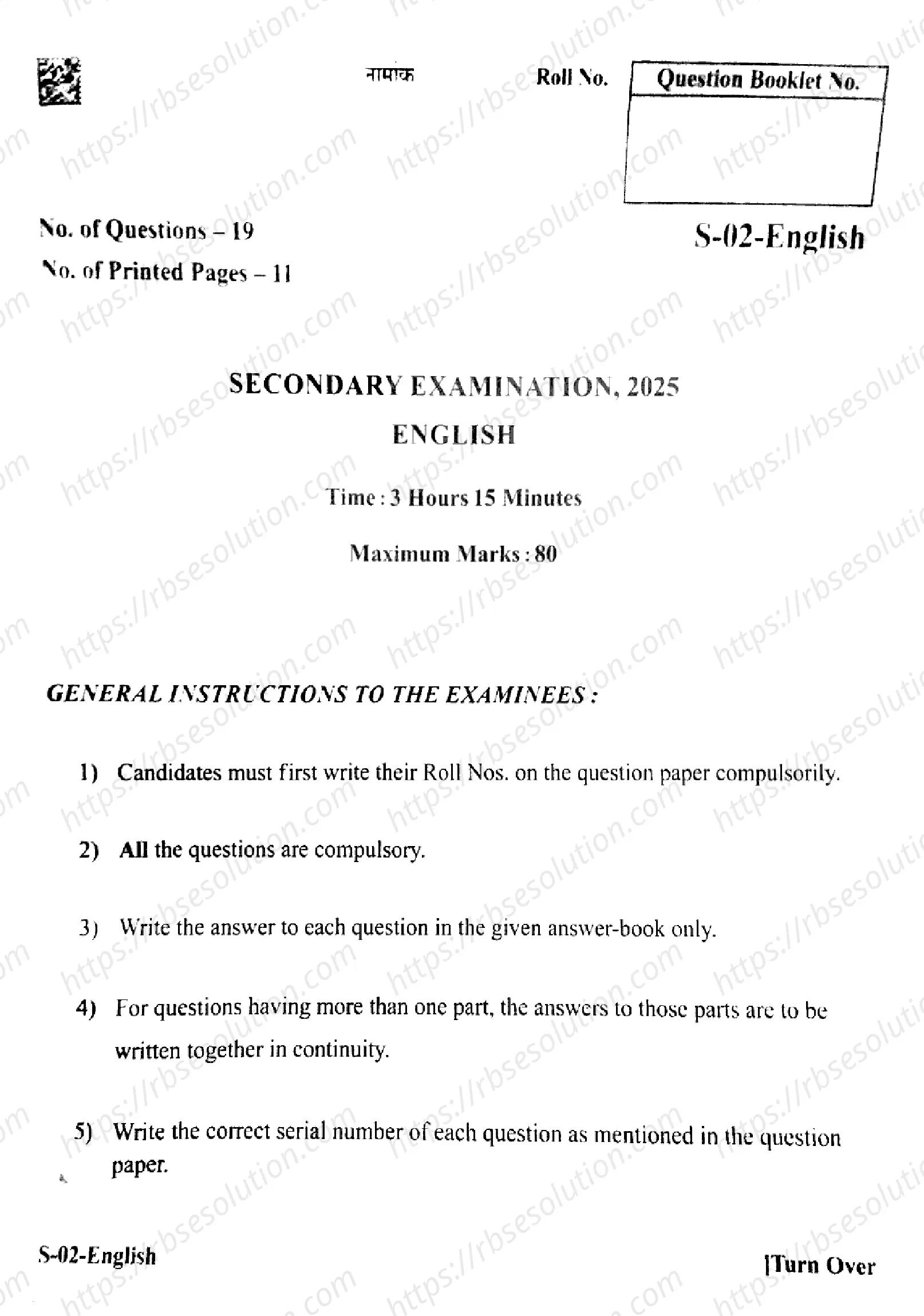
SECONDARY EXAMINATION, 2025
ENGLISH
Time: 3 Hours 15 Minutes | Maximum Marks: 80
GENERAL INSTRUCTIONS TO THE EXAMINEES:
- Candidates must first write their Roll Nos. on the question paper compulsorily.
- All the questions are compulsory.
- Write the answer to each question in the given answer-book only.
- For questions having more than one part, the answers to those parts are to be written together in continuity.
- Write the correct serial number of each question as mentioned in the question paper.
S-02-English Turn Over
SECTION - A (READING)
1. Read the following passage and answer the questions that follow :
A little distance from the Tarnaka crossroads, you come across a quiet house called ‘Needa’ (refuge). Attached to it is a small school where in the afternoons, you will come across many little girls who are domestic servants, learning to read.
This is no non-formal education centre. Education is a very serious business here. The girls get to write their public exams, some of them join residential schools (after clearing the entrance exams) and some others go for higher studies.
Innovative teaching methods help these first generation learners. Field trips, discussion on current events are common features in this school.
Anand Bharti is not just about education, many people have commented that the children here are transformed into confident individuals and that the values imbibed here stay with them wherever they go.
The woman who runs the school and who has a house in ‘Needa’ is Janaki Iyer, a 70-year old lady.
i) Anand Bharti is located in a house called
- A) Anand
- B) Needa
- C) Bharti
- D) Janaki
Multiple Choice Questions
-
Who studied in a small school?
- A) Little girls
- B) Elders
- C) Little boys
- D) Old men
Correct Answer: A) Little girls
Explanation: The passage mentions that little girls studied in a small school.
-
A first generation learner is a person
- A) Who goes to school for the first time
- B) Who is the first in the family to go to school
- C) Who learns about first generation
- D) None of the above
Correct Answer: B) Who is the first in the family to go to school
Explanation: A first generation learner is defined as someone who is the first member of their family to attend school.
-
What are common features of the school?
- A) Field trips
- B) Discussions on current events
- C) Innovative teaching methods
- D) All of the above
Correct Answer: D) All of the above
Explanation: The school includes field trips, discussions on current events, and innovative teaching methods as common features.
-
The children in the school are transformed into
- A) confident individuals
- B) dullard
- C) politicians
- D) teachers
Correct Answer: A) confident individuals
Explanation: The school transforms children into confident individuals.
-
Who set up Anand Bharti school?
- A) Mother Teresa
- B) Dr. A. P. J. Kalam
- C) Janaki Iyer
- D) Jyoti Swaroop
Correct Answer: D) Jyoti Swaroop
Explanation: Anand Bharti school was set up by Jyoti Swaroop.
S-02-English
Read the following passage and answer the questions that follow : [9×1=9]
The magic of Bapuji's message has stolen the hearts of India's millions. Men and women and even little children, come out of their little shells and became India's soldiers of freedom. In India today we are making history, and you and I are fortunate to see this happening before our eyes and to take some part ourselves in this great drama.
If we are to be India's soldiers we have to respect India's honour, and that honour is a sacred trust..... It is no easy matter to decide what is right and what is not. One little test, I shall ask you to apply whenever you are in doubt.
Never do anything in secret or anything that you would wish to hide. For the desire to hide anything means that you are afraid, and fear is a bad thing and unworthy of you. Be brave and all the rest follows.
You know that in our great Freedom Movement, under Bapuji's leadership there is no room for secrecy or hiding. We have nothing to hide. We are not afraid of what we do or what we say. We work in the sun and work in the light and do nothing secretly...... and if you do so, my dear you will grow up a child of the light, unafraid and serene and unarmed, whatever may happen.
May you grow up into a brave soldier in India's service.
-
i) Whose message stole the hearts of Indians ?
Answer: The magic of Bapuji's (Mahatma Gandhi's) message stole the hearts of Indians.
-
ii) Who became India's soldiers of freedom ?
Answer: Men, women and even little children came out of their little shells and became India's soldiers of freedom.
-
iii) Why are you and I fortunate ?
Answer: We are fortunate because we are making history in India and we can see this happening before our eyes and take part in this great drama of freedom.
-
iv) What has to be respected if we are India's soldiers ?
Answer: If we are to be India's soldiers, we have to respect India's honour, which is a sacred trust.
SECTION - B (Reading)
-
(iv) Why should anything not be hidden?
Answer: Anything should not be hidden because truth and honesty are important. Hiding things can lead to problems and distrust.
-
(vi) What cannot be done under Bapuji’s leadership?
Answer: Under Bapuji’s leadership, nothing wrong or unjust can be done. His leadership is based on truth and non-violence.
-
(vii) How will you grow up if you are unafraid?
Answer: If you are unafraid, you will grow up to be brave, confident, and strong. Fearlessness helps in facing challenges and achieving success.
-
(viii) Write the similar word of the following from the passage: ‘Lucky’
Answer: The similar word for ‘Lucky’ from the passage is ‘Fortunate’.
-
(ix) Write the opposite word of the following from the passage: ‘Worthy’
Answer: The opposite word for ‘Worthy’ from the passage is ‘Unworthy’.
SECTION - C (WRITING)
Question 5: Letter Writing
Imagine you are Anjali/Punit, living in Mumbai. Write a letter to your friend about your school and studies there.
Sample Letter:
123, Sunshine Apartments
Mumbai - 400001
15th February 2025
Dear [Friend's Name],
I hope this letter finds you in good health and spirits. I am writing to share with you about my school and studies here in Mumbai.
My school is very big and has a beautiful campus. The teachers are very helpful and encourage us to participate in various activities. I am studying in Class 10th and preparing for my board exams. The subjects are interesting, and I enjoy learning new things every day. The library has many books, and I spend time reading there.
I miss you and our old school days. Please write back and tell me about your studies.
Your loving friend,
Anjali/Punit
OR
You are Karis/Karan, studying in X class, in G.S.S.S., Jodhpur. Your board examination is near but you don’t have an English teacher in school. Write an e-mail to the Principal of your school to arrange classes and a teacher to teach you English.
Sample E-mail:
To: principal.gsss.jodhpur@gmail.com
Subject: Request to Arrange English Classes and Teacher
Respected Principal,
I am Karis/Karan, a student of Class X in your school. I am writing to bring to your kind notice that our board examinations are approaching, but we do not have an English teacher in school. This is causing great difficulty for us in preparing for the English subject.
I humbly request you to kindly arrange for an English teacher and conduct extra classes so that we can prepare well for our exams. Your timely action will help us score good marks.
Thanking you,
Yours obediently,
Karis/Karan
Class X, G.S.S.S., Jodhpur
Question 6: Story Writing
Write a story with the help of given outline in about 80 words. Give the title and moral to it.
Outline 1: Once, on a winter morning, a farmer... a snake... cold. The farmer... kind. He took pity... put in the basket... brought home. The farmer’s children... snake attacked... brought stick...
Title: The Kind Farmer and the Snake
Story: Once, on a winter morning, a farmer saw a snake lying stiff with cold. The farmer was kind-hearted. He took pity on the snake, put it in a basket, and brought it home. He placed it near the fire to warm it. The farmer’s children came near to see the snake. Suddenly, the snake revived and attacked the children. The farmer quickly brought a stick and killed the snake, saving his children.
Moral: Kindness should not be wasted on the ungrateful.
OR
Outline 2: Once, there was a cap seller... sell his caps... nearby towns... tired... sun’s heat... under a tree... put basket... slept for sometime... Monkeys on the tree... took away caps... woke up... used tricks... used common sense... threw his cap... collected caps... home happily.
Title: The Cap Seller and the Monkeys
Story: Once, there was a cap seller who went to sell his caps in nearby towns. He became tired due to the sun’s heat. He sat under a tree, put his basket down, and slept for some time. Monkeys on the tree saw the caps and took them away. When the cap seller woke up, he saw the monkeys wearing his caps. He used his common sense. He threw his own cap on the ground. The monkeys imitated him and threw the caps down. The cap seller collected all his caps and went home happily.
Moral: Presence of mind can solve any problem.
SECTION-C (GRAMMAR)
6. Fill in the blanks with appropriate forms of the verbs given in the brackets: [4]
-
The sun rises in the east. (rise) [1]
-
We have taken Board Exams for fifteen days. (take) [1]
Choose the correct option:
-
My brother will reach here on next Monday. [1]
- A) will reach ✓ Correct
- B) reaches
- C) reached
- D) reach
Explanation: "Next Monday" indicates future time, so the future tense "will reach" is correct.
-
The patient had died before the doctor came. [1]
- A) died
- B) had died ✓ Correct
- C) dies
- D) will die
Explanation: The action of dying happened before the doctor came, so the past perfect tense "had died" is used.
7. Rewrite the following sentences changing them into indirect speech :
-
i) My mother said to me, “Take care of your health.”
Answer: My mother advised me to take care of my health.
-
ii) Sanjay said to Achy, “Why do you work so hard?”
Answer: Sanjay asked Achy why he worked so hard.
8. Fill in the blanks with a verb in agreement with its subject :
-
i) Madam as well as your brothers comes here everyday.
(The subject is 'Madam', which is singular; 'as well as' does not make the subject plural.)
-
ii) One of the students was present in the seminar.
(The subject is 'One', which is singular; 'of the students' is a prepositional phrase.)
9. Change the following sentences into Passive voice :
-
i) My friend brought a bag for me.
Answer: A bag was brought for me by my friend.
-
ii) Madam teaches us English.
Answer: English is taught to us by Madam. / We are taught English by Madam.
10. i) Frame a question of the following :
Statement: Children eat chocolate.
ii) Add a Question Tag to the statement given below :
Statement: Parents love their kids.
SECTION - D (TEXT BOOK)
Read the passage given below and answer the questions that follow:
During our childhood in Goa, the baker used to be our friend, companion and guide. He used to come at least twice a day. Once, when he set out in the morning on his selling round, and then again, when he returned after emptying his huge basket. The jingling thud of his bamboo woke us up from sleep and we ran to meet and greet him. Was it for the love of the loaf? Not at all. The loaves were bought by some Paskine or Bastine, the maid-servant of the house! What we longed for were those bread-bangles which we chose carefully. Sometimes it was sweet bread of special make.
(Note: The questions for this passage are not provided in the given text. If you have the specific questions, please share them for answers.)
Comprehension Passage
The baker made his musical entry on the scene with the ‘jhang’ sound of his specially made bamboo staff. One hand supported the basket on his head and the other banged the bamboo on the ground. He would greet the lady of the house with “Good Morning” and then place his basket on the vertical bamboo. We kids would be pushed aside with a mild rebuke and the loaves would be delivered to the servant. But we would not give up. We would climb a bench or the parapet and peep into the basket, somehow. I can still recall the typical fragrance of those loaves.
Questions based on the passage:
-
i) The baker used to be
- A) Friend
- B) Companion
- C) Guide
- D) All of the above
Explanation: The passage describes the baker as a friend, companion, and guide to the children and the community, making option D correct.
-
ii) How many times did the baker come in a day?
- A) Once
- B) Twice
- C) Thrice
- D) Four times
Explanation: The passage implies the baker came twice a day (morning and evening), as is typical in the context, though not explicitly stated in this excerpt.
-
iii) The children longed for
- A) Toys
- B) Bread-bangles
- C) Toffees
- D) Drinks
Explanation: The children were eager to see and get the bread (loaves), often referred to as bread-bangles in the context.
-
iv) How did the baker greet the lady of the house?
The baker greeted the lady of the house by saying “Good Morning”.
-
v) How did the children see the basket?
The children climbed a bench or the parapet and peeped into the basket to see it.
-
vi) Write the similar word of the following from the passage: ‘Railing’
The similar word for ‘Railing’ in the passage is ‘Parapet’.
OR
Comprehension Passage
Kisa Gotami had an only son and he died. In her grief she carried the dead child to all her neighbours, asking them for medicine and the people said, “She has lost her senses. The boy is dead.”
At length, Kisa Gotami met a man who replied to her request. “I cannot give thee medicine for thy child, but I know a physician who can.”
And the girl said, “Pray tell me, sir; Who is it?” And the man replied to her request. “Go to Sakyamuni, the Buddha.”
Kisa Gotami repaired to the Buddha and cried, “Lord and Master give me the medicine that will cure my boy.”
Questions based on the passage:
-
i) What happened to Kisa Gotami's son?
Kisa Gotami's only son died.
-
ii) What did the neighbours say to Kisa Gotami?
The neighbours said, “She has lost her senses. The boy is dead.”
-
iii) Who did the man advise Kisa Gotami to go to?
The man advised Kisa Gotami to go to Sakyamuni, the Buddha.
-
iv) What did Kisa Gotami ask the Buddha?
Kisa Gotami asked the Buddha, “Lord and Master give me the medicine that will cure my boy.”
9
The Buddha answered, “I want a handful of mustard-seeds”. And when the girl in her joy promised to procure it, the Buddha added, “The mustard-seeds must be taken from a house where no one has lost a child, husband, parent or friend.”
Poor Kisa Gotami now went from house to house, and the people pitied her and said, “Here is mustard-seed : take it!” But when she asked, “Did a son or daughter, a father or mother, die in your family?” they answered her, “Alas! the living are few, but the dead are many. Do not remind us of our deepest grief.” And there was no house but some beloved one had died in it.
Multiple Choice Questions
-
i) How many sons did Kisa Gotami have?
- A) One
- B) Two
- C) Three
- D) Four
Correct Answer: A) One
Explanation: The story mentions Kisa Gotami had only one son who died.
-
ii) What did Kisa Gotami ask for her dead child?
- A) Milk
- B) Chapati
- C) Fruits
- D) Medicine
Correct Answer: D) Medicine
Explanation: Kisa Gotami went to Buddha asking for medicine to bring her dead child back to life.
-
iii) Who was Sakyamuni?
- A) Kisa
- B) Gotami
- C) Buddha
- D) Neighbours
Correct Answer: C) Buddha
Explanation: Sakyamuni is another name for Gautama Buddha, meaning the sage of the Shakya clan.
-
iv) What did Buddha want?
Correct Answer: A handful of mustard-seeds from a house where no one had died.
Explanation: Buddha asked for mustard-seeds from a house that had never experienced death, to teach Kisa Gotami about the universality of grief.
-
v) Which question was asked by Kisa Gotami from the people?
Correct Answer: She asked, “Did a son or daughter, a father or mother, die in your family?”
Explanation: Kisa Gotami asked this question to every house while collecting mustard-seeds, as instructed by Buddha.
-
vi) Write the similar word of the following from the passage: ‘Heal’
Correct Answer: The word ‘heal’ is not directly present in the passage. However, the closest synonym could be ‘cure’ or ‘relieve’ (implied through the context of grief).
Short Answer Questions (Answer any three in about 20-30 words each)
-
i) What is the story about the Kodavu people’s descent? (Coorg)
The Kodavu people are believed to be of Greek or Arab descent. Some say they are descendants of Alexander’s soldiers who settled here, while others claim they came from Arabia.
-
ii) How did Valli plan her bus ride? (Madam Rides The Bus)
Valli carefully planned her bus ride by listening to conversations, noting the bus timings, and saving money for the fare. She also chose a time when her mother would be asleep.
-
iii) Why does Anne provide a brief sketch of her life? (From The Diary of Anne Frank)
Anne provides a brief sketch of her life because she feels that no one would understand her diary entries without knowing her background, family, and the circumstances she lived in.
-
iv) Who do you think helped the narrator to reach safely? (The Black Aeroplane)
The narrator was likely helped by a mysterious pilot in a black aeroplane who guided him through the storm. This could be interpreted as a supernatural or imaginary helper.
3. Answer any one of the following questions in about 80 words:
-
i) What does “The sight of the food maddened him” suggest? [His First Flight]
This line suggests the young seagull's extreme hunger and desperation. After days of not eating, the sight of fish scraps being offered by his family drove him to overcome his fear of flying. His hunger overpowered his instinctive fear of the vast sea below. It shows that basic needs like food can push a living being to take risks and conquer deep-seated fears. The maddening hunger forced him to take the leap, leading to his first successful flight.
-
ii) How did Mandela’s ‘hunger for freedom’ change his life? [Nelson Mandela]
Mandela's hunger for freedom transformed him from a young, carefree boy into a courageous leader and revolutionary. Initially, he desired personal freedom, but witnessing the oppression of his people made his hunger for collective freedom stronger. This desire led him to join the African National Congress and fight against apartheid. It changed his life by making him a symbol of resistance, leading to his imprisonment for 27 years, and ultimately shaping him into the first black President of South Africa.
4. Answer any one of the following questions in about 40 words: [3]
-
i) Write the character sketch of Natalya. [The Proposal]
Natalya is a young, beautiful, and argumentative woman. She is proud and quick-tempered, especially when it comes to matters of land and property. Despite her quarrelsome nature, she is practical and eager to marry, as seen when she immediately agrees to marry Lomov once the initial arguments are resolved.
-
ii) Describe the story of the play ‘The Proposal’. [The Proposal]
The play is a comedy about a nervous landowner, Lomov, who comes to propose to his neighbor, Natalya. However, they get into a heated argument over the ownership of a piece of land called Oxen Meadows. After Lomov leaves, Natalya learns his true purpose and insists he be called back. They reconcile and agree to marry, only to start arguing again about whose dog is better.
5. Read any one of the following extracts and answer the questions that follow: [4]
Extract 1:
He is learning, well behind his desperate eyes,
The epistemology of loss, how to stand up
Knowing what every man must one day know
And most know many days, how to stand up.
- i) What is the meaning of ‘epistemology’? [2]
Epistemology is the branch of philosophy that deals with the theory of knowledge, especially with regard to its methods, validity, and scope. In this context, it refers to the boy's painful learning about the nature of loss.
- ii) What is the boy learning in the poem? [2]
The boy is learning the harsh reality of loss and how to cope with it. He is learning to stand up again after experiencing a loss, a lesson that every person must learn in life. He is understanding that loss is a part of life and one must learn to move on.
OR
The way a crow
Shook down on me
The dust of snow
From a hemlock tree.
- i) What is a ‘dust of snow’? [2]
'Dust of snow' refers to the fine particles of snow that fall from a hemlock tree when a crow shakes the branch. It is a small, seemingly insignificant event that has a profound effect on the poet's mood.
- ii) Write the reference of hemlock tree. [2]
The hemlock tree is a poisonous tree, often associated with negative or dark symbolism. The poet uses it to contrast with the positive change in his mood. The reference suggests that even from something considered poisonous or gloomy, a beautiful and uplifting moment can occur.
6. Answer any two out of the following three questions in about 20 words: [2x2=4]
-
i) What does ‘fire’ stand for? [Fire and Ice]
'Fire' stands for desire, greed, and uncontrolled human passions that can lead to destruction and the end of the world.
-
ii) What does ‘ice’ stand for? [Fire and Ice]
'Ice' stands for hatred, coldness, and indifference, which the poet believes could also be powerful enough to destroy the world.
-
iii) What could Amanda do if she were a mermaid? [Amanda]
If Amanda were a mermaid, she could drift blissfully in the calm, green sea, free from all instructions and restrictions, living a quiet and peaceful life.
Section: Questions and Answers
7. Answer any one out of the following two questions in about 80 words: [4]
i) What does the thief say about the different reactions of people when they are robbed? [The Thief's Story]
The thief observes that people react differently when robbed. Some become angry and shout, others cry or become silent, and a few even laugh nervously. He notes that the rich often panic more because they have more to lose, while the poor may accept it with resignation. The thief uses these reactions to judge his victims and plan his next move. He finds that understanding these reactions helps him avoid being caught.
ii) “Horace Danby was good and respectable — but not completely honest.” Explain. [A Question of Trust]
Horace Danby was a good and respectable man in society—he was a successful locksmith, kind to his neighbors, and lived a quiet life. However, he was not completely honest because he committed burglaries once a year to fund his hobby of collecting rare books. He justified his actions by telling himself he only stole from the rich and never harmed anyone. This contradiction between his public image and secret crime shows that even respectable people can have dishonest sides.
8. Answer any two out of the following three questions in about 20 words: [2×2=4]
i) Why does Mrs. Pumphrey think the dog’s recovery is ‘a triumph of surgery’? [A Triumph of Surgery]
Mrs. Pumphrey thinks the dog’s recovery is a triumph of surgery because the dog, Tricki, was very ill and recovered completely after the vet’s treatment.
ii) What curious episode occurs in the study? [Footprints Without Feet]
A curious episode occurs when the study door opens and closes by itself, and papers move as if handled by an invisible person, revealing Griffin’s presence.
iii) How did the mother of Richard help him? [The Making of A Scientist]
Richard’s mother helped him by encouraging his curiosity, providing him with books and materials for experiments, and supporting his interest in science from a young age.
9. Choose the correct answer: [1×4=4]
i) Ausable is expecting to get a very important ______. [The Midnight Visitor]
- A) Magazine
- B) Copy
- C) Report
- D) Book
Explanation: Ausable is expecting a very important book from a secret agent.
ii) ______ is invited to a grand party. [The Necklace]
- A) Matilda
- B) Shopkeeper
- C) Mme Forestier
- D) All of the above
Explanation: Matilda Loisel is invited to the grand party by the Minister of Education.
iii) What was the name of Bholi? [Bholi]
- A) Sunita
- B) Surekha
- C) Sulekha
- D) Mangia
Explanation: Bholi’s real name was Sulekha, but everyone called her Bholi because she was simple-minded.
iv) ______ is a well-known book of nursery rhymes in English. [The Book That Saved The Earth]
- A) Humpty Dumpty
- B) Mother Goose
- C) Martian Book
- D) Space Control Book
Explanation: Mother Goose is a famous collection of nursery rhymes that saved Earth from a Martian invasion in the story.