
RBSE Class 10th 2026 ENGLISH-S-02 Previous Year Papers
Class 10th students hunting authentic previous year papers for ENGLISH-S-02 (2026) land here for a reason: the paper below matches how RBSE assessments are remembered from that year. RBSE Solution does not mix years on one page; each combination gets its own notes.
Skim the overview sections, then work through the scanned pages. Pair this practice with RBSE books and solutions when you need to relearn a concept a question exposed.
Paper details
Quick reference for this previous year papers page — confirm board, class, and year & subject before you study.
| Board | RBSE |
|---|---|
| Class | Class 10th |
| Exam year | 2026 |
| Subject | ENGLISH-S-02 |
| Resource type | Previous Year Papers |
| Category | RBSE Previous Year Question Papers |
| Website | RBSE Solution |
The table summarises this Previous Year Papers resource. Confirm RBSE, Class 10th, year 2026, and subject ENGLISH-S-02 before studying.
RBSE Solution organises previous year papers so each URL carries chapter-specific guidance — better for students and for search engines than one generic paragraph for the whole class.
Turning 2026 papers into insight
One ENGLISH-S-02 paper reveals style; several from the same year reveal pattern. After this page, open sibling subjects listed below to see whether marks cluster in certain units.
Keep rough work dated in your notebook. Examiners in Class 10th expect clear numbering even in practice sessions.
RBSE Class 10th 2026 ENGLISH-S-02
Scroll through the Previous Year Papers pages for ENGLISH-S-02 (2026).
Rajasthan Board Class 10th ENGLISH-S-02 2026 solved Previous Year Question Papers
SECONDARY EXAMINATION, 2026
ENGLISH
Time: 3 Hours 15 Minutes
Maximum Marks: 80
No. of Questions: 20
No. of Printed Pages: 11
INSTRUCTIONS TO THE EXAMINEES:
- Candidates must first write their Roll Nos. on the question paper compulsorily.
- All the questions are compulsory.
- Write the answer to each question in the given answer-book only.
- For questions having more than one part, the answers to those parts are to be written together in continuity.
- Write the correct serial number of each question as mentioned in the question paper.
Page content could not be transcribed.
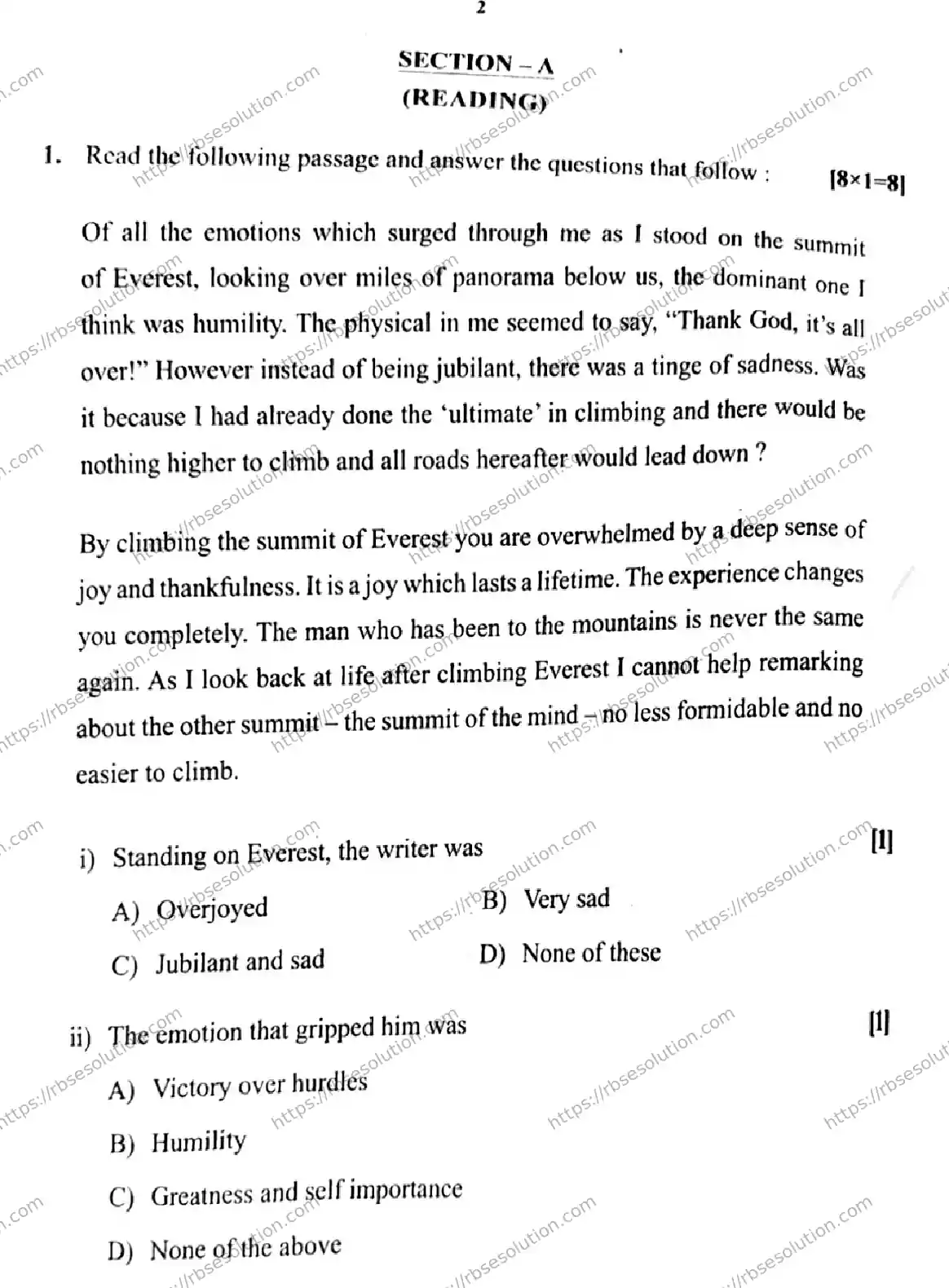
SECTION — A (READING)
I. Read the following passage and answer the questions that follow:
[8×1=8]
Of all the emotions which surged through me as I stood on the summit of Everest, looking over miles of panorama below us, the dominant feeling I think was humility. The physical in me seemed to say, "Thank God, it's all over!" However instead of being jubilant, there was a tinge of sadness. Was it because I had already done the 'ultimate' in climbing and there would be nothing higher to climb and all roads hereafter would lead down?
By climbing the summit of Everest you are overwhelmed by a deep sense of joy and thankfulness. It is a joy which lasts a lifetime. The man who has been to the mountains is never the same again. As I look back at life after climbing Everest I cannot help remarking about the other summit — the summit of the mind — no less formidable and no easier to climb.
-
Standing on Everest, the writer was
- A) Overjoyed
- B) Very sad
- C) Jubilant and sad
- D) None of these
Explanation: The passage states that instead of being jubilant, there was a tinge of sadness, indicating mixed feelings of joy and sadness.
-
The emotion that gripped him was
- A) Victory over hurdles
- B) Humility
- C) Greatness and self importance
- D) None of the above
Explanation: The writer clearly mentions that the dominant feeling was humility, not victory or self-importance.
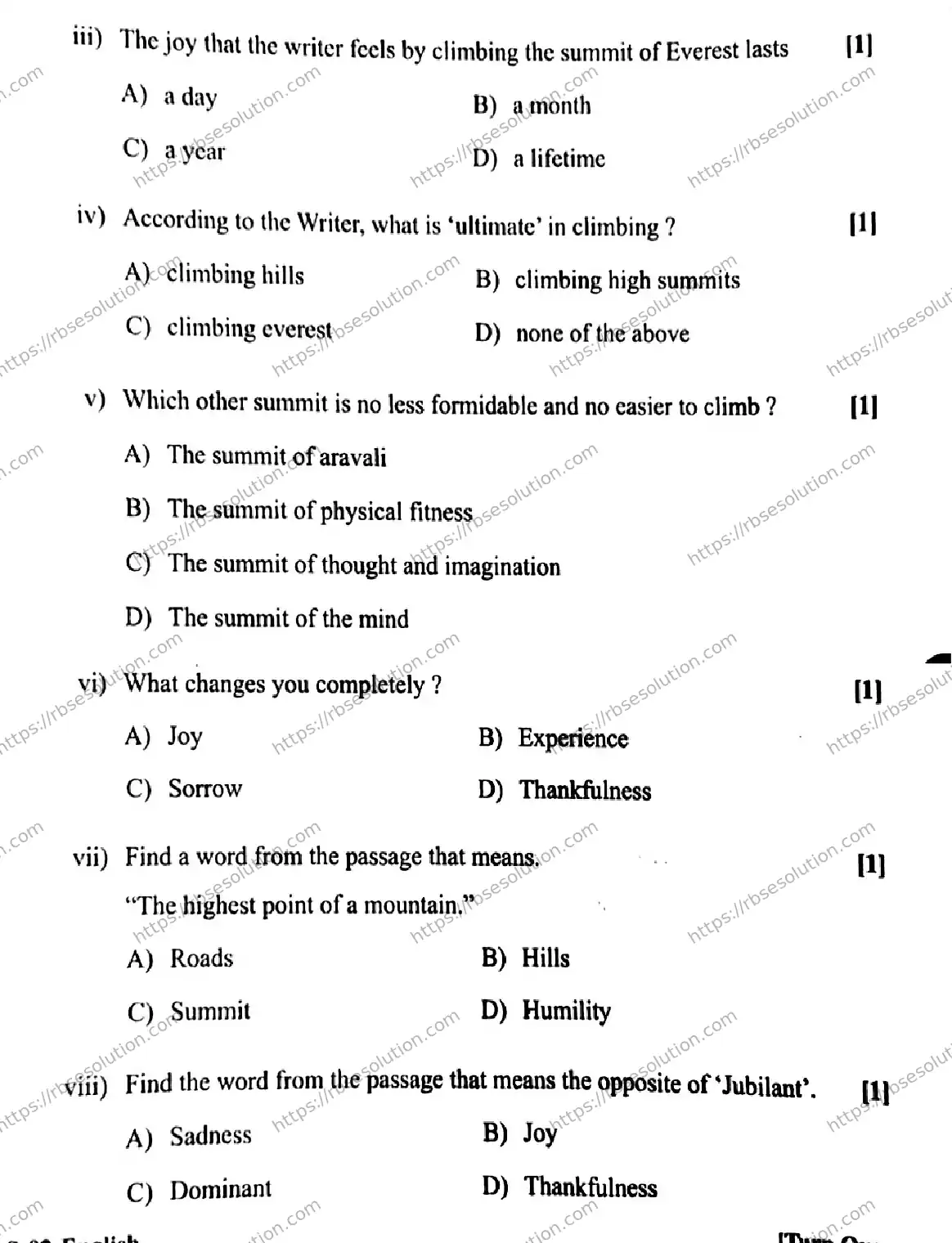
iii) The joy that the writer feels by climbing the summit of Everest lasts
- A) a day
- B) a month
- C) a year
- D) a lifetime
Explanation: The writer describes the joy of reaching the summit of Everest as a lasting, lifelong feeling, not temporary.
iv) According to the Writer, what is ‘ultimate’ in climbing?
- A) climbing hills
- B) climbing high summits
- C) climbing Everest
- D) none of the above
Explanation: The writer considers climbing Mount Everest as the ultimate achievement in mountaineering.
v) Which other summit is no less formidable and no easier to climb?
- A) The summit of Aravali
- B) The summit of physical fitness
- C) The summit of thought and imagination
- D) The summit of the mind
Explanation: The writer compares the challenge of climbing Everest to the equally difficult summit of thought and imagination.
vi) What changes you completely?
- A) Joy
- B) Experience
- C) Sorrow
- D) Thankfulness
Explanation: According to the passage, it is experience that brings about a complete change in a person.
vii) Find a word from the passage that means: “The highest point of a mountain.”
- A) Roads
- B) Hills
- C) Summit
- D) Humility
Explanation: The word 'summit' refers to the highest point of a mountain.
viii) Find the word from the passage that means the opposite of ‘Jubilant’.
- A) Sadness
- B) Joy
- C) Dominant
- D) Thankfulness
Explanation: 'Jubilant' means feeling great happiness; its opposite is 'sadness'.
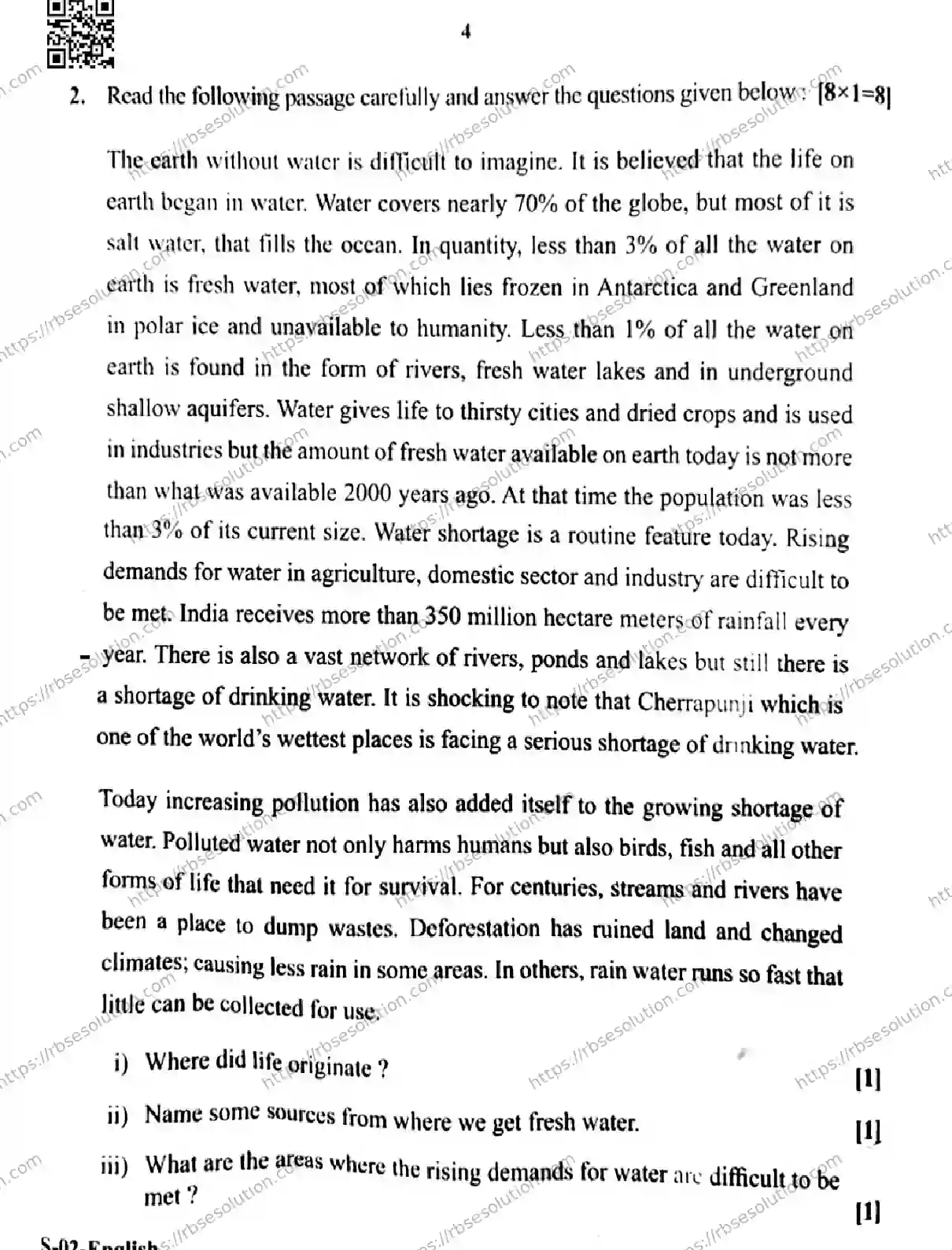
2. Read the following passage carefully and answer the questions given below: [8×2=16]
The earth without water is difficult to imagine. It is believed that the life on earth began in water. Water covers nearly 70% of the globe, but most of it is salt water, that fills the ocean. In quantity, less than 3% of all the water on earth is fresh water, most of which lies frozen in Antarctica and Greenland in polar ice and unavailable to humanity. Less than 1% of all the water on earth is found in the form of rivers, fresh water lakes and in underground shallow aquifers. Water gives life to thirsty cities and dried crops and is used in industries but the amount of fresh water available on earth today is not more than what was available 2000 years ago. At that time the population was less than 3% of its current size. Water shortage is a routine feature today. Rising demands for water in agriculture, domestic sector and industry are difficult to be met. India receives more than 350 million hectare meters of rainfall every year. There is also a vast network of rivers, ponds and lakes but still there is a shortage of drinking water. It is shocking to note that Cherrapunji which is one of the world's wettest places is facing a serious shortage of drinking water.
Today increasing pollution has also added itself to the growing shortage of water. Polluted water not only harms humans but also birds, fish and other forms of life that need it for survival. For centuries, streams and rivers have been a place to dump wastes. Deforestation has ruined land and changed climates; causing less rain in some areas. In others, rain water runs so fast that little can be collected for use.
Questions:
-
Where did life originate?
Answer: Life originated in water. The passage states that it is believed life on earth began in water.
-
Name some sources from where we get fresh water.
Answer: Fresh water is obtained from rivers, fresh water lakes, and underground shallow aquifers.
-
What are the areas where the rising demands for water are difficult to be met?
Answer: The rising demands for water are difficult to be met in agriculture, the domestic sector, and industry.
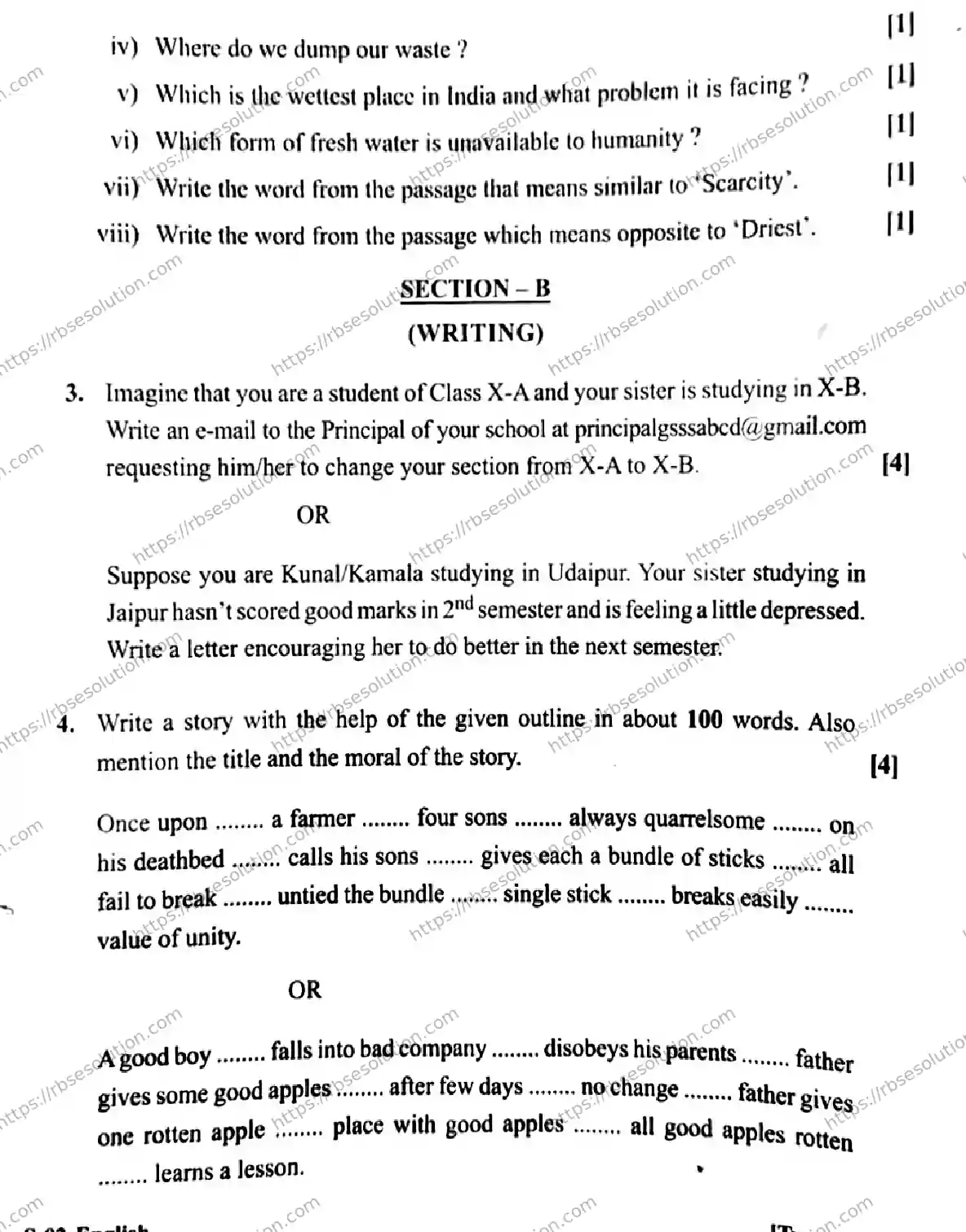
iv) Where do we dump our waste?
Answer: We dump our waste in landfills or garbage dumps.
v) Which is the wettest place in India and what problem is it facing?
Answer: Mawsynram in Meghalaya is the wettest place in India. It is facing the problem of excessive rainfall leading to landslides, soil erosion, and damage to crops and property.
vi) Which form of fresh water is unavailable to humanity?
Answer: The form of fresh water unavailable to humanity is the water locked in glaciers, ice caps, and deep underground aquifers.
vii) Write the word from the passage that means similar to "Scarcity".
Answer: The word from the passage that means similar to "Scarcity" is shortage (or dearth, depending on the passage).
viii) Write the word from the passage which means opposite to 'Driest'.
Answer: The word from the passage which means opposite to 'Driest' is wettest.
SECTION - B (WRITING)
3. Imagine that you are a student of Class X-A and your sister is studying in X-B. Write an e-mail to the Principal of your school at principalgsssabed@gmail.com requesting him/her to change your section from X-A to X-B.
Answer:
To: principalgsssabed@gmail.com
Subject: Request for Change of Section from X-A to X-B
Respected Principal,
I am a student of Class X-A in your school. My sister is studying in Class X-B. Due to some family reasons, we need to be in the same section so that we can travel together and support each other academically. I kindly request you to change my section from X-A to X-B.
I shall be grateful if you consider my request.
Thanking you,
Yours obediently,
[Your Name]
Class X-A, Roll No. [Your Roll No.]
OR
Suppose you are Kunal/Kamala studying in Udaipur. Your sister studying in Jaipur hasn't scored good marks in 2nd semester and is feeling a little depressed. Write a letter encouraging her to do better in the next semester.
Answer:
Udaipur
Date: [Current Date]
Dear [Sister's Name],
I hope this letter finds you in good health. I heard about your 2nd semester results. Please don't feel disheartened. Marks are not the only measure of your abilities. Every failure is a stepping stone to success. Take this as a learning experience and work harder next time. I believe in you and know you can do much better. Stay positive and focused. I am always here for you.
With love,
Your brother/sister,
Kunal/Kamala
4. Write a story with the help of the given outline in about 100 words. Also mention the title and the moral of the story.
Outline: Once upon ........ a farmer ........ four sons ........ always quarrelsome ........ on his deathbed ... calls his sons ........ gives each a bundle of sticks fail to break ........ untied the bundle ... single stick ........ breaks easily value of unity.
Title: The Bundle of Sticks
Story: Once upon a time, there was a farmer who had four sons. They were always quarrelsome. On his deathbed, the farmer called his sons and gave each a bundle of sticks. He asked them to break the bundle. They all tried but failed. Then the farmer untied the bundle and gave each son a single stick. They broke it easily. The farmer said, "United we stand, divided we fall."
Moral: Unity is strength.
OR
Outline: A good boy ........ falls into bad company ........ disobeys his parents ........ father gives some good apples ....... after few days ........ no change ........ father gives one rotten apple ........ place with good apples ........ all good apples rot ........ learns a lesson.
Title: The Rotten Apple
Story: A good boy fell into bad company and started disobeying his parents. His father gave him some good apples and asked him to keep them. After a few days, there was no change in the boy's behavior. Then the father gave him one rotten apple and placed it with the good apples. Soon, all the good apples rotted. The boy understood that bad company spoils good character.
Moral: A rotten apple spoils the whole barrel. / Bad company corrupts good character.
SECTION - B (Writing)
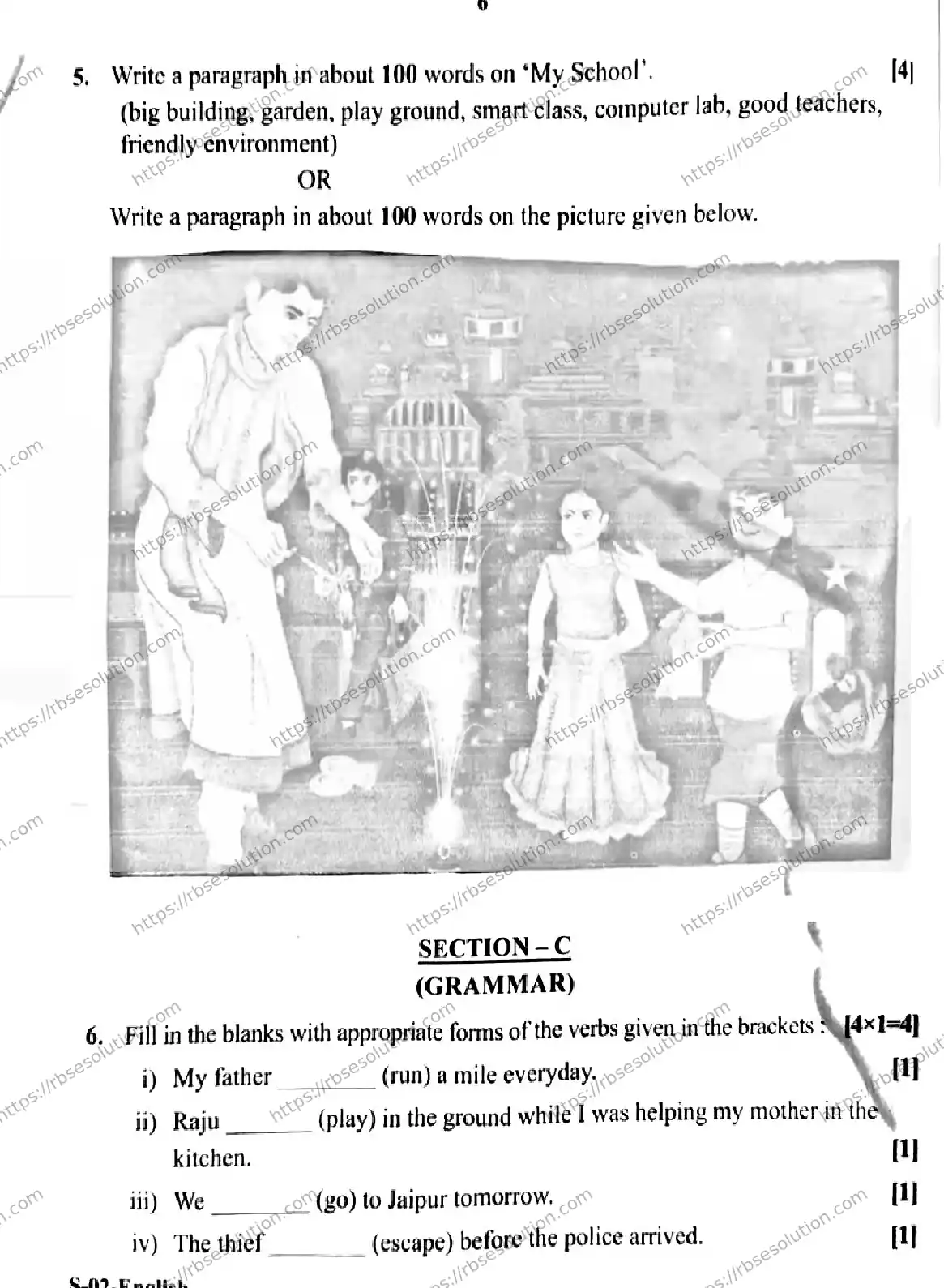
8. Write a paragraph in about 100 words on 'My School' using the following hints:
Hints: big building, garden, playground, smart class, computer lab, good teachers, friendly environment
My School
My school is one of the best schools in our city. It has a big building with many spacious classrooms. The school has a beautiful garden where colourful flowers bloom. There is a large playground where we play games like cricket and football. Our school has smart classes with projectors that make learning interesting. The computer lab is well-equipped with modern computers. Our teachers are very kind and hardworking. They always help us in studies. The environment of my school is very friendly and positive. I love my school very much.
OR
Write a paragraph in about 100 words on the picture given below.
(Picture not available in the text)
SECTION - C (Grammar)
9. Fill in the blanks with appropriate forms of the verbs given in the brackets:
-
My father runs (run) a mile everyday.
Explanation: The sentence talks about a habitual action (everyday), so the present simple tense 'runs' is used.
-
Raju was playing (play) in the ground while I was helping my mother in the kitchen.
Explanation: The action was ongoing in the past when another action happened. Hence, past continuous tense 'was playing' is correct.
-
We will go (go) to Jaipur tomorrow.
Explanation: The word 'tomorrow' indicates a future action, so 'will go' (simple future tense) is used.
-
The thief had escaped (escape) before the police arrived.
Explanation: The action of escaping happened before another past action (police arrived). Therefore, past perfect tense 'had escaped' is used.
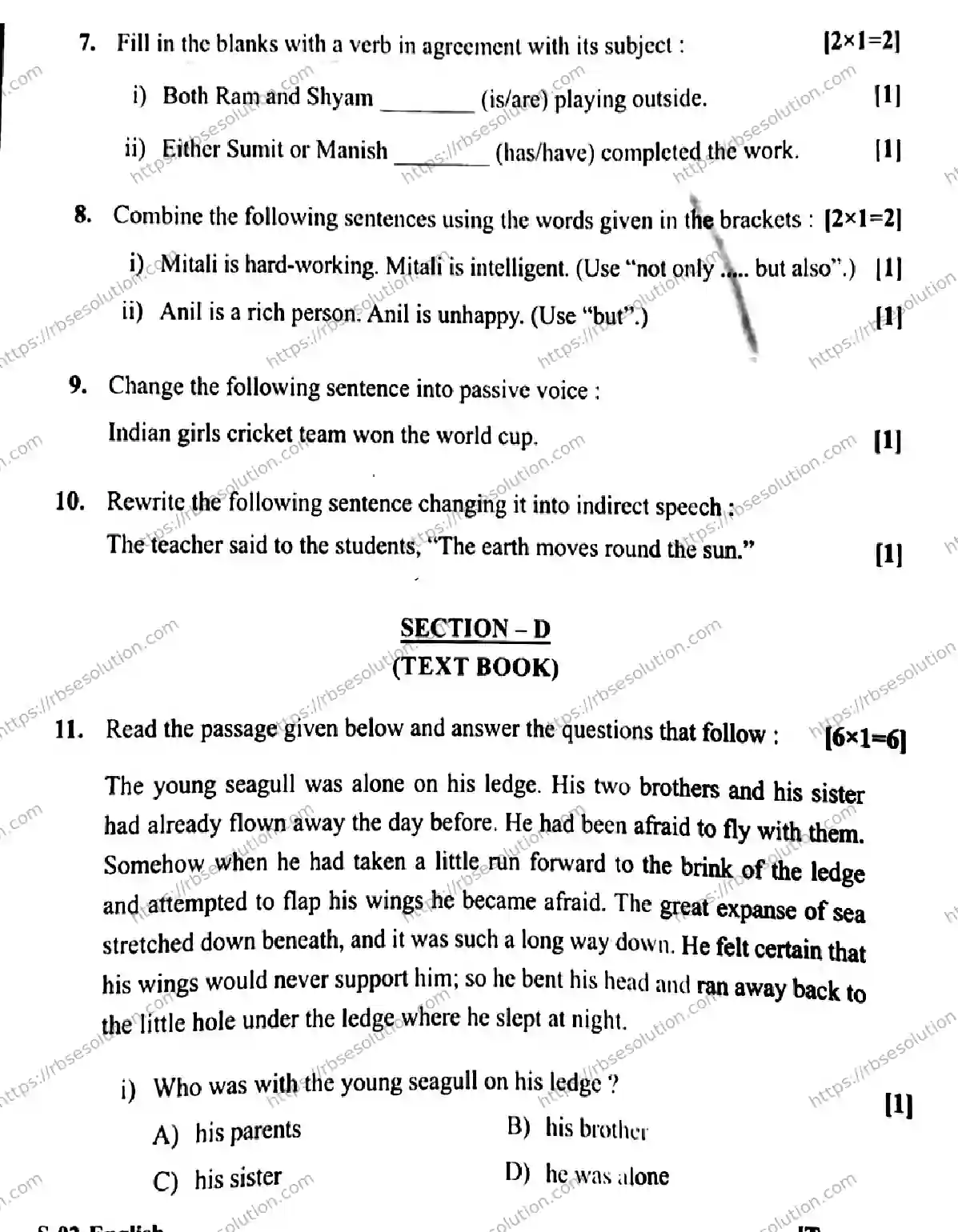
7. Fill in the blanks with a verb in agreement with its subject : [2×1=2]
i) Both Ram and Shyam are playing outside.
ii) Either Sumit or Manish has completed the work.
8. Combine the following sentences using the words given in the brackets : [2×1=2]
i) Anil is a rich person, but Anil is unhappy.
ii) Mitali is not only hard-working but also intelligent.
9. Change the following sentence into passive voice :
The world cup was won by the Indian girls cricket team.
10. Rewrite the following sentence changing it into indirect speech:
The teacher told the students that the earth moves round the sun.
SECTION - D (TEXT BOOK)
11. Read the passage given below and answer the questions that follow : [6×1=6]
The young seagull was alone on his ledge. His two brothers and his sister had already flown away the day before. He had been afraid to fly with them. Somehow when he had taken a little run forward to the brink of the ledge and attempted to flap his wings, he became afraid. The great expanse of sea stretched down beneath, and it was such a long way down. He felt certain that his wings would never support him; so he bent his head and ran away back to the little hole under the ledge where he slept at night.
i) Who was with the young seagull on his ledge ?
- A) his parents
- B) his brother
- C) his sister
- D) he was alone
Previous Year Question Paper – ENGLISH-S-02 (2026)
Section: Comprehension & Literature
Questions based on the first passage:
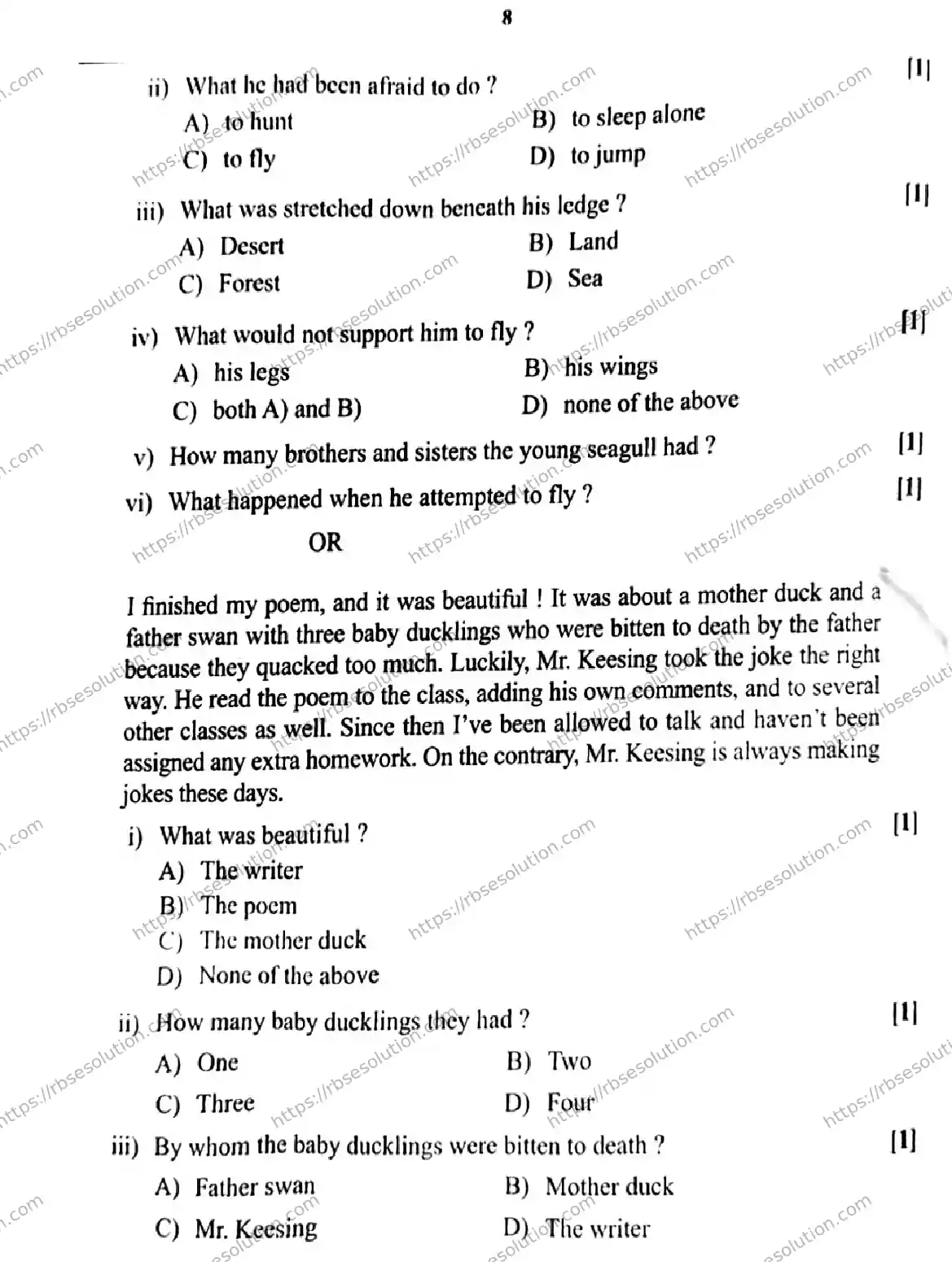
ii) What he had been afraid to do?
- to hunt
- to sleep alone
- to fly
- to jump
Answer: C) to fly
The young seagull was afraid to fly because he thought his wings would not support him.
iii) What was stretched down beneath his ledge?
- Desert
- Land
- Forest
- Sea
Answer: D) Sea
The sea stretched far beneath the ledge where the young seagull sat.
iv) What would not support him to fly?
- his legs
- his wings
- both A) and B)
- none of the above
Answer: B) his wings
The young seagull believed his wings would not support him to fly.
v) How many brothers and sisters the young seagull had?
Answer: The young seagull had two brothers and one sister (three siblings in total).
vi) What happened when he attempted to fly?
Answer: When the young seagull attempted to fly, he was terrified and could not move. He felt his wings would not support him, so he remained on the ledge, afraid to take the leap.
Questions based on the second passage (OR):
i) What was beautiful?
- The writer
- The poem
- The mother duck
- None of the above
Answer: B) The poem
The writer (Anne Frank) said, "I finished my poem, and it was beautiful!"
ii) How many baby ducklings they had?
- One
- Two
- Three
- Four
Answer: C) Three
The poem mentioned three baby ducklings.
iii) By whom the baby ducklings were bitten to death?
- Father swan
- Mother duck
- Mr. Keesing
- The writer
Answer: A) Father swan
According to the poem, the father swan bit the ducklings to death because they quacked too much.
Section – B (Short Answer Questions)
1. Answer the following questions (any six):
-
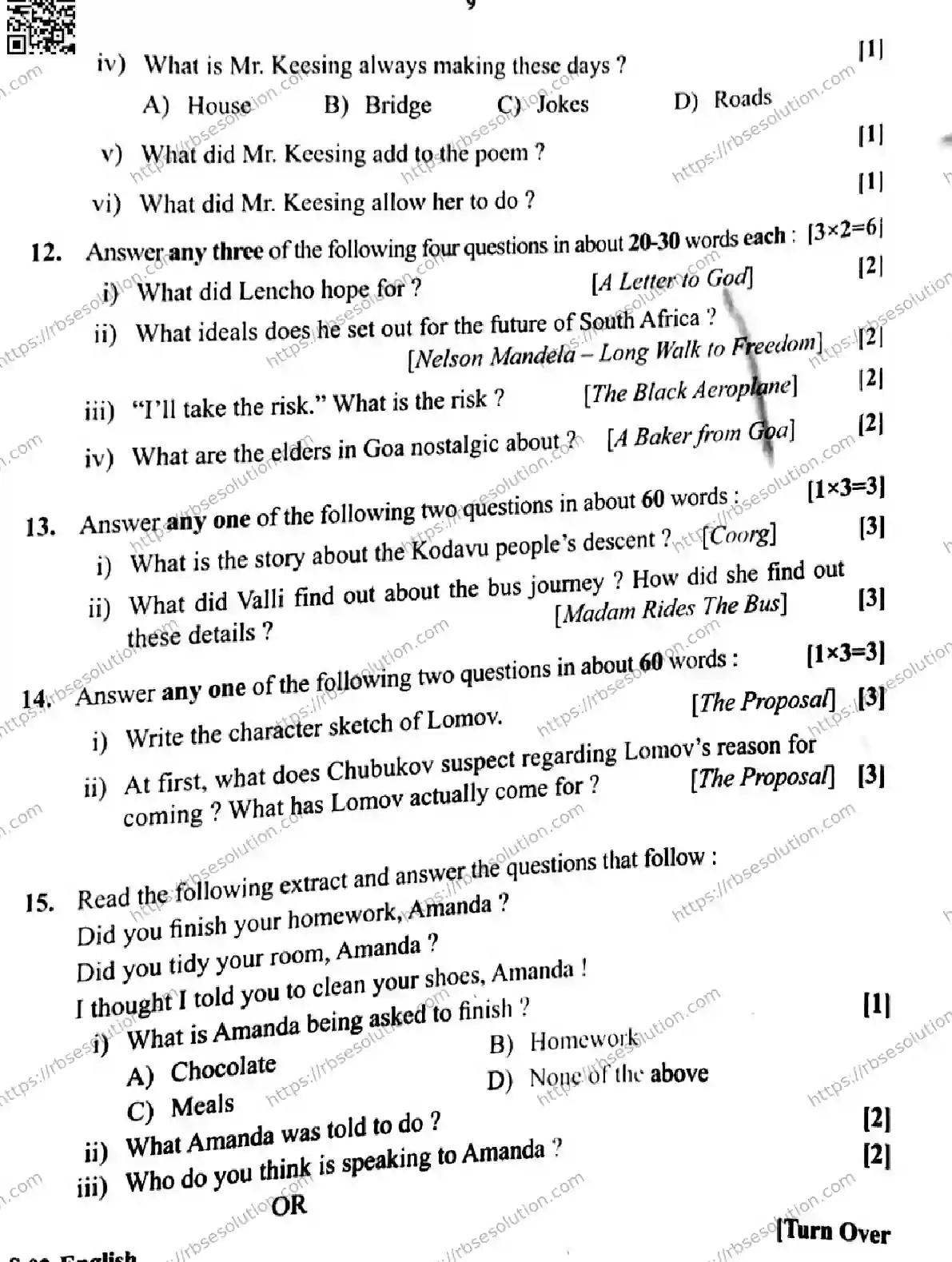
iv) What is Mr. Keesing always making these days?
- A) House
- B) Bridge
- C) Jokes
- D) Roads
Explanation: Mr. Keesing, Anne Frank's teacher, was always making jokes these days, especially after she wrote a poem for him.
-
v) What did Mr. Keesing add to the poem?
Mr. Keesing added a comment to the poem, saying that Anne had proven her point and he would not confiscate her chattering anymore. -
vi) What did Mr. Keesing allow her to do?
Mr. Keesing allowed Anne to talk in class, but only after she had written the poem and he was satisfied with her explanation.
2. Answer any three of the following four questions in about 20-30 words each: [3×2=6]
-
i) What did Lencho hope for? [A Letter to God]
Lencho hoped for a good rain so that his cornfield would yield a good harvest and he could feed his family. -
ii) What ideals does he set out for the future of South Africa? [Nelson Mandela – Long Walk to Freedom]
Nelson Mandela set out ideals of freedom, equality, and justice for all South Africans, where people of all races would live together in peace and harmony. -
iii) “I'll take the risk.” What is the risk? [The Black Aeroplane]
The risk was flying through a terrible storm with no fuel left, no radio contact, and no visibility, hoping to land safely at an airport. -
iv) What are the elders in Goa nostalgic about? [A Baker from Goa]
The elders in Goa are nostalgic about the traditional Portuguese-style bread and the old-fashioned baker who would come with his basket and horn.
3. Answer any one of the following two questions in about 60 words: [3]
-
i) What is the story about the Kodavu people's descent? [Coorg]
According to legend, the Kodavu people are descendants of Greek or Arab soldiers. One story says that a part of Alexander's army, unable to return home, settled in Coorg. Another story claims they are of Arab origin because their customs, like the marriage rituals and the traditional dress, resemble those of Arabs. -
ii) What did Valli find out about the bus journey? How did she find out these details? [Madam Rides The Bus]
Valli found out that the bus journey to the town cost thirty paise one way and took about forty-five minutes. She gathered these details by listening carefully to conversations between the bus conductor and other passengers, and by asking the conductor herself.
4. Answer any one of the following two questions in about 60 words: [3]
-
i) Write the character sketch of Lomov. [The Proposal]
Lomov is a wealthy but nervous landowner who comes to propose to Natalya. He is hypochondriac, often feeling his heart beating fast and his legs giving way. He is argumentative and easily gets into heated debates over trivial matters like the ownership of Oxen Meadows and the superiority of his dog. Despite his intentions, he fails to propose smoothly. -
ii) At first, what does Chubukov suspect regarding Lomov's reason for coming? What has Lomov actually come for? [The Proposal]
At first, Chubukov suspects that Lomov has come to borrow money, as he is dressed in formal evening wear. However, Lomov has actually come to propose marriage to Chubukov's daughter, Natalya.
5. Read the following extract and answer the questions that follow:
Did you tidy your room, Amanda?
I thought I told you to clean your shoes, Amanda!
-
i) What is Amanda being asked to finish?
- A) Chocolate
- B) Homework
- C) Meals
- D) None of the above
Explanation: Amanda is being asked to finish her meals, as the speaker says "Did you tidy your room?" and "clean your shoes," implying she has not completed her chores.
-
ii) What was Amanda told to do?
Amanda was told to tidy her room and clean her shoes. -
iii) Who do you think is speaking to Amanda?
The speaker is most likely Amanda's mother or a parent figure who is instructing her to do her household chores.
Previous Year Question Paper – ENGLISH (S-02)
Poem: Fog (Carl Sandburg)
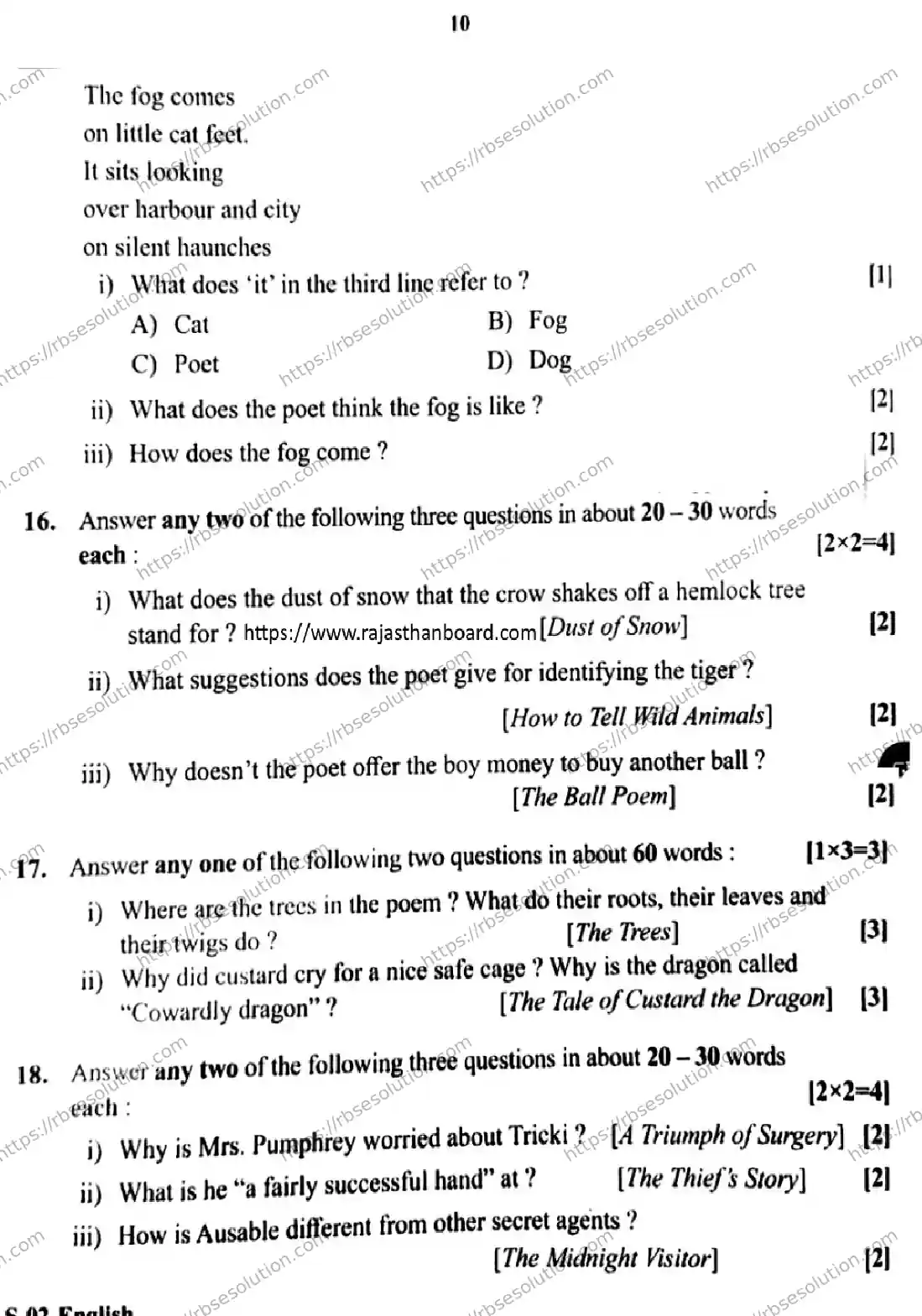
i) What does ‘it’ in the third line refer to?
- A) Cat
- B) Fog
- C) Poet
- D) Dog
Explanation: In the poem, the fog is personified as a cat. The pronoun 'it' refers to the fog.
ii) What does the poet think the fog is like?
The poet thinks the fog is like a cat. It comes silently, sits quietly, and then moves away, just like a cat's movements.
iii) How does the fog come?
The fog comes silently and slowly, "on little cat feet." It appears without any noise, just like a cat creeping in.
6. Answer any two of the following three questions in about 20–30 words each: [2×2=4]
i) What does the dust of snow that the crow shakes off a hemlock tree stand for? (Dust of Snow)
The dust of snow stands for the small, unexpected moments of joy and positivity that can change a person's mood and outlook on life.
ii) What suggestions does the poet give for identifying the tiger? (How to Tell Wild Animals)
The poet suggests that if you see a large, striped animal with fierce eyes and it roars loudly, it is a tiger. If it attacks you, you know for sure.
iii) Why doesn’t the poet offer the boy money to buy another ball? (The Ball Poem)
The poet doesn't offer money because he wants the boy to understand the value of loss and learn to cope with grief. Buying a new ball would not teach him this important lesson.
7. Answer any one of the following two questions in about 60 words: [2×3=6]
i) Where are the trees in the poem? What do their roots, their leaves and their twigs do? (The Trees)
In the poem, the trees are inside the house, kept in pots. Their roots try to free themselves from the cracks of the veranda floor. Their leaves strain towards the glass window, and their twigs bend and try to break free. The trees want to go outside into the forest where they belong.
ii) Why did Custard cry for a nice safe cage? Why is the dragon called “Cowardly dragon”? (The Tale of Custard the Dragon)
Custard cried for a nice safe cage because he was very timid and afraid of everything. He is called a "cowardly dragon" because, unlike other brave pets (the cat, dog, and mouse), Custard always showed fear and preferred safety over adventure. However, in the end, he proved to be the bravest when he fought the pirate.
8. Answer any two of the following three questions in about 20–30 words each: [2×2=4]
i) Why is Mrs. Pumphrey worried about Tricki? (A Triumph of Surgery)
Mrs. Pumphrey is worried because Tricki has become very lazy, refuses to eat, and lies motionless all day. She fears he is seriously ill.
ii) What is he “a fairly successful hand” at? (The Thief’s Story)
He (Hari Singh) is a fairly successful hand at stealing and cheating people. He is an experienced thief who knows how to trick others.
iii) How is Ausable different from other secret agents? (The Midnight Visitor)
Ausable is different because he is fat, sloppy, and does not look like a typical secret agent. He is not handsome or athletic, but he is very clever and uses his wits to outsmart others.
Section: Questions and Answers
9. Answer any one of the following two questions in about 60 words:
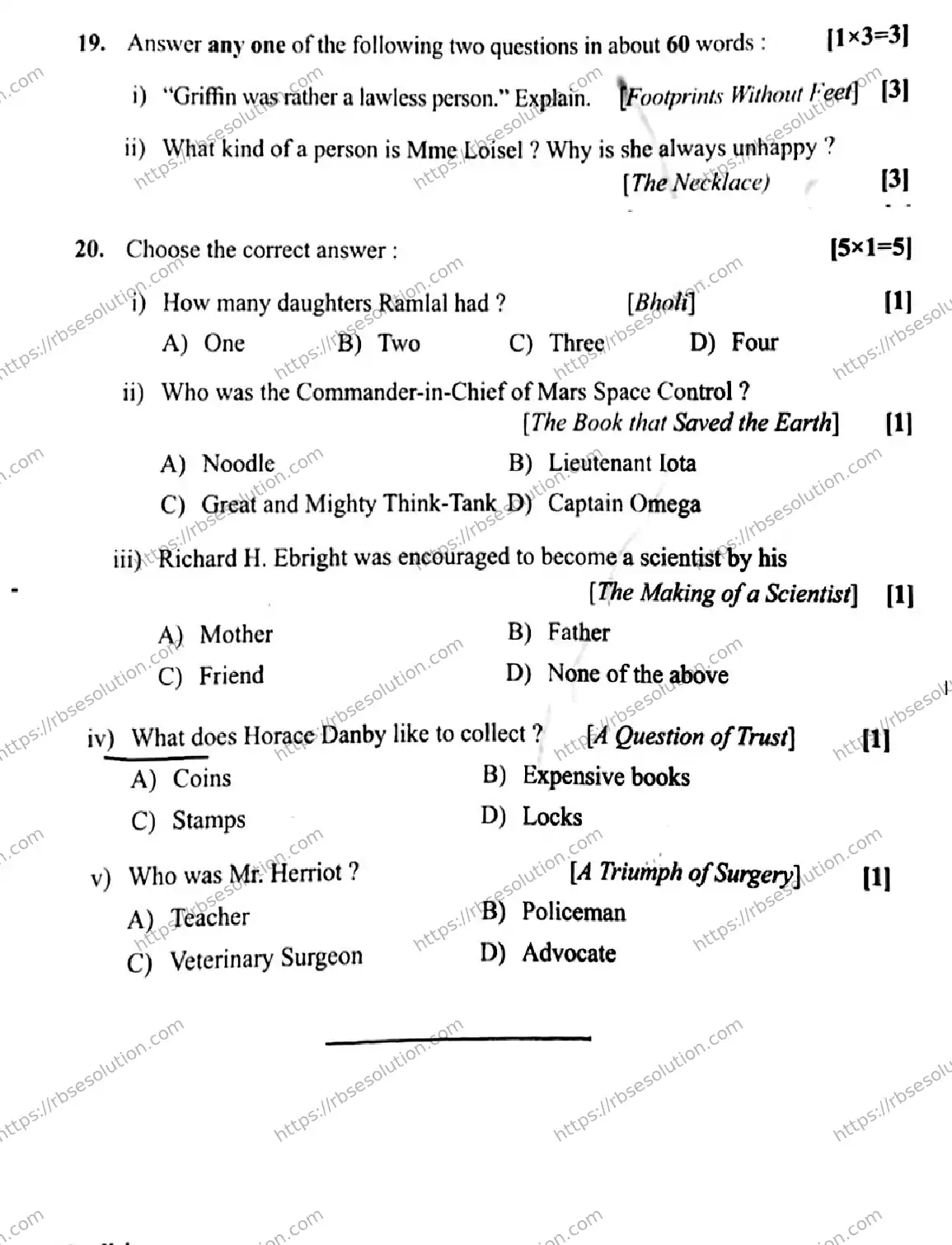
i) “Griffin was rather a lawless person.” Explain. (Footprints Without Feet) [3]
Griffin, the scientist, was indeed a lawless person. He misused his scientific discovery of becoming invisible for selfish and criminal purposes. He set fire to his landlord’s house, robbed a shopkeeper, and even attacked innocent people. He had no respect for law or society and acted only for his own benefit, proving his lawless nature.
ii) What kind of a person is Mme Loisel? Why is she always unhappy? (The Necklace) [3]
Mme Loisel is a beautiful but discontented and materialistic woman. She dreams of a life of luxury, wealth, and admiration, but she is born into a middle-class family. She is always unhappy because she feels she deserves more than what she has. Her constant desire for expensive things and social status makes her unable to appreciate her simple life, leading to her perpetual dissatisfaction.
20. Choose the correct answer: [5×1=5]
-
i) How many daughters did Ramlal have? (Bholi)
- A) One
- B) Two
- C) Three
- D) Four
Explanation: Ramlal had seven children—three sons and four daughters. Bholi was one of the daughters.
-
ii) Who was the Commander-in-Chief of Mars Space Control? (The Book that Saved the Earth)
- A) Noodle
- B) Lieutenant Lota
- C) Great and Mighty Think-Tank
- D) Captain Omega
Explanation: The Great and Mighty Think-Tank was the ruler and Commander-in-Chief of Mars Space Control.
-
iii) Richard H. Ebright was encouraged to become a scientist by his (The Making of a Scientist)
- A) Mother
- B) Father
- C) Friend
- D) None of the above
Explanation: Richard Ebright’s mother encouraged his interest in science by buying him books, telescopes, and other equipment, and by taking him on trips.
-
iv) What does Horace Danby like to collect? (A Question of Trust)
- A) Coins
- B) Expensive books
- C) Stamps
- D) Locks
Explanation: Horace Danby was a respectable locksmith who loved collecting rare and expensive books.
-
v) Who was Mr. Herriot? (A Triumph of Surgery)
- A) Teacher
- B) Policeman
- C) Veterinary Surgeon
- D) Advocate
Explanation: Mr. James Herriot was a veterinary surgeon who treated Tricki, the dog, in the story.