
RBSE Class 11th 2018 English (Compulsory)-V2-2018 Previous Year Papers
English (Compulsory)-V2-2018 from the 2018 exam year is part of the Class 11th previous year papers archive on RBSE Solution. Many learners start here after finishing the textbook to see how questions were actually framed on the Rajasthan Board of Secondary Education (RBSE) paper.
Treat this question paper as a mock under gentle timing first, then as a marking exercise the second time. The introduction on this page is written only for this subject-and-year pair, not copied from other pages.
Bookmark the link if you coach juniors — the layout stays stable for search engines and classroom sharing.
Paper details
Quick reference for this previous year papers page — confirm board, class, and year & subject before you study.
| Board | RBSE |
|---|---|
| Class | Class 11th |
| Exam year | 2018 |
| Subject | English (Compulsory)-V2-2018 |
| Resource type | Previous Year Papers |
| Category | RBSE Previous Year Question Papers |
| Website | RBSE Solution |
The table summarises this Previous Year Papers resource. Confirm RBSE, Class 11th, year 2018, and subject English (Compulsory)-V2-2018 before studying.
RBSE Solution organises previous year papers so each URL carries chapter-specific guidance — better for students and for search engines than one generic paragraph for the whole class.
Turning 2018 papers into insight
One English (Compulsory)-V2-2018 paper reveals style; several from the same year reveal pattern. After this page, open sibling subjects listed below to see whether marks cluster in certain units.
Keep rough work dated in your notebook. Examiners in Class 11th expect clear numbering even in practice sessions.
RBSE Class 11th 2018 English (Compulsory)-V2-2018
Scroll through the Previous Year Papers pages for English (Compulsory)-V2-2018 (2018).


Rajasthan Board Class 11th English (Compulsory)-V2-2018 2018 solved Previous Year Question Papers
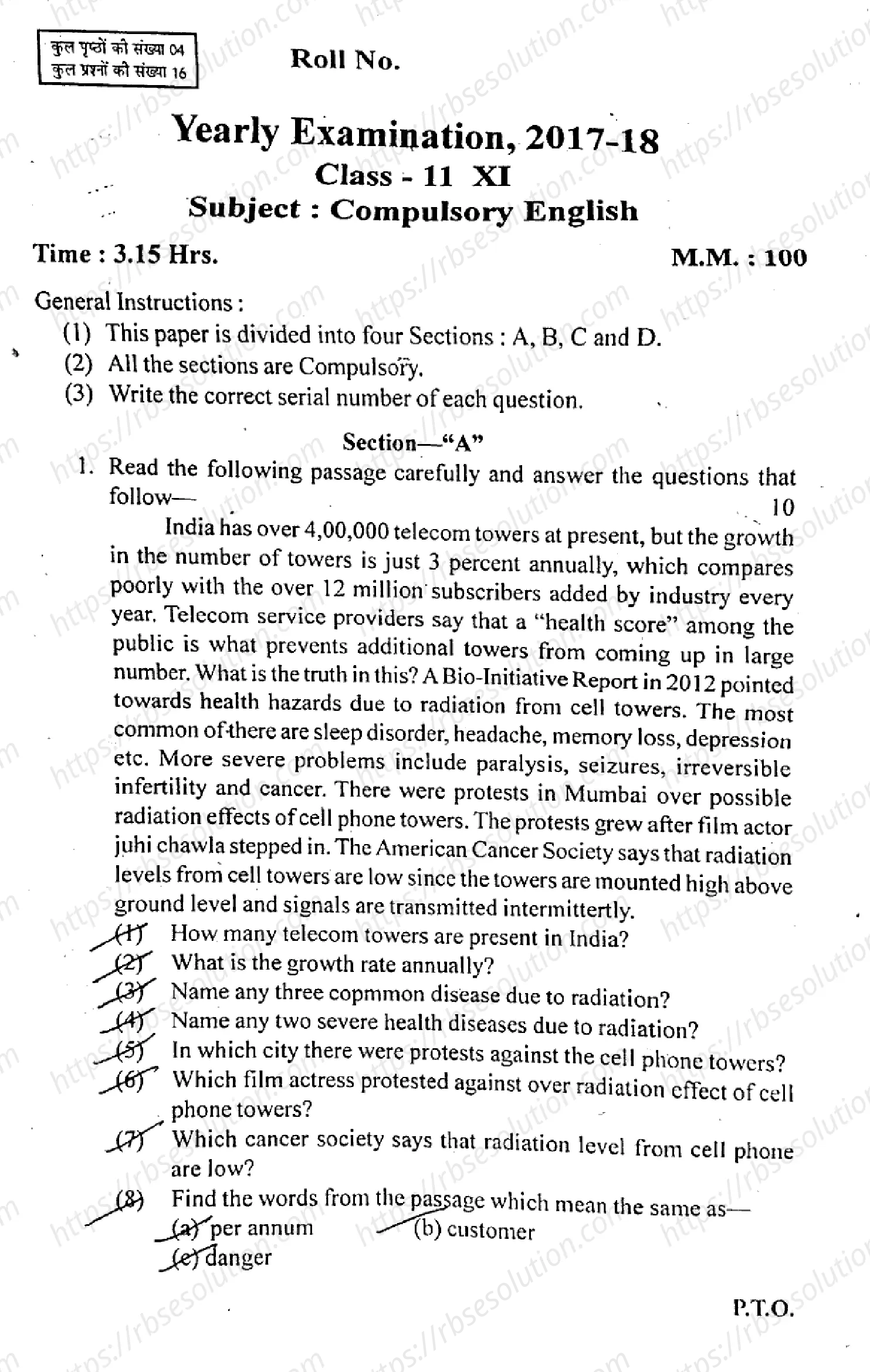
Yearly Examination, 2018
Class – XI
Subject: Compulsory English
Time: 3.5 Hrs. M.M.: 100
General Instructions:
- This paper is divided into four Sections: A, B, C and D.
- All the sections are compulsory.
- Write the correct serial number of each question.
Section – “A”
1. Read the following passage carefully and answer the questions that follow:
India has over 4,00,000 telecom towers at present, but the growth in the number of towers is just 3 percent annually, which compares poorly with the over 2 million subscribers added by industry every year. Telecom service providers say that a “health scare” among the public is what prevents additional towers from coming up in large number. What is the truth in this? A Bio-Initiative Report in 2012 pointed towards health hazards due to radiation from cell towers. The most common of these are sleep disorder, headache, memory loss, depression etc. More severe problems include paralysis, seizures, irreversible infertility and cancer. There were protests in Mumbai over possible radiation effects of cell phone towers. The protests grew after film actor Juhi Chawla stepped in. The American Cancer Society says that radiation levels from cell towers are low since the towers are mounted high above ground level and signals are transmitted intermittently.
-
(A) How many telecom towers are present in India?
India has over 4,00,000 telecom towers at present.
-
(B) What is the growth rate annually?
The growth rate is 3 percent annually.
-
(C) Name any three common diseases due to radiation.
Three common diseases due to radiation are: sleep disorder, headache, and memory loss (or depression).
-
(D) Name any two severe health diseases due to radiation.
Two severe health diseases due to radiation are: paralysis and cancer (or seizures, irreversible infertility).
-
(E) In which city there were protests against the cell phone towers?
There were protests in Mumbai against the cell phone towers.
-
(F) Which film actress protested against over radiation effect of cell phone towers?
Film actor Juhi Chawla protested against the radiation effect of cell phone towers.
-
(G) Which cancer society says that radiation level from cell phone are low?
The American Cancer Society says that radiation levels from cell towers are low.
-
(H) Find the words from the passage which mean the same as:
- per annum – annually
- customer – subscriber
- danger – hazard
Section ‘B’
Write in about 100-120 words on ‘How I cleaned School Campus’.
You may touch upon the following points—
- rainy season
- school ground
- campus
- monitor
- Principal
- teachers
- divided students into groups
- work
- cut bushes
- dry grass
- weed
- burnt them
- praised
- we all happy
How I Cleaned School Campus
It was the rainy season and our school ground was overgrown with bushes, dry grass, and weeds. As the class monitor, I brought this to the attention of our Principal. The Principal and teachers decided to take action. They divided all students into groups and assigned each group a specific area of the campus. My group was tasked with cutting bushes and removing dry grass and weeds. We worked hard for two hours, pulling out the weeds and piling up the dry grass. Finally, we burnt the collected waste. The Principal and teachers praised our efforts. We all felt very happy seeing our clean and beautiful campus.
Or
Write a paragraph in about 100-120 words on the topic “A visit to a zoo”, on the basis of the following hints—
- Last week
- father
- zoo
- entry tickets
- entered
- kinds of birds
- wild animals
- cage-reptiles
- water pond
- enjoyed
- returned
- by home
A Visit to a Zoo
Last week, my father took me to the zoo. We bought entry tickets and entered the zoo. First, we saw many kinds of colourful birds in a large aviary. Then we moved to the area for wild animals like lions, tigers, and bears. We also saw reptiles kept in glass cages. There was a beautiful water pond where ducks and swans were swimming. We enjoyed watching the animals and birds very much. After spending a few hours, we returned home happily.
Write an article in about 100-120 words on ‘Role of Youth in the development of nation’.
Role of Youth in the Development of Nation
The youth are the backbone of any nation. They possess energy, enthusiasm, and new ideas. In the development of a nation, the youth can play a crucial role by getting educated and skilled. They can contribute to fields like technology, agriculture, and industry. Young people can also participate in social work, spreading awareness about health, hygiene, and environmental protection. By being honest and hardworking, they can fight corruption and build a strong economy. The government should provide them with opportunities and platforms to showcase their talents. When the youth are empowered, the nation progresses rapidly. Therefore, every young person must realise their responsibility and work towards the nation's growth.
Or
Write a report on ‘the Annual Day function’ in your school, Jodhpur.
Report: Annual Day Function
Jodhpur, [Date]: The Annual Day function of our school was celebrated with great pomp and show. The event began with the lighting of the lamp by the chief guest. The Principal presented the annual report highlighting the school's achievements. Students presented a colourful cultural programme including songs, dances, and a skit. The chief guest praised the students for their performances and distributed prizes to the winners. The function ended with a vote of thanks. Everyone enjoyed the evening and felt proud of the school's progress.
Imagine you are Suresh studying in Govt. Sr. Sec. School, Jodhpur. Write an application to your Principal requesting him to issue Transfer Certificate (T.C.).
Application for Transfer Certificate
To,
The Principal,
Govt. Sr. Sec. School,
Jodhpur.
Subject: Request for Transfer Certificate
Respected Sir,
I, Suresh, a student of Class 11th (Science) in your school, request you to kindly issue my Transfer Certificate. My father has been transferred to Jaipur due to his job, and the whole family is moving there. Therefore, I need to take admission in a school in Jaipur. I have cleared all my dues and have no pending fees or library books. I shall be grateful if you issue my T.C. at the earliest.
Thanking you,
Yours obediently,
Suresh
Class 11th (Science)
Roll No. ______
Or
Write a letter on behalf of M/s Gupta & Sons, 14, A/71, Old Street, Jaipur to M/s Mehta Brothers, 18, Tripolia Market, Jodhpur, asking quotations for cotton clothes and their discounts and terms of payment.
Letter Asking for Quotation
M/s Gupta & Sons
14, A/71, Old Street
Jaipur
Date: ________
To,
M/s Mehta Brothers
18, Tripolia Market
Jodhpur
Subject: Quotation for Cotton Clothes
Dear Sir,
We are a leading retailer of garments in Jaipur. We are interested in purchasing a bulk quantity of cotton clothes for the upcoming summer season. Please send us your latest quotation for various types of cotton fabrics and readymade garments. Also, kindly mention the discounts you offer on bulk orders and your terms of payment (cash, credit, etc.). We look forward to a long-term business relationship with you.
Thanking you,
Yours faithfully,
For M/s Gupta & Sons
(Manager)
Section ‘C’
Put the adverbs given in the brackets in the correct place.
- They were still working on their project.
- My sister has not finished doing her homework yet.
- He is always complaining.
- He sometimes comes to see me on Saturday.
- She usually stays at school all afternoon.
Fill in the blanks with correct form of the verbs given in the bracket.
- I saw a lion in the forest.
- Look there! They are coming towards us.
- When I was helping in the kitchen, Maya came.
- She had completed her work before I went to her.
Complete the following dialogues using suitable modals—
Student : Good morning, Madam.
Teacher : Very good morning.
Student : May I ask a question?
Teacher : Yes, you may.
Student : Could you explain me the modal ‘can’?
Teacher : Yes, I can. Modal ‘can’ is used to express present ability, general possibility, etc.
Student : Thank you, Madam.
Teacher : You are welcome.
7. Change the following into Passive Voice—
- She could help him.
- Who broke this flower pot?
Answers:
- He could be helped by her.
- By whom was this flower pot broken?
8. Change the following sentences into Indirect Speech—
- He said, “She must help him.”
- The teacher said, “Do not play in the sun.”
Answers:
- He said that she had to help him.
- The teacher forbade the students to play in the sun.
9. Rewrite the following sentences as directed—
- Sunil was unhappy. He failed to get a job. (use ‘because’)
- We saw a film. The film was very exciting. (use ‘which’)
- She spoke politely. She was angry with her sister. (use ‘although’)
- Raj went to bed. He locked the door. (use ‘before’)
- It is very cold. We cannot sit out. (use ‘too…to’)
- She is too ill to cook food in the morning. (use ‘so…that’)
- No other mountain peak is as high as Everest. (use ‘highest’)
- Sita is as clever as Radha. (use ‘clever’)
Answers:
- Sunil was unhappy because he failed to get a job.
- We saw a film which was very exciting.
- Although she was angry with her sister, she spoke politely.
- Raj locked the door before he went to bed.
- It is too cold for us to sit out.
- She is so ill that she cannot cook food in the morning.
- Everest is the highest mountain peak.
- Sita is cleverer than Radha.
Section—C
10. Read the following passage and answer the questions below them—
It is almost like a providential blessing that we, the rich countries, have found it in our heart at least to consider. The World War and to try to mitigate its poverty. In spite of the mixture of motives and the persistence of exploitative practices, I think that this fairly recent development in the outlook of the rich is an honourable one. And it could save us, for the poverty of the poor makes it in any case impossible for them successfully to adopt our technology. Of course, they often try to do so, and then have to bear the more dire consequences, in terms of mass unemployment, mass migration into cities, rural decay, and intolerable social tensions. They need, in fact, the very thing I am talking about, which we also need: a different kind of technology: a technology with a human face, which instead of making human hands and brains redundant, helps them to become far more productive than they have ever been before. As Gandhi said, the poor of the world cannot be helped by mass production, only by production by the masses.
- What is like a providential blessing?
- Why can’t the poor adopt the present technology?
- What are the harmful effects of the modern technology?
- According to the writer, which technology do we need?
- What did Gandhi say?
- Find from the passage the words which mean:
(i) the state of being extremely poor.
(ii) movement from one part to another.
Answers:
- The consideration by rich countries to mitigate the poverty of poor countries is like a providential blessing.
- The poor cannot adopt the present technology because their poverty makes it impossible for them to do so successfully.
- The harmful effects of modern technology include mass unemployment, mass migration into cities, rural decay, and intolerable social tensions.
- We need a different kind of technology—a technology with a human face that makes human hands and brains more productive, not redundant.
- Gandhi said that the poor of the world cannot be helped by mass production, only by production by the masses.
- (i) poverty (ii) migration
11. Answer the following questions in about 10-15 words (any 4)—
- What is the greatest evil of advertising? (A Task on Advertising)
- What does eco-tourism aim at? (Eco-tourism)
Answers:
- The greatest evil of advertising is that it creates artificial needs and encourages materialism.
- Eco-tourism aims at promoting responsible travel to natural areas, conserving the environment, and improving the well-being of local people.
Section: Short Answer Questions
-
(3) What was the British thing which Americans did not abandon? (Toasted English)
Answer: The British thing which Americans did not abandon was the English language itself, though they adapted it into a distinct form known as American English.
-
(4) Which, according to the girl Prakriti, is a false religion? (Chandalika)
Answer: According to Prakriti, the false religion is the religion of caste discrimination and untouchability, which divides human beings based on birth.
-
What are the national ideals of India? (India: Our Motherland)
Answer: The national ideals of India are truth, non-violence, peace, love, and universal brotherhood, as enshrined in the Indian Constitution and the teachings of great leaders.
-
What will bring happiness, peace, and prosperity? (Vision 2020)
Answer: According to Dr. A.P.J. Abdul Kalam's Vision 2020, hard work, education, scientific temper, and national unity will bring happiness, peace, and prosperity to India.
Section: Stanza Comprehension
3. Read the following stanza and answer the questions that follow:
Mother; I am the one
you sent away
when the doctor told you
I would be
a girl—In the end they had to
give me an injection to kill me.
-
(4) To whom is the poem addressed?
Answer: The poem is addressed to the mother of the unborn child.
-
Why did they give her an injection?
Answer: They gave her an injection to kill the unborn female fetus because the mother did not want a girl child.
Or
I am both man and woman
I am paper boats for children
I am habits for fishermen
I am a cloud for shaven monks
I reflect all movements
-
(7) To which gender does Ganga belong to and why?
Answer: Ganga belongs to both genders because the river is referred to as a female (Ganga Mata) but also embodies masculine qualities like strength and flow, symbolizing unity of all.
-
How do children enjoy themselves with Ganga's water and why do fishermen seek the Ganga?
Answer: Children enjoy themselves by making paper boats and floating them on Ganga's water. Fishermen seek the Ganga because it provides them with fish, which is their livelihood and habit.
Section: Short Answer Questions (10-15 words each) – Answer any three
-
In which Hindi month does the festival of Raksha Bandhan fall?
Answer: The festival of Raksha Bandhan falls in the Hindi month of Shravan (Sawan).
-
Describe the scene in the autopsy room.
Answer: The autopsy room is cold, sterile, and filled with the smell of chemicals, with a dead body lying on a metal table under bright lights.
-
In which city does the infanticide take place?
Answer: The infanticide takes place in the city of Mumbai (Bombay).
-
What does Ganga find on its way to the sea?
Answer: Ganga finds cities, villages, forests, mountains, and the diverse life of India on its way to the sea.
Section: Answer in about 50-60 words
"Peace is costly, but it's worth the expense". Explain. (The Gentlemen of the Jungle)
Explanation: This statement means that achieving and maintaining peace often requires great sacrifices, compromises, and resources. However, the benefits of peace—harmony, security, and prosperity—far outweigh the costs. In the story, the animals learn that peace is valuable even if it means giving up some personal interests, as conflict leads to greater loss.
Or
What are the most important concerns of the old starved man and how does he show them in his behaviour? (The Refugees)
Answer: The old starved man's most important concerns are food, shelter, and survival. He shows these through his desperate actions—begging for food, searching for a place to stay, and clinging to any hope of safety. His behaviour reflects extreme hunger and exhaustion, as he is willing to endure humiliation just to get a meal or a warm place.
Section: Answer in about 30-40 words (Any two)
-
What did Aksionov do just before he left the first inn? (God sees the truth but waits)
Answer: Just before leaving the first inn, Aksionov paid the innkeeper for his stay and had a cup of tea. He then prayed to God, thanked Him for the journey so far, and set out on his way, unaware of the false accusation that would soon follow.
-
Why does the train get late? (Out of Business)
Answer: The train gets late because of a sudden breakdown in the engine. The railway staff had to repair it, causing a delay. This lateness becomes a turning point in the story, as it gives the protagonist time to reconsider his plans.
-
What price did Sindhu ask for the third goat and the flute? (The three dancing goats)
Answer: Sindhu asked for a very high price for the third goat and the flute—he demanded the buyer's entire wealth or a magical item in exchange. This shows his greed and cleverness in bargaining.
-
Why did Algu's heart begin to beat fast when Tumman was appointed as the head of the Panchayat? (Panchparmeshwar)
Answer: Algu's heart began to beat fast because he feared that Tumman, being his enemy, would be biased and give an unfair judgment against him. He worried that the Panchayat would not be impartial, and his reputation or property might be at risk.