
RBSE Class 11th 2024 English-2024 Previous Year Papers
You opened the RBSE Class 11th 2024 English-2024 Previous Year Papers page — a focused place to read the real previous year question paper for that subject and year. RBSE Solution keeps exam-year sets together so you can practise the same cycle your seniors faced.
Previous year papers reward patience: read instructions, note mark distribution, then attempt questions before peeking at solutions elsewhere on the site. This URL always loads the same free previous year papers content for English-2024 (2024).
Use the details table to confirm class and year, then scroll to the paper images or PDF below. More subjects from 2024 are linked later on this page.
Paper details
Quick reference for this previous year papers page — confirm board, class, and year & subject before you study.
| Board | RBSE |
|---|---|
| Class | Class 11th |
| Exam year | 2024 |
| Subject | English-2024 |
| Resource type | Previous Year Papers |
| Category | RBSE Previous Year Question Papers |
| Website | RBSE Solution |
The table summarises this Previous Year Papers resource. Confirm RBSE, Class 11th, year 2024, and subject English-2024 before studying.
RBSE Solution organises previous year papers so each URL carries chapter-specific guidance — better for students and for search engines than one generic paragraph for the whole class.
How to practise with this question paper
Stage one: read the English-2024 question paper from 2024 without a timer and highlight command words — explain, prove, calculate, discuss. Stage two: attempt selected questions closed-book. Stage three: compare with solutions or teacher feedback.
Previous Year Papers work best when you log mistakes by topic, not only by question number. That log becomes your revision index before pre-boards.
RBSE Class 11th 2024 English-2024
Scroll through the Previous Year Papers pages for English-2024 (2024).


Rajasthan Board Class 11th English-2024 2024 solved Previous Year Question Papers
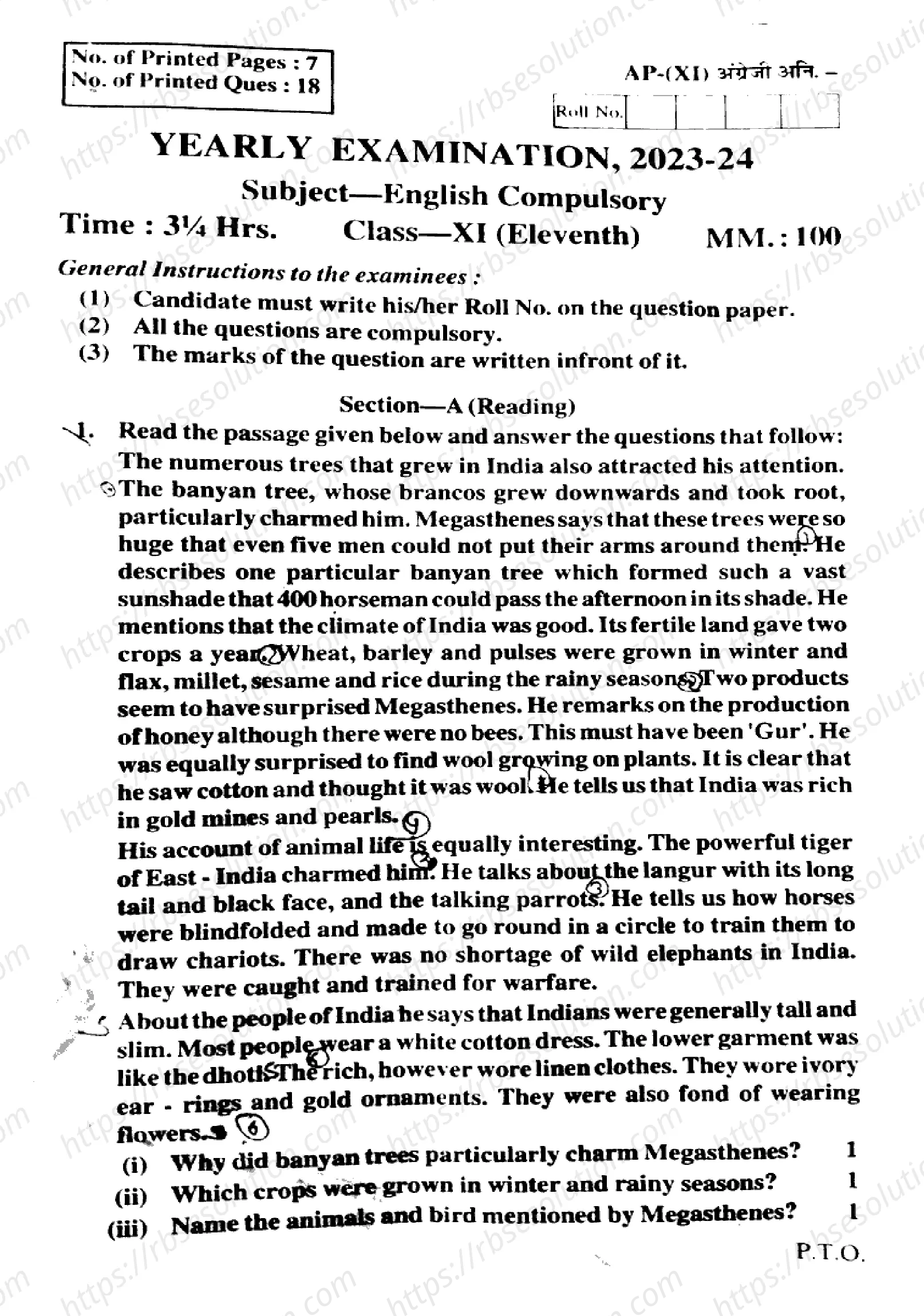
YEARLY EXAMINATION, 2023-24
Subject—English Compulsory
Class—XI (Eleventh)
Time : 3¼ Hrs. MM.: 80
General Instructions to the examinees:
- Candidate must write his/her Roll No. on the question paper.
- All the questions are compulsory.
- The marks of the question are written in front of it.
Section—A (Reading)
Read the passage given below and answer the questions that follow:
The numerous trees that grew in India also attracted his attention. The banyan tree, whose branches grew downwards and took root, particularly charmed him. Megasthenes says that these trees were so huge that even five men could not put their arms around them. He describes one particular banyan tree which formed such a vast sunshade that 400 horsemen could pass the afternoon in its shade. He mentions that the climate of India was good. Its fertile land gave two crops a year. Wheat, barley and pulses were grown in winter and flax, millet, sesame and rice during the rainy season. Two products seem to have surprised Megasthenes. He remarks on the production of honey although there were no bees. This must have been 'Gur'. He was equally surprised to find wool growing on plants. It is clear that he saw cotton and thought it was wool. He tells us that India was rich in gold mines and pearls.
His account of animal life is equally interesting. The powerful tiger of East India charmed him. He talks about the langur with its long tail and black face, and the talking parrots. He tells us how horses were blindfolded and made to go round in a circle to train them to draw chariots. There was no shortage of wild elephants in India. They were caught and trained for warfare.
About the people of India he says that Indians were generally tall and slim. Most people wear a white cotton dress. The lower garment was like the dhoti. The rich, however, wore linen clothes. They wore ivory ear-rings and gold ornaments. They were also fond of wearing flowers.
Questions:
-
Why did banyan trees particularly charm Megasthenes?
Answer: The banyan trees charmed Megasthenes because their branches grew downwards and took root, and they were so huge that even five men could not encircle them. One particular banyan tree provided shade large enough for 400 horsemen to rest in the afternoon.
-
Which crops were grown in winter and rainy seasons?
Answer: In winter, wheat, barley and pulses were grown. During the rainy season, flax, millet, sesame and rice were grown.
-
Name the animals and bird mentioned by Megasthenes?
Answer: The animals mentioned are the tiger, the langur (with a long tail and black face), horses, and wild elephants. The bird mentioned is the talking parrot.
Section A: Reading Comprehension
Passage 1 (Megasthenes' Account)
(i) What did Megasthenes say about the physique of Indians?
Megasthenes praised the physique of Indians, describing them as tall, well-built, and strong.
(ii) How did the most people dress up themselves?
Most people dressed in simple cotton garments, usually a single piece of cloth wrapped around the body.
(iii) Which ornaments did the rich wear?
The rich wore ornaments made of gold and precious stones.
(iv) In which thing was India rich?
- Copper
- Gold mines and pearls
- Silver
- None
Explanation: Megasthenes noted that India was rich in gold mines and pearls, which were highly valued.
(v) Wild elephants were caught and trained for ________.
- Warfare
- Chariots
- Procession
- None
Explanation: Wild elephants were captured and trained primarily for warfare, as they were used in battles.
(vi) Which two products surprised him much?
- Wheat, barley
- Flax, millet
- Gur, cotton
- None
Explanation: Megasthenes was surprised by the production of gur (jaggery) and cotton, which were abundant in India.
(vii) Find out the antonym of the word 'barren' from the passage.
- Fertile
- Crops
- Climate
- None
Explanation: The antonym of 'barren' (meaning unproductive) is 'fertile' (meaning productive).
Passage 2 (Shivaji's Escape and Campaign)
(i) What type of king was Shivaji, the great?
Shivaji was a very wise and brave king.
(ii) How did Shivaji come out of the prison of Aurangzeb?
Shivaji thought of a clever plan and escaped from the prison at Agra in 1666.
(iii) What did Shivaji do to get back his forts?
Shivaji consulted his brave and trusted generals, organized his own forces, and began to wrest fort after fort from the hands of Aurangzeb.
(iv) What pledge did Shivaji make to recapture Kondana?
Shivaji pledged that he would not enjoy a hearty meal or sound sleep until they recaptured Kondana.
(v) Who blessed whom for Kondana?
Jijabai (Shivaji's mother) blessed Shivaji for the recapture of Kondana, saying "May God give you a speedy success."
(vi) Write the name of Shivaji's two brave generals.
Shivaji's two brave generals were Pratap Rao Gurjar and Niraji Raoji.
Section—A
vii) Shivaji escaped from the Agra in ............
- 1666
- 1670
- 1668
- None
Explanation: Shivaji escaped from Agra in 1666. Since none of the given options (1666, 1670, 1668) match exactly, the correct answer is 'None'.
viii) Which fort was very important for Shivaji?
- Satara
- Pratapgarh
- Kondana
- None
Explanation: Kondana fort (later renamed Sinhagad) was very important for Shivaji Maharaj.
ix) Find out the opposite of the word 'coward' from the Passage:
- Brave
- Clever
- Trusted
- None
Explanation: The opposite of 'coward' is 'brave'.
x) What is the name of Shivaji's mother?
- Shivani
- Rama Bai
- Jija Bai
- None
Explanation: Shivaji Maharaj's mother was Jijabai (Jija Bai).
Section—B
3. You are Vinita, a student of XI class, Govt. Girls Sr. Sec. School, Banswara. Describe an event of 'The Prize Distribution Function' in your school in about 100 words.
OR
Describe the process of 'Admission to a School' in about 100 words with the help of the following inputs:
Get a prospectus … fill the form … have a test … allowed … submit documents … deposited fees.
4. You are Aryan. Write a speech in about 100 words on the topic "Mobile Phone – Boon or Curse".
OR
Write an article on "The Importance of Newspaper" in about 100 words.
5. You are Sunita, a student of XI class. You fell ill and could not go to school for 15 days. Your name has been struck off from the school. Write a letter for re-admission.
OR
Write a letter to the Collector of your District for the ban on the use of Loud-Speakers at late night.
6. Fill in the blanks with a suitable determiner. (A, An, The, A little, Any, Some, A few) (1×4=4)
(i) He hasn't got ………… envelope.
- Some
- Any
- A
- The
Explanation: In negative sentences, 'any' is used. 'He hasn't got any envelope' is correct.
(ii) ………… Earth moves round the sun.
- Some
- Any
- A
- The
Explanation: 'The' is used before unique celestial bodies like 'the Earth'.
(iii) ………… rich should help the poor.
- Some
- Any
- A
- The
Explanation: 'The rich' refers to rich people as a group, so 'the' is used.
(iv) Kinjal gave me ………… money she had.
- The few
- The little
- An
- The
Explanation: 'Money' is uncountable, so 'the little' is used to mean 'whatever small amount she had'.
Fill in the blanks with the correct form of the verbs given in the brackets.
(i) Aryan will have finished (finish) this work by morning.
(ii) He usually takes (take) exercise in the evening.
(iii) He has been teaching (teach) English since 1999.
(iv) Ram will go (go) to Delhi tomorrow.
Fill in the blanks with suitable modals:
(i) Could you please shut the window? (polite request)
(ii) He can operate a computer. (ability)
(iii) We should obey our elders. (moral duty)
(iv) May God bless you. (wish)
Fill in the blanks with suitable preposition:
(i) She is fond of coffee.
- (a) About
- (b) In
- (c) Of
- (d) On
(ii) The boys are swimming in the river.
- (a) Of
- (b) An
- (c) About
- (d) In
(iii) I hope we meet again in the future someday.
- (a) About
- (b) Of
- (c) In
- (d) On
(iv) She picked the flowers with great care.
- (a) Between
- (b) Along
- (c) With
- (d) By
Read the passage carefully and choose the correct answer:
In July 1976, my wife Mary, son Jonathan, 6, daughter Suzanne, 7, and I set sail from Plymouth, England to duplicate the round-the-world voyage made 200 years earlier by Captain James Cook. For the longest time, Mary and I - a 37 year old businessman - had dreamt of sailing in the wake of the famous explorer, and for the past 16 years, we had spent all our leisure time honing our seafaring skills in British waters. Our boat Wave Walker, a 23 meter, 30 ton wooden beauty, had been professionally built, and we had spent months fitting it out and testing it in the roughest weather we could find. The first leg of our planned three-year, 105,000 km journey passed pleasantly as we sailed down the west coast of Africa to Cape Town.
(i) What was the occupation of the writer?
- (a) A businessman
- (b) A sailor
- (c) A doctor
- (d) None
Explanation: The passage states, "Mary and I - a 37 year old businessman," so the writer was a businessman.
(ii) What does seafaring mean?
- (a) Swimming in sea
- (b) Trading by sea
- (c) Regular travelling by sea
- (d) None
Explanation: In the context of the passage, "seafaring skills" refers to skills related to regular travel or work at sea, making option (c) the correct choice.
Section A: Reading Comprehension
Passage 1
-
What was the name of their boat?
- (a) Pitsannde
- (b) Voyager
- (c) Wave-walker
- (d) Avenger
Explanation: The correct answer is 'Avenger' as mentioned in the lesson about the sea voyage.
-
Which of these is similar in meaning to 'leisure'?
- (a) Limited time
- (b) Free time
- (c) Labour
- (d) Difficulty
Explanation: 'Leisure' means free time when one is not working or occupied.
-
When did they start their journey?
- (a) July 1976
- (b) July 1978
- (c) July 1990
- (d) None
Explanation: The journey began in July 1990 as per the lesson.
-
Who is the author of this lesson?
- (a) Gordon Cook
- (b) James Cook
- (c) Mary
- (d) Suzanne
Explanation: The lesson is authored by Suzanne.
Passage 2
We lifted her off the bed and, as is customary, laid her on the ground and covered her with a red shroud. After a few hours of mourning, we left her alone to make arrangements for her funeral. In the evening we went to her room with a crude stretcher to take her to be cremated. The sun was setting and had lit her room and verandah with a blaze of golden light. We stopped halfway in the courtyard. All over the verandah and in her room right up to where she lay dead and stiff wrapped in the red shroud, thousands of sparrows sat scattered on the floor. There was no chirruping. We felt sorry for the birds and my mother fetched some bread for them, and threw it to them. They took no notice of the bread.
-
Who was covered with a red shroud?
- (a) The grandfather
- (b) The grandmother
- (c) The mother
- (d) None
Explanation: The grandmother was covered with a red shroud as described in the passage.
-
Why did the birds not eat the breadcrumbs?
- (a) They were not hungry
- (b) They were mourning
- (c) They had no time
- (d) None
Explanation: The sparrows were mourning the grandmother's death and therefore did not eat the bread.
-
Which word in the passage means 'a cloth used to cover the dead body'?
- (a) Shroud
- (b) Blaze
- (c) Funeral
- (d) None
Explanation: 'Shroud' means a cloth used to wrap a dead body.
-
Who is the author of the lesson?
- (a) Tulson
- (b) Williams
- (c) Khushwant Singh
- (d) None
Explanation: The lesson is written by Khushwant Singh.
-
Which of the following has a similar meaning to the word 'Weeping'?
- (a) Lit
- (b) Mourning
- (c) Stiff
- (d) Broke
Explanation: 'Weeping' means crying or mourning, so 'mourning' is the correct synonym.
-
The birds...
The birds were mourning the grandmother's death and did not eat the bread thrown to them.
Section: Textual Questions
41. Read the following extract and explain reference with context. (3 marks)
"The cardboard shows me how it was
When the two girl cousins went paddling,
Each one holding one of my mother's hands.
And she the big girl - some twelve years or so."
(A Photograph)
Reference: These lines are from the poem "A Photograph" by Shirley Toulson.
Context: The poet is looking at an old photograph of her mother as a young girl. The cardboard frame shows the scene when the poet's mother (then about twelve years old) went paddling at the beach with her two girl cousins. Each cousin held one of the mother's hands, capturing a moment of childhood joy and innocence.
"I am the poem of Earth, said the voice of the rain
Eternal I rise impalpable out of the land,
And the bottomless sea."
(The Voice of The Rain)
Reference: These lines are from the poem "The Voice of the Rain" by Walt Whitman.
Context: The poet asks the rain who it is, and the rain answers in its own voice. The rain describes itself as the "poem of Earth," meaning it is a beautiful and eternal creation of nature. It rises invisibly from the land and the deep sea, then returns to Earth in a continuous cycle.
42. Answer any three of the following questions in 10–20 words each. (2×3=6)
-
How did the grandmother spend her time? (The Portrait of a Lady)
She spent her time praying, telling beads, and feeding sparrows in the temple.
-
Who was Tutankhamun? (Discovering Tut: The Saga Continues)
Tutankhamun was a young Egyptian pharaoh who ruled during the 18th dynasty and died at age 18.
-
Who was the world's most dangerous animal and why? (The Ailing Planet)
Humans are the most dangerous animal because they are destroying the environment and causing ecological imbalance.
-
How did the author's grandmother look? (The Portrait of a Lady)
She was old, wrinkled, short, fat, slightly bent, and wore a white dress with silver hair.
9. Answer any two of the following questions in 60–80 words each. (4×2=8)
-
How did the author describe his grandmother? (The Portrait of a Lady)
The author describes his grandmother as an old, wrinkled woman with silver hair. She was short, fat, and slightly bent. She wore a white dress and moved around the house like a ghost. She was deeply religious and spent her days praying and telling beads. She was kind and loving, feeding sparrows daily. She was not educated but was wise and had a strong bond with the author. Her face was peaceful and beautiful despite her age.
-
Why is the earth said to be an ailing planet? (The Ailing Planet)
The Earth is called an ailing planet because of severe environmental degradation caused by human activities. Deforestation, pollution, overexploitation of resources, and loss of biodiversity have made the planet sick. The concept of sustainable development is ignored, leading to an ecological crisis. The Earth's health is declining rapidly, threatening the survival of all living beings. Immediate action is needed to restore the planet's health.
-
What were the things that Professor Gaitonde noticed as the train entered the British Raj territory? (The Adventure)
As the train entered the British Raj territory, Professor Gaitonde noticed several changes. The railway stations had British names and signs. The officials were British, and the train compartments were more luxurious. The landscape showed British-style buildings and gardens. The people were dressed in Western clothes, and there was a sense of order and discipline. Everything seemed different from the India he knew, as if he had entered a parallel world where British rule continued.
4. Answer any two of the following questions in 10–20 words. (2×2=4)
-
What does the rain call herself? (The Voice of The Rain)
The rain calls herself the "poem of Earth."
-
What were the girls doing in the photograph? (A Photograph)
The girls were paddling at the beach, holding the poet's mother's hands.
-
Which local bird is like the goldfinch? (The Laburnum Top)
The local bird that is like the goldfinch is the Indian goldfinch or the "sone chidiya."
5. Answer any one of the following questions in 60–80 words. (4 marks)
-
Write the theme of the poem 'The Voice of the Rain'. (The Voice of The Rain)
The central theme of the poem "The Voice of the Rain" is the eternal cycle of nature. The rain describes itself as the "poem of Earth," rising from the land and sea, then returning to nourish the Earth. This cycle symbolizes the continuous process of birth, death, and rebirth. The rain gives life to seeds and plants, making the Earth fertile and beautiful. The poem also highlights the connection between nature and poetry, suggesting that both are eternal and essential for life.
-
According to the poet, when does the child become an adult? (Childhood)
According to the poet Markus Natten in the poem "Childhood," a child becomes an adult when they realize that adults are not always sincere and truthful. The poet marks the end of childhood when he understands that people are hypocritical and do not practice what they preach. He also realizes that he can now think independently and form his own opinions. The loss of innocence and the ability to see the world realistically mark the transition from childhood to adulthood.
Section: Long Answer Questions (4 marks each)
10. Answer any one of the following questions in 60 words.
(a) What was the narrator's experience when she entered the house? (The Address)
When the narrator entered the house at 46 Marconi Street, she was overwhelmed by a sense of familiarity and loss. The house was filled with her mother's belongings—furniture, crockery, and other household items—which brought back vivid memories of her past life. However, she felt disconnected and realized that these objects no longer held any meaning for her. The experience was painful, and she decided to leave without claiming anything, accepting that the past was gone forever.
(b) What plan did Mrs. Fitzgerald make to give Mrs. Pearson's family a good lesson? (Mother's Day)
Mrs. Fitzgerald, a strong-willed woman, decided to teach Mrs. Pearson's family a lesson by swapping personalities with her. Using her knowledge of magic, she exchanged bodies with Mrs. Pearson. As Mrs. Pearson, she then confronted the family—her husband George, son Cyril, and daughter Doris—by speaking firmly and refusing to serve them. She made them realize how selfish and inconsiderate they had been, forcing them to appreciate Mrs. Pearson's efforts and change their behavior.
Section: Short Answer Questions (2 marks each)
17. Answer any three of the following questions in 40-20 words.
(i) Why did the narrator go to 46 Marconi Street? (The Address)
The narrator went to 46 Marconi Street to find her mother's belongings that had been left with Mrs. Dorling during the war. She wanted to reclaim them and reconnect with her past.
(ii) Where did they hide the horse? (The Summer of the Beautiful White Horse)
They hid the beautiful white horse in a deserted barn behind some bushes, away from the main road, to keep it safe from being discovered by its owner or anyone else.
(iii) How did Dr. Monson solve the dilemma? (The Birth)
Dr. Monson faced a dilemma when a newborn baby appeared lifeless. He remained calm and used his medical knowledge to revive the baby by applying artificial respiration and other techniques, ultimately saving the child's life.
(iv) Who was John Byro? (The Summer of the Beautiful White Horse)
John Byro was a farmer who owned a beautiful white horse. He was a kind and honest man who reported the theft of his horse to the police and later recognized it with the boys.
Section: Multiple Choice Questions (1 mark each)
18. Choose the correct option of the following questions.
(i) What are the hallmarks of the Garoghlanian family?
- Trust
- Honesty
- Both (a) and (b)
- None
Explanation: The Garoghlanian family was known for their trust and honesty, which were their most prized traits.
(ii) Why did the King's crown fall?
- Because the arch was built too low
- Because he lost his balance
- Because the crown was heavy
- Because he was attacked
Explanation: The king's crown fell because the arch of the gate was built too low, causing it to be knocked off his head.
(iii) Mrs. Pearson was ______ about Mrs. Fitzgerald's plan.
- Excited
- Hesitant
- Sure
- Envious
Explanation: Mrs. Pearson was hesitant about Mrs. Fitzgerald's plan to swap personalities because she was unsure and nervous about the consequences.
(iv) What did the king order to be constructed?
- An arch
- A tomb
- Foot step
- A building
Explanation: The king ordered an arch to be constructed, but it was built too low, causing his crown to fall.