
RBSE Class 11th 2024 English-APS (1101)-2024 Previous Year Papers
English-APS (1101)-2024 from the 2024 exam year is part of the Class 11th previous year papers archive on RBSE Solution. Many learners start here after finishing the textbook to see how questions were actually framed on the Rajasthan Board of Secondary Education (RBSE) paper.
Treat this question paper as a mock under gentle timing first, then as a marking exercise the second time. The introduction on this page is written only for this subject-and-year pair, not copied from other pages.
Bookmark the link if you coach juniors — the layout stays stable for search engines and classroom sharing.
Paper details
Quick reference for this previous year papers page — confirm board, class, and year & subject before you study.
| Board | RBSE |
|---|---|
| Class | Class 11th |
| Exam year | 2024 |
| Subject | English-APS (1101)-2024 |
| Resource type | Previous Year Papers |
| Category | RBSE Previous Year Question Papers |
| Website | RBSE Solution |
The table summarises this Previous Year Papers resource. Confirm RBSE, Class 11th, year 2024, and subject English-APS (1101)-2024 before studying.
RBSE Solution organises previous year papers so each URL carries chapter-specific guidance — better for students and for search engines than one generic paragraph for the whole class.
Turning 2024 papers into insight
One English-APS (1101)-2024 paper reveals style; several from the same year reveal pattern. After this page, open sibling subjects listed below to see whether marks cluster in certain units.
Keep rough work dated in your notebook. Examiners in Class 11th expect clear numbering even in practice sessions.
RBSE Class 11th 2024 English-APS (1101)-2024
Scroll through the Previous Year Papers pages for English-APS (1101)-2024 (2024).
Rajasthan Board Class 11th English-APS (1101)-2024 2024 solved Previous Year Question Papers
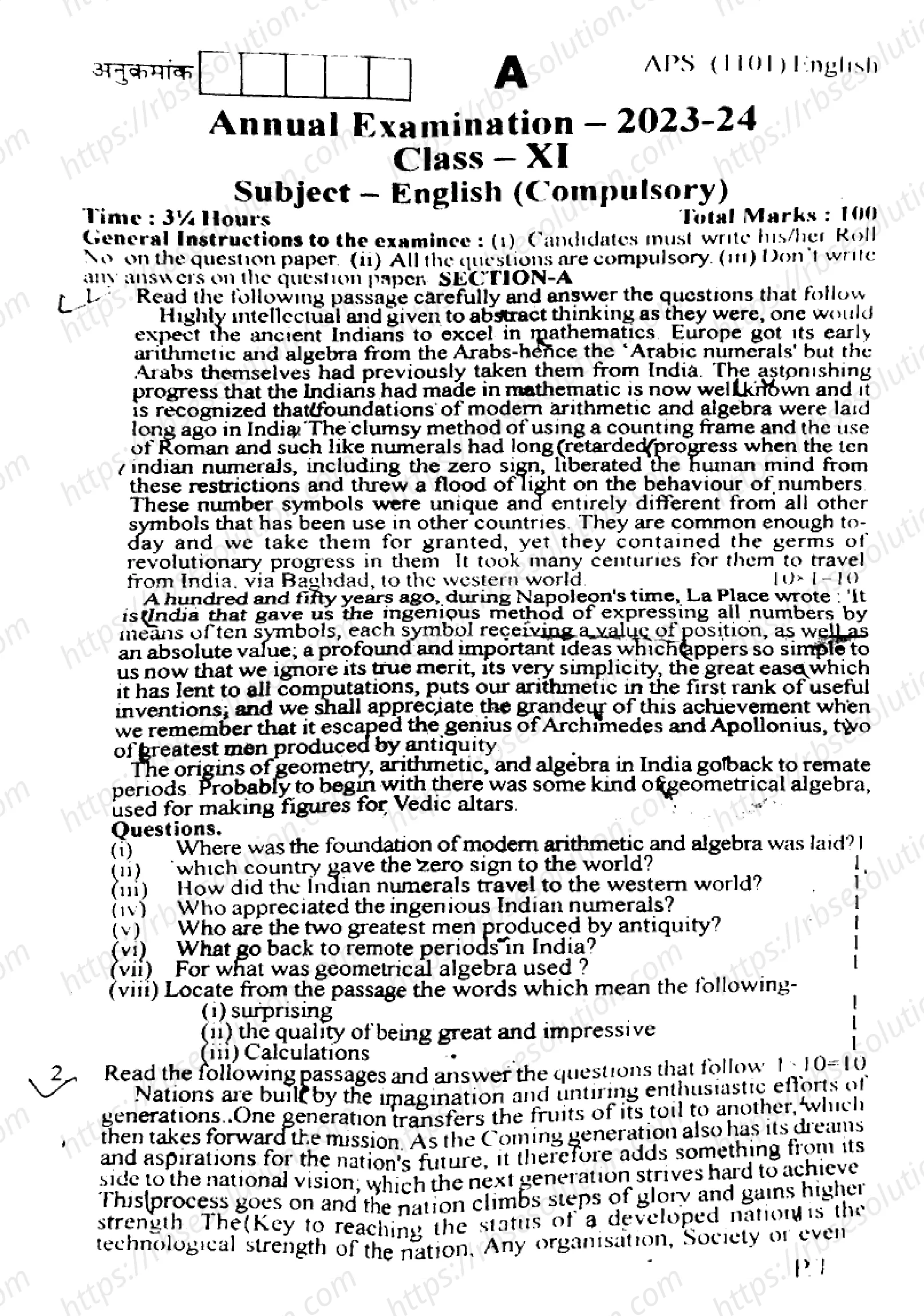
Annual Examination — 2023-24
Class — XI
Subject — English (Compulsory)
Time: 3¼ Hours
Maximum Marks: 100
General Instructions to the examinee:
- Candidates must write his/her Roll No. on the question paper.
- All the questions are compulsory.
- Do not write any answers on the question paper.
SECTION-A
1. Read the following passage carefully and answer the questions that follow:
Highly intellectual and given to abstract thinking as they were, one would expect the ancient Indians to excel in mathematics. Europe got its early arithmetic and algebra from the Arabs—hence the "Arabic numerals"—but the Arabs themselves had previously taken them from India. The astonishing progress that the Indians had made in mathematics is now well known and it is recognized that the foundations of modern arithmetic and algebra were laid long ago in India. The clumsy method of using a counting frame and the use of Roman and such like numerals had long retarded progress when the ten Indian numerals, including the zero sign, liberated the human mind from these restrictions and threw a flood of light on the behaviour of numbers. These number symbols were unique and entirely different from all other symbols that had been used in other countries. They are common enough today and we take them for granted, yet they contained the germs of revolutionary progress in them. It took many centuries for them to travel from India, via Baghdad, to the western world.
A hundred and fifty years ago, during Napoleon's time, Laplace wrote: "It is India that gave us the ingenious method of expressing all numbers by means of ten symbols, each symbol receiving a value of position, as well as an absolute value; a profound and important idea which appears so simple to us now that we ignore its true merit, its very simplicity, the great ease which it has lent to all computations, puts our arithmetic in the first rank of useful inventions; and we shall appreciate the grandeur of this achievement when we remember that it escaped the genius of Archimedes and Apollonius, two of the greatest men produced by antiquity."
The origins of arithmetic and algebra in India go back to remote periods. Probably to begin with there was some kind of geometrical algebra, used for making figures for Vedic altars.
Questions:
-
Where was the foundation of modern arithmetic and algebra laid?
Answer: The foundation of modern arithmetic and algebra was laid in India.
-
Which country gave the zero sign to the world?
Answer: India gave the zero sign to the world.
-
How did the Indian numerals travel to the western world?
Answer: The Indian numerals travelled from India, via Baghdad, to the western world.
-
Who appreciated the ingenious Indian numerals?
Answer: Laplace appreciated the ingenious Indian numerals.
-
Who are the two greatest men produced by antiquity?
Answer: Archimedes and Apollonius are the two greatest men produced by antiquity.
-
What go back to remote periods in India?
Answer: The origins of arithmetic and algebra go back to remote periods in India.
-
For what was geometrical algebra used?
Answer: Geometrical algebra was used for making figures for Vedic altars.
-
Locate from the passage the words which mean the following:
-
surprising
Answer: astonishing
-
the quality of being great and impressive
Answer: grandeur
-
calculations
Answer: computations
-
2. Read the following passage and answer the questions that follow:
Nations are built by the imagination and untiring enthusiastic efforts of generations. One generation transfers the fruits of its toil to another, which then takes forward the mission. As the coming generation also has its dreams and aspirations for the nation's future, it therefore adds something from its side to the national vision, which the next generation strives hard to achieve. This process goes on and the nation climbs steps of glory and gains higher strength. The key to reaching the status of a developed nation is the technological strength of the nation. Any organisation, society or...
SECTION-A
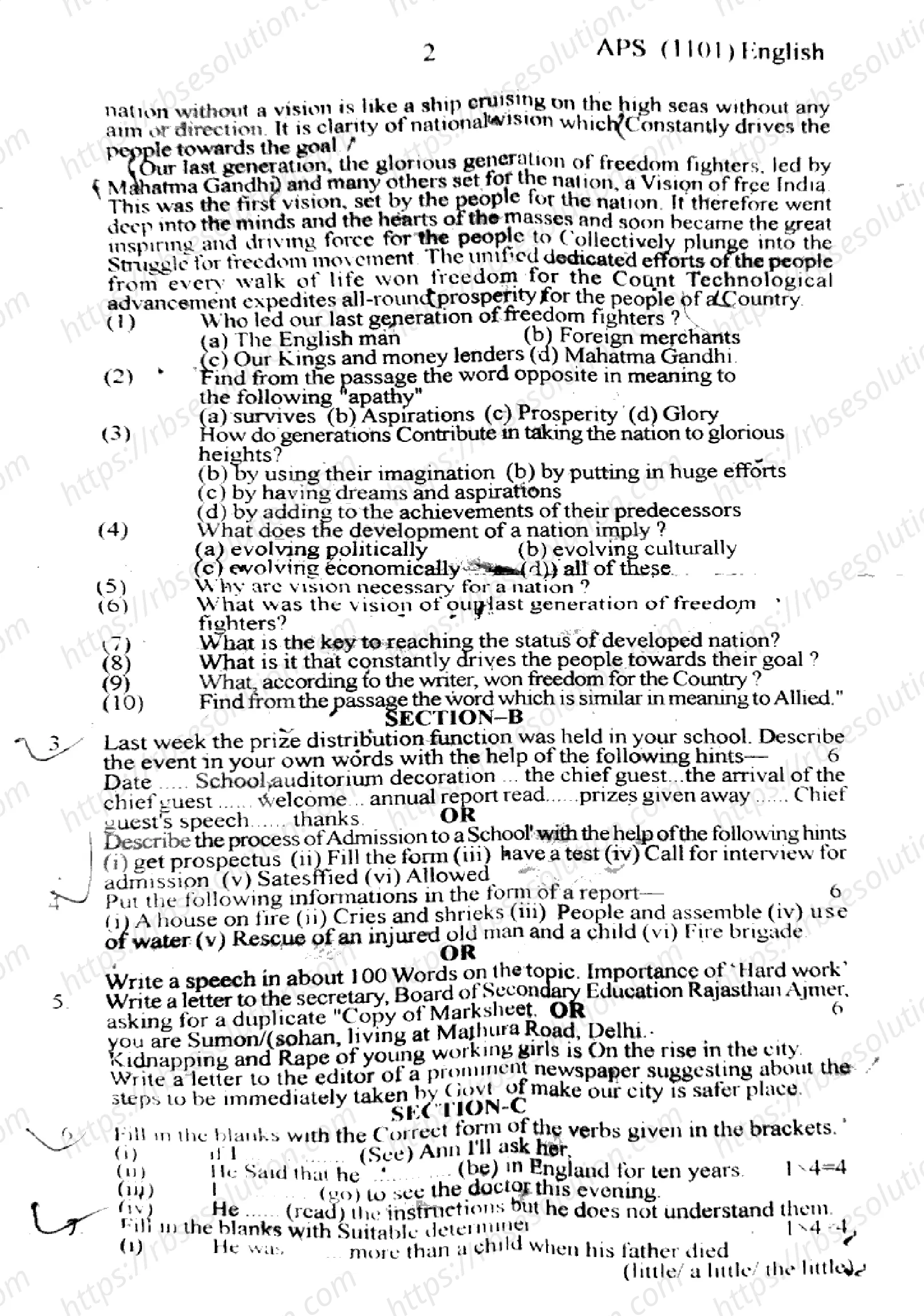
1. Who led our last generation of freedom fighters?
- (a) The English man
- (b) Foreign merchants
- (c) Our Kings and money lenders
- (d) Mahatma Gandhi
Explanation: The passage clearly states that the last generation of freedom fighters was led by Mahatma Gandhi and many others.
2. Find from the passage the word opposite in meaning to "apathy".
- (a) survives
- (b) Aspirations
- (c) Prosperity
- (d) Glory
Explanation: "Apathy" means lack of interest or enthusiasm. The opposite would be "Glory" which signifies great honor or achievement, implying active interest and effort.
3. How do generations contribute in taking the nation to glorious heights?
- (a) by using their imagination
- (b) by putting in huge efforts
- (c) by having dreams and aspirations
- (d) by adding to the achievements of their predecessors
Explanation: The passage implies that each generation builds upon the work of the previous one, adding to the achievements to reach greater heights.
4. What does the development of a nation imply?
- (a) evolving politically
- (b) evolving culturally
- (c) evolving economically
- (d) all of these
Explanation: Development of a nation encompasses political, cultural, and economic evolution, as all are interconnected for overall progress.
5. Why is vision necessary for a nation?
Vision is necessary for a nation because it provides direction and purpose. Without a vision, a nation is like a ship cruising on the high seas without any aim or direction. It drives the people towards a common goal and inspires collective effort.
6. What was the vision of our last generation of freedom fighters?
The vision of our last generation of freedom fighters, led by Mahatma Gandhi, was to achieve a free India. This vision went deep into the minds and hearts of the people and became the driving force for the freedom movement.
7. What is the key to reaching the status of a developed nation?
The key to reaching the status of a developed nation is technological advancement, as it expedites all-round prosperity for the people of a country.
8. What is it that constantly drives the people towards their goal?
Clarity of national vision constantly drives the people towards their goal.
9. What, according to the writer, won freedom for the country?
According to the writer, the unified dedicated efforts of the people from every walk of life won freedom for the country.
10. Find from the passage the word which is similar in meaning to "allied".
The word "unified" in the passage is similar in meaning to "allied".
SECTION-B
2. Last week the prize distribution function was held in your school. Describe the event in your own words with the help of the following hints—
Hints: Date, School auditorium decoration, the chief guest, the arrival of the chief guest, welcome, annual report, prizes given away, Chief guest's speech, thanks.
Last week, our school held its annual prize distribution function. The event took place in the beautifully decorated school auditorium. The chief guest, a renowned educationist, arrived and was warmly welcomed with a bouquet. The principal presented the annual report highlighting the school's achievements. Then, prizes were given away to students for academic excellence, sports, and extracurricular activities. The chief guest delivered an inspiring speech, encouraging students to work hard. The function ended with a vote of thanks.
3. Describe the process of 'Admission to a School' with the help of the following hints—
Hints: (i) get prospectus (ii) Fill the form (iii) have a test (iv) Call for interview for admission (v) Seat allotted (vi) Allowed.
The process of admission to a school begins with obtaining the prospectus from the school office. Then, the admission form is filled with required details and submitted. After that, the student has to appear for an entrance test. Based on the test results, the school calls the student for an interview. If selected, a seat is allotted to the student. Finally, the student is allowed to join the school after completing all formalities.
4. Put the following information in the form of a report—
Hints: (i) A house on fire (ii) Cries and shrieks (iii) People assemble (iv) use of water (v) Rescue of an injured old man and a child (vi) Fire brigade
Report: A House on Fire
Yesterday evening, a house in our locality caught fire. Soon, cries and shrieks were heard from inside. A large crowd assembled at the spot. Some brave people used water to control the flames. They rescued an injured old man and a child from the burning house. The fire brigade arrived later and extinguished the fire completely. No major loss of life was reported.
5. Write a speech in about 100 words on the 'Importance of Hard Work'.
Speech: Importance of Hard Work
Good morning everyone. Today, I want to talk about the importance of hard work. Hard work is the key to success. No great achievement is possible without effort. It builds character, discipline, and perseverance. Hard work turns dreams into reality. Remember, there is no substitute for hard work. So, let us all commit to working hard and achieving our goals. Thank you.
6. Write a letter to the Secretary, Board of Secondary Education, Rajasthan, Ajmer, asking for a duplicate copy of Marksheet. You are Sumit/Sohan, living at Majhura Road, Delhi.
Letter to the Secretary for Duplicate Marksheet
Majhura Road,
Delhi
Date: [Current Date]
To,
The Secretary,
Board of Secondary Education,
Rajasthan, Ajmer
Subject: Request for Duplicate Marksheet
Respected Sir/Madam,
I, Sumit/Sohan, a student of Class 11th, had appeared for the Board examination in the year 2024. Unfortunately, I have lost my original marksheet. I request you to kindly issue me a duplicate copy of my marksheet. My roll number and other details are attached. I shall be grateful for your prompt action.
Thanking you,
Yours faithfully,
Sumit/Sohan
7. Kidnapping and Rape of young working girls is on the rise in the city. Write a letter to the editor of a prominent newspaper suggesting the steps to be immediately taken to make our city a safer place.
Letter to the Editor
Majhura Road,
Delhi
Date: [Current Date]
To,
The Editor,
[Newspaper Name],
Delhi
Subject: Urgent Steps to Make Our City Safer for Women
Dear Sir,
Through your esteemed newspaper, I wish to draw attention to the rising cases of kidnapping and rape of young working girls in our city. Immediate steps are needed: strict patrolling in vulnerable areas, installation of CCTV cameras, self-defense training for girls, and fast-track courts for such cases. Public awareness campaigns and helpline numbers should be widely publicized. I hope the authorities take swift action.
Yours truly,
Sumit/Sohan
SECTION-C
8. Fill in the blanks with the correct form of the verbs given in the brackets.
- If I see (see) Ann, I'll ask her.
- He said that he had been (be) in England for ten years.
- I am going (go) to see the doctor this evening.
- He has read (read) the instructions but he does not understand them.
9. Fill in the blanks with suitable determiners (little/a little/the little).
- He was more than a little upset when his father died.
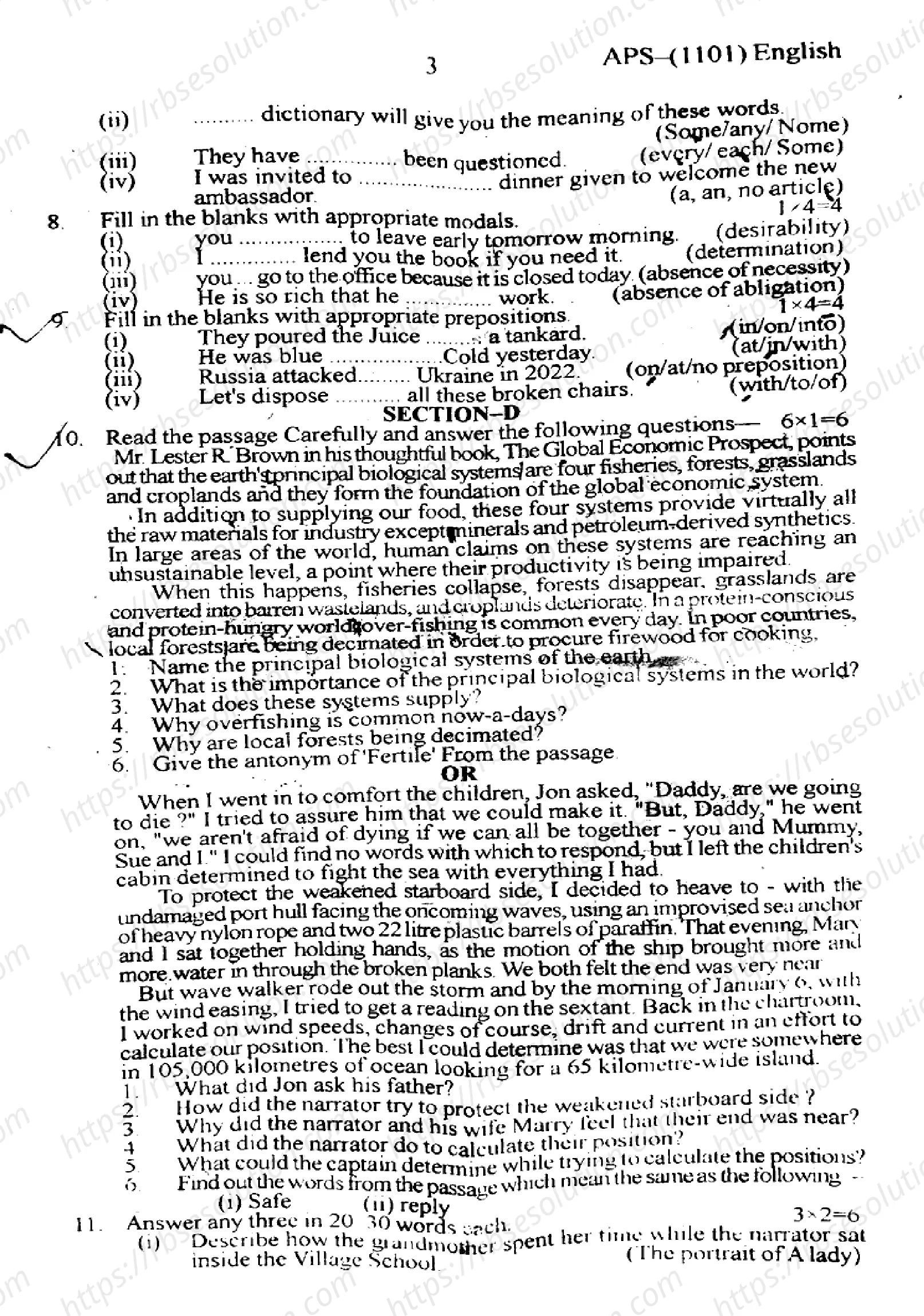
Fill in the blanks with appropriate articles (a, an, the, no article):
- The dictionary will give you the meaning of these words.
- They have some invitations to the dinner.
- He has been questioned every day.
- I am a chosen ambassador to the dinner given to welcome the chief guest.
Fill in the blanks with appropriate modals:
- I must leave early tomorrow morning. (desirability)
- You shall go to the library if you need it. (determination)
- I need not go to the office because it is closed today. (absence of necessity)
- He is so rich that he need not work. (absence of obligation)
Fill in the blanks with appropriate prepositions:
- They poured the juice into a tankard.
- He was blue with cold yesterday.
- Russia attacked on Ukraine in 2022.
- Let's dispose of all these broken chairs.
SECTION-D
Read the passage carefully and answer the following questions:
Passage: Mr. Lester R. Brown in his thoughtful book, The Global Economic Prospect, points out that the earth's principal biological systems are four: fisheries, forests, grasslands and croplands, and they form the foundation of the global economic system. In addition to supplying our food, these four systems provide virtually all the raw materials for industry except minerals and petroleum-derived synthetics. In large areas of the world, human claims on these systems are reaching an unsustainable level, a point where their productivity is being impaired. When this happens, fisheries collapse, forests disappear, grasslands are converted into barren wastelands, and croplands deteriorate. In a protein-conscious and protein-hungry world, overfishing is common every day. In poor countries, local forests are decimated in order to procure firewood for cooking.
-
What is the importance of the principal biological systems in the world?
The principal biological systems form the foundation of the global economic system. They supply our food and provide virtually all raw materials for industry, except minerals and petroleum-derived synthetics.
-
Name the principal biological systems of the earth.
The four principal biological systems are: fisheries, forests, grasslands, and croplands.
-
What do these systems supply?
These systems supply our food and virtually all raw materials for industry, except minerals and petroleum-derived synthetics.
-
Why is overfishing common nowadays?
Overfishing is common nowadays because the world is protein-conscious and protein-hungry, leading to excessive fishing to meet the demand for protein.
-
Why are local forests being decimated?
Local forests are being decimated in poor countries to procure firewood for cooking.
-
Give the antonym of "Fertile" from the passage.
The antonym of "Fertile" in the passage is "barren" (as in "barren wastelands").
Read the passage carefully and answer the following questions:
Passage: When I went in to comfort the children, Jon asked, "Daddy, are we going to die?" I tried to assure him that we could make it. "But, Daddy," he went on, "we aren't afraid of dying if we can all be together - you and Mummy, Sue and I." I could find no words with which to respond, but I left the children's cabin determined to fight the sea with everything I had. To protect the starboard side, I decided to heave to - with the storm jib and heavy weather jib. Whatever the motion of the ship, we brought no more water in through the broken planks. We both felt it brought more and more. But Wavewalker rode out the storm and by the morning of January 6, we could get a reading on the sextant. Back in the chartroom, I calculated our position. The changes of course, drift and current in an effort to cover 105,000 kilometres of ocean. All I could determine was that we were somewhere here, looking for a 65 kilometre-wide island.
-
What did Jon ask his father?
Jon asked his father, "Daddy, are we going to die?"
-
How did the narrator try to protect the weakened starboard side?
The narrator decided to heave to with the storm jib and heavy weather jib to protect the starboard side.
-
Why did the narrator and his wife Mary feel that their end was near?
They felt their end was near because the ship was taking in water through broken planks, and the storm was severe, making survival seem unlikely.
-
What could the narrator do to calculate their position?
The narrator used a sextant to get a reading and then calculated their position in the chartroom, considering changes of course, drift, and current.
-
Find out the words from the passage which mean the same as the following:
- Safe – The word "safe" is not directly used, but the context implies "survive" or "make it." However, from the passage, the closest word indicating safety is "make it" (as in "we could make it").
- Determine – The word "determined" appears in the passage (as in "determined to fight the sea").
Answer any three in 20-30 words:
-
Describe how the author spent her time while the narrator was away. (The Portrait of a Lady)
The author's grandmother spent her time by praying, reading scriptures, and feeding sparrows. She remained calm and composed, waiting for the narrator's return.
-
Describe the scene inside the village school. (The Portrait of a Lady)
The village school was a small, quiet place with children sitting on mats. The teacher taught them the alphabet and prayers. The atmosphere was simple and disciplined.
-
Describe the narrator's feelings when he saw the island. (We're Not Afraid to Die...)
The narrator felt immense relief and joy when he saw the island. It meant safety after the terrifying storm, and he was grateful that his family had survived.
Section C (Long Answer Questions)
11. Answer any two of the following questions in about 60 words:
-
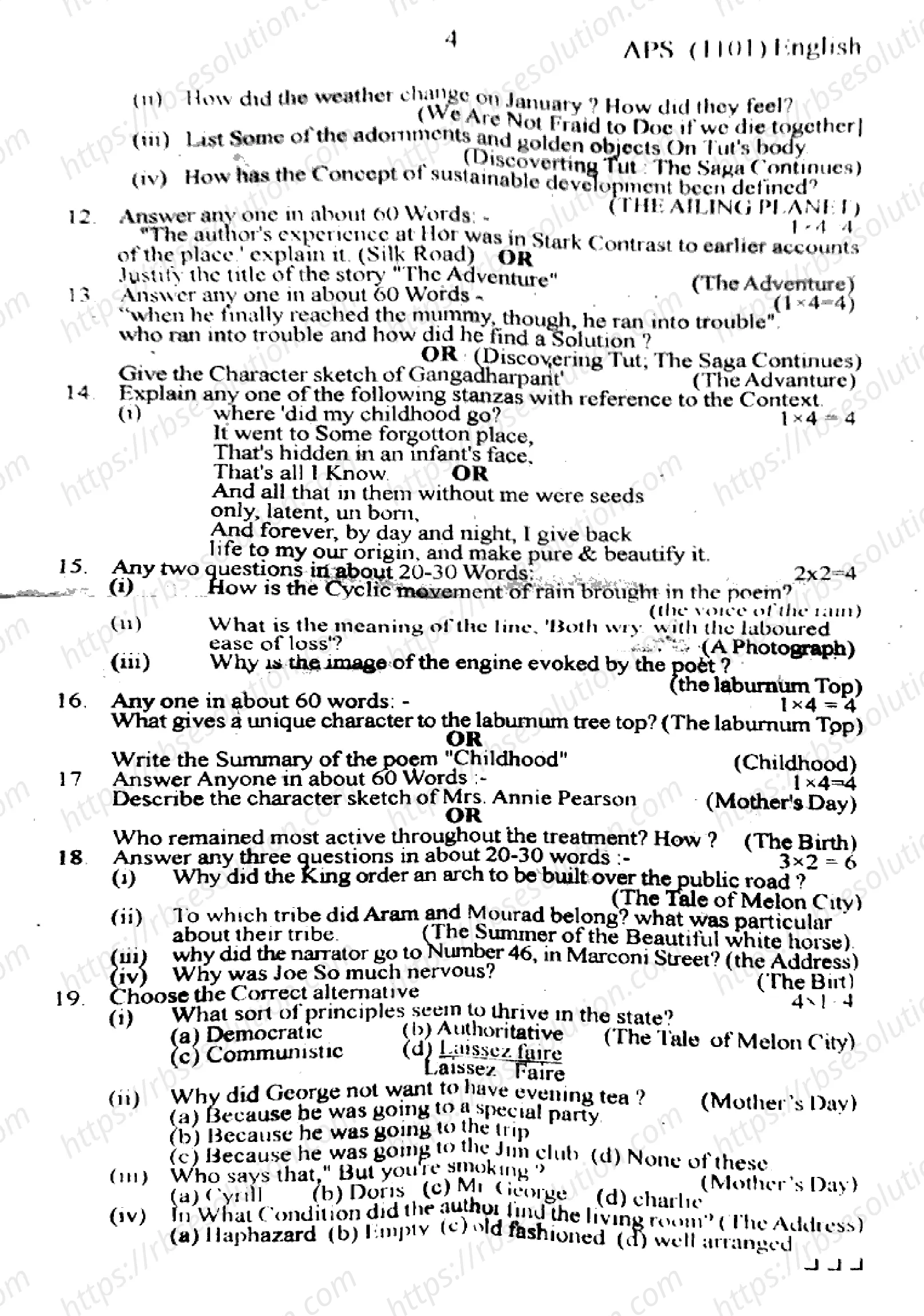
How did the weather change on January? How did they feel? (We Are Not Afraid to Die… If We Can All Be Together)
On January 2, the weather turned extremely rough. The waves grew monstrous, reaching heights of 36 feet. The wind speed increased to 100 knots. The crew felt terrified but determined. They faced the storm with courage, knowing they might die together. Their spirit of unity and resilience helped them survive the ordeal.
-
List some of the adornments and solid objects on Tut's body. (Discovering Tut: The Saga Continues)
King Tut's mummy was adorned with various precious items. These included a solid gold mask, gold amulets, bracelets, rings, and collars. His body was wrapped in linen bandages and placed inside a series of nested coffins. The innermost coffin was made of solid gold. Other objects like daggers, sandals, and a headrest were also placed with him.
-
How has the concept of sustainable development been defined? (The Ailing Planet: The Green Movement's Role)
Sustainable development has been defined as development that meets the needs of the present without compromising the ability of future generations to meet their own needs. It emphasizes responsible use of resources, environmental protection, and long-term ecological balance. This concept contrasts sharply with earlier accounts of unchecked industrial growth and resource exploitation.
12. Answer any one in about 100 words:
-
"The author's experience at Hor was in stark contrast to earlier accounts of the place." Explain. (Silk Road)
The author's experience at Hor was disappointing compared to earlier descriptions. Earlier accounts portrayed Hor as a vibrant, sacred town with beautiful monasteries and a lively atmosphere. However, when the author visited, he found it to be a dusty, desolate place with few people. The famous monastery was under renovation and looked neglected. The stark contrast highlights how places can change over time due to modernization, neglect, or changing circumstances. The author felt a sense of loss and disillusionment.
OR
-
Justify the title of the story "The Adventure." (The Adventure)
The title "The Adventure" is justified because the protagonist, Professor Gaitonde, experiences an extraordinary journey through time and space. After a head injury, he finds himself in an alternate reality where historical events unfolded differently. He travels to Bombay and witnesses a world where the Marathas won the Battle of Panipat. This strange experience is an intellectual and emotional adventure. He explores this alternate world, gathers evidence, and finally returns to his original reality. The story is a thrilling adventure of the mind.
13. Answer any one in about 60 words:
-
"When he finally reached the mummy, though, he ran into trouble." Who ran into trouble and how did he find a solution? (Discovering Tut: The Saga Continues)
Zahi Hawass, the Egyptian archaeologist, ran into trouble. When he tried to lift Tut's mummy from its coffin, the resin had hardened and glued the mummy to the coffin. The intense heat of the sun had melted the resin, making it impossible to move the mummy. Hawass solved the problem by placing the coffin in the sun to further soften the resin, allowing the mummy to be carefully removed.
OR
-
Give the character sketch of Gangadharpant. (The Adventure)
Professor Gangadharpant Gaitonde is a brilliant historian and rational thinker. He is curious, analytical, and deeply committed to historical truth. After his strange experience in an alternate reality, he remains calm and scientific, trying to understand what happened. He is courageous, as he explores the unfamiliar world without fear. He is also humble, accepting that some things are beyond his understanding. His character reflects the spirit of inquiry and intellectual adventure.
14. Explain any one of the following stanzas with reference to the context:
-
"Where did my childhood go?
It went to some forgotten place,
That's hidden in an infant's face,
That's all I know." (Childhood)Context: The poet reflects on the loss of childhood innocence and wonders where it has gone.
Explanation: The poet asks a rhetorical question about the disappearance of childhood. He suggests that childhood has gone to a forgotten place, hidden in the face of an infant. This implies that childhood is not completely lost but remains in the memory and innocence of very young children. The poet accepts that he cannot fully understand this loss; he only knows that childhood is gone and can be seen in babies.
OR
-
"And all that in them without me were seeds only, latent, unborn,
And forever, by day and night, I give back life to my own origin, and make pure and beautify it." (The Voice of the Rain)Context: The rain speaks about its role in nurturing the earth.
Explanation: The rain says that without its presence, all things on earth would remain as mere seeds—potential but not actualized. The rain gives life to its origin (the earth) by falling and nourishing it. It purifies and beautifies the earth constantly, day and night. This cyclical process shows the rain's essential role in sustaining life and maintaining the beauty of nature.
15. Answer any two questions in about 20-30 words:
-
How is the cyclic movement of rain brought in the poem? (The Voice of the Rain)
The rain rises as vapour from the earth, forms clouds, falls back as rain, and returns to its origin. This cycle is continuous and eternal.
-
What is the meaning of the line, "Both wry with the laboured ease of loss"? (A Photograph)
The line means that both the sea and the poet's mother's smile are twisted or distorted by the painful effort of accepting loss, yet they appear effortless.
-
Why is the image of the engine evoked by the poet? (The Laburnum Top)
The poet compares the goldfinch's movement to an engine starting up, showing sudden energy and life. The engine image emphasizes the bird's swift, mechanical action.
16. Answer any one in about 60 words:
-
What gives a unique character to the laburnum tree top? (The Laburnum Top)
The laburnum tree top gets its unique character from the goldfinch bird. The tree is usually silent and still, but when the bird arrives, it becomes alive with movement and sound. The bird's yellow body matches the tree's yellow flowers, creating a beautiful harmony. The tree top transforms into a lively, vibrant space full of chirping and fluttering, making it special and memorable.
OR
-
Write the summary of the poem "Childhood." (Childhood)
The poem "Childhood" by Markus Natten explores the loss of childhood innocence. The poet wonders when he lost his childhood and realizes it happened when he stopped believing in heaven and hell, and when he saw hypocrisy in adults. He concludes that childhood is hidden in an infant's face, suggesting it is not completely lost but remains in memory. The poem reflects on growing up and the painful realization of the world's imperfections.
17. Answer any one in about 60 words:
-
Describe the character sketch of Annie Pearson. (Mother's Day)
Annie Pearson is a devoted wife and mother who is often taken for granted by her family. She is patient, hardworking, and selfless, always putting her family's needs first. However, she is also strong-willed and assertive when she decides to stand up for herself. With the help of her friend Mrs. Fitzgerald, she transforms from a meek housewife into a confident woman who demands respect. She represents the struggles of many women in traditional roles.
OR
-
Who remained most active throughout the treatment? How? (The Birth)
Dr. Andrew Manson remained most active throughout the treatment. He worked tirelessly to revive the stillborn baby. He performed artificial respiration, massaged the baby's chest, and used hot and cold water baths to stimulate breathing. He refused to give up even when others thought it was hopeless. His determination and medical skill eventually succeeded in bringing the baby back to life.
18. Answer any three questions in about 20-30 words:
-
Why did the King order an arch to be built over a public road? (The Tale of Melon City)
The King ordered an arch to be built because he hit his head on a low-hanging beam while riding his horse. He felt insulted and wanted to avoid such incidents.
-
To which tribe did Aram and Mourad belong? What was particular about their tribe? (The Summer of the Beautiful White Horse)
Aram and Mourad belonged to the Armenian tribe. Their tribe was known for its honesty and integrity. They considered stealing a sin and were proud of their reputation for truthfulness.
-
Why did the narrator go to Number 46, Marconi Street? (The Address)
The narrator went to Number 46, Marconi Street to reclaim her mother's belongings that were left with Mrs. Dorling during the war. She wanted to recover her past memories.
-
Why was Joe so much nervous? (The Birth)
Joe was nervous because his wife was in labor and the baby was not breathing after birth. He feared losing both his wife and child, and was anxious about the outcome.
19. Choose the correct alternative:
-
What sort of principles seem to thrive in the state? (The Tale of Melon City)
- (a) Democratic
- (b) Authoritative
- (c) Communistic
- (d) Laissez faire
Explanation: The state in the poem is ruled by an absolute monarch who makes arbitrary decisions, showing authoritative principles.
-
Why did George not want to have evening tea? (Mother's Day)
- (a) Because he was going to a cocktail party
- (b) Because he was going on a trip
- (c) Because he was going to his club
- (d) None of these
Explanation: George wanted to go to his club for the evening, so he did not want to have tea at home.
-
Who says that, "But you! Oh my God!" (Mother's Day)
- (a) Cyril
- (b) Doris
- (c) Mrs. Fitzgerald
- (d) Charlie
Explanation: Mrs. Fitzgerald says this line when she sees Annie Pearson transformed and speaking assertively, expressing shock and admiration.
-
What condition did the narrator find the living room in? (The Address)
- (a) Haphazard
- (b) Empty
- (c) Old-fashioned
- (d) Well arranged
Explanation: The narrator found the living room well arranged, with all the familiar objects from her mother's house neatly placed, which shocked her.