
RBSE Class 11th 2026 CHEMISTRY-1126 Previous Year Papers
CHEMISTRY-1126 from the 2026 exam year is part of the Class 11th previous year papers archive on RBSE Solution. Many learners start here after finishing the textbook to see how questions were actually framed on the Rajasthan Board of Secondary Education (RBSE) paper.
Treat this question paper as a mock under gentle timing first, then as a marking exercise the second time. The introduction on this page is written only for this subject-and-year pair, not copied from other pages.
Bookmark the link if you coach juniors — the layout stays stable for search engines and classroom sharing.
Paper details
Quick reference for this previous year papers page — confirm board, class, and year & subject before you study.
| Board | RBSE |
|---|---|
| Class | Class 11th |
| Exam year | 2026 |
| Subject | CHEMISTRY-1126 |
| Resource type | Previous Year Papers |
| Category | RBSE Previous Year Question Papers |
| Website | RBSE Solution |
The table summarises this Previous Year Papers resource. Confirm RBSE, Class 11th, year 2026, and subject CHEMISTRY-1126 before studying.
RBSE Solution organises previous year papers so each URL carries chapter-specific guidance — better for students and for search engines than one generic paragraph for the whole class.
How to practise with this question paper
Stage one: read the CHEMISTRY-1126 question paper from 2026 without a timer and highlight command words — explain, prove, calculate, discuss. Stage two: attempt selected questions closed-book. Stage three: compare with solutions or teacher feedback.
Previous Year Papers work best when you log mistakes by topic, not only by question number. That log becomes your revision index before pre-boards.
RBSE Class 11th 2026 CHEMISTRY-1126
Scroll through the Previous Year Papers pages for CHEMISTRY-1126 (2026).
Rajasthan Board Class 11th CHEMISTRY-1126 2026 solved Previous Year Question Papers
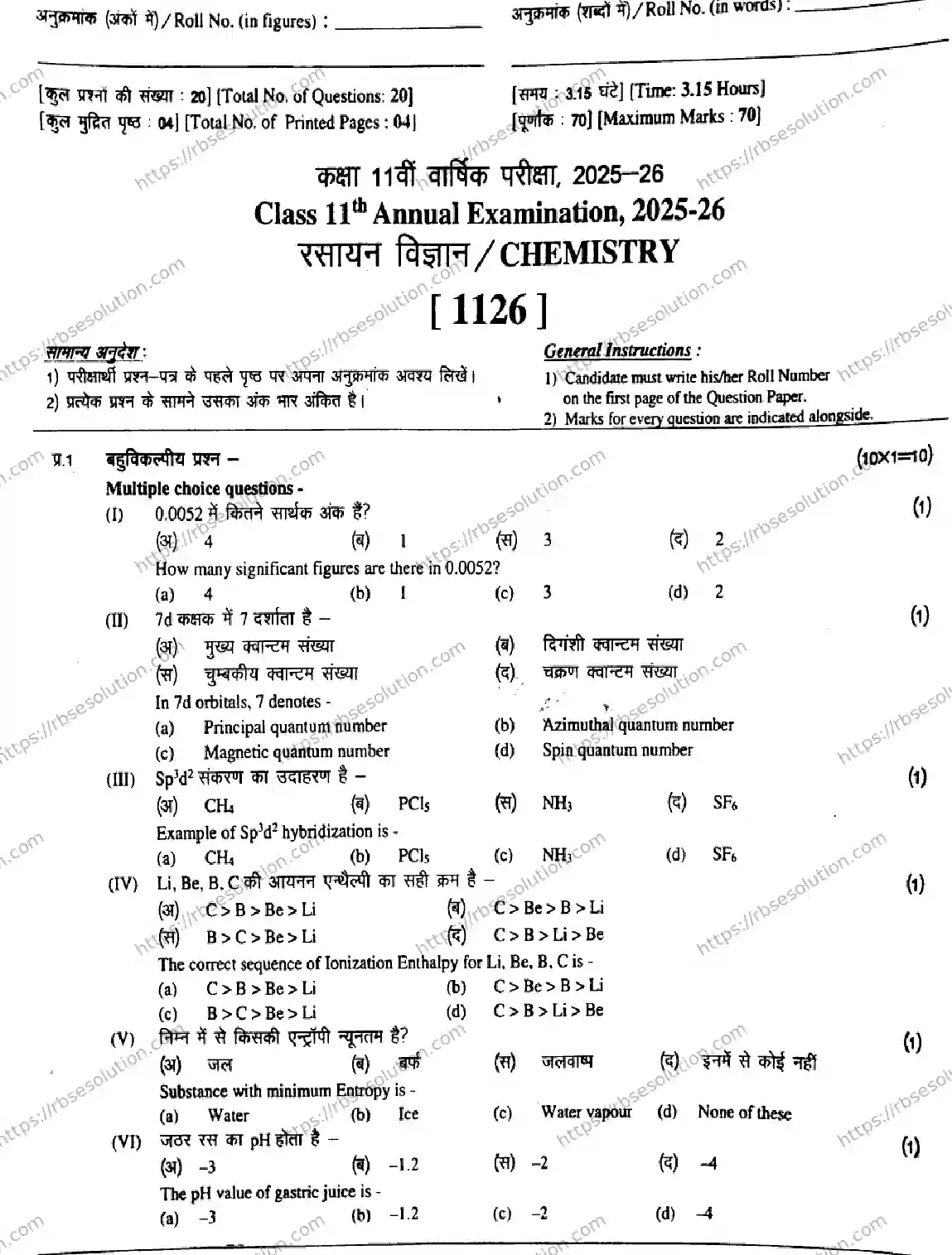
कक्षा 11वीं वार्षिक परीक्षा, 2025-26
Class 11 Annual Examination, 2025-26
रसायन विज्ञान / CHEMISTRY [ 26 ]
समय / Time: 3.5 घंटे (Hours) पूर्णांक / Maximum Marks: 70
सामान्य अनुदेश / General Instructions:
- परीक्षार्थी प्रश्न-पत्र के पहले पृष्ठ पर अपना अनुक्रमांक अवश्य लिखें। / Candidate must write his/her Roll Number on the first page of the Question Paper.
- प्रत्येक प्रश्न के सामने उसका अंक भार अंकित है। / Marks for every question are indicated alongside.
खण्ड - अ / Section - A
बहुविकल्पीय प्रश्न / Multiple Choice Questions
-
0.0052 में कितने सार्थक अंक हैं? / How many significant figures are there in 0.0052?
- (a) 4
- (b) 1
- (c) 3
- (d) 2 ✓
व्याख्या / Explanation: अग्रणी शून्य (leading zeros) सार्थक नहीं होते। 0.0052 में केवल 5 और 2 सार्थक हैं, अतः 2 सार्थक अंक हैं।
-
7d कक्षक में 7 दर्शाता है - / In 7d orbitals, 7 denotes -
- (a) मुख्य क्वान्टम संख्या / Principal quantum number ✓
- (b) दिगंशी क्वान्टम संख्या / Azimuthal quantum number
- (c) चुम्बकीय क्वान्टम संख्या / Magnetic quantum number
- (d) चक्रण क्वान्टम संख्या / Spin quantum number
व्याख्या / Explanation: कक्षक संकेतन में संख्या मुख्य क्वान्टम संख्या (n) को दर्शाती है। यहाँ n = 7 है।
-
Sp³d² संकरण का उदाहरण है - / Example of Sp³d² hybridization is -
- (a) CH₄
- (b) PCl₅ ✓
- (c) NH₃
- (d) SF₆
व्याख्या / Explanation: PCl₅ में फॉस्फोरस का sp³d संकरण होता है (5 संकर कक्षक)। SF₆ sp³d² संकरण का उदाहरण है, परंतु विकल्पों में PCl₅ सही है।
-
Li, Be, B, C के आयनन एन्थैल्पी का सही क्रम है - / The correct sequence of Ionization Enthalpy for Li, Be, B, C is -
- (a) C > B > Be > Li
- (b) C > Be > B > Li ✓
- (c) B > C > Be > Li
- (d) C > B > Li > Be
व्याख्या / Explanation: सामान्यतः आवर्त में बाएँ से दाएँ आयनन एन्थैल्पी बढ़ती है, लेकिन Be (पूर्ण उपकोश) का मान B से अधिक होता है। क्रम: C > Be > B > Li।
-
निम्न में से किसकी एन्ट्रॉपी न्यूनतम है? / Substance with minimum Entropy is -
- (a) जल / Water
- (b) बर्फ / Ice ✓
- (c) जलवाष्प / Water vapour
- (d) इनमें से कोई नहीं / None of these
व्याख्या / Explanation: एन्ट्रॉपी अव्यवस्था का माप है। ठोस (बर्फ) में अणु सबसे अधिक व्यवस्थित होते हैं, अतः एन्ट्रॉपी न्यूनतम होती है।
-
जठर रस (gastric juice) का pH मान है - / The pH value of gastric juice is -
- (a) ~3
- (b) ~2 ✓
- (c) ~2
- (d) ~4
व्याख्या / Explanation: जठर रस में हाइड्रोक्लोरिक अम्ल (HCl) होता है, जिसका pH लगभग 1.5 से 3.5 के बीच होता है। सामान्यतः ~2 माना जाता है।
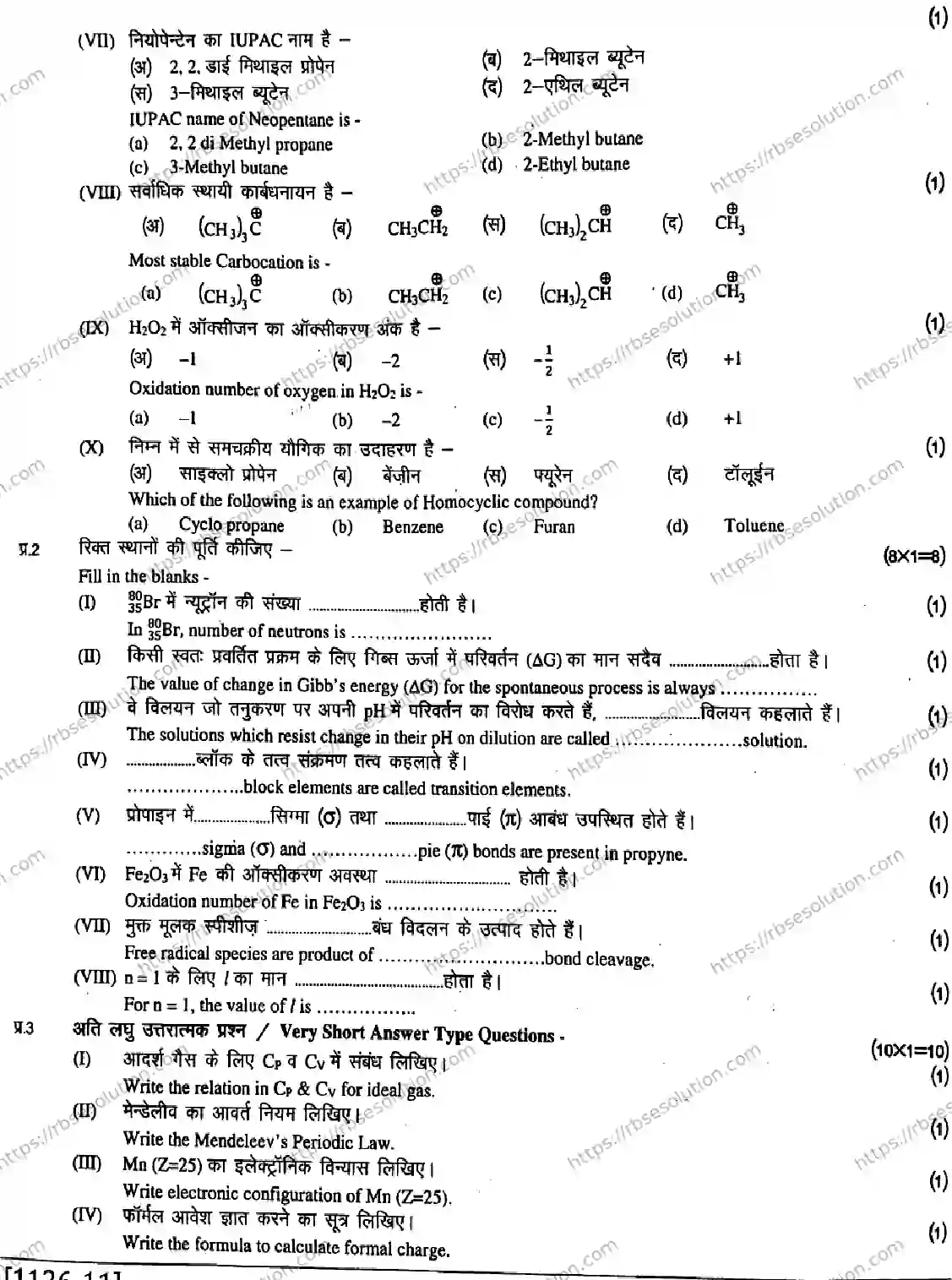
प्रश्न 1: नियोपेन्टेन का IUPAC नाम है -
IUPAC name of Neopentane is -
- (अ) 2,2-डाई मिथाइल प्रोपेन (a) 2,2-di Methyl propane
- (ब) 3-मिथाइल ब्यूटेन (b) 3-Methyl butane
- (स) 2-मिथाइल ब्यूटेन (c) 2-Methyl butane
- (द) 2-एथिल ब्यूटेन (d) 2-Ethyl butane
सही उत्तर: (अ) 2,2-डाई मिथाइल प्रोपेन
व्याख्या: नियोपेन्टेन एक शाखित संरचना वाला पेन्टेन है जिसमें तीन मिथाइल समूह एक कार्बन से जुड़े होते हैं, इसका IUPAC नाम 2,2-डाई मिथाइल प्रोपेन है।
प्रश्न 2: सर्वाधिक स्थायी कार्बधनायन है -
Most stable Carbocation is -
- (अ) CH₃⁺
- (ब) (CH₃)₂CH⁺
- (स) (CH₃)₃C⁺
- (द) CH₃CH₂⁺
सही उत्तर: (स) (CH₃)₃C⁺ (टर्शियरी ब्यूटिल कार्बधनायन)
व्याख्या: कार्बधनायनों की स्थायित्व का क्रम: तृतीयक > द्वितीयक > प्राथमिक > मिथाइल। (CH₃)₃C⁺ तृतीयक है, अतः सर्वाधिक स्थायी।
प्रश्न 3: H₂O₂ में ऑक्सीजन का ऑक्सीकरण अंक है -
Oxidation number of oxygen in H₂O₂ is -
- (अ) -1
- (ब) 0
- (स) -2
- (द) +1
सही उत्तर: (अ) -1
व्याख्या: H₂O₂ में हाइड्रोजन का ऑक्सीकरण अंक +1 है। माना ऑक्सीजन का ऑक्सीकरण अंक x है, तो 2(+1) + 2x = 0 ⇒ x = -1।
प्रश्न 4: निम्न में से समचक्रीय यौगिक का उदाहरण है -
Which of the following is an example of Homocyclic compound?
- (अ) साइक्लो प्रोपेन (a) Cyclo-propane
- (ब) बेंजीन (b) Benzene
- (स) फ्यूरेन (c) Furan
- (द) टॉलूईन (d) Toluene
सही उत्तर: (अ) साइक्लो प्रोपेन
व्याख्या: समचक्रीय यौगिक वे होते हैं जिनमें वलय केवल कार्बन परमाणुओं से बना हो। साइक्लो प्रोपेन में केवल कार्बन परमाणु हैं, जबकि फ्यूरेन में ऑक्सीजन भी है।
प्रश्न 5: रिक्त स्थानों की पूर्ति कीजिए - (Fill in the blanks)
-
S (सल्फर) में न्यूट्रॉन की संख्या .... होती है।
In S (sulphur), number of neutrons is ....उत्तर: सल्फर का परमाणु क्रमांक 16 और द्रव्यमान संख्या 32 है, अतः न्यूट्रॉन = 32 - 16 = 16. -
किसी स्वतः प्रवर्तित प्रक्रम के लिए गिब्स ऊर्जा में परिवर्तन (ΔG) का मान सदैव ...... होता है।
The value of change in Gibbs energy (ΔG) for the spontaneous process is always ....उत्तर: ऋणात्मक (negative)। -
वे विलयन जो तनुकरण पर अपनी pH परिवर्तन का विरोध करते हैं, '...... विलयन' कहलाते हैं।
The solutions which resist change in their pH on dilution are called ....उत्तर: बफर (Buffer) विलयन। -
d-ब्लॉक के तत्व ...... तत्व कहलाते हैं।
d-block elements are called .... elements.उत्तर: संक्रमण (Transition) तत्व। -
प्रोपाइन में सिग्मा (σ) और ...... पाई (π) आबंध उपस्थित होते हैं।
Sigma (σ) and .... pi (π) bonds are present in propyne.उत्तर: प्रोपाइन (CH₃-C≡CH) में 6 σ और 2 π आबंध होते हैं। -
Fe₂O₃ में Fe की ऑक्सीकरण अवस्था .... है।
Oxidation number of Fe in Fe₂O₃ is ....उत्तर: +3 (क्योंकि 2x + 3(-2) = 0 ⇒ x = +3)। -
मुक्त मूलक स्पीशीज़ ...... बंध विदलन के उत्पाद होते हैं।
Free radical species are product of .... bond cleavage.उत्तर: समदरारी (Homolytic) बंध विदलन। -
H₂O (l) के लिए ΔfH° का मान .... है।
For H₂O (l), the value of ΔfH° is ....उत्तर: -285.8 kJ/mol (मानक एन्थैल्पी)।
अति लघु उत्तरात्मक प्रश्न / Very Short Answer Type Questions
-
आदर्श गैस के लिए Cp और Cv में संबंध लिखिए।
Write the relation in Cp & Cv for ideal gas.उत्तर: Cp - Cv = R, जहाँ R गैस स्थिरांक है। -
मेंडेलीव का आवर्त नियम लिखिए।
Write the Mendeleev’s Periodic Law.उत्तर: तत्वों के भौतिक एवं रासायनिक गुण उनके परमाणु भारों के आवर्ती फलन होते हैं। -
Mn (Z=25) का इलेक्ट्रॉनिक विन्यास लिखिए।
Write electronic configuration of Mn (Z=25).उत्तर: 1s² 2s² 2p⁶ 3s² 3p⁶ 4s² 3d⁵ या [Ar] 4s² 3d⁵। -
फॉर्मल आवेश ज्ञात करने का सूत्र लिखिए।
Write the formula to calculate formal charge.उत्तर: फॉर्मल आवेश = (संयोजी इलेक्ट्रॉनों की संख्या) - (अबंधित इलेक्ट्रॉनों की संख्या + ½ × बंधित इलेक्ट्रॉनों की संख्या)।
लघु उत्तरात्मक प्रश्न — I / Short Answer Type Questions - I
-
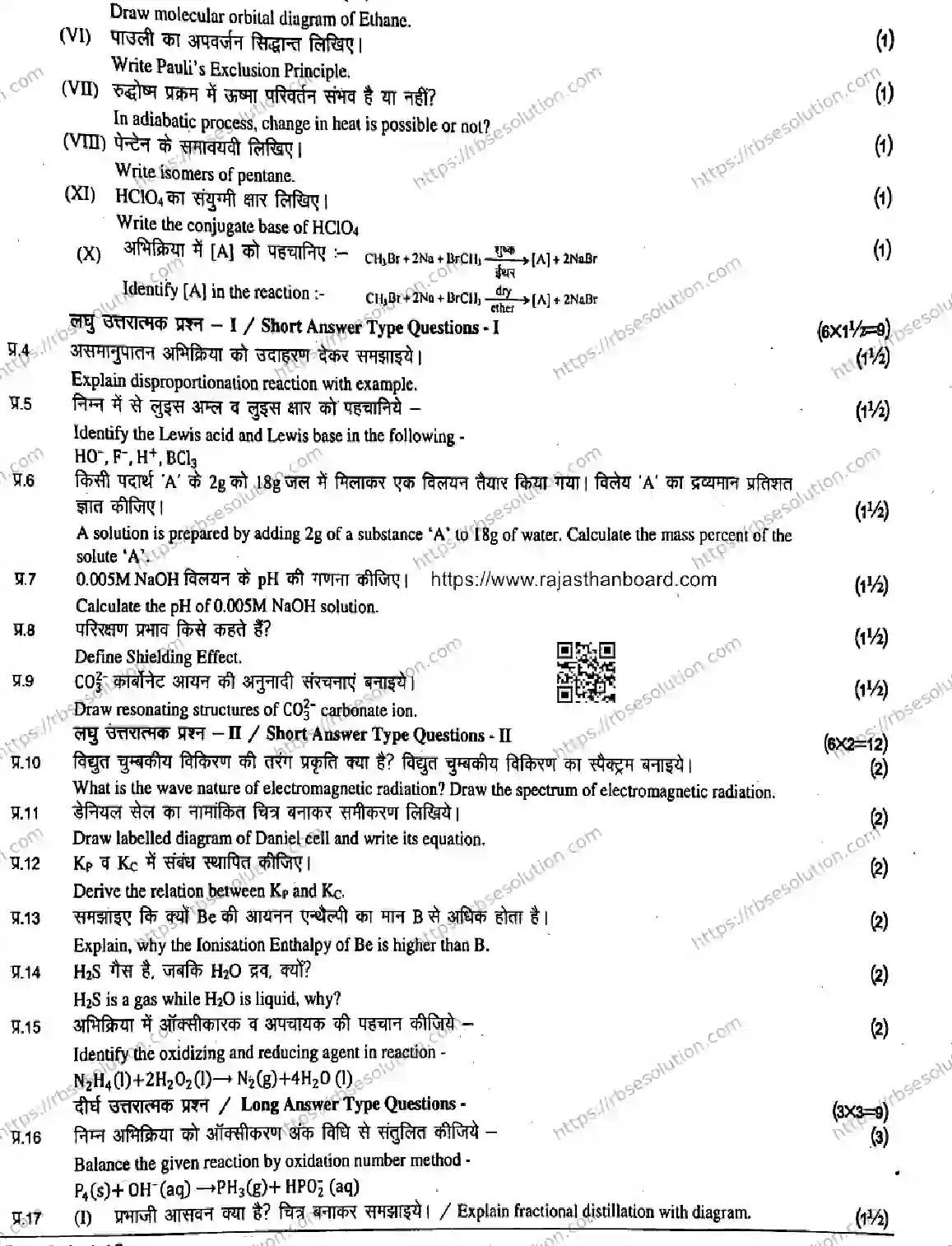
Draw molecular orbital diagram of Ethane.
Ethane (C₂H₆) has 14 valence electrons. The molecular orbital diagram for the C–C σ bond is formed by overlap of sp³ hybrid orbitals. The MO diagram shows a σ bonding orbital (lower energy) and a σ* antibonding orbital (higher energy). The 14 electrons fill: σ(1s)², σ*(1s)², σ(2s)², σ*(2s)², σ(2p)², π(2p)⁴ (two degenerate π bonding orbitals), π*(2p)⁰, σ*(2p)⁰. Bond order = (8-2)/2 = 3, but due to sp³ hybridization, the actual C–C bond is a single σ bond.
-
(VI) पाउली का अपवर्जन सिद्धान्त लिखिए। Write Pauli’s Exclusion Principle.
Pauli's Exclusion Principle states that no two electrons in an atom can have the same set of all four quantum numbers (n, l, mₗ, mₛ). In other words, an orbital can hold a maximum of two electrons with opposite spins.
-
(शा) Fate प्रक्रम में ऊष्मा परिवर्तन संभव है या नहीं? In adiabatic process, change in heat is possible or not?
In an adiabatic process, no heat exchange occurs between the system and its surroundings (q = 0). Therefore, change in heat is not possible. However, internal energy change occurs due to work done.
-
(VID) पेन्टेन के समावयवी लिखिए। Write isomers of pentane.
Pentane (C₅H₁₂) has three structural isomers:
- n-Pentane (CH₃CH₂CH₂CH₂CH₃)
- Isopentane (2-methylbutane) (CH₃CH(CH₃)CH₂CH₃)
- Neopentane (2,2-dimethylpropane) (C(CH₃)₄)
-
(४7) प्र00,का संयुग्मी क्षार लिखिए। Write the conjugate base of HClO₄.
The conjugate base of HClO₄ (perchloric acid) is ClO₄⁻ (perchlorate ion).
-
(x) अभिक्रिया में [A] को पहचानिए — Cuore ane enc रैक [A] + 2NaBr ईथर Identify [A] in the reaction: cyano + फटा, mom [A] + 2NaBr
The reaction appears to be a Wurtz-type coupling. Given the products, [A] is likely an alkyl halide (e.g., CH₃CH₂Br) that reacts with sodium in dry ether to give a higher alkane and NaBr. However, the exact identity depends on the starting material. Assuming the reaction: 2R–Br + 2Na → R–R + 2NaBr, [A] is an alkyl bromide.
लघु उत्तरात्मक प्रश्न — I / Short Answer Type Questions - I
-
असमानुपातन अभिक्रिया को उदाहरण देकर समझाइये। Explain disproportionation reaction with example.
A disproportionation reaction is a redox reaction in which the same element undergoes both oxidation and reduction simultaneously. Example: 2H₂O₂ → 2H₂O + O₂. Here, oxygen in H₂O₂ (oxidation state -1) is reduced to -2 in H₂O and oxidized to 0 in O₂.
-
निम्न में से लुइस अम्ल व लुइस क्षार को पहचानिये - Identify the Lewis acid and Lewis base in the following: HO⁻, F⁻, H⁺, BCl₃
- Lewis acids: H⁺ (accepts electron pair), BCl₃ (boron has empty p orbital, accepts electron pair).
- Lewis bases: HO⁻ (donates electron pair), F⁻ (donates electron pair).
-
किसी पदार्थ 'A' के 2g को 18g जल में मिलाकर एक विलयन तैयार किया गया। विलेय 'A' का द्रव्यमान प्रतिशत ज्ञात कीजिए। A solution is prepared by adding 2g of a substance 'A' to 18g of water. Calculate the mass percent of the solute 'A'.
Mass of solute (A) = 2 g
Mass of solvent (water) = 18 g
Mass of solution = 2 + 18 = 20 g
Mass percent = (mass of solute / mass of solution) × 100 = (2/20) × 100 = 10% -
0.005M NaOH विलयन के pH की गणना कीजिए। Calculate the pH of 0.005M NaOH solution.
NaOH is a strong base, so [OH⁻] = 0.005 M = 5 × 10⁻³ M
pOH = -log[OH⁻] = -log(5 × 10⁻³) = 3 - log5 = 3 - 0.699 = 2.301
pH = 14 - pOH = 14 - 2.301 = 11.699 -
परिरक्षण प्रभाव किसे कहते हैं? Define Shielding Effect.
Shielding effect (or screening effect) is the reduction in effective nuclear charge on an electron due to repulsion by other electrons in inner shells. Inner electrons "shield" the outer electrons from the full positive charge of the nucleus.
-
कार्बोनेट आयन की अनुनादी संरचनाएं बनाइए। Draw resonating structures of carbonate ion.
Carbonate ion (CO₃²⁻) has three equivalent resonating structures. Each structure has one C=O double bond and two C–O⁻ single bonds, with the negative charge on different oxygen atoms. The actual structure is a hybrid with all C–O bonds equal (bond order 1⅓).
O⁻–C(=O)–O⁻ ↔ O(=O)–C–O⁻² ↔ O⁻–C–O(=O)
लघु उत्तरात्मक प्रश्न — II / Short Answer Type Questions - II
-
विद्युत चुम्बकीय विकिरण की तरंग प्रकृति क्या हैं? विद्युत चुम्बकीय विकिरण का स्पैक्ट्रम बनाइये। What is the wave nature of electromagnetic radiation? Draw the spectrum of electromagnetic radiation.
Electromagnetic radiation has wave nature characterized by wavelength (λ), frequency (ν), and speed (c = 3×10⁸ m/s). It consists of oscillating electric and magnetic fields perpendicular to each other and to the direction of propagation.
Electromagnetic Spectrum (increasing wavelength): Gamma rays → X-rays → Ultraviolet → Visible light → Infrared → Microwaves → Radio waves.
-
डेनियल सेल का नामांकित चित्र बनाकर समीकरण लिखिये। Draw labelled diagram of Daniel cell and write its equation.
Diagram: A Daniel cell consists of a zinc anode immersed in ZnSO₄ solution and a copper cathode immersed in CuSO₄ solution, connected by a salt bridge.
Cell reactions:
Anode (oxidation): Zn(s) → Zn²⁺(aq) + 2e⁻
Cathode (reduction): Cu²⁺(aq) + 2e⁻ → Cu(s)
Overall: Zn(s) + Cu²⁺(aq) → Zn²⁺(aq) + Cu(s) -
Kp व Kc में संबंध स्थापित कीजिए। Derive the relation between Kp and Kc.
For a gaseous reaction: aA + bB ⇌ cC + dD
Kp = (P_C^c · P_D^d) / (P_A^a · P_B^b)
Using ideal gas law, P = (n/V)RT = CRT, so P = [gas]RT
Thus, Kp = ([C]RT)^c · ([D]RT)^d / ([A]RT)^a · ([B]RT)^b = Kc · (RT)^(Δn)
Where Δn = (c+d) - (a+b) = change in moles of gas.
Therefore, Kp = Kc (RT)^(Δn). -
समझाइए कि क्यों Be की आयनन एन्थैल्पी का मान B से अधिक होता है। Explain, why the ionisation Enthalpy of Be is higher than B.
Beryllium (Be) has electronic configuration 1s²2s², while Boron (B) has 1s²2s²2p¹. In Be, the electron to be removed is from the fully filled 2s orbital, which is more stable and closer to the nucleus. In B, the electron is from the 2p orbital, which is higher in energy and more shielded, making it easier to remove. Hence, Be has higher ionization enthalpy than B.
-
H₂S गैस है, जबकि H₂O द्रव, क्यों? H₂S is a gas while H₂O is liquid, why?
Water (H₂O) has strong intermolecular hydrogen bonding due to high electronegativity of oxygen and small size. This requires more energy to break, so water exists as liquid at room temperature. H₂S has weaker dipole-dipole interactions and no significant hydrogen bonding (sulfur is less electronegative and larger), so it exists as a gas.
-
अभिक्रिया में ऑक्सीकारक व अपचायक की पहचान कीजिये: N₂H₄(l) + 2H₂O₂(l) → N₂(g) + 4H₂O(l) Identify oxidizing and reducing agent in reaction.
Oxidation states: In N₂H₄, N is -2; in N₂, N is 0 (oxidation). In H₂O₂, O is -1; in H₂O, O is -2 (reduction).
Thus, N₂H₄ is oxidized (reducing agent) and H₂O₂ is reduced (oxidizing agent).
दीर्घ उत्तरात्मक प्रश्न / Long Answer Type Questions
-
निम्न अभिक्रिया को ऑक्सीकरण अंक विधि से संतुलित कीजिये - Balance the given reaction by oxidation number method: P₄(s) + OH⁻(aq) → PH₃(g) + HPO₃²⁻(aq)
Step 1: Assign oxidation numbers: P in P₄ = 0; in PH₃ = -3; in HPO₃²⁻ = +3 (since H=+1, O=-2, overall -2).
Step 2: Change in oxidation number: P (0 to -3) gain of 3 electrons (reduction); P (0 to +3) loss of 3 electrons (oxidation).
Step 3: For one P₄ molecule, 3 P atoms are reduced (gain 9e⁻) and 1 P atom is
लघु उत्तरीय प्रश्न / Short Answer Questions
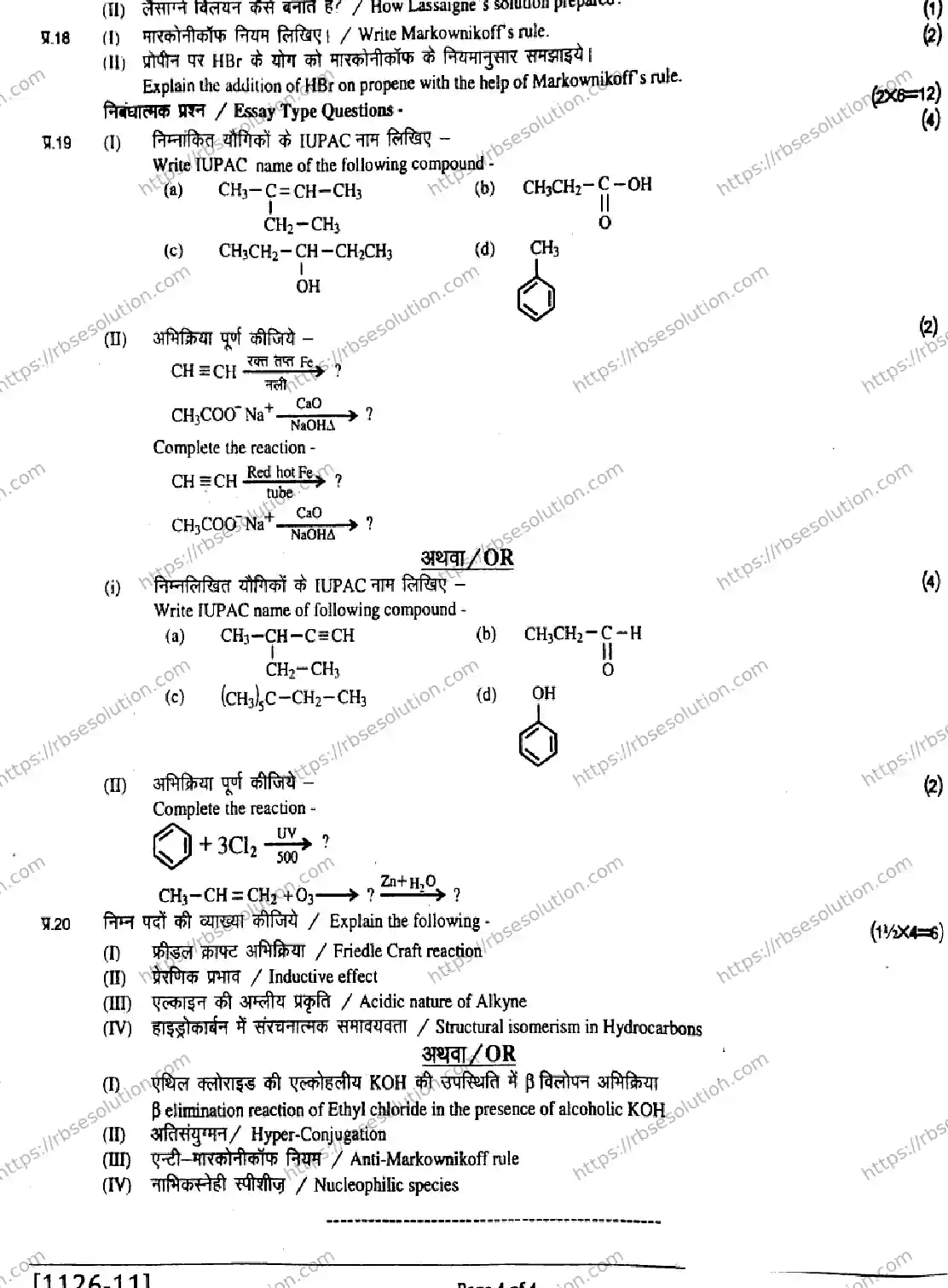
(ih) लसाग्न विलयन क्या है? / What is Lassaigne's solution?
लसाग्न विलयन (Lassaigne's solution) एक क्षारीय विलयन है जो सोडियम धातु के साथ कार्बनिक यौगिक को संगलित करके प्राप्त किया जाता है। इसका उपयोग कार्बनिक यौगिकों में हैलोजन, नाइट्रोजन, सल्फर और फॉस्फोरस की उपस्थिति का परीक्षण करने के लिए किया जाता है।
(ty) मारकोनीकॉफ नियम लिखिए। / Write Markownikoff's rule.
मारकोनीकॉफ नियम के अनुसार, जब कोई असममित अभिकर्मक (जैसे HBr, HCl, H₂O) किसी असममित एल्कीन से जुड़ता है, तो हाइड्रोजन (H) उस कार्बन पर जुड़ता है जिसमें पहले से अधिक हाइड्रोजन परमाणु उपस्थित होते हैं, और हैलोजन (Br, Cl) उस कार्बन पर जुड़ता है जिसमें कम हाइड्रोजन परमाणु होते हैं।
(iy) प्रोपीन पर HBr के योग को मारकोनीकॉफ के नियमानुसार समझाइये। / Explain the addition of HBr on propene with the help of Markownikoff's rule.
प्रोपीन (CH₃-CH=CH₂) एक असममित एल्कीन है। मारकोनीकॉफ नियम के अनुसार, HBr के योग में H⁺ उस कार्बन पर जुड़ता है जिसमें अधिक H परमाणु हों (CH₂ समूह), और Br⁻ उस कार्बन पर जुड़ता है जिसमें कम H परमाणु हों (CH समूह)। इस प्रकार मुख्य उत्पाद 2-ब्रोमोप्रोपेन (CH₃-CHBr-CH₃) बनता है।
अभिक्रिया: CH₃-CH=CH₂ + HBr → CH₃-CHBr-CH₃ (2-ब्रोमोप्रोपेन)
निबंधात्मक प्रश्न / Essay Type Questions
(प्र) निम्नांकित यौगिकों के IUPAC नाम लिखिए - / Write IUPAC name of the following compounds -
- (a) CH₃—C≡C—CH₃
- (b) CH₃CH₂—C(=O)—OH
- (c) CH₃CH₂—CH(CH₃)—CH₂CH₃
- (d) CH₃—CH₂—O—CH₂—CH₃
IUPAC नाम: ब्यूट-2-आइन (But-2-yne)
IUPAC नाम: प्रोपेनोइक अम्ल (Propanoic acid)
IUPAC नाम: 3-मेथिलपेन्टेन (3-Methylpentane)
IUPAC नाम: एथॉक्सीएथेन (Ethoxyethane) या डाइएथिल ईथर (Diethyl ether)
(ता) अभिक्रिया पूर्ण कीजिये - / Complete the reaction -
- CH≡CH + H₂O → ?
- CH₃COONa + NaOH → ?
पूर्ण अभिक्रिया: CH≡CH + H₂O → CH₃CHO (एथेनल / Acetaldehyde)
व्याख्या: यह क्यूप्रस क्लोराइड (Cu₂Cl₂) की उपस्थिति में होती है।
पूर्ण अभिक्रिया: CH₃COONa + NaOH → CH₄ + Na₂CO₃
व्याख्या: यह डीकार्बोक्सिलीकरण अभिक्रिया है, जिसमें मीथेन (CH₄) गैस बनती है।
अथवा / OR
(6) निम्नलिखित यौगिकों के IUPAC नाम लिखिए - / Write IUPAC name of following compound -
- (a) Cl—CH₂—C≡CH
- (b) CH₃CH₂—C(=O)—H
- (c) CH₃—CH₂—CH₂—OH
- (d) CH₃—CH₂—O—CH₃
IUPAC नाम: 3-क्लोरोप्रोप-1-आइन (3-Chloroprop-1-yne)
IUPAC नाम: प्रोपेनल (Propanal)
IUPAC नाम: प्रोपेन-1-ऑल (Propan-1-ol)
IUPAC नाम: मेथॉक्सीएथेन (Methoxyethane)
(प्र) अभिक्रिया पूर्ण कीजिये - / Complete the reaction -
- CH₂=CH₂ + Cl₂ (UV प्रकाश) → ?
- CH₃—CH₂—Br + KOH (जलीय) → ?
पूर्ण अभिक्रिया: CH₂=CH₂ + Cl₂ (UV) → CH₂Cl—CH₂Cl (1,2-डाइक्लोरोएथेन)
व्याख्या: यह एक योगज अभिक्रिया है जो UV प्रकाश की उपस्थिति में होती है।
पूर्ण अभिक्रिया: CH₃—CH₂—Br + KOH (जलीय) → CH₃—CH₂—OH + KBr
व्याख्या: यह एक नाभिकस्नेही प्रतिस्थापन अभिक्रिया है जिसमें एथेनॉल बनता है।
निम्न पदों की व्याख्या कीजिये / Explain the following -
- (i) फ्रीडेल-क्राफ्ट अभिक्रिया / Friedel-Craft reaction
- एल्किलीकरण: ऐरोमैटिक वलय पर एल्किल समूह का जुड़ना, जैसे बेंजीन + CH₃Cl (AlCl₃) → टॉलूईन + HCl
- एसीलीकरण: ऐरोमैटिक वलय पर एसील समूह का जुड़ना, जैसे बेंजीन + CH₃COCl (AlCl₃) → एसीटोफेनोन + HCl
- (ii) प्रेरणिक प्रभाव / Inductive effect
- +I प्रभाव: इलेक्ट्रॉन दान करने वाले समूह (जैसे -CH₃, -C₂H₅)
- -I प्रभाव: इलेक्ट्रॉन खींचने वाले समूह (जैसे -Cl, -NO₂, -CN)
- (iii) एल्काइन की अम्लीय प्रकृति / Acidic nature of Alkyne
- (iv) हाइड्रोकार्बन में संरचनात्मक समावयवता / Structural isomerism in Hydrocarbons
- शृंखला समावयवता: कार्बन शृंखला का भिन्न विन्यास (जैसे ब्यूटेन और आइसोब्यूटेन)
- स्थान समावयवता: क्रियात्मक समूह या बंध का भिन्न स्थान (जैसे 1-ब्यूटीन और 2-ब्यूटीन)
- क्रियात्मक समूह समावयवता: भिन्न क्रियात्मक समूह (जैसे एल्कीन और साइक्लोएल्केन)
फ्रीडेल-क्राफ्ट अभिक्रिया दो प्रकार की होती है:
इसमें निर्जल AlCl₃ उत्प्रेरक का उपयोग होता है।
प्रेरणिक प्रभाव एक स्थायी प्रभाव है जिसमें किसी अणु में विद्युत-ऋणात्मक परमाणु या समूह की उपस्थिति के कारण σ-बंधों के माध्यम से इलेक्ट्रॉनों का स्थानांतरण होता है। यह दो प्रकार का होता है:
एल्काइन (जैसे एथाइन, CH≡CH) में टर्मिनल हाइड्रोजन परमाणु कमजोर अम्लीय होते हैं क्योंकि sp संकरण के कारण कार्बन की विद्युत-ऋणात्मकता अधिक होती है, जिससे C-H बंध ध्रुवीय हो जाता है। यह हाइड्रोजन को H⁺ के रूप में त्याग सकता है। उदाहरण: CH≡CH + NaNH₂ → CH≡C⁻Na⁺ + NH₃
संरचनात्मक समावयवता वह घटना है जिसमें समान आण्विक सूत्र वाले यौगिकों की संरचना भिन्न होती है। हाइड्रोकार्बन में यह निम्न प्रकार की होती है:
अथवा / OR
- (i) एथिल क्लोराइड की एल्कोहलीय KOH की उपस्थिति में β-विलोपन अभिक्रिया / β-elimination reaction of Ethyl chloride in the presence of alcoholic KOH
- (ii) अतिसंयुग्मन / Hyper-Conjugation
- (iii) एन्टी-मारकोनीकॉफ नियम / Anti-Markownikoff rule
एथिल क्लोराइड (CH₃CH₂Cl) को एल्कोहलीय KOH के साथ गर्म करने पर β-विलोपन अभिक्रिया होती है, जिसमें एथीन (CH₂=CH₂) बनता है।
अभिक्रिया: CH₃CH₂Cl + KOH (एल्कोहलीय) → CH₂=CH₂ + KCl + H₂O
यह एक विहाइड्रोहैलोजनीकरण अभिक्रिया है जिसमें एक अणु HCl का विलोपन होता है।
अतिसंयुग्मन एक प्रकार का अनुनाद प्रभाव है जिसमें किसी एल्किल समूह के C-H बंध के σ-इलेक्ट्रॉन आसन्न π-बंध या खाली p-कक्षक के साथ अतिव्यापन करते हैं। यह अणु को स्थायित्व प्रदान करता है। उदाहरण: प्रोपीन (CH₃-CH=CH₂) में मिथाइल समूह के C-H बंधों का π-बंध के साथ अतिसंयुग्मन।
एन्टी-मारकोनीकॉफ नियम