
RBSE Class 11th 2026 HALF-YEARLY-BIOLOGY-1127-011225 Previous Year Papers
Class 11th students hunting authentic previous year papers for HALF-YEARLY-BIOLOGY-1127-011225 (2026) land here for a reason: the paper below matches how RBSE assessments are remembered from that year. RBSE Solution does not mix years on one page; each combination gets its own notes.
Skim the overview sections, then work through the scanned pages. Pair this practice with RBSE books and solutions when you need to relearn a concept a question exposed.
Paper details
Quick reference for this previous year papers page — confirm board, class, and year & subject before you study.
| Board | RBSE |
|---|---|
| Class | Class 11th |
| Exam year | 2026 |
| Subject | HALF-YEARLY-BIOLOGY-1127-011225 |
| Resource type | Previous Year Papers |
| Category | RBSE Previous Year Question Papers |
| Website | RBSE Solution |
The table summarises this Previous Year Papers resource. Confirm RBSE, Class 11th, year 2026, and subject HALF-YEARLY-BIOLOGY-1127-011225 before studying.
RBSE Solution organises previous year papers so each URL carries chapter-specific guidance — better for students and for search engines than one generic paragraph for the whole class.
How to practise with this question paper
Stage one: read the HALF-YEARLY-BIOLOGY-1127-011225 question paper from 2026 without a timer and highlight command words — explain, prove, calculate, discuss. Stage two: attempt selected questions closed-book. Stage three: compare with solutions or teacher feedback.
Previous Year Papers work best when you log mistakes by topic, not only by question number. That log becomes your revision index before pre-boards.
RBSE Class 11th 2026 HALF-YEARLY-BIOLOGY-1127-011225
Scroll through the Previous Year Papers pages for HALF-YEARLY-BIOLOGY-1127-011225 (2026).
Rajasthan Board Class 11th HALF-YEARLY-BIOLOGY-1127-011225 2026 solved Previous Year Question Papers
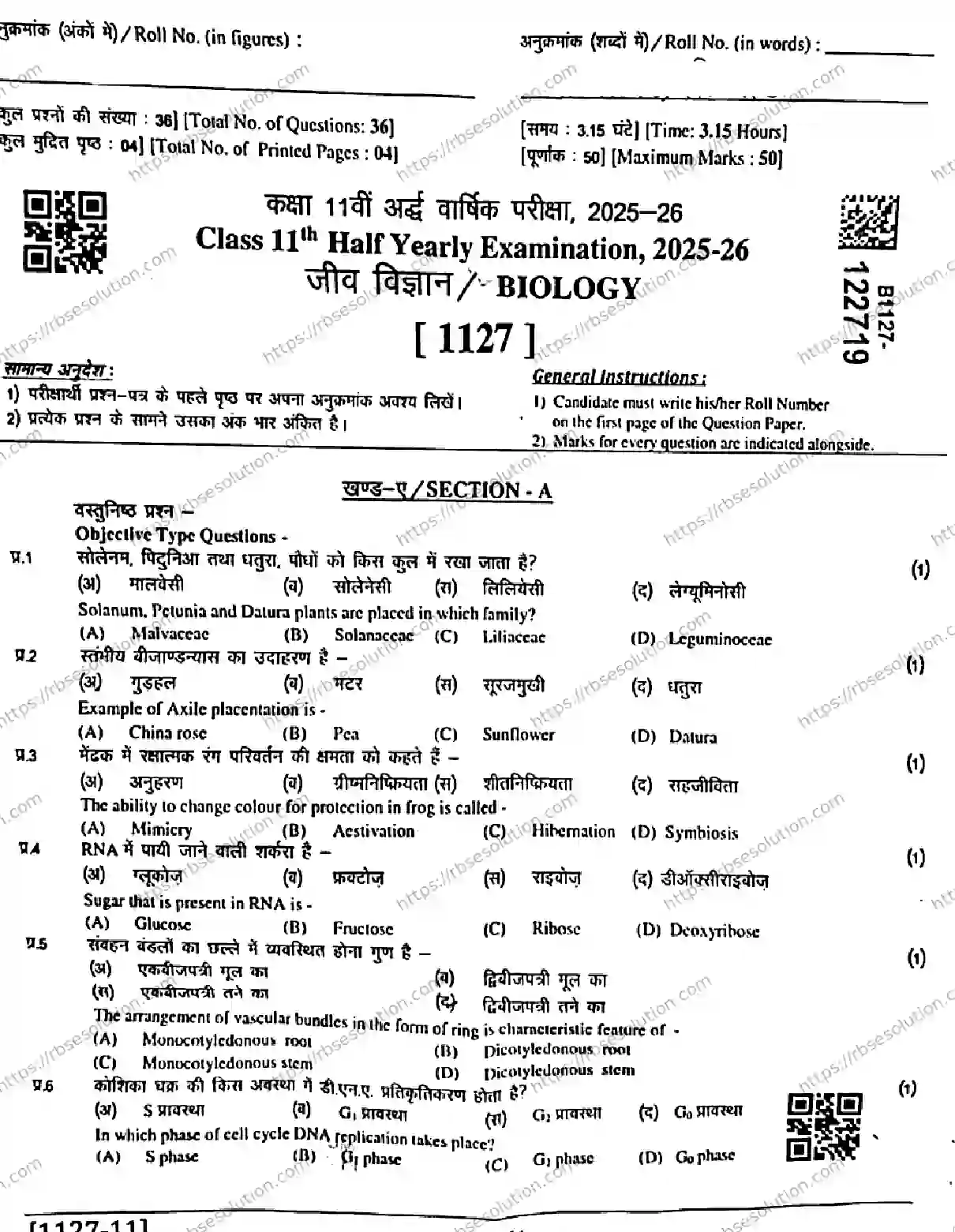
कक्षा 11वीं अर्द्ध वार्षिक परीक्षा, 2025-26
जीव विज्ञान / BIOLOGY
समय : 3.45 घंटे | पूर्णांक : 80
सामान्य अनुदेश / General Instructions:
- परीक्षार्थी प्रश्न-पत्र के पहले पृष्ठ पर अपना अनुक्रमांक अवश्य लिखें। / Candidate must write his/her Roll Number on the first page of the Question Paper.
- प्रत्येक प्रश्न के सामने उसका अंक भार अंकित है। / Marks for every question are indicated alongside.
SECTION - A / खण्ड - अ
वस्तुनिष्ठ प्रश्न / Objective Type Questions
प्रश्न 1. सोलेनम, पिटुनिया तथा धतूरा पौधों को किस कुल में रखा जाता है?
(अ) मालवेसी (ब) सोलेनेसी (स) लिलियेसी (द) लेग्यूमिनोसी
Solanum, Petunia and Datura plants are placed in which family?
(A) Malvaceae (B) Solanaceae (C) Liliaceae (D) Leguminoceae
सही उत्तर / Correct Answer: (ब) / (B) Solanaceae
ये सभी पौधे सोलेनेसी कुल (आलू परिवार) के सदस्य हैं, जिनमें फूल पंचसंयोजी तथा फल बेरी या संपुट प्रकार के होते हैं।
प्रश्न 2. स्तंभीय बीजाण्डन्यास का उदाहरण है -
(अ) गुड़हल (ब) मटर (स) सूरजमुखी (द) धतूरा
Example of Axile placentation is -
(A) China rose (B) Pea (C) Sunflower (D) Datura
सही उत्तर / Correct Answer: (अ) / (A) China rose
गुड़हल (China rose) में अंडाशय बहुकोष्ठक होता है तथा बीजांड केंद्रीय स्तंभ पर लगे होते हैं, जो स्तंभीय बीजाण्डन्यास का लक्षण है।
प्रश्न 3. मेंढक में रक्षात्मक रंग परिवर्तन की क्षमता को कहते हैं -
(अ) अनुहरण (ब) ग्रीष्मनिष्क्रियता (स) शीतनिष्क्रियता (द) सहजीविता
The ability to change colour for protection in frog is called -
(A) Mimicry (B) Aestivation (C) Hibernation (D) Symbiosis
सही उत्तर / Correct Answer: (अ) / (A) Mimicry
मेंढक अपने वातावरण के अनुसार रंग बदलकर शत्रुओं से बचता है, इसे अनुहरण (Mimicry) कहते हैं।
प्रश्न 4. RNA में पायी जाने वाली शर्करा है -
(अ) ग्लूकोज (ब) फ्रक्टोज (स) राइबोज (द) डीऑक्सीराइबोज़
Sugar that is present in RNA is -
(A) Glucose (B) Fructose (C) Ribose (D) Deoxyribose
सही उत्तर / Correct Answer: (स) / (C) Ribose
RNA में पेंटोज शर्करा राइबोज पाई जाती है, जबकि DNA में डीऑक्सीराइबोज होती है।
प्रश्न 5. संवहन बंडलों का छल्ले में व्यवस्थित होना गुण है -
(अ) एकबीजपत्री जड़ का (ब) द्विबीजपत्री मूल का
(स) एकबीजपत्री तने का (द) द्विबीजपत्री तने का
The arrangement of vascular bundles in the form of ring is characteristic feature of -
(A) Monocotyledonous root (B) Dicotyledonous root
(C) Monocotyledonous stem (D) Dicotyledonous stem
सही उत्तर / Correct Answer: (द) / (D) Dicotyledonous stem
द्विबीजपत्री तने में संवहन बंडल एक वलय (ring) के रूप में व्यवस्थित होते हैं, जबकि एकबीजपत्री तने में ये बिखरे होते हैं।
प्रश्न 6. कोशिका चक्र की किस अवस्था में DNA प्रतिकृतिकरण होता है?
(अ) S प्रावस्था (ब) G₁ प्रावस्था (स) G₂ प्रावस्था (द) M प्रावस्था
In which phase of cell cycle DNA replication takes place?
(A) S phase (B) G₁ phase (C) G₂ phase (D) M phase
सही उत्तर / Correct Answer: (अ) / (A) S phase
कोशिका चक्र की S (Synthesis) प्रावस्था में DNA का प्रतिकृतिकरण (replication) होता है, जिससे प्रत्येक गुणसूत्र की प्रतिलिपि बनती है।
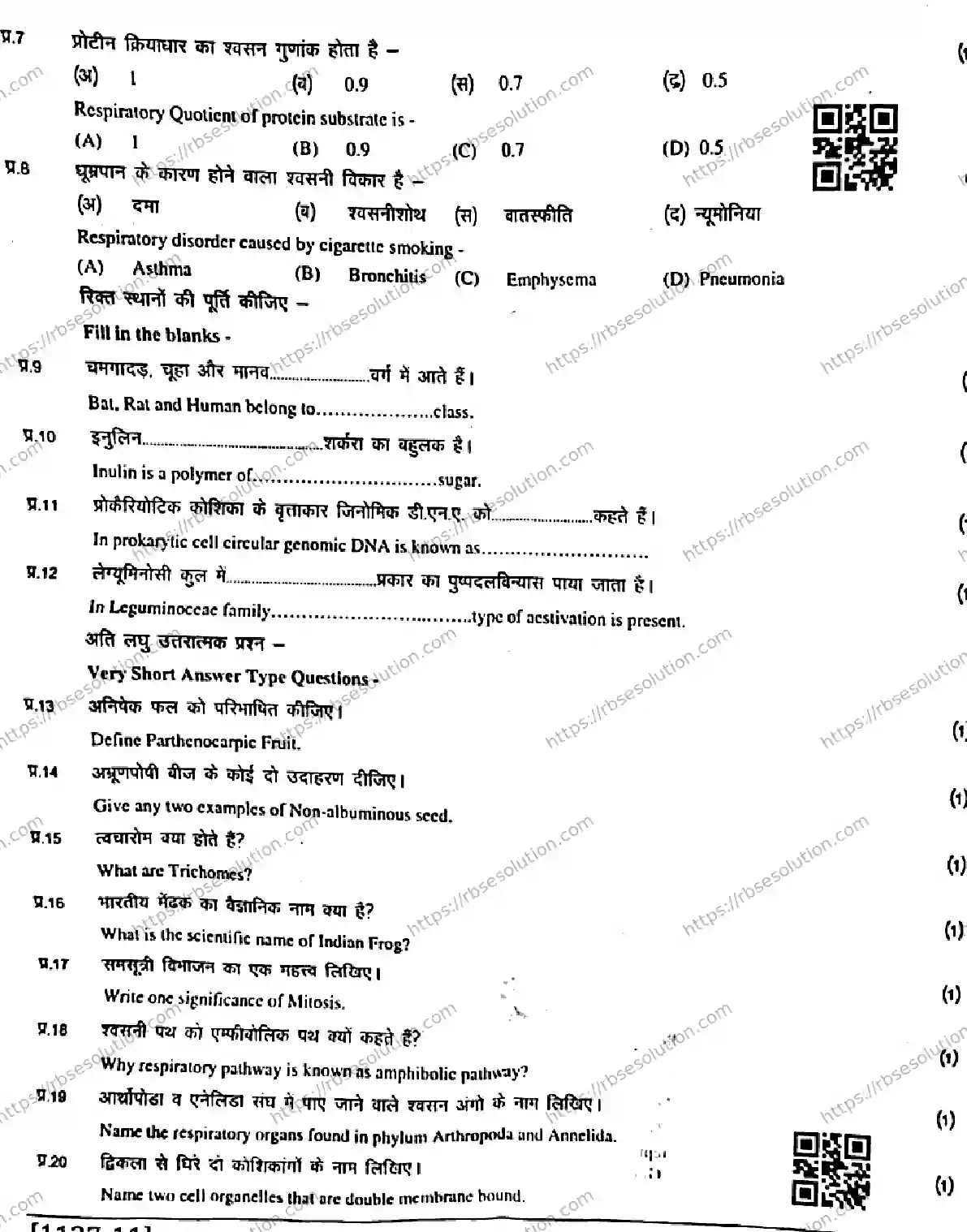
प्रश्न 3.40
प्रोटीन क्रियाधार का श्वसन गुणांक होता है -
- (A) 4
- (B) 0.9
- (C) 0.7
- (D) 0.5
सही उत्तर: (B) 0.9
प्रोटीन के श्वसन में ऑक्सीजन की खपत और कार्बन डाइऑक्साइड उत्सर्जन का अनुपात लगभग 0.9 होता है।
प्रश्न 3.41
धूम्रपान के कारण होने वाला श्वसनी विकार है -
- (A) दमा (Asthma)
- (B) श्वसनीशोथ (Bronchitis)
- (C) न्यूमोनिया (Pneumonia)
- (D) वातस्फीति (Emphysema)
सही उत्तर: (B) श्वसनीशोथ (Bronchitis)
धूम्रपान से श्वसनी में सूजन आ जाती है, जिसे ब्रोंकाइटिस कहते हैं।
रिक्त स्थानों की पूर्ति कीजिए -
- चमगादड़, चूहा और मानव स्तनधारी वर्ग में आते हैं।
- प्रोकैरियोटिक कोशिका के वृत्ताकार जीनोमिक DNA को न्यूक्लियॉइड कहते हैं।
- लेग्यूमिनोसी कुल में पुष्पदलविन्यास पाया जाता है।
अति लघु उत्तरीय प्रश्न -
प्रश्न 1: अनिषेक फल को परिभाषित कीजिए।
उत्तर: अनिषेक फल (Parthenocarpic Fruit) वह फल है जो बिना निषेचन के विकसित होता है और इसमें बीज नहीं होते। उदाहरण: केला, अंगूर।
प्रश्न 2: अबीज बीज के कोई दो उदाहरण दीजिए।
उत्तर: अबीज बीज (Non-albuminous seed) के दो उदाहरण: मटर (Pisum sativum) और चना (Cicer arietinum)।
प्रश्न 3: त्वचारोम क्या होते हैं?
उत्तर: त्वचारोम (Trichomes) पादपों के तने या पत्तियों पर पाए जाने वाले बाल जैसे बहुकोशिकीय या एककोशिकीय उपांग होते हैं, जो सुरक्षा और पानी के अवशोषण में सहायक होते हैं।
प्रश्न 4: भारतीय मेंढक का वैज्ञानिक नाम क्या है?
उत्तर: भारतीय मेंढक का वैज्ञानिक नाम Rana tigrina है।
प्रश्न 5: समसूत्री विभाजन का एक महत्व लिखिए।
उत्तर: समसूत्री विभाजन (Mitosis) का एक महत्व यह है कि यह शरीर की वृद्धि और क्षतिग्रस्त कोशिकाओं की मरम्मत में सहायक होता है।
प्रश्न 6: श्वसनी पथ को एम्फीबोलिक पथ क्यों कहते हैं?
उत्तर: श्वसनी पथ (Respiratory pathway) को एम्फीबोलिक पथ कहते हैं क्योंकि यह अपचय (catabolism) और उपचय (anabolism) दोनों में भाग लेता है। यह कार्बोहाइड्रेट, वसा और प्रोटीन के टूटने में मदद करता है और साथ ही इनके संश्लेषण में भी उपयोग होता है।
प्रश्न 7: आर्थ्रोपोडा व एनेलिडा संघ में पाए जाने वाले श्वसन अंगों के नाम लिखिए।
उत्तर: आर्थ्रोपोडा संघ में श्वसन अंग श्वासनली (Tracheae) या पुस्तक फेफड़े (Book lungs) होते हैं, जबकि एनेलिडा संघ में श्वसन अंग त्वचा (Skin) या गिल्स (Gills) होते हैं।
प्रश्न 8: द्विकला से घिरे दो कोशिकांगों के नाम लिखिए।
उत्तर: द्विकला (Double membrane) से घिरे दो कोशिकांग: माइटोकॉन्ड्रिया (Mitochondria) और प्लास्टिड (Plastid)।
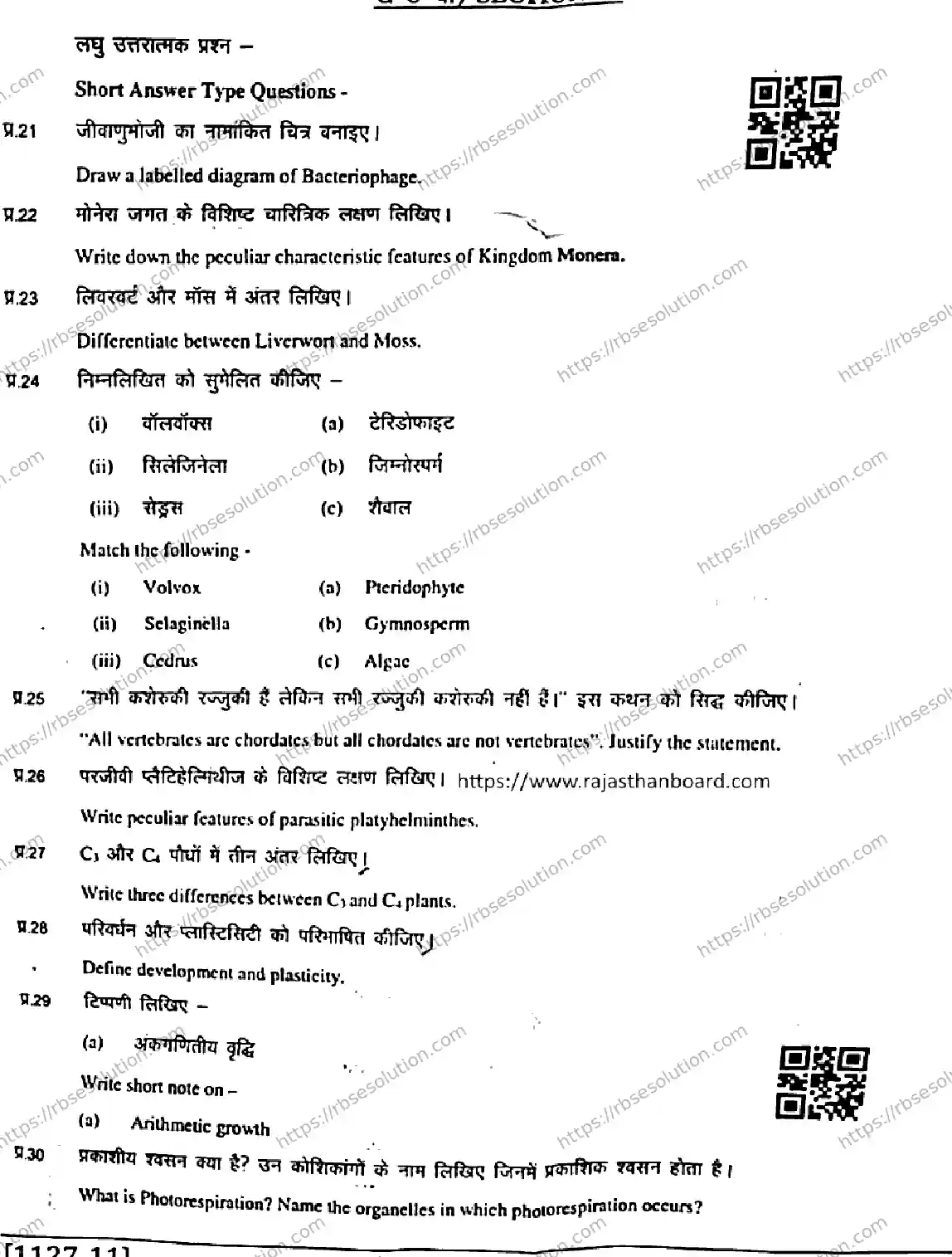
लघु उत्तरात्मक प्रश्न – Short Answer Type Questions
-
जीवाणुभोजी का नामांकित चित्र बनाइए।
Draw a labelled diagram of Bacteriophage.Solution: A bacteriophage (or phage) is a virus that infects bacteria. Its structure consists of:
- Head (Capsid): Icosahedral structure containing genetic material (DNA or RNA).
- Collar: Connects head to tail.
- Tail (Sheath): Hollow tube through which genetic material is injected.
- Base plate: At the end of tail, helps in attachment.
- Tail fibers: Help in recognizing and binding to bacterial cell surface.
(Note: A labelled diagram should show these parts clearly.)
-
मोनेरा जगत के विशिष्ट चारित्रिक लक्षण लिखिए।
Write down the peculiar characteristic features of Kingdom Monera.Solution: Peculiar characteristics of Kingdom Monera:
- Prokaryotic organisms (no true nucleus or membrane-bound organelles).
- Unicellular, though some form colonies.
- Cell wall present (made of peptidoglycan in bacteria).
- Reproduce asexually by binary fission, budding, or fragmentation.
- Nutrition: autotrophic (photosynthetic/chemosynthetic) or heterotrophic (saprophytic/parasitic).
- Genetic material is a single circular DNA molecule (nucleoid).
- Examples: Bacteria, Cyanobacteria (blue-green algae), Archaebacteria.
-
लिवरवर्ट और मॉस में अंतर लिखिए।
Differentiate between Liverwort and Moss.Character Liverwort Moss Plant body Thalloid, dorsiventral, without differentiation into stem and leaves Erect, with stem-like and leaf-like structures Rhizoids Unicellular Multicellular Sporophyte Simple, without seta, capsule dehisces by valves Differentiated into foot, seta, and capsule; capsule opens by operculum Examples Marchantia, Riccia Funaria, Polytrichum -
निम्नलिखित को सुमेलित कीजिए –
Match the following –(i) वॉलवॉक्स (Volvox) – (a) टेरिडोफाइट (Pteridophyte)
(ii) सेलाजिनेला (Selaginella) – (b) जिम्नोस्पर्म (Gymnosperm)
(iii) सीड्रस (Cedrus) – (c) शैवाल (Algae)Correct Matching:
- (i) Volvox – (c) Algae (शैवाल)
- (ii) Selaginella – (a) Pteridophyte (टेरिडोफाइट)
- (iii) Cedrus – (b) Gymnosperm (जिम्नोस्पर्म)
-
“सभी कशेरुकी रज्जुकी हैं लेकिन सभी रज्जुकी कशेरुकी नहीं हैं।” इस कथन को सिद्ध कीजिए।
“All vertebrates are chordates but all chordates are not vertebrates.” Justify the statement.Solution: Chordates are animals possessing a notochord, dorsal hollow nerve cord, pharyngeal slits, and a post-anal tail at some stage. Vertebrates are a subphylum of chordates where the notochord is replaced by a vertebral column (backbone).
- All vertebrates are chordates because they possess all four chordate characteristics at some stage of life (e.g., in embryos, the notochord is present before being replaced by vertebrae).
- Not all chordates are vertebrates because there are chordates like Urochordates (e.g., Ascidia) and Cephalochordates (e.g., Amphioxus) that never develop a vertebral column; they retain the notochord throughout life.
Thus, vertebrates are a subset of chordates.
-
परजीवी प्लैटिहेल्मिन्थीज के विशिष्ट लक्षण लिखिए।
Write peculiar features of parasitic platyhelminthes.Solution: Peculiar features of parasitic platyhelminthes (e.g., tapeworms, flukes):
- Body is dorsoventrally flattened, leaf-like or ribbon-like.
- Absence of digestive system in some (e.g., tapeworms absorb nutrients directly through body surface).
- Presence of suckers and hooks for attachment to host.
- Hermaphroditic (both male and female reproductive organs in same individual).
- High reproductive capacity (produce many eggs).
- Reduced nervous and sensory systems.
- Protective covering (tegument) resistant to host digestive enzymes.
-
C₃ और C₄ पौधों में तीन अंतर लिखिए।
Write three differences between C₃ and C₄ plants.Character C₃ Plants C₄ Plants First stable product 3-phosphoglyceric acid (3-PGA) – a 3-carbon compound Oxaloacetic acid (OAA) – a 4-carbon compound Leaf anatomy No bundle sheath cells; mesophyll cells perform Calvin cycle Kranz anatomy: bundle sheath cells surround vascular bundles; Calvin cycle occurs in bundle sheath Photorespiration High photorespiration (loss of CO₂) Very low or absent photorespiration -
परिवर्धन और प्लास्टिसिटी को परिभाषित कीजिए।
Define development and plasticity.Solution:
- Development: The sum total of all changes that an organism undergoes from the time of fertilization (or germination) until death. It includes growth, differentiation, and maturation.
- Plasticity: The ability of an organism to alter its development (morphology, physiology, or behavior) in response to environmental conditions. For example, in plants, the same genotype can produce different phenotypes under different environments (e.g., heterophylly in aquatic plants).
-
टिप्पणी लिखिए – अंकगणितीय वृद्धि
Write short note on – Arithmetic growthSolution: Arithmetic growth is a type of growth in which the increase in size or number occurs at a constant rate over time. In this pattern, only one daughter cell continues to divide while the other differentiates and matures. The mathematical expression is: Lt = L0 + rt, where Lt is length at time t, L0 is initial length, and r is the constant rate of growth. Example: Growth of root or shoot apex in length (elongation). The graph of arithmetic growth is a straight line.
-
प्रकाशीय श्वसन क्या है? उन कोशिकांगों के नाम लिखिए जिनमें प्रकाशीय श्वसन होता है।
What is Photorespiration? Name the organelles in which photorespiration occurs.Solution: Photorespiration is a process in plants where, in the presence of light, the enzyme RuBisCO fixes oxygen instead of carbon dioxide, leading to a wasteful pathway that releases CO₂ without producing ATP or NADPH. It occurs in C₃ plants when CO₂ concentration is low and O₂ concentration is high.
Organelles involved in photorespiration:
- Chloroplasts – where RuBisCO catalyzes the oxygenation of RuBP.
- Peroxisomes – where glycolate is converted to glycine and then serine.
- Mitochondria – where glycine is converted to serine with release of CO₂.
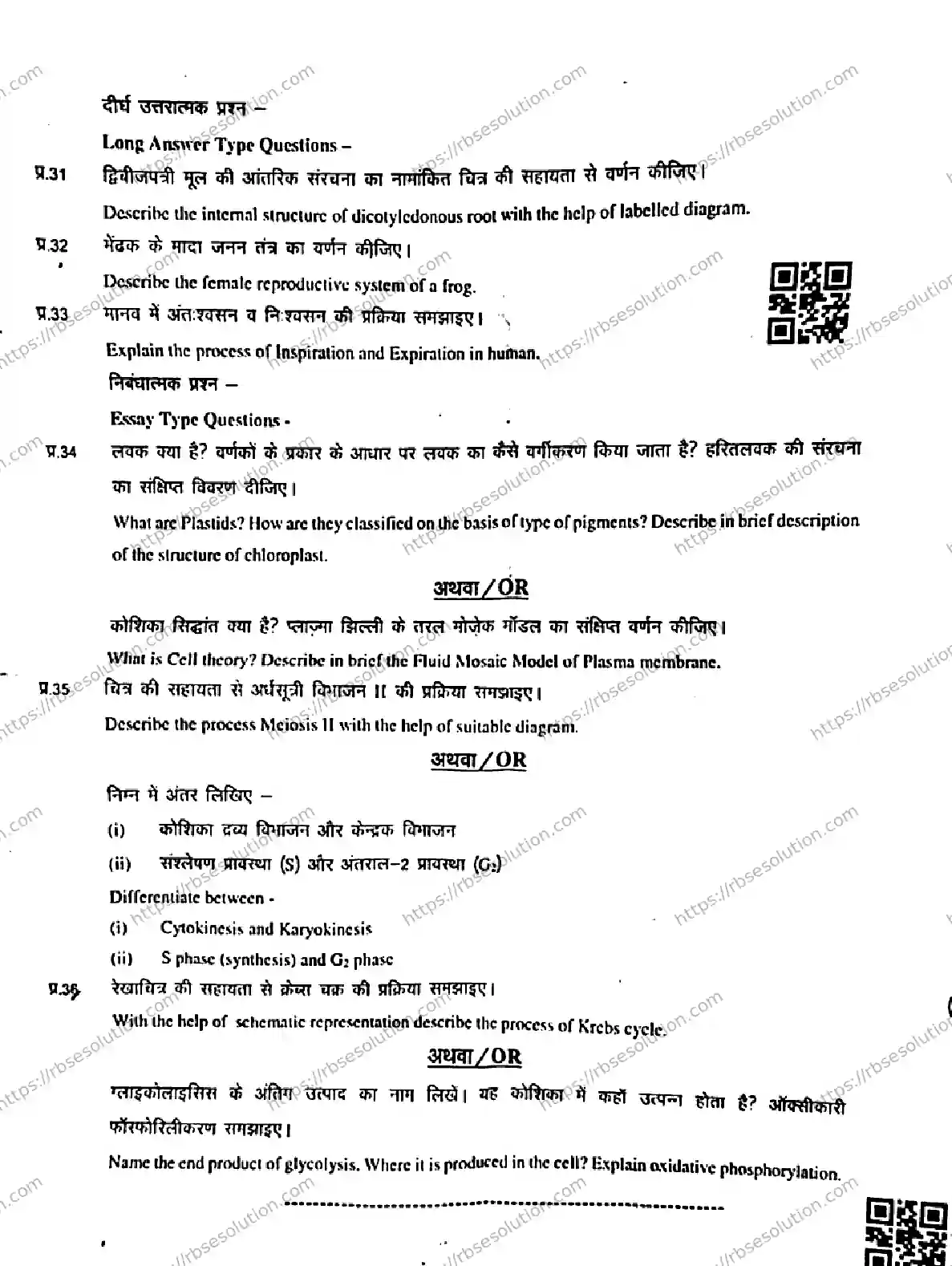
दीर्घ उत्तरात्मक प्रश्न
Long Answer Type Questions
प्रश्न 33 (क): द्विबीजपत्री मूल की आंतरिक संरचना का नामांकित चित्र की सहायता से वर्णन कीजिए।
Describe the internal structure of dicotyledonous root with the help of labelled diagram.
उत्तर: द्विबीजपत्री मूल की आंतरिक संरचना निम्नलिखित भागों में विभाजित होती है:
- त्वचा (Epidermis): सबसे बाहरी परत, जिसमें एककोशिकीय रोम होते हैं।
- वल्कुट (Cortex): बहुस्तरीय, पैरेन्काइमा कोशिकाओं से बना, भोजन संग्रहण का कार्य करता है।
- अंतस्त्वचा (Endodermis): एककोशिकीय परत, कैस्पेरियन पट्टियाँ पाई जाती हैं।
- परिचक्र (Pericycle): अंतस्त्वचा के अंदर, पार्श्व मूलों का निर्माण करता है।
- संवहन बंडल (Vascular Bundles): जाइलम और फ्लोएम के पृथक-पृथक समूह, जाइलम तारकीय (star-shaped) होता है।
- मज्जा (Pith): केंद्र में छोटा या अनुपस्थित।
(चित्र: एक वृत्ताकार संरचना जिसमें बाहर से अंदर की ओर एपिडर्मिस, कॉर्टेक्स, एंडोडर्मिस, पेरीसाइकिल, जाइलम और फ्लोएम दर्शाए गए हैं।)
प्रश्न 33 (ख): मेंढक के मादा जनन तंत्र का वर्णन कीजिए।
Describe the female reproductive system of a frog.
उत्तर: मेंढक के मादा जनन तंत्र में निम्नलिखित अंग होते हैं:
- अंडाशय (Ovaries): एक जोड़ी, गुर्दों के पास स्थित, अंडे उत्पन्न करते हैं।
- डिंबवाहिनी (Oviducts): अंडाशय से अंडों को क्लोएका तक ले जाती हैं।
- गर्भाशय (Uterus): डिंबवाहिनी का निचला भाग, अंडों का अस्थायी संग्रहण।
- क्लोएका (Cloaca): जनन, मूत्र और पाचन तंत्र का सामान्य मार्ग।
मादा मेंढक में बाह्य जननांग नहीं होते। अंडे बाहरी निषेचन के लिए जल में छोड़े जाते हैं।
प्रश्न 33 (ग): मानव में अंतःश्वसन व निःश्वसन की प्रक्रिया समझाइए।
Explain the process of Inspiration and Expiration in human.
उत्तर:
अंतःश्वसन (Inspiration): यह वायु को फेफड़ों में लेने की प्रक्रिया है। इसमें डायाफ्राम संकुचित होकर नीचे आता है और पसलियाँ ऊपर उठती हैं, जिससे वक्ष गुहा का आयतन बढ़ता है और फेफड़ों में दाब कम होता है, जिससे वायु अंदर प्रवेश करती है।
निःश्वसन (Expiration): यह फेफड़ों से वायु बाहर निकालने की प्रक्रिया है। इसमें डायाफ्राम शिथिल होकर ऊपर उठता है और पसलियाँ नीचे आती हैं, जिससे वक्ष गुहा का आयतन घटता है और फेफड़ों में दाब बढ़ता है, जिससे वायु बाहर निकलती है।
निबंधात्मक प्रश्न
Essay Type Questions
प्रश्न 34: लवक क्या हैं? वर्णकों के प्रकार के आधार पर लवक का कैसे वर्गीकरण किया जाता है? हरितलवक की संरचना का संक्षिप्त विवरण दीजिए।
What are Plastids? How are they classified on the basis of type of pigments? Describe in brief description of the structure of chloroplast.
उत्तर: लवक (Plastids) पादप कोशिकाओं में पाए जाने वाले अर्ध-स्वायत्त अंगक हैं जो भोजन निर्माण और संग्रहण में सहायक होते हैं।
वर्णकों के आधार पर वर्गीकरण:
- हरितलवक (Chloroplasts): हरे वर्णक (क्लोरोफिल) युक्त, प्रकाश-संश्लेषण में सहायक।
- वर्णी लवक (Chromoplasts): पीले, नारंगी या लाल वर्णक (कैरोटीनॉयड) युक्त, फलों और फूलों को रंग प्रदान करते हैं।
- श्वेतलवक (Leucoplasts): वर्णक रहित, भोजन संग्रहण (स्टार्च, तेल, प्रोटीन) में सहायक।
हरितलवक की संरचना: हरितलवक दोहरी झिल्ली से घिरा होता है। इसके अंदर थायलाकॉइड नामक चपटी थैलियाँ होती हैं, जो ग्रैना (एकल थायलाकॉइड का समूह) बनाती हैं। थायलाकॉइड के चारों ओर स्ट्रोमा नामक तरल भरा होता है, जिसमें DNA, राइबोसोम और एंजाइम पाए जाते हैं।
अथवा / OR
प्रश्न 34: कोशिका सिद्धांत क्या है? प्लाज़्मा झिल्ली के तरल मोज़ेक मॉडल का संक्षिप्त वर्णन कीजिए।
What is Cell theory? Describe in brief the Fluid Mosaic Model of Plasma membrane.
उत्तर:
कोशिका सिद्धांत (Cell Theory): श्लाइडेन और श्वान द्वारा प्रतिपादित, इसके अनुसार:
- सभी जीव कोशिकाओं से बने होते हैं।
- कोशिका जीवन की मूलभूत इकाई है।
- नई कोशिकाएँ पूर्व-मौजूद कोशिकाओं के विभाजन से बनती हैं।
तरल मोज़ेक मॉडल (Fluid Mosaic Model): सिंगर और निकोलसन द्वारा प्रस्तावित। इसके अनुसार, प्लाज़्मा झिल्ली एक द्विस्तरीय लिपिड परत होती है जिसमें प्रोटीन तैरते रहते हैं। लिपिड द्विस्तर तरल होता है, जिससे प्रोटीन गतिशील रहते हैं। इसमें कार्बोहाइड्रेट भी जुड़े होते हैं जो कोशिका पहचान में सहायक होते हैं।
प्रश्न 35: चित्र की सहायता से अर्धसूत्री विभाजन II की प्रक्रिया समझाइए।
Describe the process Meiosis II with the help of suitable diagram.
उत्तर: अर्धसूत्री विभाजन II (Meiosis II) समीकरणात्मक विभाजन है, जो अर्धसूत्री विभाजन I के बाद होता है। इसमें निम्नलिखित चरण होते हैं:
- प्रावस्था II (Prophase II): गुणसूत्र संघनित होते हैं, नाभिकीय झिल्ली और केंद्रिका विघटित होती है।
- मध्यावस्था II (Metaphase II): गुणसूत्र मध्य रेखा पर पंक्तिबद्ध होते हैं, तर्कु तंतु जुड़ते हैं।
- पश्चावस्था II (Anaphase II): सेंट्रोमियर विभाजित होते हैं, बहन क्रोमैटिड विपरीत ध्रुवों की ओर जाते हैं।
- अंत्यावस्था II (Telophase II): गुणसूत्र विसंघनित होते हैं, नाभिकीय झिल्ली पुनः बनती है, कोशिका द्रव्य विभाजन होता है।
अंत में चार अगुणित संतति कोशिकाएँ बनती हैं। (चित्र: प्रावस्था II से अंत्यावस्था II तक के चरण दर्शाए गए हैं।)
अथवा / OR
प्रश्न 35: निम्न में अंतर लिखिए:
(i) कोशिका द्रव्य विभाजन और केन्द्रक विभाजन
(ii) संश्लेषण S प्रावस्था और अंतराल-2 G₂ प्रावस्था
Differentiate between:
(i) Cytokinesis and Karyokinesis
(ii) S phase (synthesis) and G₂ phase
उत्तर:
(i) कोशिका द्रव्य विभाजन (Cytokinesis) और केन्द्रक विभाजन (Karyokinesis) में अंतर:
| क्र. सं. | कोशिका द्रव्य विभाजन (Cytokinesis) | केन्द्रक विभाजन (Karyokinesis) |
|---|---|---|
| 1. | कोशिका द्रव्य का विभाजन होता है। | केन्द्रक का विभाजन होता है। |
| 2. | यह केन्द्रक विभाजन के बाद होता है। | यह कोशिका द्रव्य विभाजन से पहले होता है। |