
RBSE Class 12th 2011 Biology-SS-42-1-2011 Previous Year Papers
Class 12th students hunting authentic previous year papers for Biology-SS-42-1-2011 (2011) land here for a reason: the paper below matches how RBSE assessments are remembered from that year. RBSE Solution does not mix years on one page; each combination gets its own notes.
Skim the overview sections, then work through the scanned pages. Pair this practice with RBSE books and solutions when you need to relearn a concept a question exposed.
Paper details
Quick reference for this previous year papers page — confirm board, class, and year & subject before you study.
| Board | RBSE |
|---|---|
| Class | Class 12th |
| Exam year | 2011 |
| Subject | Biology-SS-42-1-2011 |
| Resource type | Previous Year Papers |
| Category | RBSE Previous Year Question Papers |
| Website | RBSE Solution |
The table summarises this Previous Year Papers resource. Confirm RBSE, Class 12th, year 2011, and subject Biology-SS-42-1-2011 before studying.
RBSE Solution organises previous year papers so each URL carries chapter-specific guidance — better for students and for search engines than one generic paragraph for the whole class.
Turning 2011 papers into insight
One Biology-SS-42-1-2011 paper reveals style; several from the same year reveal pattern. After this page, open sibling subjects listed below to see whether marks cluster in certain units.
Keep rough work dated in your notebook. Examiners in Class 12th expect clear numbering even in practice sessions.
RBSE Class 12th 2011 Biology-SS-42-1-2011
Scroll through the Previous Year Papers pages for Biology-SS-42-1-2011 (2011).


Rajasthan Board Class 12th Biology-SS-42-1-2011 2011 solved Previous Year Question Papers
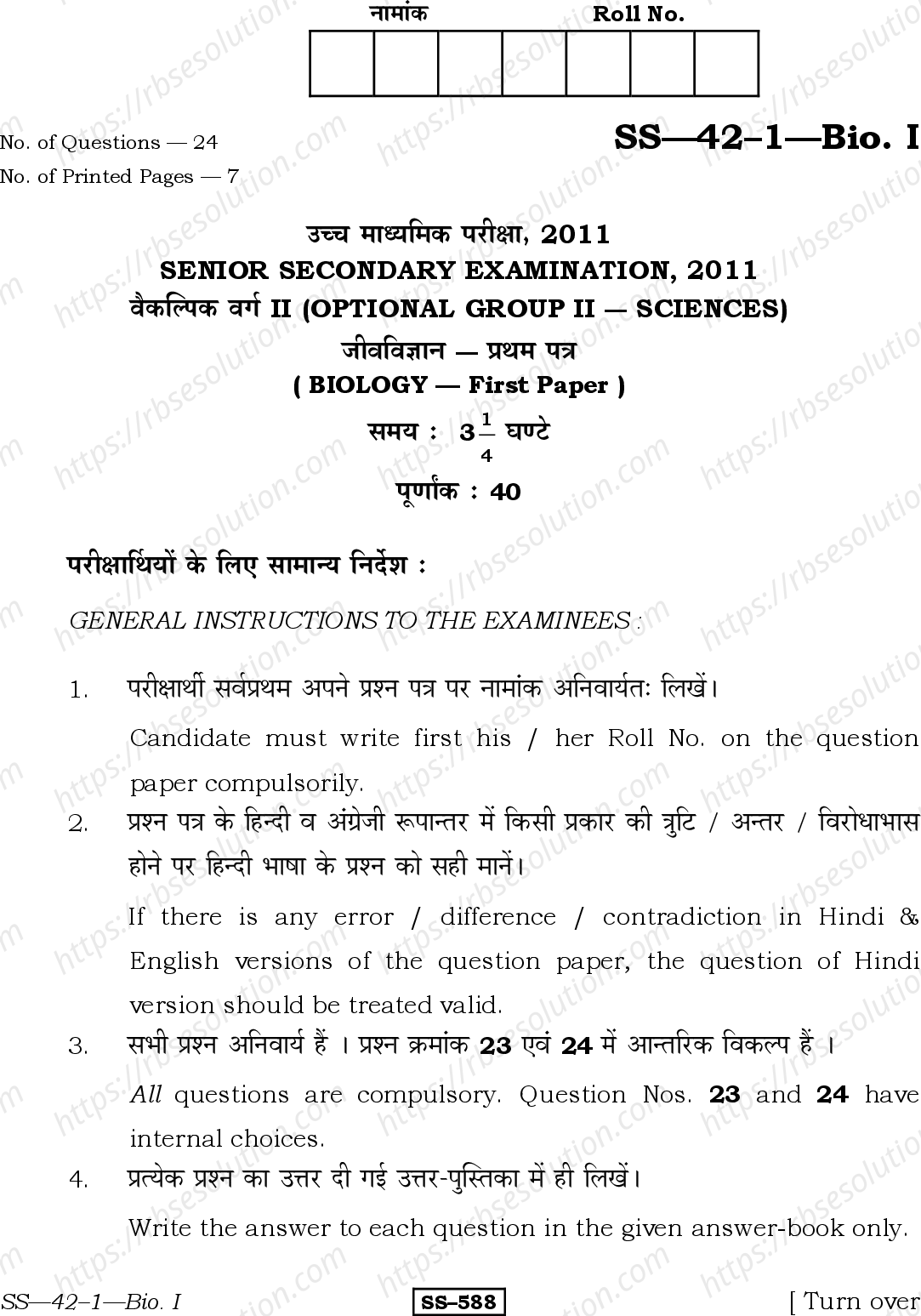
उच्च माध्यमिक परीक्षा, 2011
SENIOR SECONDARY EXAMINATION, 2011
वैकल्पिक वर्ग (OPTIONAL GROUP II – SCIENCES)
जीवविज्ञान — प्रथम पत्र (BIOLOGY — First Paper)
परीक्षार्थियों के लिए सामान्य निर्देश :
GENERAL INSTRUCTIONS TO THE EXAMINEES :
- परीक्षार्थी सर्वप्रथम अपने प्रश्न पत्र पर नामांक अनिवार्यतः लिखें।
Candidate must write first his / her Roll No. on the question paper compulsorily. - प्रश्न पत्र के हिन्दी एवं अंग्रेजी रूपान्तर में किसी प्रकार की त्रुटि / अन्तर / विरोधाभास होने पर हिन्दी भाषा के प्रश्न को सही मानें।
If there is any error / difference / contradiction in Hindi & English versions of the question paper, the question of Hindi version should be treated valid. - सभी प्रश्न अनिवार्य हैं । प्रश्न क्रमांक 23 एवं 24 में आन्तरिक विकल्प हैं ।
All questions are compulsory. Question Nos. 23 and 24 have internal choices. - प्रत्येक प्रश्न का उत्तर दी गई उत्तर-पुस्तिका में ही लिखें।
Write the answer to each question in the given answer-book only.
SS—42—1—Bio. I
No. of Questions — 24 | No. of Printed Pages — 7
निर्देश
4. जिस प्रश्न के एक से अधिक समान अंक वाले भाग हैं, उन सभी भागों का हल एक साथ सतत लिखें।
For questions having more than one part carrying similar marks, the answers of those parts are to be written together in continuity.
6. जहाँ पर आवश्यक हो, स्वच्छ नामांकित चित्र बनाइए।
Draw neat labelled diagram wherever necessary.
7. प्रश्न क्रमांक 4 के चार भाग (i, ii, iii तथा iv) हैं। प्रत्येक भाग के उत्तर के चार विकल्प (अ, ब, स एवं द) हैं। सही विकल्प का उत्तराक्षर उत्तर-पुस्तिका में निम्नानुसार तालिका बनाकर लिखें:
There are four parts (i, ii, iii and iv) in Question No. 4. Each part has four alternatives A, B, C and D. Write the letter of the correct alternative in the answer-book at a place by making a table as mentioned below:
| प्रश्न क्रमांक | सही उत्तर का क्रमाक्षर |
|---|---|
| Question No. | Correct letter of the Answer |
| (i) | |
| (ii) | |
| (iii) | |
| (iv) |
प्रश्न: हेरेरो पायी जाती है:
- (अ) वायोला एवं प्रिमुला में
- (ब) प्रिमुला एवं आक्जेलिस में
- (स) आक्जेलिस एवं ल्यूकोजियम में
- (द) साल्विया एवं प्रिमुला में
सही उत्तर: (ब) प्रिमुला एवं आक्जेलिस में
व्याख्या: हेरेरो (Heterostyly) एक प्रकार का परागण अनुकूलन है जो प्रिमुला (Primula) और आक्जेलिस (Oxalis) जैसे पौधों में पाया जाता है, जहाँ पुष्प में विभिन्न लंबाई के स्त्रीकेसर और पुंकेसर होते हैं।
Cleistogamy is found in
- (A) Viola & Primula
- (B) Primula & Oxalis
- (C) Oxalis & Viola
- (D) Salvia & Primula
Correct Answer: (C) Oxalis & Viola
Explanation: Cleistogamy (self-pollination in closed flowers) is observed in plants like Oxalis and Viola, where flowers never open and ensure self-fertilization.
Example of vegetative propagation by roots is
- (A) Potato
- (B) Mentha spicata
- (C) Carrot
- (D) Dalbergia sisso
Correct Answer: (C) Carrot
Explanation: Carrot propagates vegetatively through its taproot, which can produce new shoots. Potato uses tubers (stems), Mentha uses runners, and Dalbergia uses seeds or cuttings.
The enzyme which dissolves the bacterial cell wall is
- (A) Lysozyme
- (B) Ligase
- (C) Phosphatase
- (D) Polymerase
Correct Answer: (A) Lysozyme
Explanation: Lysozyme breaks down peptidoglycan in bacterial cell walls, causing lysis. Ligase joins DNA, Phosphatase removes phosphate groups, and Polymerase synthesizes nucleic acids.
Asafoetida is obtained from
- (A) Stem
- (B) Root
- (C) Flower
- (D) Fruit
Correct Answer: (B) Root
Explanation: Asafoetida (hing) is a resin obtained from the taproot of Ferula plants. It is not derived from stem, flower, or fruit.
प्रश्न 1
पेनीसिलीन की खोज किसने और किस पादप से की है ?
Who invented the penicillin and from which plant ?
उत्तर: पेनीसिलीन की खोज अलेक्जेंडर फ्लेमिंग ने की थी। यह पेनिसिलियम नोटेटम (Penicillium notatum) नामक कवक से प्राप्त होता है।
प्रश्न 2
विशाल वृक्ष पारिस्थितिक तंत्र में जैवभार एवं जीवसंख्या के पिरामिड किस प्रकार के होते हैं ?
What type of pyramid will be in a tree ecosystem of biomass and number of organism ?
उत्तर: विशाल वृक्ष पारिस्थितिक तंत्र में जैवभार का पिरामिड उल्टा (inverted) होता है, जबकि जीवसंख्या का पिरामिड सीधा (upright) होता है।
प्रश्न 3
पारिस्थितिक दशांश का नियम क्या है ?
What is the rule of Ecological tenth ?
उत्तर: पारिस्थितिक दशांश का नियम लिंडमैन (Lindeman) द्वारा प्रतिपादित किया गया। इसके अनुसार, एक पोषी स्तर से दूसरे पोषी स्तर पर केवल 10% ऊर्जा स्थानांतरित होती है, शेष 90% ऊर्जा विभिन्न क्रियाओं में व्यय हो जाती है।
प्रश्न 4
इन-सीटू संरक्षण एवं एक्स-सीटू संरक्षण में क्या अन्तर है ?
What is the difference between In-situ conservation and Ex-situ conservation ?
उत्तर:
- इन-सीटू संरक्षण (In-situ conservation): इसमें जीवों को उनके प्राकृतिक आवास में संरक्षित किया जाता है, जैसे राष्ट्रीय उद्यान, अभयारण्य, बायोस्फीयर रिजर्व।
- एक्स-सीटू संरक्षण (Ex-situ conservation): इसमें जीवों को उनके प्राकृतिक आवास से बाहर संरक्षित किया जाता है, जैसे प्राणी उद्यान, वनस्पति उद्यान, जीन बैंक, बीज बैंक।
प्रश्न 5
योगर्ट किस प्रकार प्राप्त करते हैं ?
How is Yogurt obtained ?
उत्तर: योगर्ट दूध में लैक्टोबैसिलस बल्गेरिकस (Lactobacillus bulgaricus) और स्ट्रेप्टोकोकस थर्मोफिलस (Streptococcus thermophilus) जीवाणुओं के किण्वन द्वारा प्राप्त किया जाता है। ये जीवाणु दूध की शर्करा (लैक्टोज) को लैक्टिक अम्ल में बदलते हैं, जिससे दूध जम जाता है और योगर्ट बनता है।
प्रश्न 6
इन्टरफेरोन क्या है तथा इसका क्या कार्य है ?
What is Interferon and what is its function ?
उत्तर: इन्टरफेरोन एक प्रकार का प्रोटीन है जो वायरस के संक्रमण के प्रतिक्रिया में शरीर की कोशिकाओं द्वारा स्रावित होता है। इसका कार्य वायरस के प्रतिकृति को रोकना और प्रतिरक्षा तंत्र को सक्रिय करना है।
प्रश्न 7
"परागकण लम्बी अवधि तक जीवाश्म के रूप में परिरक्षित पाए जाते हैं।" यह किस पदार्थ के कारण और क्यों होता है ?
"Pollen grains are preserved for a long period in the form of fossils." Which substance is responsible for this property and why ?
उत्तर: परागकणों के लंबे समय तक जीवाश्म के रूप में संरक्षित रहने का कारण स्पोरोपोलेनिन (Sporopollenin) नामक पदार्थ है। यह एक अत्यंत कठोर और रासायनिक रूप से प्रतिरोधी पदार्थ है, जो एसिड, क्षार और उच्च तापमान को सहन कर सकता है, जिससे परागकण लाखों वर्षों तक संरक्षित रहते हैं।
प्रश्न 8
विषम वर्तिकात्व से क्या तात्पर्य है ? उदाहरण सहित स्पष्ट कीजिए।
What is Heterostyly ? Explain with example.
उत्तर: विषम वर्तिकात्व (Heterostyly) एक आनुवंशिक अनुकूलन है जिसमें एक ही प्रजाति के विभिन्न पुष्पों में स्त्रीकेसर (वर्तिका) और पुंकेसर की लंबाई भिन्न-भिन्न होती है। यह स्व-परागण को रोकने और पर-परागण को बढ़ावा देने के लिए होता है।
उदाहरण: प्रिमुला (Primula) में पिन (pin) और थ्रुम (thrum) प्रकार के पुष्प पाए जाते हैं। पिन पुष्प में लंबी वर्तिका और छोटे पुंकेसर होते हैं, जबकि थ्रुम पुष्प में छोटी वर्तिका और लंबे पुंकेसर होते हैं।
प्रश्न 9
यदि नील हरित शैवाल से हेटेरोसिस्ट हटा दी जाय, तो कौन-सी क्रिया प्रभावित होगी ?
If Heterocyst is removed from Blue-green algae, which activity will be affected ?
उत्तर: यदि नील हरित शैवाल (सायनोबैक्टीरिया) से हेटेरोसिस्ट हटा दी जाए, तो नाइट्रोजन स्थिरीकरण (Nitrogen fixation) की क्रिया प्रभावित होगी। हेटेरोसिस्ट विशेष कोशिकाएं हैं जो वायुमंडलीय नाइट्रोजन को अमोनिया में बदलने का कार्य करती हैं।
प्रश्न 2
गुलाब की कलम में जड़ें शीघ्र प्राप्त करने के लिये आप क्या सुझाव देंगे?
What will you suggest to initiate early roots in Rose cuttings?
उत्तर: गुलाब की कलम में जड़ें शीघ्र प्राप्त करने के लिए निम्नलिखित सुझाव दिए जा सकते हैं:
- कलम को जड़ उत्तेजक हार्मोन (जैसे इंडोल ब्यूटिरिक अम्ल - IBA) के घोल में डुबोकर रोपें।
- कलम को नम वातावरण में रखें और उचित तापमान (लगभग 20-25°C) प्रदान करें।
- रोपण से पहले कलम के निचले सिरे को तिरछा काटें ताकि जड़ निकलने का क्षेत्र बढ़े।
- हल्की और जल निकासी वाली मिट्टी का उपयोग करें।
प्रश्न 3
कवक मूल साहचर्य किसे कहते हैं? एक उदाहरण दीजिए।
What is Mycorrhizal association? Give one example.
उत्तर: कवक मूल साहचर्य (Mycorrhizal association) कवक और उच्च पादपों की जड़ों के बीच पाया जाने वाला सहजीवी संबंध है, जिसमें दोनों एक-दूसरे को लाभ पहुंचाते हैं। कवक पादप को मिट्टी से खनिज और जल अवशोषित करने में मदद करता है, जबकि पादप कवक को कार्बोहाइड्रेट प्रदान करता है।
उदाहरण: पाइनस (Pinus) वृक्ष की जड़ों में पाया जाने वाला कवक मूल साहचर्य।
प्रश्न 4
किन्हीं दो पेट्रो पादपों के वानस्पतिक नाम लिखिए।
Write the botanical names of any two petroplants.
उत्तर: पेट्रो पादप (Petroplants) वे पादप हैं जिनसे पेट्रोलियम जैसे ईंधन प्राप्त किए जा सकते हैं। दो पेट्रो पादपों के वानस्पतिक नाम निम्नलिखित हैं:
- Jatropha curcas (रतनजोत)
- Euphorbia tirucalli (थूहर)
प्रश्न 5
पुष्प एक प्रकार का रूपान्तरित निश्चित वृद्धि वाला प्ररोह है। समझाइये।
The flower is a modified determinate shoot. Explain.
उत्तर: पुष्प को रूपान्तरित निश्चित वृद्धि वाला प्ररोह (modified determinate shoot) इसलिए कहा जाता है क्योंकि:
- पुष्प का विकास प्ररोह के शीर्षस्थ विभज्योतक से होता है, जो सामान्य प्ररोह की तरह ही होता है, लेकिन इसकी वृद्धि निश्चित (determinate) होती है, अर्थात यह एक निश्चित आकार तक बढ़ने के बाद रुक जाता है।
- पुष्प के विभिन्न भाग (बाह्यदल, दल, पुंकेसर, स्त्रीकेसर) रूपान्तरित पत्तियाँ हैं, जो प्रजनन कार्यों के लिए विशिष्टीकृत हो गई हैं।
- पुष्प में गांठें (nodes) और अंतर्गांठें (internodes) अत्यधिक छोटी होती हैं, जो इसे एक संक्षिप्त प्ररोह बनाती हैं।
प्रश्न 6
छुईमुई पादप के किसी भाग को स्पर्श करने पर उसके पत्ते बन्द हो जाते हैं। कारण बताइये।
Leaflets of Mimosa pudica (Touch-me-not plant) are closed if any part of plant is touched. Give reason.
उत्तर: छुईमुई (Mimosa pudica) के पत्तों के बंद होने का कारण एक प्रकार की संवेदनशील गति (thigmonastic movement) है। जब पादप के किसी भाग को स्पर्श किया जाता है, तो पत्ती के आधार पर स्थित पल्वीनस (pulvinus) नामक कोशिकाओं से जल तेजी से बाहर निकल जाता है, जिससे कोशिकाएं शिथिल हो जाती हैं और पत्तियाँ मुड़कर बंद हो जाती हैं। यह एक रक्षात्मक प्रतिक्रिया है जो पादप को शाकाहारी जीवों से बचाती है।
प्रश्न 7
यदि कोशिका A का O.P. = 8 Atm, T.P. = 6 Atm तथा कोशिका B का O.P. = 5 Atm, T.P. = 2 Atm तो जल का विसरण किस कोशिका की ओर होगा और क्यों?
If cell A has O.P. = 8 Atm, T.P. = 6 Atm and cell B has O.P. = 5 Atm, T.P. = 2 Atm then the diffusion of water will be towards which cell and why?
उत्तर: जल का विसरण उस कोशिका की ओर होगा जिसका जल विभव (Water Potential) कम होता है। जल विभव (Ψ) = दाब विभव (Pressure Potential) - परासरण दाब (Osmotic Pressure) या Ψ = T.P. - O.P. (सरलीकृत रूप में)।
- कोशिका A के लिए: ΨA = 6 - 8 = -2 Atm
- कोशिका B के लिए: ΨB = 2 - 5 = -3 Atm
चूंकि कोशिका B का जल विभव (-3 Atm) कोशिका A के जल विभव (-2 Atm) से अधिक ऋणात्मक (कम) है, इसलिए जल का विसरण कोशिका A से कोशिका B की ओर होगा।
प्रश्न 8
चारा प्रदान करने वाले किन्हीं दो पादपों के वानस्पतिक नाम एवं कुल लिखिए।
Write the botanical names and family of any two fodder yielding plants.
उत्तर: चारा प्रदान करने वाले दो पादपों के वानस्पतिक नाम एवं कुल निम्नलिखित हैं:
| पादप का नाम | वानस्पतिक नाम | कुल (Family) |
|---|---|---|
| बरसीम (Berseem) | Trifolium alexandrinum | Fabaceae |
| ज्वार (Sorghum) | Sorghum bicolor | Poaceae |
प्रश्न 9
"टमाटर का छिलका इतना मोटा कि दीवार पर जोर से मारने पर भी नहीं फटता।" इस टमाटर का क्या नाम है? इस व्यवहार का क्या कारण है?
उत्तर: इस टमाटर को मैटर टमाटर (Matter Tomato) या दृढ़ फल वाला टमाटर कहा जाता है। इस व्यवहार का कारण यह है कि इस टमाटर में पॉलीगैलेक्ट्यूरोनेज़ (Polygalacturonase) एंजाइम की कमी होती है, जो फलों को नरम करने के लिए जिम्मेदार होता है। इस एंजाइम की अनुपस्थिति में कोशिका भित्ति में पेक्टिन का विघटन नहीं होता, जिससे छिलका मोटा और मजबूत बना रहता है। यह आनुवंशिक रूप से संशोधित (GM) टमाटर है जिसे लंबी दूरी तक परिवहन के लिए विकसित किया गया है।
20.
"Tomato has thick pericarp and does not burst even when it is thrown forcibly against wall." What is the name of this tomato? Give reason for this behaviour.
Answer: The name of this tomato is Slab Tomato (or Processing Tomato).
Reason: This behaviour is due to the presence of a thick pericarp (fruit wall) and a firm, solid texture. These tomatoes are specifically bred for mechanical harvesting and processing (e.g., for ketchup, sauces) because they can withstand rough handling, transport, and impact without bursting or cracking. The thick pericarp provides structural integrity and resistance to splitting.
21.
कृत्रिम बीज का उत्पादन किस प्रकार किया जाता है? कृत्रिम बीज का नामांकित चित्र बनाइये।
How are artificial seeds produced? Draw a labelled diagram of artificial seed.
Answer: Artificial seeds are produced by encapsulating somatic embryos (derived from plant tissue culture) in a protective coating. The process involves:
- Production of somatic embryos: Plant cells are cultured in a nutrient medium to form embryos (similar to zygotic embryos).
- Encapsulation: These embryos are mixed with a gel (e.g., sodium alginate) and dropped into a calcium chloride solution to form beads.
- Coating: The beads are coated with a protective layer (e.g., synthetic seed coat) containing nutrients, fungicides, and growth regulators.
- Storage and germination: The artificial seeds can be stored and later germinated under suitable conditions.
Labelled diagram of artificial seed:
        _________________________
       |   Protective coating    |
       |   (Synthetic seed coat) |
       |   ___________________   |
       |  |  Somatic embryo   |  |
       |  |  (inside gel bead)|  |
       |  |___________________|  |
       |   Nutrient layer        |
       |_________________________|
Labels: Protective coating (synthetic seed coat), Somatic embryo, Gel bead (alginate), Nutrient layer.
22.
चक्रीय प्रकाश-फॉस्फोराइलेशन एवं अचक्रीय प्रकाश-फॉस्फोराइलेशन में चार प्रमुख अन्तर लिखिए।
Write four main differences between cyclic photophosphorylation and non-cyclic photophosphorylation.
| Feature | Cyclic Photophosphorylation | Non-cyclic Photophosphorylation |
|---|---|---|
| 1. Electron flow | Electrons cycle back to the same photosystem (PS I). | Electrons flow from water to NADP⁺ (linear path). |
| 2. Photosystems involved | Only PS I is involved. | Both PS I and PS II are involved. |
| 3. Products | Only ATP is produced. | ATP, NADPH, and O₂ are produced. |
| 4. Water splitting | No water splitting; no O₂ release. | Water is split; O₂ is released. |
23.
जैविक कृषि के कोई चार उद्देश्य लिखिये।
Write any four objectives of Bioagriculture.
- Environmental sustainability: To reduce the use of synthetic chemicals (pesticides, fertilizers) and promote natural farming methods that protect soil, water, and biodiversity.
- Soil health improvement: To enhance soil fertility through organic matter, crop rotation, and biological nitrogen fixation.
- Human health: To produce chemical-free, nutritious food that is safe for consumption.
- Economic viability: To reduce input costs for farmers and promote self-reliance through local resources and traditional knowledge.
24.
वाहक रहित प्रत्यक्ष जीन स्थानान्तरण किसे कहते हैं? इसकी चार प्रमुख विधियों के नाम लिखिए। जीन-गन विधि का नामांकित चित्र बनाकर वर्णन कीजिए।
What is vector-less direct gene transfer? Write names of its main four methods. Describe with labelled diagram Gene-gun method.
Vector-less direct gene transfer: It is a method of introducing foreign DNA into a cell without using a biological vector (like a plasmid or virus). The DNA is directly delivered into the cell using physical or chemical methods.
Four main methods:
- Gene gun method (biolistics)
- Microinjection
- Electroporation
- Liposome-mediated transfer
Gene-gun method (Biolistics):
In this method, DNA-coated gold or tungsten particles (microprojectiles) are accelerated at high speed using a gene gun. The particles penetrate the cell wall and membrane, delivering the DNA into the cell's nucleus or cytoplasm. It is commonly used for plant cells and some animal cells.
Labelled diagram of Gene-gun method:
        _________________________
       |   Gene gun device       |
       |   (Helium gas or        |
       |    gunpowder driven)    |
       |_________________________|
                |
                |  (High pressure)
                v
        _________________________
       |  DNA-coated micro-      |
       |  projectiles (gold/     |
       |  tungsten particles)    |
       |_________________________|
                |
                v
        _________________________
       |  Target cells (e.g.,    |
       |  plant leaf or embryo)  |
       |  placed on a petri dish |
       |_________________________|
Labels: Gene gun device, DNA-coated microprojectiles, Target cells (plant tissue), Petri dish.
25.
नग्न चट्टानों पर मरुक्रमक के विभिन्न चरणों का उदाहरण सहित वर्णन कीजिये। नग्न चट्टानों पर शैलक्रमक का चित्र बनाइये।
अथवा
जलारम्भी अनुक्रमण के विभिन्न चरणों का उदाहरण सहित वर्णन कीजिये। जलक्रमक की विभिन्न अवस्थाओं का चित्र बनाइये।
Describe with examples the various stages of xerosere found on bare rocks. Draw the diagram of Lithosere on bare rock.
OR
Describe with examples the various stages of hydrosere. Draw the diagram of different stages of hydrosere.
Answer (Xerosere on bare rocks - Lithosere):
Xerosere is a plant succession that begins on dry, bare rocks (lithosere). The stages are:
- Crustose lichen stage: Pioneers like Lecanora and Rhizocarpon grow on bare rock, secreting acids that weather the rock surface.
- Foliose lichen stage: Lichens like Parmelia and Umbilicaria form leafy structures, trapping dust and organic matter.
- Moss stage: Mosses like Polytrichum and Bryum colonize the thin soil layer, further building organic matter.
- Herb stage: Grasses and small herbs (e.g., Poa, Festuca) establish, creating deeper soil.
- Shrub stage: Shrubs like Rhododendron and Berberis appear, providing shade and more organic matter.
- Climax forest stage: Trees like Pinus or Quercus dominate, forming a stable forest community.
Diagram of Lithosere on bare rock:
        Stage 1: Bare rock
        _________________________
       |   (No vegetation)       |
       |_________________________|
                |
                v
        Stage 2: Crustose lichens
        _________________________
       |   (Thin crust on rock)  |
       |_________________________|
                |
                v
        Stage 3: Foliose lichens
        _________________________
       |   (Leafy lichens)       |
       |_________________________|
                |
                v
        Stage 4: Mosses
        _________________________
       |   (Green carpet)        |
       |_________________________|
                |
                v
        Stage 5: Herbs & grasses
        _________________________
       |   (Small plants)        |
       |_________________________|
                |
                v
        Stage 6: Shrubs
        _________________________
       |   (Bushes)              |
       |_________________________|
                |
                v
        Stage 7: Climax forest
        _________________________
       |   (Tall trees)          |
       |_________________________|
Note: Each stage modifies the environment, making it suitable for the next stage.
23. Describe with example the various stages of hydrosere succession. Draw the diagram of various stages of hydrosere. (3+1=4)
Hydrosere is a plant succession that occurs in an aquatic environment (like a pond or lake) which gradually transforms into a land community. The various stages are:
- Phytoplankton stage: Microscopic algae (e.g., Chlamydomonas, Spirogyra) appear first, adding organic matter to the water.
- Submerged plant stage: Rooted submerged plants like Hydrilla, Vallisneria grow, trapping silt and raising the bottom.
- Floating plant stage: Plants like Nymphaea (water lily), Eichhornia (water hyacinth) cover the surface, reducing light and oxygen below.
- Reed-swamp stage: Emergent plants like Typha (cattail), Phragmites (reed) grow in shallow water, further filling the basin.
- Sedge-meadow stage: Moisture-loving grasses and sedges (e.g., Carex) dominate as water recedes.
- Woodland stage: Shrubs and trees like Salix (willow) appear, leading to a climax forest.
Example: A pond in a temperate region gradually filling with silt and organic debris, eventually becoming a forest.
(Diagram should show a cross-section of a pond with labeled stages from open water to forest.)
24. ग्लाइकोलायसिस प्रक्रिया को आरेखी चित्र की सहायता से समझाइये तथा इसका सार लिखिये।
अथवा
क्रेब्स चक्र को आरेखी चित्र की सहायता से समझाइये तथा सार लिखिए।
Explain the Glycolysis process with the help of linear diagram and write its summary. (2+1+1=4)
OR
Explain Krebs cycle with the help of linear diagram and write its summary. (2+1+1=4)
Glycolysis (Embden-Meyerhof Pathway)
Process: Glycolysis occurs in the cytoplasm of all living cells. It is the breakdown of one molecule of glucose (6C) into two molecules of pyruvate (3C) through a series of enzyme-catalyzed reactions.
Linear diagram (simplified):
Glucose (6C)
    ↓ (2 ATP used)
Glucose-6-phosphate
    ↓
Fructose-6-phosphate
    ↓ (1 ATP used)
Fructose-1,6-bisphosphate
    ↓ (splits)
Glyceraldehyde-3-phosphate (2 molecules)
    ↓ (2 NADH produced)
1,3-Bisphosphoglycerate
    ↓ (2 ATP produced)
3-Phosphoglycerate
    ↓
2-Phosphoglycerate
    ↓
Phosphoenolpyruvate (PEP)
    ↓ (2 ATP produced)
Pyruvate (2 molecules, 3C each)
Summary:
- Input: 1 Glucose (6C), 2 NAD⁺, 2 ADP + 2 Pi
- Output: 2 Pyruvate (3C), 2 NADH + H⁺, net 2 ATP (4 produced, 2 used)
- Location: Cytoplasm
- Significance: First step of cellular respiration; does not require oxygen; produces ATP and NADH for further energy extraction.
Krebs Cycle (Citric Acid Cycle / TCA Cycle)
Process: The Krebs cycle occurs in the mitochondrial matrix. It oxidizes acetyl-CoA (derived from pyruvate) to CO₂, producing energy-rich molecules.
Linear diagram (simplified):
Acetyl-CoA (2C) + Oxaloacetate (4C)
    ↓
Citrate (6C)
    ↓ (isomerization)
Isocitrate (6C)
    ↓ (NADH produced)
α-Ketoglutarate (5C)
    ↓ (NADH produced)
Succinyl-CoA (4C)
    ↓ (GTP/ATP produced)
Succinate (4C)
    ↓ (FADH₂ produced)
Fumarate (4C)
    ↓
Malate (4C)
    ↓ (NADH produced)
Oxaloacetate (4C) → (cycle repeats)
Summary (per turn of the cycle):
- Input: 1 Acetyl-CoA (2C), 3 NAD⁺, 1 FAD, 1 ADP + Pi
- Output: 2 CO₂, 3 NADH + H⁺, 1 FADH₂, 1 GTP (or ATP)
- Location: Mitochondrial matrix
- Significance: Major source of electron carriers (NADH, FADH₂) for oxidative phosphorylation; produces ATP directly; central hub of metabolism.