
RBSE Class 12th 2018 -SS-30-2018 Previous Year Papers
Class 12th students hunting authentic previous year papers for -SS-30-2018 (2018) land here for a reason: the paper below matches how RBSE assessments are remembered from that year. RBSE Solution does not mix years on one page; each combination gets its own notes.
Skim the overview sections, then work through the scanned pages. Pair this practice with RBSE books and solutions when you need to relearn a concept a question exposed.
Paper details
Quick reference for this previous year papers page — confirm board, class, and year & subject before you study.
| Board | RBSE |
|---|---|
| Class | Class 12th |
| Exam year | 2018 |
| Subject | -SS-30-2018 |
| Resource type | Previous Year Papers |
| Category | RBSE Previous Year Question Papers |
| Website | RBSE Solution |
The table summarises this Previous Year Papers resource. Confirm RBSE, Class 12th, year 2018, and subject -SS-30-2018 before studying.
RBSE Solution organises previous year papers so each URL carries chapter-specific guidance — better for students and for search engines than one generic paragraph for the whole class.
How to practise with this question paper
Stage one: read the -SS-30-2018 question paper from 2018 without a timer and highlight command words — explain, prove, calculate, discuss. Stage two: attempt selected questions closed-book. Stage three: compare with solutions or teacher feedback.
Previous Year Papers work best when you log mistakes by topic, not only by question number. That log becomes your revision index before pre-boards.
RBSE Class 12th 2018 -SS-30-2018
Scroll through the Previous Year Papers pages for -SS-30-2018 (2018).
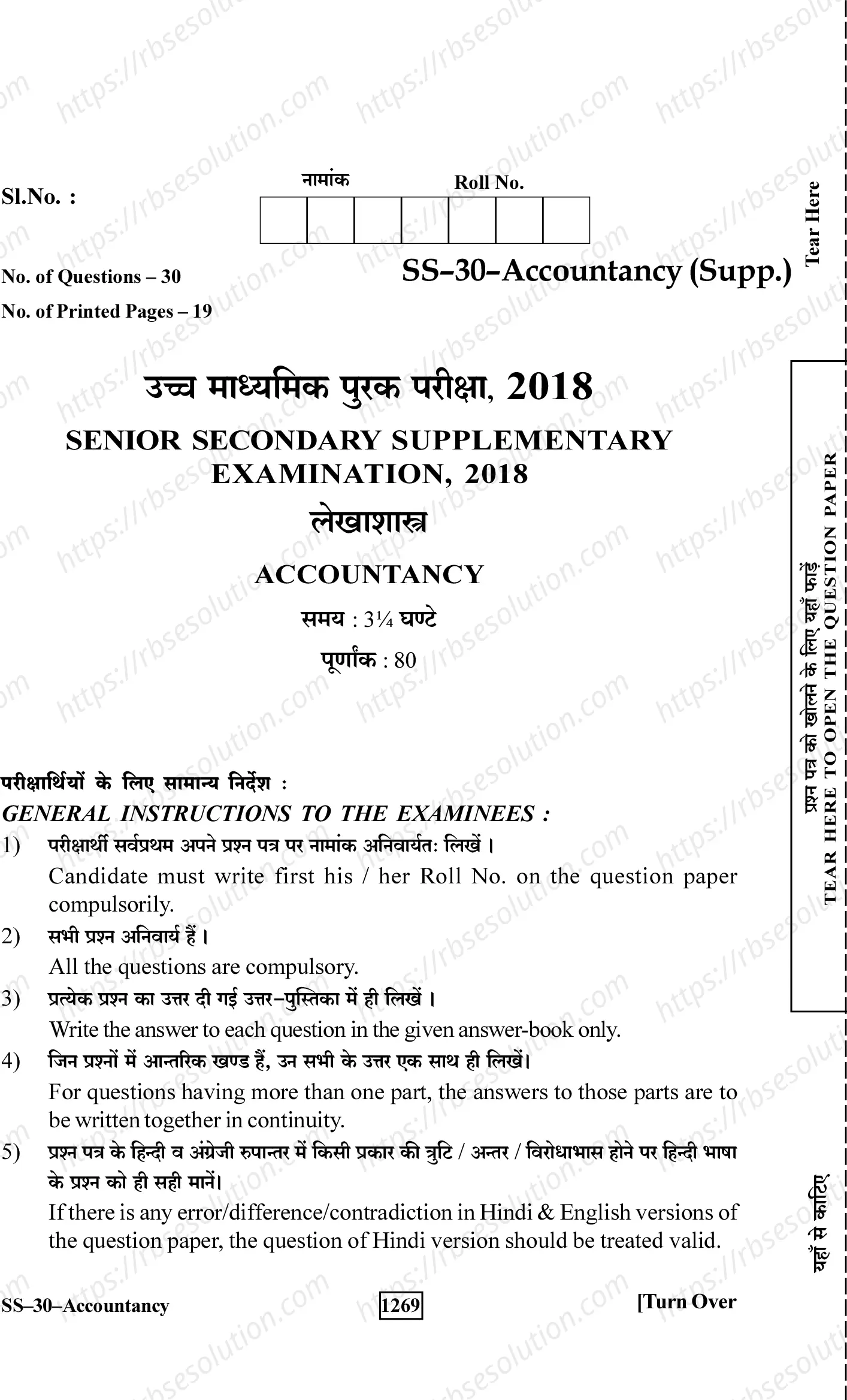


Rajasthan Board Class 12th -SS-30-2018 2018 solved Previous Year Question Papers
SLNo. : No. of Questions - 30
नामांक / Roll No. No. of Printed Pages — 9
उच्च माध्यमिक पुरक, 2018
SENIOR SECONDARY SUPPLEMENTARY EXAMINATION, 2018
लेखाशास्त्र
ACCOUNTANCY
समय : 3¼ घण्टे पूर्णांक : 80
परीक्षार्थियों के लिए सामान्य निर्देश :
GENERAL INSTRUCTIONS TO THE EXAMINEES :
- परीक्षार्थी सर्वप्रथम अपने प्रश्न पत्र पर नामांक अनिवार्यत: लिखें।
Candidate must write first his / her Roll No. on the question paper compulsorily. - सभी प्रश्न अनिवार्य हैं।
All the questions are compulsory. - प्रत्येक प्रश्न का उत्तर दी गई उत्तर-पुस्तिका में ही लिखें।
Write the answer to each question in the given answer-book only. - जिन प्रश्नों में आन्तरिक खण्ड हैं, उन सभी के उत्तर एक साथ ही लिखें।
For questions having more than one part, the answers to those parts are to be written together in continuity. - प्रश्न पत्र के हिन्दी व अंग्रेजी संस्करण में किसी प्रकार की त्रुटि / अन्तर / विरोधाभास होने पर हिन्दी भाषा के प्रश्न को ही सही मानें।
If there is any error/difference/contradiction in Hindi & English versions of the question paper, the question of Hindi version should be treated valid.
SS-30-Accountancy 269 [Turn Over
SS-30-Accountancy (Supp.)
Tear Here
प्रश्न पत्र को खोलने के लिए यहाँ फाड़ें
TEAR HERE TO OPEN THE QUESTION PAPER
परीक्षा पत्र – निर्देश
सामान्य निर्देश
- यह प्रश्न पत्र दो खण्डों में विभक्त है – अ और ब।
- खण्ड ‘अ’ सभी छात्रों के लिए अनिवार्य है।
- खण्ड ‘ब’ के दो भाग हैं, प्रत्येक भाग में सात प्रश्न हैं। परीक्षार्थी को किसी एक भाग के सभी सात प्रश्नों को हल करना है।
General Instructions
- This question paper contains two Sections – A and B.
- Section 'A' is compulsory for all candidates.
- Section 'B' has two portions. Every portion has a set of seven questions. Candidate can attempt only a set of seven questions of any one portion.
प्रश्नों का वितरण एवं अंक योजना
| खण्ड | प्रश्न संख्या | प्रत्येक प्रश्न के अंक |
|---|---|---|
| अ | 1 – 8 | 1 |
| अ | 9 – 16 | 2 |
| अ | 17 – 21 | 3 |
| अ | 22 – 23 | 4 |
| ब | 24 – 25 | 6 |
| ब | 26 – 27 | 8 |
| ब | 28 – 29 | 10 |
| ब | 30 | 6 |
अथवा (वैकल्पिक भाग के लिए भी यही अंक योजना लागू होती है।)
| खण्ड | प्रश्न संख्या | प्रत्येक प्रश्न के अंक |
|---|---|---|
| ब (OR) | 24 – 25 | 6 |
| ब (OR) | 26 – 27 | 8 |
| ब (OR) | 28 – 29 | 10 |
| ब (OR) | 30 | 6 |
अन्य निर्देश
प्रश्न संख्या 22 (खण्ड-अ) तथा 30 (खण्ड-ब) में आन्तरिक विकल्प हैं।
There are internal choices in Q. No. 22 (Section-A) and Q. No. 30 (Section-B).
SS—30—Accountancy 269
खण्ड - अ / SECTION - A
-
एक साझेदारी फर्म द्वारा लाभ-हानि नियोजन खाता क्यों बनाया जाता है?
Why Profit and Loss Appropriation Account is prepared by a Partnership firm?
लाभ-हानि नियोजन खाता साझेदारी फर्म द्वारा शुद्ध लाभ या हानि को साझेदारों के बीच उनके लाभ-हानि अनुपात में वितरित करने, तथा साझेदारों के वेतन, ब्याज, कमीशन आदि के समायोजन के लिए बनाया जाता है। यह खाता फर्म के लाभ-हानि खाते के बाद बनाया जाता है।
Profit and Loss Appropriation Account is prepared to distribute the net profit or loss among partners in their profit-sharing ratio, and to adjust partners' salaries, interest, commission, etc. It is prepared after the Profit and Loss Account of the firm.
-
अवकाश ग्रहण करने वाले अथवा मृतक साझेदार को ख्याति में हिस्सा पाने का अधिकार क्यों होता है?
Why a retiring or deceased partner is entitled to a share of goodwill of the firm?
अवकाश ग्रहण करने वाले या मृतक साझेदार ने फर्म की ख्याति (गुडविल) के निर्माण में अपने परिश्रम, योगदान और व्यावसायिक संबंधों से योगदान दिया होता है। अतः फर्म छोड़ने पर वह ख्याति में अपने हिस्से का अधिकारी होता है, जिसे शेष साझेदारों द्वारा उसे भुगतान किया जाता है।
A retiring or deceased partner has contributed to the creation of the firm's goodwill through their efforts, contribution, and business relations. Therefore, upon leaving the firm, they are entitled to their share of goodwill, which is paid to them by the remaining partners.
-
मृतक साझेदार के निष्पादक को अदत्त राशि पर ब्याज किस दर से देय होता है?
At what rate of interest is payable on the amount remaining unpaid to the executor of deceased partner?
यदि साझेदारी संलेख में कोई विशेष दर निर्धारित नहीं है, तो मृतक साझेदार के निष्पादक को अदत्त राशि पर 6% प्रति वर्ष की दर से ब्याज देय होता है (जैसा कि भारतीय साझेदारी अधिनियम, 1932 के अनुसार प्रावधान है)।
If no specific rate is mentioned in the partnership deed, interest at the rate of 6% per annum is payable on the amount remaining unpaid to the executor of the deceased partner (as per the Indian Partnership Act, 1932).
-
पूजा के अवकाश ग्रहण करने के समय "कर्मचारी क्षतिपूर्ति संचय" के ₹30,000 के विभाजन हेतु जर्नल प्रविष्टि कीजिए, यदि इसके लिए कोई दावा नहीं है। फर्म में शिवानी, पूजा तथा सुमन तीन साझेदार हैं जिनका लाभ हानि अनुपात 3:2:1 है।
Give the journal entry to distribute 'Workmen Compensation Reserve' of ₹30,000 at the time of retirement of Pooja, when there is no claim against it. The firm has three partners Shivani, Pooja & Suman and their profit sharing ratio is 3:2:1.
व्याख्या: जब कोई दावा नहीं है, तो कर्मचारी क्षतिपूर्ति संचय की पूरी राशि साझेदारों के पूंजी खातों में उनके लाभ-हानि अनुपात (3:2:1) में हस्तांतरित की जाती है।
जर्नल प्रविष्टि:
दिनांक विवरण बट्टा (₹) जमा (₹) कर्मचारी क्षतिपूर्ति संचय खाता ...नामे 30,000 शिवानी के पूंजी खाते में (3/6 × 30,000) 15,000 पूजा के पूंजी खाते में (2/6 × 30,000) 10,000 सुमन के पूंजी खाते में (1/6 × 30,000) 5,000 (कर्मचारी क्षतिपूर्ति संचय के वितरण हेतु) Explanation: When there is no claim, the entire amount of Workmen Compensation Reserve is transferred to the partners' capital accounts in their profit-sharing ratio (3:2:1).
-
फर्म के समापन के समय डूबत ऋण प्रावधान खाते का शेष किस खाते में हस्तांतरित किया जाता है?
At the time of dissolution of the firm balance of provision for bad debts A/c is transferred to which A/c?
फर्म के समापन के समय डूबत ऋण प्रावधान खाते का शेष वसूली खाते (Realisation Account) में हस्तांतरित किया जाता है।
At the time of dissolution of the firm, the balance of Provision for Bad Debts Account is transferred to the Realisation Account.
-
ऋणपत्रों के समपार्श्विक प्रतिभूति के रूप में निर्गमन की स्थिति में, यदि प्रविष्टि की जाती है तो किस खाते को नामे किया जाएगा?
In the case of issue of debentures as collateral security, if entry is passed, which account will be debited?
ऋणपत्रों के समपार्श्विक प्रतिभूति के रूप में निर्गमन की स्थिति में, यदि प्रविष्टि की जाती है तो ऋणपत्र समपार्श्विक प्रतिभूति खाता (Debentures Collateral Security Account) को नामे किया जाएगा।
In the case of issue of debentures as collateral security, if an entry is passed, the Debentures Collateral Security Account will be debited.
7. संदीप लि. ने उमेश से ₹90,000 की मशीनरी क्रय की, उसके प्रतिफलस्वरूप उमेश को ₹1,00,000 अंकित मूल्य के 9% ऋणपत्र निर्गमित किये। संदीप लि. की पुस्तकों में ऋणपत्र के निर्गमन की प्रविष्टि कीजिए।
Sandeep Ltd. purchased a machinery from Umesh for ₹90,000. For the consideration of it, issued 9% Debentures with a nominal value of ₹1,00,000 to Umesh. Give a journal entry in the books of Sandeep Ltd. for issue of debentures.
Journal Entry in the books of Sandeep Ltd.
| Date | Particulars | L.F. | Debit (₹) | Credit (₹) |
|---|---|---|---|---|
| Machinery A/c Dr. | 90,000 | |||
| Discount on Issue of Debentures A/c Dr. | 10,000 | |||
| To 9% Debentures A/c | 1,00,000 | |||
| (Being machinery purchased from Umesh and 9% debentures of ₹1,00,000 issued at discount of ₹10,000 as consideration) | ||||
Explanation: The machinery is worth ₹90,000, but debentures of ₹1,00,000 are issued. The difference of ₹10,000 is treated as discount on issue of debentures.
8. संयुक्त साहस का समापन कब होता है?
When dissolution of the Joint Venture is happen?
Answer: The dissolution of a Joint Venture occurs when the venture's objective is achieved, i.e., when all the goods purchased are sold, all expenses are paid, and the final profit or loss is distributed among the co-venturers. It can also be dissolved by mutual agreement or on the expiry of the venture's term.
9. अनिल व सुनील साझेदार हैं जो लाभ हानि 3:2 में बांटते हैं। उन्होंने लाभों में 1/3 हिस्से के लिए मुकेश को नया साझेदार बनाया। मुकेश ख्याति में अपने हिस्से के लिए ₹20,000 नकद, ₹30,000 फर्नीचर तथा ₹10,000 का स्टॉक लाया। फर्म की पुस्तकों में आवश्यक जर्नल प्रविष्टियां कीजिए।
Anil and Sunil are partners sharing profits & losses in the ratio of 3:2. They Admitted Mukesh for 1/3 share as a new partner. Mukesh brought ₹20,000 in cash, furniture worth ₹30,000 and stock worth ₹10,000 for his share of goodwill. Give necessary journal entries in the books of the firm.
Journal Entries in the books of the firm
| Date | Particulars | L.F. | Debit (₹) | Credit (₹) |
|---|---|---|---|---|
| Cash A/c Dr. | 20,000 | |||
| Furniture A/c Dr. | 30,000 | |||
| Stock A/c Dr. | 10,000 | |||
| To Mukesh's Capital A/c | 60,000 | |||
| (Being assets brought by Mukesh as his capital and goodwill share) | ||||
| Mukesh's Capital A/c Dr. | 60,000 | |||
| To Anil's Capital A/c (3/5 of 60,000) | 36,000 | |||
| To Sunil's Capital A/c (2/5 of 60,000) | 24,000 | |||
| (Being goodwill brought by Mukesh transferred to old partners in sacrificing ratio 3:2) | ||||
Explanation: Mukesh brings total assets worth ₹60,000 (₹20,000 cash + ₹30,000 furniture + ₹10,000 stock) for his 1/3 share of goodwill. This goodwill is credited to old partners Anil and Sunil in their sacrificing ratio (3:2).
10. मनीष और गोविन्द कपड़े के क्रय विक्रय करने हेतु संयुक्त साहस में प्रवेश करते हैं और लाभ-हानि को 2:1 के अनुपात में बांटने का निश्चय करते हैं। मनीष ने ₹1,80,000 के कपड़े खरीदे तथा किराया व बीमे के ₹6,000 चुकाये। गोविन्द ने ₹1,00,000 के कपड़े खरीदे तथा खर्चे के ₹4,000 चुकाए। मनीष ने ₹2,50,000 के कपड़े तथा गोविन्द ने ₹70,000 के कपड़े बेचे। मनीष की पुस्तकों में संयुक्त साहस खाता बनाइए यह मानते हुए कि सभी साहसी समस्त व्यवहारों का लेखा रखते हैं।
Manish and Govind entered in joint venture to purchase and sales of cloth and decide to distribute profits or loss in 2:1 ratios. Manish purchased cloth ₹1,80,000 and paid ₹6,000 for Rent & Insurance. Govind purchased cloth ₹1,00,000 and paid ₹4,000 for expenses. Manish sold the cloths worth ₹2,50,000 and Govind sold cloths for ₹70,000. Prepare Joint Venture Account in the books of Manish assuming that all transactions are entered by both parties.
Joint Venture Account in the books of Manish
| Particulars | Amount (₹) | Particulars | Amount (₹) | ||||||||||||||||||||||||||||||||||||||||||||||||||||||||||||||||||||||||||||||||||||||||||||||||||||||||||||||||||||||||||||||||||||||||||||||||||||||||||||||||||||||||||||||||||||||||||||||||||||||||||||||||||||||||||||||||||||||||||||||||||||||||||||||||||||||||||||||||||||||||||||||||||||||||||||||||||||||||||||||||||||||||||||||||||||||||||||||||||||||||||||||||||||||||||||||||||||||||||||||||||||||||||||||||||||||||||||||||||||||||||||||||||||||||||||||||||||||||||||||||||||||||||||||||||||||||||||||||||||||||||||||||||||||||||||||||||||||||||||||||||||||||||||||||||||||||||||||||||||||||||||||||||||||||||||||||||||||||||||||||||||||||||||||||||||||||||||||||||||||||||||||||||||||||||||||||||||||||||||||||||||||||||||||||||||||||||||||||||||||||||||||||||||||||||||||||||||||||||||||||||||||||||||||||||||||||||||||||||||||||||||||||||||||||||||||||||||||||||||||||||||||||||||||||||||||||||||||||||||||||||||||
|---|---|---|---|---|---|---|---|---|---|---|---|---|---|---|---|---|---|---|---|---|---|---|---|---|---|---|---|---|---|---|---|---|---|---|---|---|---|---|---|---|---|---|---|---|---|---|---|---|---|---|---|---|---|---|---|---|---|---|---|---|---|---|---|---|---|---|---|---|---|---|---|---|---|---|---|---|---|---|---|---|---|---|---|---|---|---|---|---|---|---|---|---|---|---|---|---|---|---|---|---|---|---|---|---|---|---|---|---|---|---|---|---|---|---|---|---|---|---|---|---|---|---|---|---|---|---|---|---|---|---|---|---|---|---|---|---|---|---|---|---|---|---|---|---|---|---|---|---|---|---|---|---|---|---|---|---|---|---|---|---|---|---|---|---|---|---|---|---|---|---|---|---|---|---|---|---|---|---|---|---|---|---|---|---|---|---|---|---|---|---|---|---|---|---|---|---|---|---|---|---|---|---|---|---|---|---|---|---|---|---|---|---|---|---|---|---|---|---|---|---|---|---|---|---|---|---|---|---|---|---|---|---|---|---|---|---|---|---|---|---|---|---|---|---|---|---|---|---|---|---|---|---|---|---|---|---|---|---|---|---|---|---|---|---|---|---|---|---|---|---|---|---|---|---|---|---|---|---|---|---|---|---|---|---|---|---|---|---|---|---|---|---|---|---|---|---|---|---|---|---|---|---|---|---|---|---|---|---|---|---|---|---|---|---|---|---|---|---|---|---|---|---|---|---|---|---|---|---|---|---|---|---|---|---|---|---|---|---|---|---|---|---|---|---|---|---|---|---|---|---|---|---|---|---|---|---|---|---|---|---|---|---|---|---|---|---|---|---|---|---|---|---|---|---|---|---|---|---|---|---|---|---|---|---|---|---|---|---|---|---|---|---|---|---|---|---|---|---|---|---|---|---|---|---|---|---|---|---|---|---|---|---|---|---|---|---|---|---|---|---|---|---|---|---|---|---|---|---|---|---|---|---|---|---|---|---|---|---|---|---|---|---|---|---|---|---|---|---|---|---|---|---|---|---|---|---|---|---|---|---|---|---|---|---|---|---|---|---|---|---|---|---|---|---|---|---|---|---|---|---|---|---|---|---|---|---|---|---|---|---|---|---|---|---|---|---|---|---|---|---|---|---|---|---|---|---|---|---|---|---|---|---|---|---|---|---|---|---|---|---|---|---|---|---|---|---|---|---|---|---|---|---|---|---|---|---|---|---|---|---|---|---|---|---|---|---|---|---|---|---|---|---|---|---|---|---|---|---|---|---|---|---|---|---|---|---|---|---|---|---|---|---|---|---|---|---|---|---|---|---|---|---|---|---|---|---|---|---|---|---|---|---|---|---|---|---|---|---|---|---|---|---|---|---|---|---|---|---|---|---|---|---|---|---|---|---|---|---|---|---|---|---|---|---|---|---|---|---|---|---|---|---|---|---|---|---|---|---|---|---|---|---|---|---|---|---|---|---|---|---|---|---|---|---|---|---|---|---|---|---|---|---|---|---|---|---|---|---|---|---|---|---|---|---|---|---|---|---|---|---|---|---|---|---|---|---|---|---|---|---|---|---|---|---|---|---|---|---|---|---|---|---|---|---|---|---|---|---|---|---|---|---|---|---|---|---|---|---|---|---|---|---|---|---|---|---|---|---|---|---|---|---|---|---|---|---|---|---|---|---|---|---|---|---|---|---|---|---|---|---|---|---|---|---|---|---|---|---|---|---|---|---|---|---|---|---|---|---|---|---|---|---|---|---|---|---|---|---|---|---|---|---|---|---|---|---|---|---|---|---|---|---|---|---|---|---|---|---|---|---|---|---|---|---|---|---|---|---|---|---|---|---|---|---|---|---|---|---|---|---|---|---|---|---|---|---|---|---|---|---|---|---|---|---|---|---|---|---|---|---|---|---|---|---|---|---|---|---|---|---|---|---|---|---|---|---|---|---|---|---|---|---|---|---|---|---|---|---|---|---|---|---|---|---|---|---|---|---|---|---|---|---|---|---|---|---|---|---|---|---|---|---|---|---|---|---|---|---|---|---|---|---|---|---|---|---|---|---|---|---|---|---|---|---|---|---|---|---|---|---|---|---|---|---|---|---|---|---|---|
| To Purchases (Manish) | 1,80,000 | By Sales (Manish) | 2,50,000 | ||||||||||||||||||||||||||||||||||||||||||||||||||||||||||||||||||||||||||||||||||||||||||||||||||||||||||||||||||||||||||||||||||||||||||||||||||||||||||||||||||||||||||||||||||||||||||||||||||||||||||||||||||||||||||||||||||||||||||||||||||||||||||||||||||||||||||||||||||||||||||||||||||||||||||||||||||||||||||||||||||||||||||||||||||||||||||||||||||||||||||||||||||||||||||||||||||||||||||||||||||||||||||||||||||||||||||||||||||||||||||||||||||||||||||||||||||||||||||||||||||||||||||||||||||||||||||||||||||||||||||||||||||||||||||||||||||||||||||||||||||||||||||||||||||||||||||||||||||||||||||||||||||||||||||||||||||||||||||||||||||||||||||||||||||||||||||||||||||||||||||||||||||||||||||||||||||||||||||||||||||||||||||||||||||||||||||||||||||||||||||||||||||||||||||||||||||||||||||||||||||||||||||||||||||||||||||||||||||||||||||||||||||||||||||||||||||||||||||||||||||||||||||||||||||||||||||||||||||||||||||||||
| To Rent & Insurance (Manish) | 6,000 | By Sales (Govind) | 70,000 | ||||||||||||||||||||||||||||||||||||||||||||||||||||||||||||||||||||||||||||||||||||||||||||||||||||||||||||||||||||||||||||||||||||||||||||||||||||||||||||||||||||||||||||||||||||||||||||||||||||||||||||||||||||||||||||||||||||||||||||||||||||||||||||||||||||||||||||||||||||||||||||||||||||||||||||||||||||||||||||||||||||||||||||||||||||||||||||||||||||||||||||||||||||||||||||||||||||||||||||||||||||||||||||||||||||||||||||||||||||||||||||||||||||||||||||||||||||||||||||||||||||||||||||||||||||||||||||||||||||||||||||||||||||||||||||||||||||||||||||||||||||||||||||||||||||||||||||||||||||||||||||||||||||||||||||||||||||||||||||||||||||||||||||||||||||||||||||||||||||||||||||||||||||||||||||||||||||||||||||||||||||||||||||||||||||||||||||||||||||||||||||||||||||||||||||||||||||||||||||||||||||||||||||||||||||||||||||||||||||||||||||||||||||||||||||||||||||||||||||||||||||||||||||||||||||||||||||||||||||||||||||||
| To Purchases (Govind) | 1,00,000 | ||||||||||||||||||||||||||||||||||||||||||||||||||||||||||||||||||||||||||||||||||||||||||||||||||||||||||||||||||||||||||||||||||||||||||||||||||||||||||||||||||||||||||||||||||||||||||||||||||||||||||||||||||||||||||||||||||||||||||||||||||||||||||||||||||||||||||||||||||||||||||||||||||||||||||||||||||||||||||||||||||||||||||||||||||||||||||||||||||||||||||||||||||||||||||||||||||||||||||||||||||||||||||||||||||||||||||||||||||||||||||||||||||||||||||||||||||||||||||||||||||||||||||||||||||||||||||||||||||||||||||||||||||||||||||||||||||||||||||||||||||||||||||||||||||||||||||||||||||||||||||||||||||||||||||||||||||||||||||||||||||||||||||||||||||||||||||||||||||||||||||||||||||||||||||||||||||||||||||||||||||||||||||||||||||||||||||||||||||||||||||||||||||||||||||||||||||||||||||||||||||||||||||||||||||||||||||||||||||||||||||||||||||||||||||||||||||||||||||||||||||||||||||||||||||||||||||||||||||||||||||||||||
| To Expenses (Govind) | 4,000 | ||||||||||||||||||||||||||||||||||||||||||||||||||||||||||||||||||||||||||||||||||||||||||||||||||||||||||||||||||||||||||||||||||||||||||||||||||||||||||||||||||||||||||||||||||||||||||||||||||||||||||||||||||||||||||||||||||||||||||||||||||||||||||||||||||||||||||||||||||||||||||||||||||||||||||||||||||||||||||||||||||||||||||||||||||||||||||||||||||||||||||||||||||||||||||||||||||||||||||||||||||||||||||||||||||||||||||||||||||||||||||||||||||||||||||||||||||||||||||||||||||||||||||||||||||||||||||||||||||||||||||||||||||||||||||||||||||||||||||||||||||||||||||||||||||||||||||||||||||||||||||||||||||||||||||||||||||||||||||||||||||||||||||||||||||||||||||||||||||||||||||||||||||||||||||||||||||||||||||||||||||||||||||||||||||||||||||||||||||||||||||||||||||||||||||||||||||||||||||||||||||||||||||||||||||||||||||||||||||||||||||||||||||||||||||||||||||||||||||||||||||||||||||||||||||||||||||||||||||||||||||||||||
| To Profit transferred to: | |||||||||||||||||||||||||||||||||||||||||||||||||||||||||||||||||||||||||||||||||||||||||||||||||||||||||||||||||||||||||||||||||||||||||||||||||||||||||||||||||||||||||||||||||||||||||||||||||||||||||||||||||||||||||||||||||||||||||||||||||||||||||||||||||||||||||||||||||||||||||||||||||||||||||||||||||||||||||||||||||||||||||||||||||||||||||||||||||||||||||||||||||||||||||||||||||||||||||||||||||||||||||||||||||||||||||||||||||||||||||||||||||||||||||||||||||||||||||||||||||||||||||||||||||||||||||||||||||||||||||||||||||||||||||||||||||||||||||||||||||||||||||||||||||||||||||||||||||||||||||||||||||||||||||||||||||||||||||||||||||||||||||||||||||||||||||||||||||||||||||||||||||||||||||||||||||||||||||||||||||||||||||||||||||||||||||||||||||||||||||||||||||||||||||||||||||||||||||||||||||||||||||||||||||||||||||||||||||||||||||||||||||||||||||||||||||||||||||||||||||||||||||||||||||||||||||||||||||||||||||||||||||
| - Manish's Capital A/c (2/3) | 20,000 | ||||||||||||||||||||||||||||||||||||||||||||||||||||||||||||||||||||||||||||||||||||||||||||||||||||||||||||||||||||||||||||||||||||||||||||||||||||||||||||||||||||||||||||||||||||||||||||||||||||||||||||||||||||||||||||||||||||||||||||||||||||||||||||||||||||||||||||||||||||||||||||||||||||||||||||||||||||||||||||||||||||||||||||||||||||||||||||||||||||||||||||||||||||||||||||||||||||||||||||||||||||||||||||||||||||||||||||||||||||||||||||||||||||||||||||||||||||||||||||||||||||||||||||||||||||||||||||||||||||||||||||||||||||||||||||||||||||||||||||||||||||||||||||||||||||||||||||||||||||||||||||||||||||||||||||||||||||||||||||||||||||||||||||||||||||||||||||||||||||||||||||||||||||||||||||||||||||||||||||||||||||||||||||||||||||||||||||||||||||||||||||||||||||||||||||||||||||||||||||||||||||||||||||||||||||||||||||||||||||||||||||||||||||||||||||||||||||||||||||||||||||||||||||||||||||||||||||||||||||||||||||||||
| - Govind's Capital A/c (1/3) | 10,000 | ||||||||||||||||||||||||||||||||||||||||||||||||||||||||||||||||||||||||||||||||||||||||||||||||||||||||||||||||||||||||||||||||||||||||||||||||||||||||||||||||||||||||||||||||||||||||||||||||||||||||||||||||||||||||||||||||||||||||||||||||||||||||||||||||||||||||||||||||||||||||||||||||||||||||||||||||||||||||||||||||||||||||||||||||||||||||||||||||||||||||||||||||||||||||||||||||||||||||||||||||||||||||||||||||||||||||||||||||||||||||||||||||||||||||||||||||||||||||||||||||||||||||||||||||||||||||||||||||||||||||||||||||||||||||||||||||||||||||||||||||||||||||||||||||||||||||||||||||||||||||||||||||||||||||||||||||||||||||||||||||||||||||||||||||||||||||||||||||||||||||||||||||||||||||||||||||||||||||||||||||||||||||||||||||||||||||||||||||||||||||||||||||||||||||||||||||||||||||||||||||||||||||||||||||||||||||||||||||||||||||||||||||||||||||||||||||||||||||||||||||||||||||||||||||||||||||||||||||||||||||||||||||
| Total | 3,20,000 | Total
5. प्रेषणी (Consignee) की पुस्तकों में प्रेषण सम्बन्धी डूबत ऋण की जर्नल प्रविष्टियांयदि प्रेषणी (Consignee) को डूबत ऋण (Bad Debts) के सम्बन्ध में जर्नल प्रविष्टियाँ करनी हैं: i) जब उसे परिशोध कमीशन (Del Credere Commission) दिया गया हो:इस स्थिति में प्रेषणी डूबत ऋण के लिए स्वयं उत्तरदायी होता है। वह प्रेषक को पूरी राशि देने के लिए बाध्य होता है। जर्नल प्रविष्टि:
स्पष्टीकरण: परिशोध कमीशन प्राप्त होने पर प्रेषणी डूबत ऋण का जोखिम वहन करता है, इसलिए वह प्रेषक को पूरी राशि देता है और डूबत ऋण को अपने खाते में डेबिट करता है। ii) जब उसे परिशोध कमीशन (Del Credere Commission) नहीं दिया गया हो:इस स्थिति में प्रेषणी डूबत ऋण के लिए उत्तरदायी नहीं होता। वह केवल प्रेषक को सूचित करता है। जर्नल प्रविष्टि:
स्पष्टीकरण: परिशोध कमीशन न होने पर प्रेषणी केवल एजेंट है, डूबत ऋण का जोखिम प्रेषक का है, इसलिए प्रेषक के खाते को डेबिट किया जाता है। 6. कुलदीप द्वारा राहुल को साईकिलों का प्रेषणदिया गया है:
असामान्य हानि (Abnormal Loss) का मूल्य:असामान्य हानि = चोरी गई साईकिलों की लागत + उन पर लगा आनुपातिक व्यय प्रति साईकिल की लागत = ₹2,000 प्रति साईकिल पर प्रेषण व्यय = ₹10,000 / 50 = ₹200 अतः प्रति साईकिल की कुल लागत = ₹2,000 + ₹200 = ₹2,200 असामान्य हानि = 10 × ₹2,200 = ₹22,000 बिना बिके माल (Unsold Stock) का मूल्य:राहुल को प्राप्त साईकिलें = 50 - 10 = 40 बेची गई साईकिलें = 30 बिना बिकी साईकिलें = 40 - 30 = 10 प्रति साईकिल की लागत (राहुल तक पहुँचने पर) = ₹2,000 + ₹200 + (₹5,000 / 40) = ₹2,200 + ₹125 = ₹2,325 बिना बिके माल का मूल्य = 10 × ₹2,325 = ₹23,250 7. फुटबाल क्लब का आय-व्यय खाता - सही परिणामदिया गया है: आय-व्यय खाता घाटा = ₹2,500 समायोजन:
सही परिणाम = दिया गया घाटा + समायोजन का शुद्ध प्रभाव समायोजन का शुद्ध प्रभाव = (बकाया वेतन) - (पूर्वदत्त किराया) - (उपार्जित ब्याज) + (अनुपार्जित चंदा) = ₹400 - ₹300 - ₹400 + ₹200 = -₹100 (अर्थात घाटा बढ़ेगा) सही घाटा = ₹2,500 + ₹100 = ₹2,600 अतः आय-व्यय खाते का सही परिणाम ₹2,600 का घाटा है। 8. खेल सामग्री के व्यय का समायोजन (3 मार्च 2017 को समाप्त वर्ष के लिए)दी गई सूचनाएँ:
आय-व्यय खाते में खेल सामग्री के व्यय की गणना:
स्पष्टीकरण: खेल सामग्री के व्यय की गणना करते समय प्रारम्भिक स्टॉक, क्रय (बकाया समायोजन सहित) और अंतिम स्टॉक को ध्यान में रखा जाता है। यहाँ क्रय की गणना चुकाई गई राशि में प्रारम्भिक बकाया जोड़कर और अंतिम बकाया घटाकर की गई है। 5. From the following information, show the expenses of games material with adjustment in Income & Expenditure Account for the year ending 31st March 2017:
Solution: Amount to be shown in Income & Expenditure Account = Opening Stock + Amount Paid + Opening Outstanding - Closing Stock - Closing Outstanding = ₹4,000 + ₹5,600 + ₹1,000 - ₹3,600 - ₹1,400 = ₹10,600 - ₹5,000 = ₹5,600 Thus, ₹5,600 will be shown as expenses for games material in the Income & Expenditure Account for the year ended 31st March 2017. 6. गौरव और महेश साझेदार हैं व लाभों को 2:1 के अनुपात में बाँटते हैं। 1 अप्रैल 2016 को उनकी पूंजी क्रमशः ₹6,00,000 व ₹4,00,000 हैं। साझेदारी संलेख में पूंजी पर 5% वार्षिक ब्याज और महेश को ₹3,750 प्रति तिमाही वेतन का प्रावधान है। 31 मार्च 2017 को समाप्त वर्ष के लिए, पूंजी पर ब्याज और वेतन का प्रावधान करने से पहले, ₹30,000 का लाभ है। वर्ष के लिए लाभों का विभाजन दिखाते हुए लाभ-हानि नियोजन खाता बनाइए।Gaurav and Mahesh are partners sharing profits in the ratio of 2:1. On 1st April 2016 their capital is respectively ₹6,00,000 and ₹4,00,000. The partnership deed provided interest on capital @ 5% p.a. and salary to Mahesh as ₹3,750 per quarter. The net profit before providing interest on capital and salary amounts to ₹30,000 for the year ended 31st March 2017. Prepare Profit & Loss Appropriation A/c and show the distribution of profit for the year. Solution: Profit & Loss Appropriation Account for the year ended 31st March 2017
Working Note: Interest on capital (₹30,000 + ₹20,000 = ₹50,000) + Salary (₹15,000) = ₹65,000. Since net profit is only ₹30,000, there is a loss of ₹35,000 which is shared in profit-sharing ratio 2:1. 7. पी, क्यू व आर एक फर्म में साझेदार हैं। आर 1 अप्रैल 2016 को फर्म से अवकाश ग्रहण करता है। उस तिथि को उनकी पूंजी का क्रेडिट शेष ₹60,000 है। यह निश्चय किया गया कि फर्म द्वारा आर को देय राशि 10% वार्षिक ब्याज सहित दो समान अर्द्धवार्षिक किस्तों में चुकायी जाएगी। आर का ऋण खाता बनाइए यह मानते हुए कि खाते प्रतिवर्ष 31 मार्च को बंद होते हैं।P, Q and R are partners in a firm. On 1st April 2016, R retires from the firm. On that date the credit balance of his capital A/c stood at ₹60,000. It is agreed to pay his due amount in two equal half yearly installments with interest @ 10% p.a. Prepare R's loan A/c assuming that the accounts are closed on 31st March every year. Solution: R's Loan Account
Working Note: Each installment = ₹60,000 / 2 = ₹30,000 (principal) + interest. Interest for first 6 months on ₹60,000 @ 10% = ₹3,000; first installment = ₹30,000 + ₹3,000 = ₹33,
आ, ब और स एक फर्म में साझेदार हैं। 31 मार्च 2017 को उन्होंने फर्म को समाप्त करने का निश्चय किया। समापन की तिथि को आ, ब तथा स की पूंजियाँ क्रमशः ₹ 1,00,000, ₹ 60,000 तथा ₹ 40,000 थीं। वसूली खाता ₹ 60,000 का नाम शेष प्रदर्शित करता है। ब ने देनदारों को ₹ 1,00,000 में लिया तथा स ने ₹ 5,000 के लेनदारों को भुगतान करने का वादा किया। आ दिवालिया हो गया तथा उसकी निजी सम्पत्तियों से केवल ₹ 2,000 वसूल हुए। गार्नर बनाम मरे नियम लागू करते हुए साझेदारों का पूंजी खाता बनाइए। यह मानते हुए कि साहुकार साझेदार वसूली की हानि में अपना हिस्सा नकद नहीं लाएंगे। गार्नर बनाम मरे नियम के अनुसार: दिवालिया साझेदार की पूंजी की कमी को सॉल्वेंट साझेदार अपने पूंजी अनुपात में वहन करते हैं। पूंजी अनुपात: आ : ब : स = 1,00,000 : 60,000 : 40,000 = 5 : 3 : 2 वसूली हानि: ₹ 60,000 (नाम शेष) हानि वितरण (पूंजी अनुपात में): आ की निजी संपत्ति से वसूली: ₹ 2,000 आ की पूंजी खाते में कमी: ₹ 30,000 - ₹ 2,000 = ₹ 28,000 (दिवालिया) यह कमी ब और स द्वारा पूंजी अनुपात (3:2) में वहन की जाएगी: नोट: ब और स को आ की दिवालिया कमी ₹ 28,000 को अपने पूंजी अनुपात (3:2) में वहन करना होगा, लेकिन प्रश्नानुसार वे नकद नहीं लाएंगे, इसलिए यह राशि उनके पूंजी खातों में डेबिट की जाएगी। भारतीय कंपनी अधिनियम 2013 की अनुसूची III के अनुसार केवल मुख्य शीर्षकों को दिखाते हुए एक कंपनी के तुलन पत्र का प्रारूप बनाइए। संयुक्त साहस और साझेदारी में कोई चार अंतर बताइए। चेन्नई के ओमप्रकाश ने उदयपुर के विक्रांत को 600 साड़ियां दर ₹ 300 प्रति साड़ी लागत पर प्रेषित की। ओमप्रकाश ने प्रेषण पर ₹ 6,000 व्यय किये। ओमप्रकाश ने ₹ 50,000 की राशि का तीन माह का विनिमय बिल विक्रांत पर लिखा जिसे उसने स्वीकार किया। ओमप्रकाश ने बिल को ₹ 49,000 में बैंक से भुना लिया। विक्रांत ने ₹ 800 चुंगी के चुकाये और 500 साड़ियाँ @ ₹ 400 प्रति साड़ी बेच दी। 40 साड़ियाँ गोदाम से चोरी हो गयी। विक्रांत को 10% सामान्य कमीशन देय है। विक्रांत की पुस्तकों में ओमप्रकाश का खाता बनाइए तथा असामान्य हानि की गणना कीजिए। असामान्य हानि की गणना: कुल साड़ियाँ = 600 चोरी गई साड़ियाँ = 40 प्रति साड़ी लागत = ₹ 300 प्रेषण व्यय प्रति साड़ी = ₹ 6,000 / 600 = ₹ 10 प्रति साड़ी कुल लागत = ₹ 300 + ₹ 10 = ₹ 310 असामान्य हानि का मूल्य = 40 × ₹ 310 = ₹ 12,400 रितेश क्लब के 50 नियमित सदस्य हैं जो प्रत्येक ₹100 मासिक चंदा देते हैं। क्लब ₹1,000 मासिक भवन का किराया चुकाता है। अन्य सूचनाएँ निम्नलिखित है: 31 मार्च 2017 को समाप्त वर्ष के लिए प्राप्ति एवं भुगतान खाता तथा आय-व्यय खाता बनाइए। व्याख्या: प्राप्ति एवं भुगतान खाते में केवल नकद लेन-देन दर्शाए गए हैं। आय-व्यय खाते में प्राप्य चंदा (बकाया) और देय किराया (बकाया) को शामिल किया गया है। फर्नीचर पर 10% मूल्यह्रास माना गया है। रमेश और सुरेश साझेदार हैं जो लाभों को क्रमशः 5:3 के अनुपात में बांटते हैं। 31 मार्च 2017 को समाप्त वर्ष को उनका चिट्ठा इस प्रकार था: व्याख्या: यह चिट्ठा रमेश और सुरेश की साझेदारी फर्म का है। लाभ-हानि खाता ₹6,000 (डेबिट शेष) दर्शाता है, जो हानि को इंगित करता है। सामान्य संचय ₹4,000 है। पूंजी खाते: रमेश ₹80,000 और सुरेश ₹50,000। संपत्तियों में रोकड़, देनदार (प्रावधान घटाकर), स्टॉक, विनियोग, और प्लाण्ट शामिल हैं। महेश निम्न शर्तों पर साझेदारी में प्रवेश करता हैं :- पुनर्मूल्यांकन खाता तथा साझेदारों के पूंजी खाते बनाइए। पुनर्मूल्यांकन खाता नोट: संदिग्ध ऋण प्रावधान = 8,000 का 5% = ₹400। हानि (50,400 - 6,500) = ₹43,900 पुराने साझेदारों के पूंजी खातों में उनके पुराने अनुपात में स्थानांतरित की जाएगी। साझेदारों के पूंजी खाते नोट: पुराना अनुपात (A:B:C) = 5:3:2 माना गया है। ख्याति में महेश का हिस्सा = 24,000 × (2/10) = ₹4,800। पुराने साझेदारों के पूंजी खाते पुनर्मूल्यांकन हानि से समायोजित किए गए हैं। A, B और C एक फर्म में साझेदार हैं जो लाभों को 5:3:2 में बाँटते हैं। 31 मार्च 2017 को उनका स्थिति विवरण निम्न प्रकार था :- नोट: यह स्थिति विवरण दिया गया है, प्रश्न में आगे के लिए उपयोग हो सकता है। Ramesh और Suresh साझेदार हैं जो लाभों को 5:3 के अनुपात में बांटते हैं। 31 मार्च, 2017 को उनका आर्थिक चिट्ठा निम्नलिखित था: 1 अक्टूबर, 2017 को Ramesh की मृत्यु हो गई। Ramesh के निष्पादक और शेष साझेदार Suresh के बीच निम्नलिखित सहमति हुई: 1 अक्टूबर, 2017 को Ramesh का पूंजी खाता तथा Ramesh के निष्पादक का खाता बनाइए। पिछले चार वर्षों के लाभों का औसत = (₹3,000 + ₹2,000 + ₹20,000 + ₹5,000) / 4 = ₹30,000 / 4 = ₹7,500 ख्याति = औसत लाभ × 2½ = ₹7,500 × 2.5 = ₹18,750 Ramesh का ख्याति में हिस्सा = ₹18,750 × 5/8 = ₹11,718.75 (लगभग ₹11,719) पुनर्मूल्यांकन से लाभ = ₹36,000 Ramesh का हिस्सा = ₹36,000 × 5/8 = ₹22,500 लाभ-हानि खाते में डेबिट शेष (हानि) = ₹6,000 Ramesh का हिस्सा = ₹6,000 × 5/8 = ₹3,750 (हानि) सामान्य संचय = ₹4,000 Ramesh का हिस्सा = ₹4,000 × 5/8 = ₹2,500 पिछले वर्ष (2016-17) का लाभ = ₹5,000 2017-18 के लिए अनुमानित लाभ = ₹5,000 (पिछले वर्ष के आधार पर) 1 अप्रैल से 1 अक्टूबर तक (6 माह) का लाभ = ₹5,000 × 6/12 = ₹2,500 Ramesh का हिस्सा = ₹2,500 × 5/8 = ₹1,562.50 Ramesh की पूंजी = ₹80,000 1 अप्रैल से 1 अक्टूबर तक (6 माह) ब्याज = ₹80,000 × 6% × 6/12 = ₹2,400 नोट: Ramesh को देय कुल धनराशि ₹1,16,850 है, जिसमें से आधी (₹58,425) त
Mahesh is admitted into partnership on the following terms: Prepare Revaluation Account and Partner's Capital Account. Solution: Revaluation Account Partner's Capital Account Note: The exact figures depend on the original values of stock and debtors, which are not provided in the question. The above shows the format and treatment. A, B and C were partners in a firm sharing profits in the ratio of 5:3:2. On 31st March, 2017, their Balance Sheet was as under: Note: The question continues on the next page (Turn Over). Journal Entries in the books of the firm (for A's death on 1st October 2017): 1. Calculation of Goodwill: 2. Revaluation of Assets: 3. Profit for the year 2017-18 (up to 1st Oct 2017): 4. Interest on Capital: 0% p.a. (No interest provided) 5. Amount due to A: (Assuming A's capital balance before adjustments is given or calculated from books; here we show the final settlement) Explanation: Half of the amount due to A is paid immediately to the executor, and the remaining half is transferred to the Executor's Loan Account. Given: Company issued 20,000 equity shares of ₹10 each at par. Applications received for 30,000 shares. Payment: Application ₹3, Allotment ₹3, First Call ₹2, Final Call ₹2. Pro-rata allotment to 28,000 applicants; remaining applicants refunded. Excess application money adjusted towards allotment. All money received except Manisha (applicant for 400 shares) who did not pay final call. Nusrat Ltd. issued 20,000 equity shares of ₹10 each to public. Applications were received for 30,000 shares. Amount was payable as follows: On Application = ₹3, On Allotment = ₹3, On first call = ₹2 and on second & final call = ₹2. Applications of 28,000 shares were made pro-rata allotment and amount of remaining applicants were refunded. Excess application money was utilised to adjust allotment. All the amount was received in time except one shareholder Manisha who had applied for 400 shares did not pay second & final call. Give journal entries in the books of company. (Narrations are not necessary) Working Notes: Journal Entries: What do you mean by Inter firm comparison? अंतर-फर्म तुलना से आप क्या समझते हैं? Inter-firm comparison is a technique of financial analysis where the financial performance and position of one firm is compared with other similar firms in the same industry. It helps in identifying strengths, weaknesses, and areas for improvement by benchmarking against industry standards or competitors. This comparison is usually done using ratios, common-size statements, and trend analysis. What will be the impact of 'Goods sold on credit' on a current Ratio of 2:1? State with reason. 2:1 के चालू अनुपात पर 'उधार माल बेचा' का क्या प्रभाव पड़ेगा? कारण भी बताइए। Impact: The current ratio will remain unchanged (still 2:1). Reason: When goods are sold on credit, current assets (stock) decrease by the cost of goods sold, but current assets (debtors) increase by the same amount (selling price). Since both are current assets, the total current assets remain the same. Current liabilities are unaffected. Therefore, the current ratio (Current Assets / Current Liabilities) does not change. Write the names of any four techniques of financial analysis. वित्तीय विश्लेषण की कोई चार तकनीकों के नाम लिखिए। निम्नलिखित सूचनाओं की सहायता से विनियोग पर प्रत्याय (विनियोजित पूंजी पर प्रत्याय) दर की गणना कीजिए: दी गई सूचनाएँ: गणना: उत्तर: विनियोग पर प्रत्याय दर = 100% निम्नांकित सूचनाओं से तुलनात्मक आय विवरण को पूर्ण कीजिये। (प्रश्न चिन्ह वाले स्थानों को भरिये) [4] एक पेशेवर लेखाकार के लिए नैतिकता का पालन करना क्यों आवश्यक है? समझाइये। [4] Why it is essential for a professional Accountant to follow the ethics? Explain. उत्तर: एक पेशेवर लेखाकार के लिए नैतिकता का पालन करना निम्नलिखित कारणों से आवश्यक है: नीचे दी गई सूचनाओं से निम्न अनुपातों की गणना कीजिए: [6] दी गई सूचनाएँ: हल: नोट: दिए गए आंकड़ों में कुछ विसंगतियाँ हैं (जैसे सकल लाभ = बिक्री, और स्वामित्व कोष > कुल सम्पत्तियाँ), जो संभवतः मुद्रण त्रुटि के कारण हैं। उपरोक्त गणनाएँ दिए गए आंकड़ों के आधार पर की गई हैं। विनियोग विश्लेषण अनुपातों को उदाहरण सहित समझाइए? [6] उत्तर: विनियोग विश्लेषण अनुपात (Investment Analysis Ratios) वे अनुपात हैं जो किसी कंपनी में निवेश की लाभप्रदता और दक्षता का मूल्यांकन करने में मदद करते हैं। ये अनुपात निवेशकों को यह निर्णय लेने में सहायता करते हैं कि किसी कंपनी में निवेश करना लाभदायक है या नहीं। प्रमुख विनियोग विश्लेषण अनुपात: ये अनुपात निवेशकों को कंपनी के वित्तीय स्वास्थ्य और भविष्य की संभावनाओं का आकलन करने में मदद करते हैं। Given Information: i) Current Ratio Current Ratio = Current Assets / Current Liabilities = ₹ 5,00,000 / ₹ 2,00,000 = 2.5 : 1 ii) Acid Test Ratio (Quick Ratio) Quick Assets = Current Assets - Closing Inventory = ₹ 5,00,000 - ₹ 4,50,000 = ₹ 50,000 Acid Test Ratio = Quick Assets / Current Liabilities = ₹ 50,000 / ₹ 2,00,000 = 0.25 : 1 iii) Inventory Turnover Ratio Cost of Revenue from Operations = Revenue from Operations - Gross Profit = ₹ 4,00,000 - ₹ 4,00,000 = ₹ 0 Average Inventory = (Opening Inventory + Closing Inventory) / 2 = (₹ 3,00,000 + ₹ 4,50,000) / 2 = ₹ 3,75,000 Inventory Turnover Ratio = Cost of Revenue from Operations / Average Inventory = ₹ 0 / ₹ 3,75,000 = 0 times (Note: Cost of Revenue is zero, so ratio is zero) iv) Operating Ratio Operating Profit Ratio = 26% Operating Ratio = 100% - Operating Profit Ratio = 100% - 26% = 74% v) Trade Receivable Turnover Ratio Average Trade Receivable = (Opening Trade Receivable + Closing Trade Receivable) / 2 = (₹ 3,00,000 + ₹ 4,00,000) / 2 = ₹ 3,50,000 Trade Receivable Turnover Ratio = Revenue from Operations / Average Trade Receivable = ₹ 4,00,000 / ₹ 3,50,000 = 1.14 times vi) Proprietary Ratio Proprietary Ratio = Shareholder's Fund / Total Assets = ₹ 6,00,000 / ₹ 5,00,000 = 1.2 : 1 Explain Investment Analysis Ratios with examples? Investment Analysis Ratios are financial metrics used by investors to evaluate the profitability, efficiency, and potential returns of an investment in a company. These ratios help in assessing the performance of shares and the overall financial health of the business. Key investment analysis ratios include: These ratios help investors make informed decisions about buying, holding, or selling shares by comparing the company's performance with industry standards or historical data. 24) एनालॉग कम्प्यूटर से आप क्या समझते हैं? What do you mean by Analog Computer? उत्तर: एनालॉग कम्प्यूटर एक प्रकार का कम्प्यूटर है जो निरंतर भौतिक राशियों (जैसे वोल्टेज, दबाव, तापमान) को मापकर और उन पर गणना करके परिणाम देता है। यह डिजिटल कम्प्यूटर की तरह बाइनरी अंकों (0 और 1) का उपयोग नहीं करता, बल्कि एनालॉग सिग्नलों के माध्यम से कार्य करता है। उदाहरण: स्पीडोमीटर, थर्मामीटर। Answer: An analog computer is a type of computer that measures and calculates using continuous physical quantities (such as voltage, pressure, temperature) and provides results. It does not use binary digits (0 and 1) like digital computers, but works through analog signals. Examples: Speedometer, Thermometer. 25) एन्टिटी संबंध मॉडल क्या होता है? What is Entity Relationship Model? उत्तर: एन्टिटी संबंध मॉडल (ER Model) एक डेटाबेस डिज़ाइन टूल है जो वास्तविक दुनिया की संस्थाओं (Entities) और उनके बीच के संबंधों (Relationships) को ग्राफिकल रूप में प्रस्तुत करता है। इसमें तीन मुख्य घटक होते हैं: एन्टिटी (आयत), एट्रीब्यूट (दीर्घवृत्त), और संबंध (समचतुर्भुज)। इसका उपयोग डेटाबेस की संरचना को समझने और डिज़ाइन करने के लिए किया जाता है। Answer: Entity Relationship Model (ER Model) is a database design tool that graphically represents real-world entities and the relationships between them. It has three main components: Entity (rectangle), Attribute (ellipse), and Relationship (diamond). It is used to understand and design the structure of a database. 26) एम. एस. एक्सेल स्प्रेडशीट के कोई दो महत्त्व बताइए। [2] Give any two importances of MS Excel spreadsheet. उत्तर: Answer: 27) वर्कशीट में हम रो और कॉलम का आकार किस प्रकार बढ़ा एवं घटा सकते हैं? [2] How can we resizing Rows and Columns in worksheet? उत्तर: वर्कशीट में रो और कॉलम का आकार बढ़ाने या घटाने के लिए निम्नलिखित विधियाँ हैं: Answer: To resize rows and columns in a worksheet, the following methods are used: 28) डेटाबेस मैनेजमेन्ट सिस्टम के कार्यों की व्याख्या कीजिए। [4] Explain the functions of Database management system. उत्तर: डेटाबेस मैनेजमेन्ट सिस्टम (DBMS) के प्रमुख कार्य निम्नलिखित हैं: Answer: The main functions of Database Management System (DBMS) are as follows: 29) मैनुअल लेखा प्रणाली एवं कम्प्यूटरीकृत लेखा प्रणाली में अंतर स्पष्ट कीजिए। (कोई चार) [4] State the point of differences between Manual Accounting system and Computerized Accounting system. (Any four) उत्तर: मैनुअल लेखा प्रणाली और कम्प्यूटरीकृत लेखा प्रणाली में निम्नलिखित चार अंतर हैं: Answer: The following are four differences between Manual Accounting System and Computerized Accounting System: अथवा एम. एस. एक्सल स्प्रेडशीट की विशेषताओं को समझाइये। OR Explain the features of MS Excel spreadsheet. i) PMT (Payment Function): This function calculates the periodic payment for a loan or investment based on constant payments and a constant interest rate. Syntax: Example: If you take a loan of ₹1,00,000 at an annual interest rate of 12% for 5 years (monthly payments), the monthly payment would be calculated as: ii) PPMT (Principal Payment Function): This function calculates the principal portion of a payment for a given period for a loan or investment. Syntax: Example: For the same loan, the principal portion of the first month's payment: iii) IPMT (Interest Payment Function): This function calculates the interest portion of a payment for a given period for a loan or investment. Syntax: Example: For the same loan, the interest portion of the first month's payment: Note: PMT = PPMT + IPMT (₹2,224.44 = ₹1,224.44 + ₹1,000.00) | |||||||||||||||||||||||||||||||||||||||||||||||||||||||||||||||||||||||||||||||||||||||||||||||||||||||||||||||||||||||||||||||||||||||||||||||||||||||||||||||||||||||||||||||||||||||||||||||||||||||||||||||||||||||||||||||||||||||||||||||||||||||||||||||||||||||||||||||||||||||||||||||||||||||||||||||||||||||||||||||||||||||||||||||||||||||||||||||||||||||||||||||||||||||||||||||||||||||||||||||||||||||||||||||||||||||||||||||||||||||||||||||||||||||||||||||||||||||||||||||||||||||||||||||||||||||||||||||||||||||||||||||||||||||||||||||||||||||||||||||||||||||||||||||||||||||||||||||||||||||||||||||||||||||||||||||||||||||||||||||||||||||||||||||||||||||||||||||||||||||||||||||||||||||||||||||||||||||||||||||||||||||||||||||||||||||||||||||||||||||||||||||||||||||||||||||||||||||||||||||||||||||||||||||||||||||||||||||||||||||||||||||||||||||||||||||||||||||||||||||||||||||||||||||||||||||||||||||||||||||||||||||