
RBSE Class 12th 2020 Mathematics-SS-15-2020 Previous Year Papers
Class 12th students hunting authentic previous year papers for Mathematics-SS-15-2020 (2020) land here for a reason: the paper below matches how RBSE assessments are remembered from that year. RBSE Solution does not mix years on one page; each combination gets its own notes.
Skim the overview sections, then work through the scanned pages. Pair this practice with RBSE books and solutions when you need to relearn a concept a question exposed.
Paper details
Quick reference for this previous year papers page — confirm board, class, and year & subject before you study.
| Board | RBSE |
|---|---|
| Class | Class 12th |
| Exam year | 2020 |
| Subject | Mathematics-SS-15-2020 |
| Resource type | Previous Year Papers |
| Category | RBSE Previous Year Question Papers |
| Website | RBSE Solution |
The table summarises this Previous Year Papers resource. Confirm RBSE, Class 12th, year 2020, and subject Mathematics-SS-15-2020 before studying.
RBSE Solution organises previous year papers so each URL carries chapter-specific guidance — better for students and for search engines than one generic paragraph for the whole class.
How to practise with this question paper
Stage one: read the Mathematics-SS-15-2020 question paper from 2020 without a timer and highlight command words — explain, prove, calculate, discuss. Stage two: attempt selected questions closed-book. Stage three: compare with solutions or teacher feedback.
Previous Year Papers work best when you log mistakes by topic, not only by question number. That log becomes your revision index before pre-boards.
RBSE Class 12th 2020 Mathematics-SS-15-2020
Scroll through the Previous Year Papers pages for Mathematics-SS-15-2020 (2020).
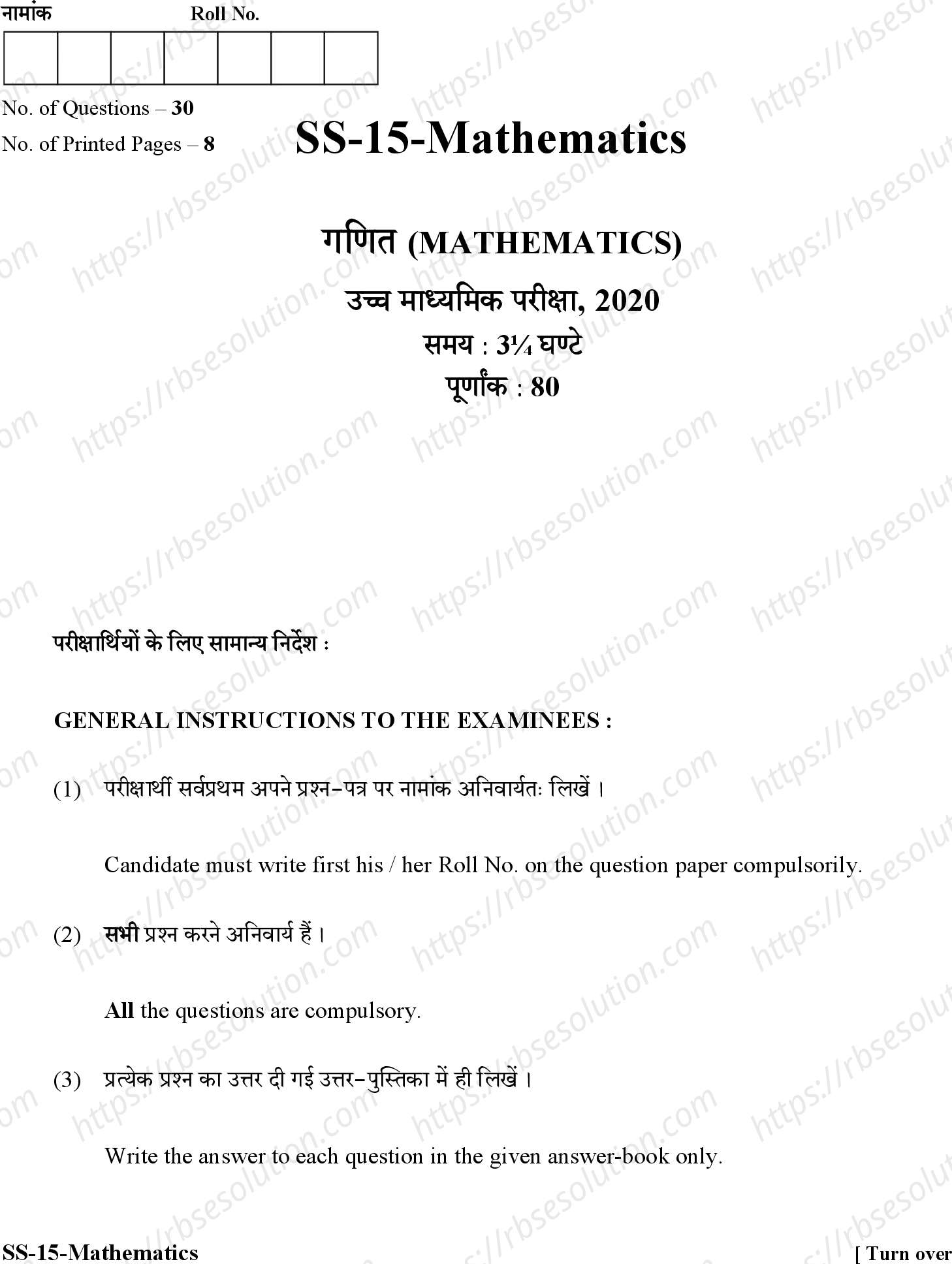


Rajasthan Board Class 12th Mathematics-SS-15-2020 2020 solved Previous Year Question Papers
गणित (MATHEMATICS)
उच्च माध्यमिक परीक्षा, 2020
समय : 3.15 घण्टे पूर्णांक : 80
परीक्षार्थियों के लिए सामान्य निर्देश :
GENERAL INSTRUCTIONS TO THE EXAMINEES :
- परीक्षार्थी सर्वप्रथम अपने प्रश्न-पत्र पर नामांक अनिवार्यतः लिखें।
Candidate must write first his / her Roll No. on the question paper compulsorily. - सभी प्रश्न करने अनिवार्य हैं।
All the questions are compulsory. - प्रत्येक प्रश्न का उत्तर दी गई उत्तर-पुस्तिका में ही लिखें।
Write the answer to each question in the given answer-book only.
SS-5-Mathematics | Turn over
खण्ड – A / Section – A
प्रश्न संख्या 1 से 10 तक प्रत्येक प्रश्न 1 अंक का है।
Q. Nos. 1 to 10 carry 1 mark each.
-
यदि f : R → R, f(x) = x² द्वारा परिभाषित है, तो f का परिसर (range) है –
If f : R → R is defined by f(x) = x², then the range of f is –
- R
- [0, ∞)
- (0, ∞)
- (-∞, 0]
उत्तर / Answer: [B] [0, ∞)
व्याख्या / Explanation: x² ≥ 0 सभी वास्तविक x के लिए, अतः परिसर [0, ∞) है। -
यदि sin⁻¹ x = y, तो –
If sin⁻¹ x = y, then –
- 0 ≤ y ≤ π
- −π/2 ≤ y ≤ π/2
- 0 < y < π
- −π/2 < y < π/2
उत्तर / Answer: [B] −π/2 ≤ y ≤ π/2
व्याख्या / Explanation: sin⁻¹ x का मुख्य मान शाखा [−π/2, π/2] है। -
आव्यूह A = [aᵢⱼ]ₘₓₙ का एक अवयव aᵢⱼ = (i + j)² द्वारा परिभाषित है, तो a₃₃ का मान है –
If an element aᵢⱼ of matrix A = [aᵢⱼ]ₘₓₙ is defined by aᵢⱼ = (i + j)², then the value of a₃₃ is –
- 36
- 25
- 16
- 9
उत्तर / Answer: [A] 36
व्याख्या / Explanation: a₃₃ = (3+3)² = 6² = 36 -
यदि A = [1 2 3] हो, तो A का परिवर्त (transpose) है –
If A = [1 2 3], then transpose of A is –
- [1 2 3]
- ⎡1⎤
⎢2⎥
⎣3⎦ - ⎡1⎤
⎢2⎥
⎣3⎦ - ⎡3⎤
⎢2⎥
⎣1⎦
उत्तर / Answer: [B] ⎡1⎤
⎢2⎥
⎣3⎦
व्याख्या / Explanation: पंक्ति आव्यूह का परिवर्त स्तम्भ आव्यूह होता है। -
यदि y = sin(ax + b) हो, तो dy/dx = ?
If y = sin(ax + b), then dy/dx = ?
- cos(ax + b)
- −a cos(ax + b)
- a cos(ax + b)
- −cos(ax + b)
उत्तर / Answer: [C] a cos(ax + b)
व्याख्या / Explanation: श्रृंखला नियम से, dy/dx = cos(ax + b) · a = a cos(ax + b) -
∫ eˣ (sin x + cos x) dx = ?
- eˣ sin x + C
- eˣ cos x + C
- −eˣ sin x + C
- −eˣ cos x + C
उत्तर / Answer: [A] eˣ sin x + C
व्याख्या / Explanation: ∫ eˣ [f(x) + f'(x)] dx = eˣ f(x) + C, यहाँ f(x) = sin x -
∫₀¹ 1/(1 + x²) dx = ?
- π/4
- π/2
- π
- 0
उत्तर / Answer: [A] π/4
व्याख्या / Explanation: ∫₀¹ 1/(1+x²) dx = [tan⁻¹ x]₀¹ = tan⁻¹ 1 − tan⁻¹ 0 = π/4 -
अवकल समीकरण dy/dx = eˣ⁺ʸ का हल है –
The solution of differential equation dy/dx = eˣ⁺ʸ is –
- eˣ + e⁻ʸ = C
- eˣ + eʸ = C
- e⁻ˣ + eʸ = C
- e⁻ˣ + e⁻ʸ = C
उत्तर / Answer: [A] eˣ + e⁻ʸ = C
व्याख्या / Explanation: dy/dx = eˣ·eʸ ⇒ e⁻ʸ dy = eˣ dx ⇒ −e⁻ʸ = eˣ − C ⇒ eˣ + e⁻ʸ = C -
सदिश a = î + ĵ + k̂ का दिशा में एकांक सदिश है –
The unit vector in the direction of vector a = î + ĵ + k̂ is –
- (î + ĵ + k̂)/√3
- (î + ĵ + k̂)/3
- î + ĵ + k̂
- √3(î + ĵ + k̂)
उत्तर / Answer: [A] (î + ĵ + k̂)/√3
व्याख्या / Explanation: |a| = √(1²+1²+1²) = √3, अतः एकांक सदिश = a/|a| -
यदि P(A) = 0.6, P(B) = 0.3 और P(A∩B) = 0.2 हो, तो P(A|B) = ?
If P(A) = 0.6, P(B) = 0.3 and P(A∩B) = 0.2, then P(A|B) = ?
- 2/3
- 1/3
- 1/2
- 3/5
उत्तर / Answer: [A] 2/3
व्याख्या / Explanation: P(A|B) = P(A∩B)/P(B) = 0.2/0.3 = 2/3
खण्ड -अ / SECTION -A
-
If f: R → R, f(x) = x² + 5x + 9, then find the value of f⁻¹(8) and f⁻¹(9).
Solution:
Let y = f(x) = x² + 5x + 9
For f⁻¹(8): Put f(x) = 8
x² + 5x + 9 = 8
x² + 5x + 1 = 0
x = [-5 ± √(25 - 4)]/2 = (-5 ± √21)/2For f⁻¹(9): Put f(x) = 9
x² + 5x + 9 = 9
x² + 5x = 0
x(x + 5) = 0
x = 0 or x = -5Answer: f⁻¹(8) = (-5 ± √21)/2, f⁻¹(9) = 0, -5
-
Find the value of 2 tan (tan⁻¹ x + tan⁻¹ x³).
Solution:
Let A = tan⁻¹ x and B = tan⁻¹ x³
tan(A + B) = (tan A + tan B)/(1 - tan A tan B) = (x + x³)/(1 - x·x³) = (x + x³)/(1 - x⁴)
Therefore, 2 tan (tan⁻¹ x + tan⁻¹ x³) = 2 × (x + x³)/(1 - x⁴)
Answer: 2(x + x³)/(1 - x⁴)
-
If
|k+4 -1| = |a -1|
|3 k-6| |3 -4|, then find the value of a.Solution:
Expanding determinants:
LHS = (k+4)(k-6) - (-1)(3) = (k+4)(k-6) + 3
RHS = a(-4) - (-1)(3) = -4a + 3
Equating: (k+4)(k-6) + 3 = -4a + 3
(k+4)(k-6) = -4a
k² - 6k + 4k - 24 = -4a
k² - 2k - 24 = -4a
Answer: a = -(k² - 2k - 24)/4
-
Define singular and non-singular matrix.
Answer:
Singular Matrix: A square matrix A is said to be singular if its determinant is zero, i.e., |A| = 0. A singular matrix does not have an inverse.
Non-singular Matrix: A square matrix A is said to be non-singular if its determinant is non-zero, i.e., |A| ≠ 0. A non-singular matrix has an inverse.
-
Prove that in interval (-1, 1) function f(x) = x² - x + 1 is neither increasing nor decreasing.
Solution:
f(x) = x² - x + 1
f'(x) = 2x - 1
For increasing function: f'(x) > 0 ⇒ 2x - 1 > 0 ⇒ x > 1/2
For decreasing function: f'(x) < 0 ⇒ 2x - 1 < 0 ⇒ x < 1/2
In interval (-1, 1):
- For x ∈ (-1, 1/2): f'(x) < 0, so function is decreasing
- For x ∈ (1/2, 1): f'(x) > 0, so function is increasing
Since the function is decreasing in one part and increasing in another part of the interval (-1, 1), it is neither purely increasing nor purely decreasing in the entire interval.
Hence proved.
-
Find ∫ 1/(1 + sin x) dx.
Solution:
∫ 1/(1 + sin x) dx
Multiply numerator and denominator by (1 - sin x):
= ∫ (1 - sin x)/(1 - sin² x) dx
= ∫ (1 - sin x)/cos² x dx
= ∫ (1/cos² x - sin x/cos² x) dx
= ∫ (sec² x - sec x tan x) dx
= tan x - sec x + C
Answer: tan x - sec x + C
-
Find the value of (2i - 3j + 4k) × (3i + 4j - 4k).
Solution:
Let A = 2i - 3j + 4k and B = 3i + 4j - 4k
A × B = |i j k|
|2 -3 4|
|3 4 -4|
= i[(-3)(-4) - (4)(4)] - j[(2)(-4) - (4)(3)] + k[(2)(4) - (-3)(3)]
= i[12 - 16] - j[-8 - 12] + k[8 + 9]
= i(-4) - j(-20) + k(17)
= -4i + 20j + 17k
Answer: -4i + 20j + 17k
खण्ड - अ (Section - A)
प्रश्न 8
दर्शाइए कि बिन्दु A(2, 3, 4), B(-1, 2, -3) तथा C(-4, 1, -10) सरेख हैं।
Show that the points A(2, 3, 4), B(-1, 2, -3) and C(-4, 1, -10) are Collinear.
हल: बिन्दुओं A और B के बीच दिशा अनुपात ज्ञात करते हैं:
AB = (-1 - 2, 2 - 3, -3 - 4) = (-3, -1, -7)
बिन्दुओं B और C के बीच दिशा अनुपात ज्ञात करते हैं:
BC = (-4 - (-1), 1 - 2, -10 - (-3)) = (-3, -1, -7)
चूँकि AB और BC के दिशा अनुपात समान हैं, अतः बिन्दु A, B और C सरेख हैं।
प्रश्न 9
रैखिक प्रोग्रामन समस्या का सुसंगत हल को परिभाषित कीजिए।
Define the feasible solution of the Linear programming problem.
हल: रैखिक प्रोग्रामन समस्या में, सुसंगत हल वह हल होता है जो समस्या के सभी अवरोधों (constraints) को संतुष्ट करता है। दूसरे शब्दों में, चरों का वह मान जो सभी रैखिक असमिकाओं या समीकरणों को पूरा करता है, सुसंगत हल कहलाता है।
प्रश्न 10
यदि P(A) = 6/11, P(B) = 5/11 और P(A ∪ B) = 7/11 हो, तो P(A/B) ज्ञात कीजिए।
If P(A) = 6/11, P(B) = 5/11 and P(A ∪ B) = 7/11, then find P(A/B).
हल: सर्वप्रथम P(A ∩ B) ज्ञात करते हैं:
P(A ∪ B) = P(A) + P(B) - P(A ∩ B)
⇒ 7/11 = 6/11 + 5/11 - P(A ∩ B)
⇒ P(A ∩ B) = 6/11 + 5/11 - 7/11 = 4/11
अब, P(A/B) = P(A ∩ B) / P(B) = (4/11) / (5/11) = 4/5
अतः P(A/B) = 4/5
खण्ड - ब (Section - B)
प्रश्न 11
यदि फलन f और g दो एकैकी आच्छादक फलन इस प्रकार हैं कि संयुक्त फलन (gof) एवं (f⁻¹og⁻¹) परिभाषित हो तो प्रदर्शित कीजिए: (gof)⁻¹ = f⁻¹og⁻¹
If f and g are one-one onto function such that composite function (gof) and (f⁻¹og⁻¹) are defined, then show that (gof)⁻¹ = f⁻¹og⁻¹.
हल: माना f: X → Y और g: Y → Z एकैकी आच्छादक फलन हैं।
तब gof: X → Z भी एकैकी आच्छादक होगा, अतः इसका प्रतिलोम (gof)⁻¹: Z → X परिभाषित होगा।
साथ ही, f⁻¹: Y → X और g⁻¹: Z → Y भी एकैकी आच्छादक होंगे।
अब, f⁻¹og⁻¹: Z → X परिभाषित है।
हमें सिद्ध करना है कि (gof)⁻¹ = f⁻¹og⁻¹
माना z ∈ Z, तब g⁻¹(z) = y ∈ Y (क्योंकि g आच्छादक है)
और f⁻¹(y) = x ∈ X (क्योंकि f आच्छादक है)
अतः (f⁻¹og⁻¹)(z) = f⁻¹(g⁻¹(z)) = f⁻¹(y) = x
अब, (gof)(x) = g(f(x)) = g(y) = z
⇒ (gof)⁻¹(z) = x
अतः प्रत्येक z ∈ Z के लिए, (gof)⁻¹(z) = (f⁻¹og⁻¹)(z)
इसलिए (gof)⁻¹ = f⁻¹og⁻¹
प्रश्न 12
यदि A - 2I = ⎡
⎢
⎣ -1 2 3
2 -3 1
3 1 0 ⎤
⎥
⎦ हो, तो AAᵀ ज्ञात कीजिए, जहाँ I, 3 × 3 क्रम का इकाई आव्यूह है।
If A - 2I = ⎡
⎢
⎣ -1 2 3
2 -3 1
3 1 0 ⎤
⎥
⎦, then find AAᵀ, where I is unit matrix of order 3 × 3.
हल: दिया है: A - 2I = ⎡
⎢
⎣ -1 2 3
2 -3 1
3 1 0 ⎤
⎥
⎦
जहाँ I = ⎡
⎢
⎣ 1 0 0
0 1 0
0 0 1 ⎤
⎥
⎦
अतः A = ⎡
⎢
⎣ -1 2 3
2 -3 1
3 1 0 ⎤
⎥
⎦ + 2I = ⎡
⎢
⎣ -1+2 2+0 3+0
2+0 -3+2 1+0
3+0 1+0 0+2 ⎤
⎥
⎦ = ⎡
⎢
⎣ 1 2 3
2 -1 1
3 1 2 ⎤
⎥
⎦
अब, Aᵀ = ⎡
⎢
⎣ 1 2 3
2 -1 1
3 1 2 ⎤
⎥
⎦T = ⎡
⎢
⎣ 1 2 3
2 -1 1
3 1 2 ⎤
⎥
⎦
AAᵀ = ⎡
⎢
⎣ 1 2 3
2 -1 1
3 1 2 ⎤
⎥
⎦ × ⎡
⎢
⎣ 1 2 3
2 -1 1
3 1 2 ⎤
⎥
⎦
= ⎡
⎢
⎣ 1(1)+2(2)+3(3) 1(2)+2(-1)+3(1) 1(3)+2(1)+3(2)
2(1)+(-1)(2)+1(3) 2(2)+(-1)(-1)+1(1) 2(3)+(-1)(1)+1(2)
3(1)+1(2)+2(3) 3(2)+1(-1)+2(1) 3(3)+1(1)+2(2) ⎤
⎥
⎦
= ⎡
⎢
⎣ 1+4+9 2-2+3 3+2+6
2-2+3 4+1+1 6-1+2
3+2+6 6-1+2 9+1+4 ⎤
⎥
⎦
= ⎡
⎢
⎣ 14 3 11
3 6 7
11 7 14 ⎤
⎥
⎦
अतः AAᵀ = ⎡
⎢
⎣ 14 3 11
3 6 7
11 7 14 ⎤
⎥
⎦
प्रश्न 13
(2x + 5)/(x² + 3x + 2) का x के सापेक्ष समाकलन कीजिए।
Integrate (2x + 5)/(x² + 3x + 2) with respect to x.
हल: ∫ (2x + 5)/(x² + 3x + 2) dx
सर्वप्रथम हर का गुणनखंड करते हैं:
x² + 3x + 2 = (x + 1)(x + 2)
अब आंशिक भिन्नों में विभाजित करते हैं:
(2x + 5)/(x² + 3x + 2) = A/(x + 1) + B/(x + 2)
⇒ 2x + 5 = A(x + 2) + B(x + 1)
⇒ 2x + 5 = (A + B)x + (2A + B)
दोनों पक्षों के गुणांकों की तुलना करने पर:
A + B = 2 ...(i)
2A + B = 5 ...(ii)
(ii) - (i) से: A = 3, तब B = -1
अतः ∫ (2x + 5)/(x² + 3x + 2) dx = ∫ [3/(x + 1) - 1/(x + 2)] dx
= 3∫ 1/(x + 1) dx - ∫ 1/(x + 2) dx
= 3 log|x + 1| - log|x + 2| + C
= log|(x + 1)³/(x + 2)| + C
अतः ∫ (2x + 5)/(x² + 3x + 2) dx = log|(x + 1)³/(x + 2)| + C
4. यदि \(y = \sqrt{\log x + \sqrt{\log x + \sqrt{\log x + \ldots \infty}}}\) हो, तो ज्ञात कीजिए।
If \(y = \sqrt{\log x + \sqrt{\log x + \sqrt{\log x + \ldots \infty}}}\), then find \(\frac{dy}{dx}\).
हल / Solution:
दिया है: \(y = \sqrt{\log x + y}\) (अनन्त श्रेणी के कारण)
दोनों पक्षों का वर्ग करने पर:
\(y^2 = \log x + y\)
\(\Rightarrow y^2 - y = \log x\)
अब \(x\) के सापेक्ष अवकलन करने पर:
\(2y \frac{dy}{dx} - \frac{dy}{dx} = \frac{1}{x}\)
\(\Rightarrow (2y - 1) \frac{dy}{dx} = \frac{1}{x}\)
\(\Rightarrow \frac{dy}{dx} = \frac{1}{x(2y - 1)}\)
5. वक्र \(2x^2 - y^2 = 4\) पर सरल रेखा \(x + 3y = 6\) के समान्तर अभिलम्ब के समीकरण ज्ञात कीजिए।
Find the equation of the normals to the curve \(2x^2 - y^2 = 4\) which are parallel to the line \(x + 3y = 6\).
हल / Solution:
दी गई रेखा: \(x + 3y = 6 \Rightarrow y = -\frac{1}{3}x + 2\)
अतः रेखा की प्रवणता \(m = -\frac{1}{3}\)
अभिलम्ब रेखा के समान्तर है, इसलिए अभिलम्ब की प्रवणता भी \(-\frac{1}{3}\) होगी।
वक्र: \(2x^2 - y^2 = 4\)
अवकलन करने पर: \(4x - 2y \frac{dy}{dx} = 0 \Rightarrow \frac{dy}{dx} = \frac{2x}{y}\)
स्पर्श रेखा की प्रवणता \(m_T = \frac{2x}{y}\)
अभिलम्ब की प्रवणता \(m_N = -\frac{1}{m_T} = -\frac{y}{2x}\)
प्रश्नानुसार: \(-\frac{y}{2x} = -\frac{1}{3} \Rightarrow \frac{y}{2x} = \frac{1}{3} \Rightarrow y = \frac{2x}{3}\)
वक्र के समीकरण में रखने पर:
\(2x^2 - \left(\frac{2x}{3}\right)^2 = 4 \Rightarrow 2x^2 - \frac{4x^2}{9} = 4\)
\(\Rightarrow \frac{18x^2 - 4x^2}{9} = 4 \Rightarrow \frac{14x^2}{9} = 4 \Rightarrow x^2 = \frac{36}{14} = \frac{18}{7}\)
\(\Rightarrow x = \pm \sqrt{\frac{18}{7}} = \pm \frac{3\sqrt{2}}{\sqrt{7}}\)
तब \(y = \frac{2}{3}x = \pm \frac{2\sqrt{2}}{\sqrt{7}}\)
बिन्दु \(\left(\frac{3\sqrt{2}}{\sqrt{7}}, \frac{2\sqrt{2}}{\sqrt{7}}\right)\) पर अभिलम्ब का समीकरण:
\(y - \frac{2\sqrt{2}}{\sqrt{7}} = -\frac{1}{3}\left(x - \frac{3\sqrt{2}}{\sqrt{7}}\right)\)
\(\Rightarrow 3y - \frac{6\sqrt{2}}{\sqrt{7}} = -x + \frac{3\sqrt{2}}{\sqrt{7}}\)
\(\Rightarrow x + 3y = \frac{9\sqrt{2}}{\sqrt{7}}\)
बिन्दु \(\left(-\frac{3\sqrt{2}}{\sqrt{7}}, -\frac{2\sqrt{2}}{\sqrt{7}}\right)\) पर अभिलम्ब का समीकरण:
\(y + \frac{2\sqrt{2}}{\sqrt{7}} = -\frac{1}{3}\left(x + \frac{3\sqrt{2}}{\sqrt{7}}\right)\)
\(\Rightarrow 3y + \frac{6\sqrt{2}}{\sqrt{7}} = -x - \frac{3\sqrt{2}}{\sqrt{7}}\)
\(\Rightarrow x + 3y = -\frac{9\sqrt{2}}{\sqrt{7}}\)
अतः अभिलम्बों के समीकरण: \(x + 3y = \pm \frac{9\sqrt{2}}{\sqrt{7}}\)
खण्ड-स / SECTION — C
6. निम्न त्रिकोणमितीय समीकरण को हल कीजिए:
\(\sin^{-1} x + \sin^{-1} 2x = \frac{\pi}{3}\)
Solve the following trigonometrical equation:
\(\sin^{-1} x + \sin^{-1} 2x = \frac{\pi}{3}\)
हल / Solution:
दिया है: \(\sin^{-1} x + \sin^{-1} 2x = \frac{\pi}{3}\)
\(\Rightarrow \sin^{-1} x = \frac{\pi}{3} - \sin^{-1} 2x\)
दोनों पक्षों में sin लेने पर:
\(\sin(\sin^{-1} x) = \sin\left(\frac{\pi}{3} - \sin^{-1} 2x\right)\)
\(\Rightarrow x = \sin\frac{\pi}{3} \cos(\sin^{-1} 2x) - \cos\frac{\pi}{3} \sin(\sin^{-1} 2x)\)
\(\Rightarrow x = \frac{\sqrt{3}}{2} \sqrt{1 - 4x^2} - \frac{1}{2} (2x)\)
\(\Rightarrow x = \frac{\sqrt{3}}{2} \sqrt{1 - 4x^2} - x\)
\(\Rightarrow 2x = \frac{\sqrt{3}}{2} \sqrt{1 - 4x^2}\)
\(\Rightarrow 4x = \sqrt{3} \sqrt{1 - 4x^2}\)
दोनों पक्षों का वर्ग करने पर:
\(16x^2 = 3(1 - 4x^2)\)
\(\Rightarrow 16x^2 = 3 - 12x^2\)
\(\Rightarrow 28x^2 = 3\)
\(\Rightarrow x^2 = \frac{3}{28}\)
\(\Rightarrow x = \pm \frac{\sqrt{3}}{2\sqrt{7}}\)
जाँच: \(x = \frac{\sqrt{3}}{2\sqrt{7}}\) के लिए, \(\sin^{-1} x + \sin^{-1} 2x = \sin^{-1}\left(\frac{\sqrt{3}}{2\sqrt{7}}\right) + \sin^{-1}\left(\frac{\sqrt{3}}{\sqrt{7}}\right)\)
चूँकि \(\frac{\sqrt{3}}{2\sqrt{7}} < \frac{1}{2}\) और \(\frac{\sqrt{3}}{\sqrt{7}} < 1\), अतः यह मान समीकरण को संतुष्ट करता है।
\(x = -\frac{\sqrt{3}}{2\sqrt{7}}\) के लिए, \(\sin^{-1} x\) ऋणात्मक होगा और \(\sin^{-1} 2x\) भी ऋणात्मक, जो \(\frac{\pi}{3}\) के बराबर नहीं हो सकता।
अतः अभीष्ट हल: \(x = \frac{\sqrt{3}}{2\sqrt{7}}\)
7. सिद्ध कीजिए कि:
\(\begin{vmatrix} 1+a & 1 & 1 \\ 1 & 1+b & 1 \\ 1 & 1 & 1+c \end{vmatrix} = abc \left(1 + \frac{1}{a} + \frac{1}{b} + \frac{1}{c}\right)\)
Prove that:
\(\begin{vmatrix} 1+a & 1 & 1 \\ 1 & 1+b & 1 \\ 1 & 1 & 1+c \end{vmatrix} = abc \left(1 + \frac{1}{a} + \frac{1}{b} + \frac{1}{c}\right)\)
हल / Solution:
माना \( \Delta = \begin{vmatrix} 1+a & 1 & 1 \\ 1 & 1+b & 1 \\ 1 & 1 & 1+c \end{vmatrix} \)
संक्रिया \(R_1 \rightarrow R_1 - R_2\) करने पर:
\( \Delta = \begin{vmatrix} a & -b & 0 \\ 1 & 1+b & 1 \\ 1 & 1 & 1+c \end{vmatrix} \)
अब \(R_2 \rightarrow R_2 - R_3\) करने पर:
\( \Delta = \begin{vmatrix} a & -b & 0 \\ 0 & b & -c \\ 1 & 1 & 1+c \end{vmatrix} \)
अब \(R_1\) के अनुदिश प्रसार करने पर:
\( \Delta = a \begin{vmatrix} b & -c \\ 1 & 1+c \end{vmatrix} - (-b) \begin{vmatrix} 0 & -c \\ 1 & 1+c \end{vmatrix} + 0 \)
\( = a [b(1+c) - (-c)(1)] + b [0(1+c) - (-c)(1)] \)
\( = a(b + bc + c) + b(0 + c) \)
\( = a(b + c + bc) + bc \)
\( = ab + ac + abc + bc \)
\( = abc + ab + bc + ca \)
\( = abc \left(1 + \frac{1}{c} + \frac{1}{a} + \frac{1}{b}\right) \)
\( = abc \left(1 + \frac{1}{a} + \frac{1}{b} + \frac{1}{c}\right) \)
अतः सिद्ध हुआ।
8. निम्न समीकरण निकाय को हल कीजिए:
\(\begin{bmatrix} 3 & 0 & 3 \\ 2 & 0 & y \\ 1 & 4 & 0 \end{bmatrix} \begin{bmatrix} x \\ y \\ z \end{bmatrix} = \begin{bmatrix} 8 \\ 2 \\ 4 \end{bmatrix} + \begin{bmatrix} 2y \\ z \\ 3y \end{bmatrix}\)
Solve the following system of equations:
\(\begin{bmatrix} 3 & 0 & 3 \\ 2 & 0 & y \\ 1 & 4 & 0 \end{bmatrix} \begin{bmatrix} x \\ y \\ z \end{bmatrix} = \begin{bmatrix} 8 \\ 2 \\ 4 \end{bmatrix} + \begin{bmatrix} 2y \\ z \\ 3y \end{bmatrix}\)
हल / Solution:
दिए गए आव्यूह समीकरण को लिखने पर:
\(\begin{bmatrix} 3x + 0y + 3z \\ 2x + 0y + yz \\ 1x + 4y + 0z \end{bmatrix} = \begin{bmatrix} 8 + 2y \\ 2 + z \\ 4 + 3y \end{bmatrix}\)
आव्यूहों की समानता से:
\(3x + 3z = 8 + 2y\) ...(i)
\(2x + yz = 2 + z\) ...(ii)
\(x + 4y = 4 + 3y\) ...(iii)
समीकरण (iii) से: \(x + 4y = 4 + 3y \Rightarrow x + y = 4 \Rightarrow y = 4 - x\)
समीकरण (i) में रखने पर: \(3x + 3z = 8 + 2(4 - x) \Rightarrow 3x + 3z = 8 + 8 - 2x\)
\(\Rightarrow 5x + 3z = 16\) ...(iv)
समीकरण (ii) में रखने पर: \(2x + (4 - x)z = 2 + z \Rightarrow 2x + 4z - xz = 2 + z\)
\(\Rightarrow 2x - xz + 4z - z = 2 \Rightarrow 2x - xz + 3z = 2\)
\(\Rightarrow x(2 - z) + 3z = 2\) ...(v)
समीकरण (iv) से: \(z = \frac{16 - 5x}{3}\)
समीकरण (v) में रखने पर:
\(x\left(2 - \frac{16 - 5x}{3}\right) + 3\left(\frac{16 - 5x}{3}\right) = 2\)
\(\Rightarrow x\left(\frac{6 - 16 + 5x}{3}\right) + (16 - 5x) = 2\)
\(\Rightarrow x\left(\frac{5x - 10}{3}\right) + 16 - 5x = 2\)
\(\Rightarrow \frac{5x^2 - 10x}{3} - 5x = 2 - 16\)
\(\Rightarrow \frac{5x^2 - 10x - 15x}{3} = -14\)
\(\Rightarrow 5x^2 - 25x = -42\)
\(\Rightarrow 5x^2 - 25x + 42 = 0\)
\(\Rightarrow 5x^2 - 15x - 10x + 42 = 0\)
\(\Rightarrow 5x(x - 3) - 10(x - 4.2) = 0\) (यहाँ गुणनखण्ड करने पर)
वास्तव में: \(5x^2 - 25x + 42 = 0\) के मूल: \(x = \frac{25 \pm \sqrt{625 - 840}}{10} = \frac{25 \pm \sqrt{-215}}{10}\)
चूँकि विविक्तकर ऋणात्मक है, अतः कोई वास्तविक हल नहीं है।
अतः समीकरण निकाय का कोई वास्तविक हल नहीं है।
cos-1 x का x के सापेक्ष समाकलन कीजिए। Integrate cos-1 x with respect to x. हल: माना I = ∫ cos-1 x dx cos-1 x को 1 × cos-1 x लिखकर खण्डशः समाकलन करने पर: I = x cos-1 x - ∫ x × (-1/√(1-x²)) dx I = x cos-1 x + ∫ x/√(1-x²) dx माना 1 - x² = t, तब -2x dx = dt ⇒ x dx = -dt/2 ∫ x/√(1-x²) dx = ∫ (-dt/2)/√t = -1/2 ∫ t-1/2 dt = -1/2 × 2√t = -√(1-x²) अतः I = x cos-1 x - √(1-x²) + C उत्तर: ∫ cos-1 x dx = x cos-1 x - √(1-x²) + C परवलयों y² = 4ax तथा x² = 4by के मध्यवर्ती क्षेत्र का क्षेत्रफल ज्ञात कीजिए। Find the area of the region enclosed between the two Parabolas y² = 4ax and x² = 4by. हल: दोनों परवलयों का प्रतिच्छेद बिन्दु ज्ञात करने के लिए समीकरणों को हल करते हैं: y² = 4ax और x² = 4by पहले समीकरण से y = √(4ax) = 2√(ax) (प्रथम चतुर्थांश में) दूसरे समीकरण से y = x²/(4b) प्रतिच्छेद पर: 2√(ax) = x²/(4b) ⇒ 8b√(ax) = x² दोनों ओर वर्ग करने पर: 64b²ax = x⁴ ⇒ x(x³ - 64ab²) = 0 अतः x = 0 या x = 4a1/3b2/3 अभीष्ट क्षेत्रफल = ∫[y₁ - y₂] dx (x = 0 से x = 4a1/3b2/3 तक) जहाँ y₁ = 2√(ax) (परवलय y² = 4ax से) और y₂ = x²/(4b) (परवलय x² = 4by से) क्षेत्रफल = ∫[2√(ax) - x²/(4b)] dx = [2√a × (2/3)x3/2 - x³/(12b)] = [(4√a/3)x3/2 - x³/(12b)] सीमाओं में सीमाएँ रखने पर अभीष्ट क्षेत्रफल = (16/3)ab वर्ग इकाई उत्तर: क्षेत्रफल = (16/3)ab वर्ग इकाई वृत्त x² + y² = 32 व रेखा y = x तथा x-अक्ष के मध्यवर्ती प्रथम चतुर्थाश में स्थित क्षेत्र का क्षेत्रफल ज्ञात कीजिए। Find the area of the region in the First quadrant enclosed by the x-axis, the line y = x and the circle x² + y² = 32. हल: वृत्त x² + y² = 32 की त्रिज्या r = √32 = 4√2 रेखा y = x और वृत्त का प्रतिच्छेद बिन्दु ज्ञात करने के लिए y = x वृत्त में रखने पर: x² + x² = 32 ⇒ 2x² = 32 ⇒ x² = 16 ⇒ x = 4 (प्रथम चतुर्थांश में) अतः प्रतिच्छेद बिन्दु P(4, 4) है। अभीष्ट क्षेत्रफल = क्षेत्र OAP का क्षेत्रफल + क्षेत्र APB का क्षेत्रफल जहाँ O(0,0), A(4,0), P(4,4), B(4√2, 0) क्षेत्र OAP (त्रिभुज) का क्षेत्रफल = ∫₀⁴ x dx = [x²/2]₀⁴ = 8 वर्ग इकाई क्षेत्र APB का क्षेत्रफल = ∫₄4√2 √(32 - x²) dx = [x/2 √(32-x²) + 16 sin-1(x/4√2)]₄4√2 = [0 + 16 sin-1(1)] - [2√16 + 16 sin-1(1/√2)] = [16 × π/2] - [8 + 16 × π/4] = 8π - 8 - 4π = 4π - 8 अतः कुल क्षेत्रफल = 8 + (4π - 8) = 4π वर्ग इकाई उत्तर: क्षेत्रफल = 4π वर्ग इकाई हल कीजिए: dy/dx + (2x tan⁻¹y - x³)(1 + y²) = 0 Solve: dy/dx + (2x tan⁻¹y - x³)(1 + y²) = 0 हल: दिया गया अवकल समीकरण: dy/dx + (2x tan⁻¹y - x³)(1 + y²) = 0 ⇒ dy/dx = -(2x tan⁻¹y - x³)(1 + y²) ⇒ dy/(1+y²) = -(2x tan⁻¹y - x³) dx माना tan⁻¹y = t, तब dy/(1+y²) = dt ∴ dt = -(2x t - x³) dx ⇒ dt + 2x t dx = x³ dx यह t में रैखिक अवकल समीकरण है: dt/dx + 2x t = x³ समाकलन गुणांक (I.F.) = e∫2x dx = ex² हल: t × ex² = ∫ x³ ex² dx + C माना x² = u, तब 2x dx = du ⇒ x dx = du/2 ∫ x³ ex² dx = ∫ x² × x ex² dx = ∫ u eu (du/2) = (1/2)∫ u eu du = (1/2)[u eu - eu] + C = (1/2)(x² - 1)ex² + C अतः t ex² = (1/2)(x² - 1)ex² + C ⇒ tan⁻¹y = (x² - 1)/2 + C e-x² उत्तर: tan⁻¹y = (x² - 1)/2 + C e-x² हल कीजिए: (1 + y²) dy/dx + (x - etan⁻¹y) = 0 Solve: (1 + y²) dy/dx + (x - etan⁻¹y) = 0 हल: दिया गया अवकल समीकरण: (1 + y²) dy/dx + (x - etan⁻¹y) = 0 ⇒ (1 + y²) dy/dx = -x + etan⁻¹y ⇒ dx/dy + x/(1+y²) = etan⁻¹y/(1+y²) यह x में रैखिक अवकल समीकरण है। समाकलन गुणांक (I.F.) = e∫dy/(1+y²) = etan⁻¹y हल: x × etan⁻¹y = ∫ etan⁻¹y × etan⁻¹y/(1+y²) dy + C = ∫ e2tan⁻¹y/(1+y²) dy + C माना tan⁻¹y = t, तब dy/(1+y²) = dt ∴ ∫ e2t dt + C = (1/2)e2t + C = (1/2)e2tan⁻¹y + C अतः x etan⁻¹y = (1/2)e2tan⁻¹y + C ⇒ x = (1/2)etan⁻¹y + C e-tan⁻¹y उत्तर: x = (1/2)etan⁻¹y + C e-tan⁻¹y सिद्ध कीजिए कि दी गई तिर्यक ऊँचाई और महत्तम आयतन वाले शंकु का अर्ध शीर्ष कोण tan⁻¹√2 होता है। Show that the semi vertical angle of a cone of maximum volume and given slant height is tan⁻¹√2. हल: माना शंकु की तिर्यक ऊँचाई l (नियत), ऊँचाई h, आधार त्रिज्या r तथा अर्ध शीर्ष कोण θ है। तब r = l sinθ, h = l cosθ शंकु का आयतन V = (1/3)πr²h = (1/3)π(l² sin²θ)(l cosθ) V = (1/3)πl³ sin²θ cosθ V को अधिकतम करने के लिए dV/dθ = 0 dV/dθ = (1/3)πl³[2 sinθ cos²θ - sin³θ] = 0 ⇒ 2 sinθ cos²θ - sin³θ = 0 ⇒ sinθ(2 cos²θ - sin²θ) = 0 sinθ ≠ 0 (क्योंकि θ = 0 अर्थपूर्ण नहीं), अतः 2 cos²θ - sin²θ = 0 ⇒ 2 cos²θ = sin²θ ⇒ tan²θ = 2 ⇒ tanθ = √2 ⇒ θ = tan⁻¹√2 द्वितीय अवकलज जाँच द्वारा यह अधिकतम है। अतः सिद्ध हुआ कि महत्तम आयतन वाले शंकु का अर्ध शीर्ष कोण tan⁻¹√2 होता है। निम्न रैखिक प्रोग्रामन समस्या को आलेखीय विधि से हल कीजिए: अधिकतम Z = 2x + 3y प्रतिबन्ध: 4x + 6y ≤ 60, 2x + y ≤ 20, x ≥ 0, y ≥ 0 Solve the following Linear Programming problem by graphical method: Max Z = 2x + 3y Constraints: 4x + 6y ≤ 60, 2x + y ≤ 20, x ≥ 0, y ≥ 0 हल: चरण 1: असमिकाओं को समीकरणों में बदलें: 4x + 6y = 60 ⇒ 2x + 3y = 30 ...(i) 2x + y = 20 ...(ii) x = 0, y = 0 चरण 2: सुसंगत क्षेत्र ज्ञात करें: समीकरण (i) के लिए बिन्दु: (0,10) और (15,0) समीकरण (ii) के लिए बिन्दु: (0,20) और (10,0) प्रतिच्छेद बिन्दु: समीकरण (i) और (ii) को हल करने पर: (ii) से y = 20 - 2x, (i) में रखने पर: 2x + 3(20 - 2x) = 30 ⇒ 2x + 60 - 6x = 30 ⇒ -4x = -30 ⇒ x = 7.5 y = 20 - 2(7.5) = 5 प्रतिच्छेद बिन्दु P(7.5, 5) चरण 3: सुसंगत क्षेत्र के कोणीय बिन्दु: O(0,0), A(10,0), P(7.5,5), B(0,10) चरण
फलन \( f(x) = |x-1| + 2|x-2| + 3|x-3| \) की बिन्दु \( x = 1, 2, 3 \) पर सांतत्यता एवं अवकलनीयता का परीक्षण कीजिए। Examine the continuity and differentiability of the function \( f(x) = |x-1| + 2|x-2| + 3|x-3| \) at points \( x = 1, 2, 3 \). हल (Solution): फलन \( f(x) = |x-1| + 2|x-2| + 3|x-3| \) को निम्न प्रकार लिखा जा सकता है: \( f(x) = \begin{cases}
-(x-1) - 2(x-2) - 3(x-3) = -6x + 14, & x < 1 \\
(x-1) - 2(x-2) - 3(x-3) = -4x + 10, & 1 \le x < 2 \\
(x-1) + 2(x-2) - 3(x-3) = 0x + 4, & 2 \le x < 3 \\
(x-1) + 2(x-2) + 3(x-3) = 6x - 14, & x \ge 3
\end{cases}\) बिन्दु \( x = 1 \) पर सांतत्यता: \( \lim_{x \to 1^-} f(x) = -6(1) + 14 = 8 \) \( \lim_{x \to 1^+} f(x) = -4(1) + 10 = 6 \) चूँकि वाम पक्ष सीमा ≠ दक्षिण पक्ष सीमा, अतः फलन \( x = 1 \) पर असतत है। अतः \( x = 1 \) पर अवकलनीयता का प्रश्न ही नहीं उठता। बिन्दु \( x = 2 \) पर सांतत्यता: \( \lim_{x \to 2^-} f(x) = -4(2) + 10 = 2 \) \( \lim_{x \to 2^+} f(x) = 0(2) + 4 = 4 \) चूँकि वाम पक्ष सीमा ≠ दक्षिण पक्ष सीमा, अतः फलन \( x = 2 \) पर असतत है। अतः \( x = 2 \) पर अवकलनीयता का प्रश्न ही नहीं उठता। बिन्दु \( x = 3 \) पर सांतत्यता: \( \lim_{x \to 3^-} f(x) = 0(3) + 4 = 4 \) \( \lim_{x \to 3^+} f(x) = 6(3) - 14 = 4 \) \( f(3) = 6(3) - 14 = 4 \) चूँकि \( \lim_{x \to 3^-} f(x) = \lim_{x \to 3^+} f(x) = f(3) = 4 \), अतः फलन \( x = 3 \) पर सतत है। बिन्दु \( x = 3 \) पर अवकलनीयता: वाम अवकलज: \( f'(3^-) = \lim_{h \to 0} \frac{f(3-h) - f(3)}{-h} = \lim_{h \to 0} \frac{4 - 4}{-h} = 0 \) दक्षिण अवकलज: \( f'(3^+) = \lim_{h \to 0} \frac{f(3+h) - f(3)}{h} = \lim_{h \to 0} \frac{6(3+h)-14 - 4}{h} = \lim_{h \to 0} \frac{6h}{h} = 6 \) चूँकि वाम अवकलज ≠ दक्षिण अवकलज, अतः फलन \( x = 3 \) पर अवकलनीय नहीं है। निष्कर्ष: फलन \( x = 1 \) और \( x = 2 \) पर असतत है, तथा \( x = 3 \) पर सतत है किन्तु अवकलनीय नहीं है। सिद्ध कीजिए : \( I = \int_0^{\pi} \log(1 + \cos x) \, dx = \pi \log \frac{1}{2} \) Prove that : \( I = \int_0^{\pi} \log(1 + \cos x) \, dx = \pi \log \frac{1}{2} \) हल (Solution): दिया है: \( I = \int_0^{\pi} \log(1 + \cos x) \, dx \) ...(i) गुण \( \int_0^a f(x) dx = \int_0^a f(a-x) dx \) का प्रयोग करने पर: \( I = \int_0^{\pi} \log(1 + \cos(\pi - x)) \, dx = \int_0^{\pi} \log(1 - \cos x) \, dx \) ...(ii) समीकरण (i) और (ii) को जोड़ने पर: \( 2I = \int_0^{\pi} [\log(1 + \cos x) + \log(1 - \cos x)] \, dx \) \( 2I = \int_0^{\pi} \log(1 - \cos^2 x) \, dx = \int_0^{\pi} \log(\sin^2 x) \, dx \) \( 2I = 2 \int_0^{\pi} \log(\sin x) \, dx \) \( I = \int_0^{\pi} \log(\sin x) \, dx \) ...(iii) पुनः गुण का प्रयोग करने पर: \( I = \int_0^{\pi} \log(\sin(\pi - x)) \, dx = \int_0^{\pi} \log(\sin x) \, dx \) (यह वही है) अब, \( I = 2 \int_0^{\pi/2} \log(\sin x) \, dx \) (सममिति से) हम जानते हैं कि \( \int_0^{\pi/2} \log(\sin x) \, dx = -\frac{\pi}{2} \log 2 \) अतः \( I = 2 \times (-\frac{\pi}{2} \log 2) = -\pi \log 2 = \pi \log \frac{1}{2} \) इति सिद्धम्। सिद्ध कीजिए : (i) \( \begin{vmatrix} a+b & b+c & c+a \end{vmatrix} = 2 \begin{vmatrix} a & b & c \end{vmatrix} \) (ii) \( [(\vec{a} \times \vec{b}) \cdot (\vec{b} \times \vec{c}) \times (\vec{c} \times \vec{a})] = [\vec{a} \ \vec{b} \ \vec{c}]^2 \) Prove that : (i) \( \begin{vmatrix} a+b & b+c & c+a \end{vmatrix} = 2 \begin{vmatrix} a & b & c \end{vmatrix} \) (ii) \( [(\vec{a} \times \vec{b}) \cdot (\vec{b} \times \vec{c}) \times (\vec{c} \times \vec{a})] = [\vec{a} \ \vec{b} \ \vec{c}]^2 \) हल (Solution): (i) माना \( \Delta = \begin{vmatrix} a+b & b+c & c+a \end{vmatrix} \) इसे सारणिक के रूप में लिखने पर: \( \Delta = \begin{vmatrix} a+b & b+c & c+a \end{vmatrix} \) संक्रिया \( C_1 \to C_1 + C_2 + C_3 \) करने पर: \( \Delta = \begin{vmatrix} 2(a+b+c) & b+c & c+a \end{vmatrix} \) \( \Delta = 2 \begin{vmatrix} a+b+c & b+c & c+a \end{vmatrix} \) अब \( C_1 \to C_1 - C_2 \) करने पर: \( \Delta = 2 \begin{vmatrix} a & b+c & c+a \end{vmatrix} \) पुनः \( C_2 \to C_2 - C_3 \) करने पर: \( \Delta = 2 \begin{vmatrix} a & b & c+a \end{vmatrix} \) अब \( C_3 \to C_3 - C_1 \) करने पर: \( \Delta = 2 \begin{vmatrix} a & b & c \end{vmatrix} \) इति सिद्धम्। (ii) हम जानते हैं कि \( \vec{a} \times \vec{b}, \vec{b} \times \vec{c}, \vec{c} \times \vec{a} \) सदिश हैं। \( (\vec{a} \times \vec{b}) \cdot [(\vec{b} \times \vec{c}) \times (\vec{c} \times \vec{a})] \) सर्वप्रथम, \( (\vec{b} \times \vec{c}) \times (\vec{c} \times \vec{a}) \) का मान ज्ञात करते हैं। सदिश त्रिक गुणनफल सूत्र \( \vec{u} \times (\vec{v} \times \vec{w}) = (\vec{u} \cdot \vec{w})\vec{v} - (\vec{u} \cdot \vec{v})\vec{w} \) का प्रयोग करने पर: माना \( \vec{u} = \vec{b} \times \vec{c}, \vec{v} = \vec{c}, \vec{w} = \vec{a} \) \( (\vec{b} \times \vec{c}) \times (\vec{c} \times \vec{a}) = [(\vec{b} \times \vec{c}) \cdot \vec{a}] \vec{c} - [(\vec{b} \times \vec{c}) \cdot \vec{c}] \vec{a} \) \( = [\vec{a} \ \vec{b} \ \vec{c}] \vec{c} - 0 \cdot \vec{a} = [\vec{a} \ \vec{b} \ \vec{c}] \vec{c} \) अब, \( (\vec{a} \times \vec{b}) \cdot [(\vec{b} \times \vec{c}) \times (\vec{c} \times \vec{a})] = (\vec{a} \times \vec{b}) \cdot ([\vec{a} \ \vec{b} \ \vec{c}] \vec{c}) \) \( = [\vec{a} \ \vec{b} \ \vec{c}] [(\vec{a} \times \vec{b}) \cdot \vec{c}] = [\vec{a} \ \vec{b} \ \vec{c}] [\vec{a} \ \vec{b} \ \vec{c}] = [\vec{a} \ \vec{b} \ \vec{c}]^2 \) इति सिद्धम्। निम्नलिखित रेखा युग्मों के मध्य न्यूनतम दूरी ज्ञात कीजिए : (i) \( \frac{x-3}{1} = \frac{y-4}{2} = \frac{z+1}{3} \) और \( \frac{x-1}{3} = \frac{y-3}{2} = \frac{z-1}{1} \) (ii) \( \vec{r} = \hat{i} + 2\hat{j} - 4\hat{k} + \lambda(2\hat{i} + 3\hat{j} + 6\hat{k}) \) तथा \( \vec{r} = 3\hat{i} + 3\hat{j} - 5\hat{k} + \mu(2\hat{i} + 3\hat{j} + 6\hat{k}) \) Find the shortest distance between the following pair of lines : (i) \( \frac{x-3}{1} = \frac{y-4}{2} = \frac{z+1}{3} \) and \( \frac{x-1}{3} = \frac{y-3}{2} = \frac{z-1}{1} \) (ii) \( \vec{r} = \hat{i} + 2\hat{j} - 4\hat{k} + \lambda(2\hat{i} + 3\hat{j} + 6\hat{k}) \) and \( \vec{r} = 3\hat{i} + 3\hat{j} - 5\hat{k} + \mu(2\hat{i} + 3\hat{j} + 6\hat{k}) \) हल (Solution): (i) पहली रेखा: \( \frac{x-3}{1} = \frac{y-4}{2} = \frac{z+1}{3} \) यहाँ \( \vec{a_1} = 3\hat{i} + 4\hat{j} - \hat{k} \) और \( \vec{b_1} = \hat{i} + 2\hat{j} + 3\hat{k} \) दूसरी रेखा: \( \frac{x-1}{3} = \frac{y-3}{2} = \frac{z-1}{1} \) यहाँ \( \vec{a_2} = \hat{i} + 3\hat{j} + \hat{k} \) और \( \vec{b_2} = 3\hat{i} + 2\hat{j} + \hat{k} \) \( \vec{a_2} - \vec{a_1} = (\hat{i} + 3\hat{j} + \hat{k}) - (3\hat{i} + 4\hat{j} - \hat{k}) = -2\hat{i} - \hat{j} + 2\hat{k} \) \( \vec{b_1} \times \vec{b_2} = \begin{vmatrix} \hat{i} & \hat{j} & \hat{k} \\ 1 & 2 & 3 \\ 3 & 2 & 1 \end{vmatrix} = \hat{i}(2-6) - \hat{j}(1-9) + \hat{k}(2-6) = -4\hat{i} + 8\hat{j} - 4\hat{k} \) \( |\vec{b_1} \times \vec{b_2}| = \sqrt{(-4)^2 + 8^2 + (-4)^2} = \sqrt{16+64+16} = \sqrt{96} = 4\sqrt{6} \) \( (\vec{a_2} - \vec{a_1}) \cdot (\vec{b_1} \times \vec{b_2}) = (-2)(-4) + (-1)(8) + (2)(-4) = 8 - 8 - 8 = -8 \) न्यूनतम दूरी \( d = \frac{|(\vec{a_2} - \vec{a_1}) \cdot (\vec{b_1} \times \
एक व्यक्ति के बारे में ज्ञात है कि वह 5 में से 3 बार सत्य बोलता है। वह एक पासे को उछालता है और बतलाता है कि उस पर आने वाली संख्या 1 है। इसकी प्रायिकता ज्ञात कीजिए कि पासे पर आने वाली संख्या वास्तव में 1 है। A man is known to speak the truth 3 out of 5 times. He throws a die and reports that it is 1. Find the probability that it is actually 1. मान लीजिए: पासे को उछालने पर: P(E₁) = 1/6, P(E₂) = 5/6 व्यक्ति के सत्य बोलने की प्रायिकता = 3/5, और झूठ बोलने की प्रायिकता = 2/5 यदि वास्तव में 1 आया है, तो व्यक्ति सत्य बोलकर 1 रिपोर्ट करेगा: P(A|E₁) = 3/5 यदि वास्तव में 1 नहीं आया (मान लीजिए कोई अन्य संख्या x आई), तो व्यक्ति झूठ बोलकर 1 रिपोर्ट करेगा: P(A|E₂) = 2/5 बेज़ प्रमेय (Bayes' Theorem) से: P(E₁|A) = [P(E₁) × P(A|E₁)] / [P(E₁) × P(A|E₁) + P(E₂) × P(A|E₂)] = (1/6 × 3/5) / (1/6 × 3/5 + 5/6 × 2/5) = (3/30) / (3/30 + 10/30) = (3/30) / (13/30) = 3/13 अतः अभीष्ट प्रायिकता = 3/13 सही उत्तर: 3/13 व्याख्या: बेज़ प्रमेय का उपयोग करके, जब व्यक्ति 1 रिपोर्ट करता है तो वास्तव में 1 आने की प्रायिकता 3/13 है। यह सत्य बोलने की प्रायिकता (3/5) और पासे पर 1 आने की प्रारंभिक प्रायिकता (1/6) पर निर्भर करती है।प्रश्न 9
प्रश्न 20
प्रश्न 21
प्रश्न 22
प्रश्न 23
प्रश्न 24
प्रश्न 25
खण्ड - द् (SECTION - D)
26.
27.
28.
29.
प्रश्न 30
हल (Solution):