
RBSE Class 12th 2022 Accountancy-SS-30-2022 Previous Year Papers
Class 12th students hunting authentic previous year papers for Accountancy-SS-30-2022 (2022) land here for a reason: the paper below matches how RBSE assessments are remembered from that year. RBSE Solution does not mix years on one page; each combination gets its own notes.
Skim the overview sections, then work through the scanned pages. Pair this practice with RBSE books and solutions when you need to relearn a concept a question exposed.
Paper details
Quick reference for this previous year papers page — confirm board, class, and year & subject before you study.
| Board | RBSE |
|---|---|
| Class | Class 12th |
| Exam year | 2022 |
| Subject | Accountancy-SS-30-2022 |
| Resource type | Previous Year Papers |
| Category | RBSE Previous Year Question Papers |
| Website | RBSE Solution |
The table summarises this Previous Year Papers resource. Confirm RBSE, Class 12th, year 2022, and subject Accountancy-SS-30-2022 before studying.
RBSE Solution organises previous year papers so each URL carries chapter-specific guidance — better for students and for search engines than one generic paragraph for the whole class.
How to practise with this question paper
Stage one: read the Accountancy-SS-30-2022 question paper from 2022 without a timer and highlight command words — explain, prove, calculate, discuss. Stage two: attempt selected questions closed-book. Stage three: compare with solutions or teacher feedback.
Previous Year Papers work best when you log mistakes by topic, not only by question number. That log becomes your revision index before pre-boards.
RBSE Class 12th 2022 Accountancy-SS-30-2022
Scroll through the Previous Year Papers pages for Accountancy-SS-30-2022 (2022).
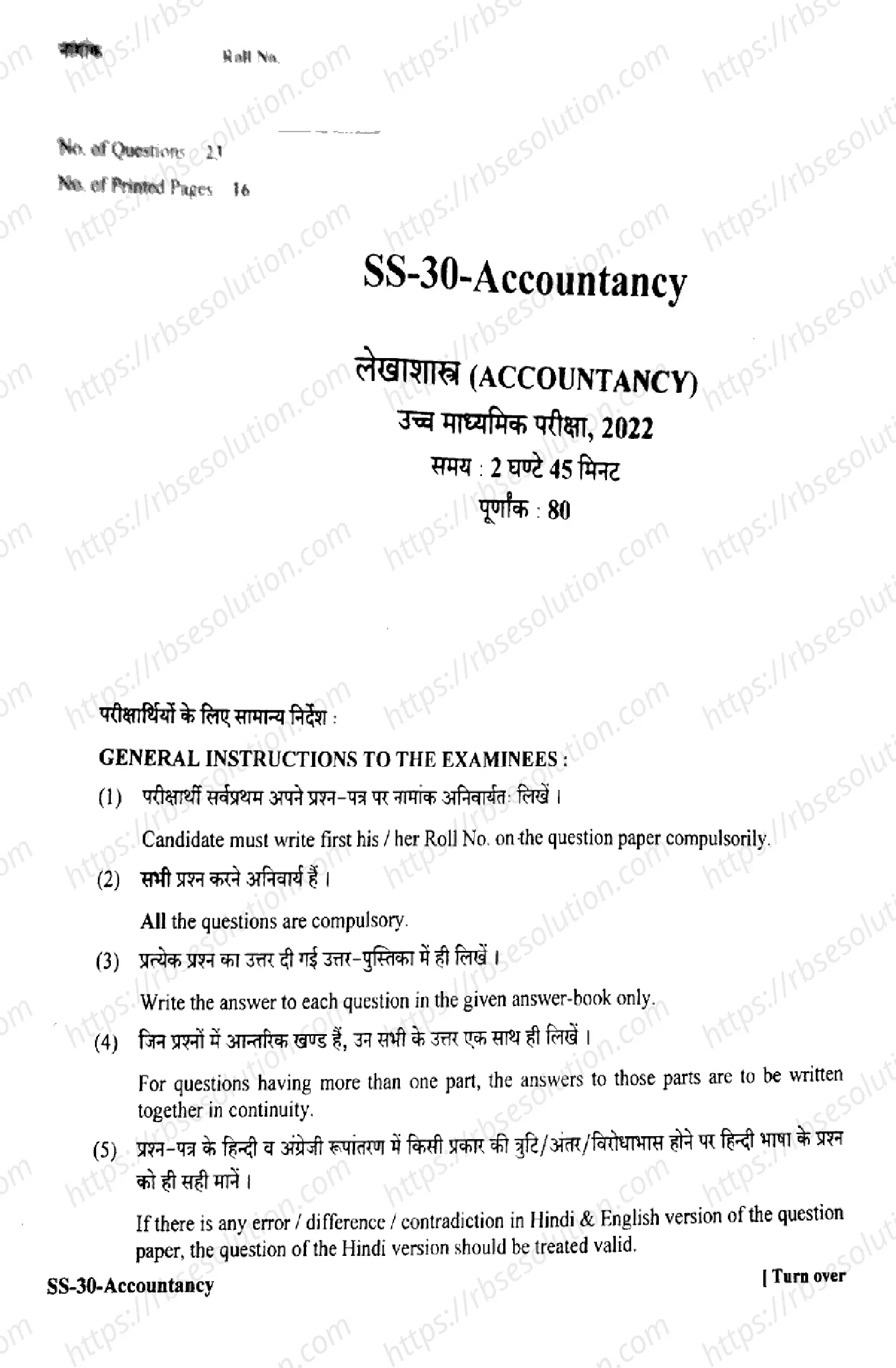


Rajasthan Board Class 12th Accountancy-SS-30-2022 2022 solved Previous Year Question Papers
लेखाशास्त्र (ACCOUNTANCY)
उच्च माध्यमिक परीक्षा, 2022
समय : 2 घण्टे 45 मिनट पूर्णांक : 80
परीक्षार्थियों के लिए सामान्य निर्देश :
GENERAL INSTRUCTIONS TO THE EXAMINEES :
- परीक्षार्थी सर्वप्रथम अपने प्रश्न-पत्र पर नामांक अनिवार्यतः लिखें।
Candidate must write first his / her Roll No. on the question paper compulsorily. - सभी प्रश्न करने अनिवार्य हैं।
All the questions are compulsory. - प्रत्येक प्रश्न का उत्तर दी गई उत्तर-पुस्तिका में ही लिखें।
Write the answer to each question in the given answer-book only. - जिन प्रश्नों में आन्तरिक खण्ड हैं, उन सभी के उत्तर एक साथ ही लिखें।
For questions having more than one part, the answers to those parts are to be written together in continuity. - प्रश्न-पत्र के हिन्दी व अंग्रेजी रूपांतरण में किसी प्रकार की त्रुटि / अंतर / विरोधाभास होने पर हिन्दी भाषा के प्रश्न को ही सही मानें।
If there is any error / difference / contradiction in Hindi & English version of the question paper, the question of the Hindi version should be treated valid.
Page 1 of 15
खण्ड - a / SECTION - A
बहुविकल्पी प्रश्न / Multiple Choice Questions
(i) गैर-लाभकारी संस्थाओं का मूल उद्देश्य होता है / The main object of Not for profit Organisations is:
- (अ) लाभ कमाना / Profit
- (ब) जन कल्याणकारी कार्य / Public Welfare Work
- (स) व्यवसाय करना / Do business
- (द) उपरोक्त में से कोई नहीं / None of the above
सही उत्तर / Correct Answer: (ब) जन कल्याणकारी कार्य / Public Welfare Work
गैर-लाभकारी संस्थाओं का मुख्य उद्देश्य लाभ कमाना नहीं, बल्कि समाज सेवा और जन कल्याण के कार्य करना होता है।
(ii) साझेदारी संलेख के अभाव में साझेदार _____ पाने का हकदार नहीं है। / Partners are not entitled to receive in the absence of partnership agreement:
- (अ) वेतन / Salary
- (ब) पूँजी पर ब्याज / Interest on capital
- (स) फीस व कमीशन / Fees & Commission
- (द) उपर्युक्त सभी / All of the above
सही उत्तर / Correct Answer: (द) उपर्युक्त सभी / All of the above
साझेदारी संलेख के अभाव में, साझेदार वेतन, पूँजी पर ब्याज, और फीस व कमीशन किसी भी प्रकार का पारिश्रमिक पाने के हकदार नहीं होते हैं।
(iii) पुनर्मूल्यांकन खाते की प्रकृति है / Nature of revaluation account is:
- (अ) व्यक्तिगत खाता / Personal account
- (ब) नाममात्र का खाता / Nominal account
- (स) वास्तविक खाता / Real account
- (द) इनमें से कोई नहीं / None of these
सही उत्तर / Correct Answer: (ब) नाममात्र का खाता / Nominal account
पुनर्मूल्यांकन खाता एक अस्थायी खाता है जो संपत्तियों और देनदारियों के पुनर्मूल्यांकन से होने वाले लाभ या हानि को दर्शाता है, इसलिए यह नाममात्र खाता है।
(iv) सारणी एफ के अनुसार, कंपनी अग्रिम माँग पर ब्याज दे सकती है / As per Table F, a company can pay interest on calls-in-advance at:
- (अ) 8%
- (ब) 0%
- (स) 2%
- (द) 4%
सही उत्तर / Correct Answer: (द) 4%
कंपनी अधिनियम की सारणी एफ के अनुसार, कंपनी अग्रिम माँग पर अधिकतम 4% प्रति वर्ष की दर से ब्याज दे सकती है।
SS-30-Accountancy
(९) ऋणपत्रधार होते हैं
Debenture holders are:
- (अ) कंपनी के स्वामी – (A) Owners of the company
- (ब) कंपनी के ग्राहक – (B) Customers of the company
- (स) कंपनी के ऋणदाता – (C) Loan Providers of the company
- (द) इनमें से कोई नहीं – (D) None of these
Explanation: Debenture holders are creditors (loan providers) of the company, not owners. They receive fixed interest and have priority over shareholders in repayment.
(vi) ऐसे ऋणपत्र जो समता अंशों में परिवर्तित किये जा सकते हैं, कहलाते हैं
The debentures which can be converted into equity shares are called:
- (अ) शोधनीय ऋणपत्र – (A) Redeemable debentures
- (ब) पंजीकृत ऋणपत्र – (B) Registered debentures
- (स) बाहक ऋणपत्र – (C) Bearer debentures
- (द) परिवर्तनीय ऋणपत्र – (D) Convertible debentures
Explanation: Convertible debentures can be exchanged for equity shares at a specified time and ratio, as per the terms of issue.
(vii) Balance Sheet के समता एवं दायित्वों के भाग की अंश पूँजी की कुल राशि में सम्मिलित होती है
Total amount of share capital in equity and liabilities part of the Balance Sheet includes the following:
- (अ) अधिकृत पूँजी – (A) Authorised capital
- (ब) निर्गमित पूँजी – (B) Issued capital
- (स) प्रार्थित एवं चुकता पूँजी – (C) Subscribed & paid up capital
- (द) संचित पूँजी – (D) Reserve capital
Explanation: In the Balance Sheet, the share capital shown under equity and liabilities is the subscribed and paid-up capital, which is the amount actually received from shareholders.
(viii) ऋणपत्रों के समपार्श्विक प्रतिभूति के रूप में निर्गमन की स्थिति में, यदि प्रविष्टि की जाती है तो किस खाते को नामे किया जाएगा?
In the case of issue of debentures as collateral security, if entry is passed, which account will be debited?
- (अ) ऋण खाता – (A) Loan account
- (ब) ऋणपत्र खाता – (B) Debenture account
- (स) ऋणपत्र उचिन्त खाता – (C) Debenture Suspense account
- (द) बैंक खाता – (D) Bank account
Explanation: When debentures are issued as collateral security, the entry debits "Debenture Suspense Account" (or "Debenture Issued as Collateral Account") and credits "Debentures Account" to record the contingent liability.
Multiple Choice Questions
(ix) वित्तीय विवरण उपयोगी होते हैं ______ के लिए।
Financial statements are useful for ______.
- (अ) कर्मचारियों के लिए (A) Employees
- (ब) अंशधारियों के लिए (B) Shareholders
Correct Answer: (ब) अंशधारियों के लिए / (B) Shareholders
Financial statements are primarily useful for shareholders to assess the company's performance and make investment decisions.
(x) निम्न में से कौन सा व्यय कर्मचारी हित का व्यय नहीं है?
Which of the following is not an employee welfare expense?
- (अ) वेतन (A) Salary
- (ब) भविष्य निधि अंशदान (B) Provident Fund Contribution
- (स) कारखाने की मशीन की मरम्मत (C) Repairs of Factory Machine
- (द) उपदान का भुगतान (D) Payment of Gratuity
Correct Answer: (स) कारखाने की मशीन की मरम्मत / (C) Repairs of Factory Machine
Repairs of factory machine is a maintenance expense, not directly related to employee welfare. Salary, PF contribution, and gratuity are employee welfare expenses.
(xi) समान आकार के विवरण (Common Size Balance Sheet) में कुल समता एवं कुल दायित्वों को ______ माना जाता है।
In common size Balance sheet, total of Equity and total Liabilities are assumed to be equal to ______.
- (अ) 1 (A) 1
- (ब) 10 (B) 10
- (स) 100 (C) 100
- (द) 1000 (D) 1000
Correct Answer: (स) 100 / (C) 100
In a common size balance sheet, total equity and liabilities are taken as 100, and each item is expressed as a percentage of this total.
(xii) यदि 365 दिन में व्यापारिक देयता आवर्त अनुपात का भाग दिया जाए तो यह अनुपात होगा :
If 365 days is divided by the Trade Payable Turnover Ratio, it becomes a ratio of :
- (अ) स्कन्ध की औसत अवधि (A) Average age of Inventory
- (ब) औसत संग्रहण अवधि (B) Average Collection Period
- (स) औसत भुगतान अवधि (C) Average Payment Period
- (द) चेक संग्रहण अवधि (D) Cheque Collection Period
Correct Answer: (स) औसत भुगतान अवधि / (C) Average Payment Period
Dividing 365 by the Trade Payable Turnover Ratio gives the Average Payment Period, which indicates the average number of days a company takes to pay its creditors.
2. रिक्त स्थानों की पूर्ति करें / Fill in the blanks :
-
आहरण पर ब्याज फर्म के लिए व्यय है।
Interest on Drawing is Expense for the firm. -
कंपनी के पार्षद सीमानियम में लिखित अधिकतम पूँजी अधिकृत पूँजी कहलाती है।
The Maximum Capital written in memorandum of association of a company is called Authorised Capital. -
ऋणपत्रों पर ब्याज की दर स्थिर होती है।
Rate of interest on debentures is Fixed. -
जब ऋणपत्रों को प्रीमियम पर निर्गमित किया जाता है, तो प्रतिभूति प्रीमियम खाता जमा किया जाता है।
When debentures are issued at premium, Securities premium account will be credited. -
प्रवृत्ति विश्लेषण, वित्तीय विश्लेषण की तकनीक है।
Trend Analysis is the technique of Financial Analysis. -
तरलता अनुपात को अम्ल परख अनुपात के रूप में जाना जाता है।
Liquidity ratio is also known as Acid Test ratio.
3. अतिलघूत्तरात्मक प्रश्न / Very short answer type questions :
-
प्रश्न: ऐसी दो मदों के नाम लिखो जो प्राप्ति व भुगतान खाते में नहीं दिखाई जाती है।
Question: Write the name of any two items which do not appear in Receipt and Payment account.उत्तर / Answer: दो मदें जो प्राप्ति व भुगतान खाते में नहीं दिखाई जाती हैं: (1) मूल्यह्रास (Depreciation), (2) अर्जित आय (Accrued Income) / देय व्यय (Outstanding Expenses)।
Two items which do not appear in Receipt and Payment account: (1) Depreciation, (2) Accrued Income / Outstanding Expenses. -
प्रश्न: 'अ' और 'ब' एक फर्म में 3:2 में लाभ बाँटते हुए साझेदार हैं। वे लाभों में 1/5 हिस्से के लिए 'स' को प्रवेश देते हैं, जिसे वह 'अ' से लेता है। नया लाभ-हानि अनुपात क्या होगा?
Question: A and B are partners in a firm, sharing profit in the ratio of 3:2. They admit C for 1/5th share of profits, which he acquires from A. New profit & loss share ratio will be?हल / Solution:
पुराना अनुपात (Old Ratio): A : B = 3 : 2
C का हिस्सा (C's share) = 1/5, जो वह A से प्राप्त करता है (which he acquires from A)
A का त्याग (A's sacrifice) = 1/5
A का नया हिस्सा (A's new share) = 3/5 - 1/5 = 2/5
B का हिस्सा (B's share) = 2/5 (अपरिवर्तित / unchanged)
C का हिस्सा (C's share) = 1/5
नया अनुपात (New Ratio) = A : B : C = 2/5 : 2/5 : 1/5 = 2 : 2 : 1
उत्तर / Answer: नया लाभ-हानि अनुपात 2:2:1 होगा। (New profit & loss sharing ratio will be 2:2:1)
(ii) अग्रिम माँग का अर्थ बताइये।
Give the meaning of Calls-in-advance.
अर्थ: जब कोई शेयरधारक कंपनी द्वारा माँगी गई राशि से अधिक या नियत तिथि से पहले ही राशि का भुगतान कर देता है, तो उसे अग्रिम माँग (Calls-in-advance) कहा जाता है। यह कंपनी के लिए एक देयता है।
Meaning: When a shareholder pays an amount exceeding the amount called up by the company or pays before the due date, it is called Calls-in-advance. It is a liability for the company.
(iv) अपरिवर्तनीय ऋणपत्रों से क्या आशय है?
What is meant by non-convertible debentures?
अर्थ: अपरिवर्तनीय ऋणपत्र वे ऋणपत्र होते हैं जिन्हें जारी करने वाली कंपनी द्वारा निर्धारित अवधि के बाद भी शेयरों या अन्य प्रतिभूतियों में परिवर्तित नहीं किया जा सकता। इन्हें केवल नकद राशि के रूप में ही चुकाया जाता है।
Meaning: Non-convertible debentures are those debentures which cannot be converted into shares or other securities even after the specified period. They are redeemed only in cash.
(v) पी लिमिटेड ने ₹ 100 वाले 4,000, 9% ऋणपत्र, 4% बट्टे पर निर्गमित किये। ऋणपत्रों के निर्गमन की जर्नल प्रविष्टि दीजिये।
P Ltd. issued 4000, 9% Debentures of ₹ 100 each at 4% discount. Give journal entry of issue of debentures.
गणना:
- अंकित मूल्य = 4,000 × ₹ 100 = ₹ 4,00,000
- बट्टा = 4% of ₹ 4,00,000 = ₹ 16,000
- प्राप्त राशि = ₹ 4,00,000 - ₹ 16,000 = ₹ 3,84,000
जर्नल प्रविष्टि:
| विवरण | नाम (₹) | जमा (₹) |
|---|---|---|
| बैंक खाता नाम | 3,84,000 | |
| ऋणपत्र निर्गमन पर बट्टा खाता नाम | 16,000 | |
| 9% ऋणपत्र खाता से | 4,00,000 | |
| (4,000, 9% ऋणपत्र 4% बट्टे पर निर्गमित) | ||
(vi) यदि ₹ 5,00,000 के ऋणपत्र सममूल्य पर निर्गमित किए गए, परन्तु 10% प्रीमियम पर शोधन योग्य हैं, तो शोधन पर प्रीमियम की राशि क्या होगी?
If debentures of ₹ 5,00,000 issued at par, but redeemable at 10% premium, what will be the amount of premium on redemption?
उत्तर: शोधन पर प्रीमियम की राशि = ₹ 5,00,000 का 10% = ₹ 50,000
Answer: Amount of premium on redemption = 10% of ₹ 5,00,000 = ₹ 50,000
(vii) मानस लिमिटेड ने ₹ 4,00,000 अंकित मूल्य के स्वयं के ऋणपत्र, खुले बाजार से तुरंत निरस्त करने के लिए ₹ 92 प्रति ऋणपत्र की दर पर क्रय किये। ऋणपत्रों के निरस्त करने पर फायदे की राशि ज्ञात कीजिए।
Manas Ltd. purchased its own debentures of the face value ₹ 4,00,000 from the open market for immediate cancellation at ₹ 92 per debenture. Calculate the amount of Gain on cancellation of debentures.
गणना:
- अंकित मूल्य = ₹ 4,00,000
- प्रति ऋणपत्र अंकित मूल्य = ₹ 100 (माना गया)
- ऋणपत्रों की संख्या = ₹ 4,00,000 / ₹ 100 = 4,000
- क्रय मूल्य = 4,000 × ₹ 92 = ₹ 3,68,000
- निरस्त करने पर फायदा = अंकित मूल्य - क्रय मूल्य = ₹ 4,00,000 - ₹ 3,68,000 = ₹ 32,000
उत्तर: ऋणपत्रों के निरस्त करने पर फायदे की राशि ₹ 32,000 है।
Answer: Gain on cancellation of debentures = ₹ 32,000
(viii) ऋणपत्रों पर ब्याज की प्रकृति क्या है?
What is the nature of interest on debentures?
उत्तर: ऋणपत्रों पर ब्याज एक वित्तीय व्यय (Financial Expense) है और इसे लाभ-हानि खाते में डेबिट किया जाता है। यह कंपनी के लिए एक निश्चित दायित्व है, चाहे कंपनी लाभ कमाए या नहीं।
Answer: Interest on debentures is a financial expense and is debited to the Profit and Loss Account. It is a fixed obligation for the company, irrespective of profit or loss.
(ix) एक कंपनी के द्वारा तैयार किये जाने वाले दो मुख्य वित्तीय विवरणों के नाम बताइये।
Name the two main financial statements prepared by a company.
उत्तर: दो मुख्य वित्तीय विवरण हैं:
- स्थिति विवरण (Balance Sheet)
- लाभ-हानि विवरण (Profit and Loss Statement) या आय विवरण (Income Statement)
Answer: The two main financial statements are:
- Balance Sheet
- Profit and Loss Statement (Income Statement)
(x) निवेशकर्ता वित्तीय विवरणों का विश्लेषण क्यों करते हैं?
Why do investors make analysis of Financial Statements?
उत्तर: निवेशकर्ता वित्तीय विवरणों का विश्लेषण निम्नलिखित कारणों से करते हैं:
- कंपनी की लाभप्रदता और वृद्धि की संभावना का आकलन करने के लिए।
- कंपनी की वित्तीय स्थिरता और शोधन क्षमता जानने के लिए।
- निवेश पर प्रतिफल (Return on Investment) का अनुमान लगाने के लिए।
- जोखिम का मूल्यांकन करने और सूचित निवेश निर्णय लेने के लिए।
Answer: Investors analyze financial statements to:
- Assess the profitability and growth potential of the company.
- Know the financial stability and solvency of the company.
- Estimate the return on investment.
- Evaluate risk and make informed investment decisions.
(xi) क्षैतिज एवं ऊर्ध्वाधर विश्लेषण में दो अन्तर बताओ।
Give two differences between horizontal and vertical analysis.
| क्षैतिज विश्लेषण (Horizontal Analysis) | ऊर्ध्वाधर विश्लेषण (Vertical Analysis) |
|---|---|
| यह विभिन्न वर्षों के वित्तीय डेटा की तुलना करता है। | यह एक ही वर्ष के वित्तीय विवरण के विभिन्न मदों का प्रतिशत में विश्लेषण करता है। |
| इसे 'प्रवृत्ति विश्लेषण' (Trend Analysis) भी कहा जाता है। | इसे 'सामान्य आकार विवरण' (Common Size Statement) भी कहा जाता है। |
(xii) एक कम्पनी का आवर्त अनुपात 4 है तथा इसकी संचालन से आगम की लागत ₹ 2,40,000 है, तो औसत स्कन्ध क्या होगा?
The inventory turnover ratio of a company is 4 and its cost of revenue from operations is ₹ 2,40,000, then average inventory will be?
सूत्र: आवर्त अनुपात = संचालन से आगम की लागत / औसत स्कन्ध
गणना:
4 = ₹ 2,40,000 / औसत स्कन्ध
औसत स्कन्ध = ₹ 2,40,000 / 4 = ₹ 60,000
उत्तर: औसत स्कन्ध ₹ 60,000 होगा।
Answer: Average inventory = ₹ 60,000
खण्ड-ब / SECTION - B
लघूत्तरात्मक प्रश्न / Short Answers Type Questions
4. निम्नांकित सूचनाओं से चन्दे की राशि जो आय-व्यय खाते में दिखायेंगे की गणना कीजिए :
| विवरण | राशि (₹) |
|---|---|
| 01-04-2019 बकाया चन्दा (Subscription in Arrear) | 5,000 |
| 01-04-2019 अग्रिम प्राप्त चन्दा (Subscription received in advance) | 5,000 |
| 31-03-2020 बकाया चन्दा (Subscription in Arrear) | 6,000 |
| 31-03-2020 अग्रिम प्राप्त चन्दा (Subscription received in advance) | 0,000 |
| 2019-20 वर्ष के दौरान प्राप्त चन्दा (Subscription received during the year) | 50,000 |
From the following informations, calculate amount of subscription, which will be shown in Income and Expenditure Account.
हल / Solution:
आय-व्यय खाते में दिखाया जाने वाला चन्दा = प्राप्त चन्दा + वर्ष के अंत में बकाया चन्दा - वर्ष के आरंभ में बकाया चन्दा + वर्ष के आरंभ में अग्रिम चन्दा - वर्ष के अंत में अग्रिम चन्दा
= 50,000 + 6,000 - 5,000 + 5,000 - 0,000
= ₹ 56,000
Calculation: Subscription for I&E A/c = Received + Closing Arrear - Opening Arrear + Opening Advance - Closing Advance = 50,000 + 6,000 - 5,000 + 5,000 - 0 = ₹56,000
5. P और Q एक फर्म में साझेदार हैं। P प्रत्येक माह की प्रथम तिथि को ₹ 2,000 तथा Q प्रत्येक माह की अन्तिम तिथि को ₹ 4,000 वर्ष पर्यन्त आहरण करते हैं। आहरण पर 12% वार्षिक दर से ब्याज लगाया जाता है। वर्ष के अन्त में आहरण पर ब्याज की गणना कीजिये।
P and Q are partners in a firm. P withdraws ₹ 2,000 at the beginning of each month. Whereas, Q withdraws ₹ 4,000 at the end of each month during the whole year. Interest on drawing is charged @ 12% per annum. Calculate the amount of interest on drawing at the end of the year.
हल / Solution:
P के आहरण पर ब्याज (Interest on P's Drawings):
P प्रत्येक माह की शुरुआत में ₹ 2,000 निकालता है। कुल वार्षिक आहरण = ₹ 2,000 × 12 = ₹ 24,000
माह की शुरुआत में आहरण के लिए औसत अवधि = (12+1)/2 = 6.5 माह
ब्याज = 24,000 × 12% × (6.5/12) = 24,000 × 0.12 × 0.54167 = ₹ 1,560
Q के आहरण पर ब्याज (Interest on Q's Drawings):
Q प्रत्येक माह के अंत में ₹ 4,000 निकालता है। कुल वार्षिक आहरण = ₹ 4,000 × 12 = ₹ 48,000
माह के अंत में आहरण के लिए औसत अवधि = (12-1)/2 = 5.5 माह
ब्याज = 48,000 × 12% × (5.5/12) = 48,000 × 0.12 × 0.45833 = ₹ 2,640
नोट: यदि वैकल्पिक विधि से करें: P के लिए 6.5 माह और Q के लिए 5.5 माह लेने पर उपरोक्त उत्तर प्राप्त होता है।
6. एक फर्म की पूँजी ₹ 4,00,000 है और औसत लाभ ₹ 60,000 तथा सामान्य प्रत्याय दर 10% है। ख्याति का मूल्य अधिलाभों के तीन वर्षों के क्रय के आधार पर ज्ञात कीजिये।
Capital of the firm is ₹ 4,00,000. Normal rate of return is 10% and average profit of the firm is ₹ 60,000. Goodwill is to be valued at three years purchase of super profits. Calculate the value of Goodwill.
हल / Solution:
सामान्य लाभ (Normal Profit) = पूँजी × सामान्य प्रत्याय दर = ₹ 4,00,000 × 10% = ₹ 40,000
अधिलाभ (Super Profit) = औसत लाभ - सामान्य लाभ = ₹ 60,000 - ₹ 40,000 = ₹ 20,000
ख्याति (Goodwill) = अधिलाभ × वर्षों की संख्या = ₹ 20,000 × 3 = ₹ 60,000
Calculation: Normal Profit = Capital × NRR = 4,00,000 × 10% = ₹40,000; Super Profit = Average Profit - Normal Profit = 60,000 - 40,000 = ₹20,000; Goodwill = Super Profit × 3 = ₹60,000.
7.
X और Y साझेदार हैं जो लाभों को 5 : 4 के अनुपात में बाँटते हैं। वे Z को फर्म में प्रवेश देते हैं, जिसे वह 'X' से 2/9 और 'Y' से 1/9 लेता है और ₹500 ख्याति (प्रीमियम) के रूप में नकद लाता है। 'Z' के प्रवेश पर आवश्यक रोजनामचा प्रविष्टियाँ दीजिए।
X and Y are partners sharing profits in the ratio of 5:4. They admit Z into the firm for 1/3rd share of profit, which he takes 2/9th from X and 1/9th from Y and brings ₹500 as goodwill (premium) in cash. Pass necessary journal entries on Z's admission.
Solution:
Step 1: Calculate Sacrificing Ratio
X's sacrifice = 2/9
Y's sacrifice = 1/9
Sacrificing Ratio = 2/9 : 1/9 = 2:1
Step 2: Journal Entries
| Date | Particulars | L.F. | Debit (₹) | Credit (₹) |
|---|---|---|---|---|
| Bank A/c Dr. | 500 | |||
| To Premium for Goodwill A/c | 500 | |||
| (Being premium for goodwill brought in by Z) | ||||
| Premium for Goodwill A/c Dr. | 500 | |||
| To X's Capital A/c (500 × 2/3) | 333.33 | |||
| To Y's Capital A/c (500 × 1/3) | 166.67 | |||
| (Being premium for goodwill distributed among sacrificing partners in sacrificing ratio 2:1) | ||||
8.
प्रतिभूति प्रीमियम राशि के कोई दो उपयोग लिखिए।
Write any two uses of Securities Premium Amount.
Answer: As per Section 52 of the Companies Act, 2013, the securities premium amount can be used for:
- Issuing fully paid bonus shares to the shareholders.
- Writing off the preliminary expenses of the company.
9.
याशु लिमिटेड ने एंजल लिमिटेड से ₹6,00,000 में एक मशीन क्रय की। याशु लिमिटेड ने ₹100 वाले 5,000 समता अंशों को 20% प्रीमियम पर एंजल लिमिटेड को भुगतान हेतु जारी किये। याशु लिमिटेड की पुस्तकों में आवश्यक जर्नल प्रविष्टियाँ दीजिए।
Yaashu Ltd. purchased a machinery from Angel Ltd. for ₹6,00,000. Yaashu Ltd. issued 5,000 Equity Shares of ₹100 each at 20% premium to Angel Ltd. as payment. Give necessary journal entries in the books of Yaashu Ltd.
Solution:
Face value of shares issued = 5,000 × ₹100 = ₹5,00,000
Premium = 20% of ₹5,00,000 = ₹1,00,000
Total value of shares issued = ₹5,00,000 + ₹1,00,000 = ₹6,00,000
| Date | Particulars | L.F. | Debit (₹) | Credit (₹) |
|---|---|---|---|---|
| Machinery A/c Dr. | 6,00,000 | |||
| To Angel Ltd. A/c | 6,00,000 | |||
| (Being machinery purchased from Angel Ltd.) | ||||
| Angel Ltd. A/c Dr. | 6,00,000 | |||
| To Equity Share Capital A/c (5,000 × ₹100) | 5,00,000 | |||
| To Securities Premium A/c (5,000 × ₹20) | 1,00,000 | |||
| (Being 5,000 equity shares of ₹100 each issued at 20% premium to Angel Ltd.) | ||||
10.
प्रियांशी लिमिटेड ने ₹10 वाले ₹2 प्रति अंश प्रीमियम सहित 5,000 समता अंशों के लिए आवेदन आमंत्रित किए। कुल आवेदन राशि ₹60,000, ₹3 प्रति अंश की दर से प्राप्त हुई। अभिदान के प्रकार का नाम लिखिए तथा आवेदन राशि प्राप्त करने की जर्नल प्रविष्टि दीजिए, आवेदित अंशों की संख्या भी ज्ञात कीजिए।
Priyanshi Ltd. had invited application for 5,000 Equity shares of ₹10 each at a premium of ₹2 each. The total application money received @ ₹3 per share was ₹60,000. Name the kind of the subscription and give journal entry for application money received. Calculate the number of shares applied for also.
Solution:
Number of shares applied for:
Application money per share = ₹3
Total application money received = ₹60,000
Number of shares applied for = ₹60,000 / ₹3 = 20,000 shares
Kind of subscription: Oversubscription (since 20,000 shares applied for against 5,000 shares issued)
Journal Entry:
| Date | Particulars | L.F. | Debit (₹) | Credit (₹) |
|---|---|---|---|---|
| Bank A/c Dr. | 60,000 | |||
| To Share Application A/c | 60,000 | |||
| (Being application money received for 20,000 shares @ ₹3 per share) | ||||
11.
एस लिमिटेड ने ₹100 वाले 3,000, 7% ऋणपत्र सममूल्य पर निर्गमित किये, जिनका शोधन 5% प्रीमियम पर होना है। 'एस लि.' की पुस्तकों में निर्गमन प्रविष्टियाँ दीजिए।
S Ltd. issued 3,000, 7% Debentures of ₹100 each at par, which are repayable at 5% premium. Give journal entries for the issue in the books of S Ltd.
Solution:
Face value of debentures = 3,000 × ₹100 = ₹3,00,000
Issue at par means issue price = ₹100 each
Redemption at 5% premium means redemption value = ₹100 + ₹5 = ₹105 each
| Date | Particulars | L.F. | Debit (₹) | Credit (₹) | ||||||||||||||||||||||||||||||||||||||||||||||||||||||||||||||||||||||||||||||||||||||||||||||||||||||||||||||||||||||||||||||||||||||||||||||||||||||||||||||||||||||||||||||||||||||||||||||||||||||||||||||||||||||||||||||||||||||||||||||||||||||||||||||||||||||||||||||||||||||||||||||||||||||||||||||||||||||||||||||||||||||||||||||||||||||||||||||||||||||||||||||||||||||||||||||||||||||||||||||||||||||||||||||||||||||||||||||||||||||||||||||||||||||||||||||||||||||||||||||||||||||||||||||||||||||||||||||||||||||||||||||||||||||||||||||||||||||||||||||||||||||||||||||||||||||||||||||||||||||||||||||||||||||||||||||||||||||||||||||||||||||||||||||||||||||||||||||||||||||||||||||||||||||||||||||||||||||||||||||||
|---|---|---|---|---|---|---|---|---|---|---|---|---|---|---|---|---|---|---|---|---|---|---|---|---|---|---|---|---|---|---|---|---|---|---|---|---|---|---|---|---|---|---|---|---|---|---|---|---|---|---|---|---|---|---|---|---|---|---|---|---|---|---|---|---|---|---|---|---|---|---|---|---|---|---|---|---|---|---|---|---|---|---|---|---|---|---|---|---|---|---|---|---|---|---|---|---|---|---|---|---|---|---|---|---|---|---|---|---|---|---|---|---|---|---|---|---|---|---|---|---|---|---|---|---|---|---|---|---|---|---|---|---|---|---|---|---|---|---|---|---|---|---|---|---|---|---|---|---|---|---|---|---|---|---|---|---|---|---|---|---|---|---|---|---|---|---|---|---|---|---|---|---|---|---|---|---|---|---|---|---|---|---|---|---|---|---|---|---|---|---|---|---|---|---|---|---|---|---|---|---|---|---|---|---|---|---|---|---|---|---|---|---|---|---|---|---|---|---|---|---|---|---|---|---|---|---|---|---|---|---|---|---|---|---|---|---|---|---|---|---|---|---|---|---|---|---|---|---|---|---|---|---|---|---|---|---|---|---|---|---|---|---|---|---|---|---|---|---|---|---|---|---|---|---|---|---|---|---|---|---|---|---|---|---|---|---|---|---|---|---|---|---|---|---|---|---|---|---|---|---|---|---|---|---|---|---|---|---|---|---|---|---|---|---|---|---|---|---|---|---|---|---|---|---|---|---|---|---|---|---|---|---|---|---|---|---|---|---|---|---|---|---|---|---|---|---|---|---|---|---|---|---|---|---|---|---|---|---|---|---|---|---|---|---|---|---|---|---|---|---|---|---|---|---|---|---|---|---|---|---|---|---|---|---|---|---|---|---|---|---|---|---|---|---|---|---|---|---|---|---|---|---|---|---|---|---|---|---|---|---|---|---|---|---|---|---|---|---|---|---|---|---|---|---|---|---|---|---|---|---|---|---|---|---|---|---|---|---|---|---|---|---|---|---|---|---|---|---|---|---|---|---|---|---|---|---|---|---|---|---|---|---|---|---|---|---|---|---|---|---|---|---|---|---|---|---|---|---|---|---|---|---|---|---|---|---|---|---|---|---|---|---|---|---|---|---|---|---|---|---|---|---|---|---|---|---|---|---|---|---|---|---|---|---|---|---|---|---|---|---|---|---|---|---|---|---|---|---|---|---|---|---|---|---|---|---|---|---|---|---|---|---|---|---|---|---|---|---|---|---|---|---|---|---|---|---|---|---|---|---|---|---|---|---|---|---|---|---|---|---|---|---|---|---|---|---|---|---|---|---|---|---|---|---|---|---|---|---|---|---|---|---|---|---|---|---|---|---|---|---|---|---|---|---|---|---|---|---|---|---|---|---|---|---|---|---|---|---|---|---|---|---|---|---|---|---|---|---|---|---|---|---|---|---|---|---|---|---|---|---|---|---|---|---|---|---|---|---|---|---|---|---|---|---|---|---|---|---|---|---|---|---|---|---|---|---|---|---|---|---|---|---|---|---|---|---|---|---|---|---|---|---|---|---|---|---|---|---|---|---|---|---|---|---|---|---|---|---|---|---|---|---|---|---|---|---|---|---|---|---|---|---|---|---|---|---|---|---|---|---|---|---|---|---|
3. निम्न मदों के शीर्षक तथा उप-शीर्षक लिखिए :Write the Head and Sub-Head of following items :
उत्तर / Answer:
4. निम्नलिखित सूचनाओं से समानाकार विवरण (Common Size Balance Sheet) तैयार कीजिए :Prepare Common Size Balance Sheet from the following information :
व्याख्या (Explanation): समानाकार विवरण में कुल को 100% मानकर प्रत्येक मद का प्रतिशत निकाला जाता है। समता = (6,00,000/8,00,000)×100 = 75%; दीर्घकालीन ऋण = (2,00,000/8,00,000)×100 = 25%; स्थायी सम्पत्तियाँ = (6,40,000/8,00,000)×100 = 80%; चालू सम्पत्तियाँ = (1,60,000/8,00,000)×100 = 20%। 5. यदि प्रारम्भिक स्टॉक ₹ 40,000, शुद्ध क्रय ₹ 2,00,000, प्रत्यक्ष व्यय ₹ 40,000 है, तथा अंतिम स्टॉक ₹ 35,000 हो तो बेचे गये माल की लागत ज्ञात करो।If opening stock is ₹ 40,000, Net purchases ₹ 2,00,000, Direct Expenses ₹ 40,000 and closing stock is ₹ 35,000, then calculate cost of goods sold. हल (Solution): बेचे गये माल की लागत (Cost of Goods Sold) = प्रारम्भिक स्टॉक + शुद्ध क्रय + प्रत्यक्ष व्यय – अंतिम स्टॉक = ₹ 40,000 + ₹ 2,00,000 + ₹ 40,000 – ₹ 35,000 = ₹ 2,80,000 – ₹ 35,000 = ₹ 2,45,000 अतः बेचे गये माल की लागत ₹ 2,45,000 है। प्रश्न 16जतिन लिमिटेड के चालू दायित्व ₹ 60,000 हैं। इसका चालू अनुपात 3 : 1 तथा तरलता अनुपात 2.25 : 1 है। रहतिये (स्टॉक) का मूल्य ज्ञात कीजिए। Current liabilities of Jatin Ltd. are ₹ 60,000. Its current ratio is 3:1 and Liquidity ratio is 2.25:1. Calculate the value of Inventories (Stock). हल: चालू दायित्व (Current Liabilities) = ₹ 60,000 चालू अनुपात (Current Ratio) = चालू सम्पत्तियाँ / चालू दायित्व = 3 : 1 अतः चालू सम्पत्तियाँ (Current Assets) = 3 × ₹ 60,000 = ₹ 1,80,000 तरलता अनुपात (Liquidity Ratio) = तरल सम्पत्तियाँ / चालू दायित्व = 2.25 : 1 अतः तरल सम्पत्तियाँ (Liquid Assets) = 2.25 × ₹ 60,000 = ₹ 1,35,000 रहतिये (Inventories) = चालू सम्पत्तियाँ - तरल सम्पत्तियाँ रहतिये = ₹ 1,80,000 - ₹ 1,35,000 = ₹ 45,000 सही उत्तर: ₹ 45,000 खण्ड-स (Section - C)प्रश्न 17निम्नलिखित सूचनाओं से आय-व्यय खाते में दिखाई जाने वाली स्टेशनरी की राशि ज्ञात कीजिए:
वर्ष 2020-21 के दौरान स्टेशनरी की राशि चुकाई ₹ 10,000। Amount paid for Stationery during 2020-21 was ₹ 10,000. हल: आय-व्यय खाते में दिखाई जाने वाली स्टेशनरी की राशि (उपभोग) निम्न प्रकार ज्ञात करेंगे: स्टेशनरी के लिए भुगतान की गई राशि = ₹ 10,000 जोड़ें: प्रारम्भिक लेनदार (01-04-2020) = ₹ 200 जोड़ें: अंतिम अग्रिम भुगतान (31-03-2021) = ₹ 600 घटाएं: अंतिम लेनदार (31-03-2021) = ₹ 4,200 घटाएं: प्रारम्भिक अग्रिम भुगतान (01-04-2020) = ₹ 400 वर्ष के दौरान क्रय = ₹ 10,000 + ₹ 200 + ₹ 600 - ₹ 4,200 - ₹ 400 = ₹ 6,200 अब उपभोग = प्रारम्भिक स्टॉक + क्रय - अंतिम स्टॉक उपभोग = ₹ 2,000 + ₹ 6,200 - ₹ 800 = ₹ 7,400 सही उत्तर: ₹ 7,400 प्रश्न 18प्रिया, सुमन और शालू एक फर्म में 5:3:2 के अनुपात में साझेदार हैं। शालू को फर्म से न्यूनतम ₹ 80,000 लाभ की गारंटी दी गई है। यदि इस राशि में कोई कमी रहती है तो उसे प्रिया और सुमन 2:3 के अनुपात में वहन करेंगी। वर्ष 2020-21 के दौरान फर्म ने ₹ 2,50,000 का लाभ अर्जित किया। फर्म का लाभ-हानि नियोजन खाता बनाइए। Priya, Suman and Shalu are partners in the ratio of 5:3:2. A guarantee is given to Shalu for a minimum profit of ₹ 80,000 per annum by the firm. Any deficiency in that amount will be borne by Priya and Suman in the ratio of 2:3. During the year 2020-21 the firm earned a profit of ₹ 2,50,000. Prepare P&L Appropriation A/c of the firm. हल: लाभ-हानि नियोजन खाता (Profit & Loss Appropriation Account) वर्ष 2020-21 के लिए
व्याख्या: कुल लाभ = ₹ 2,50,000 प्रारम्भिक वितरण (5:3:2): प्रिया = ₹ 1,25,000; सुमन = ₹ 75,000; शालू = ₹ 50,000 शालू को न्यूनतम ₹ 80,000 की गारंटी है, अतः कमी = ₹ 80,000 - ₹ 50,000 = ₹ 20,000 यह कमी प्रिया और सुमन 2:3 में वहन करेंगे: प्रिया से = 2/5 × ₹ 20,000 = ₹ 8,000 सुमन से = 3/5 × ₹ 20,000 = ₹ 12,000 अंतिम वितरण: प्रिया = ₹ 1,25,000 - ₹ 8,000 = ₹ 1,17,000 सुमन = ₹ 75,000 - ₹ 12,000 = ₹ 73,000 शालू = ₹ 50,000 + ₹ 20,000 = ₹ 80,000 प्रश्न 19अ और ब एक फर्म में बराबर लाभ-हानि के साझेदार हैं। उन्होंने स को ¼ हिस्से के लिए फर्म में प्रवेश दिया। 'स' के प्रवेश पर वे निम्नलिखित निर्णय लेते हैं:
उपरोक्त लेन-देनों से फर्म की पुस्तकों में पुनर्मूल्यांकन खाता बनाइए। पुनर्मूल्यांकन खाता
व्याख्या: भवन और स्टॉक में वृद्धि (₹40,000 + ₹4,000 = ₹44,000) को क्रेडिट किया गया। फर्नीचर, मशीन में कमी और डूबत ऋण आयोजन (₹1,000 + ₹3,000 + ₹2,000 = ₹6,000) को डेबिट किया गया। शुद्ध लाभ ₹38,000 (₹44,000 - ₹6,000) को अ और ब में बराबर (19,000 : 19,000) बाँटा गया। प्रश्न 20यदि चालू अनुपात 2.5:1, तरलता अनुपात 1.6:1 तथा कार्यशील पूँजी ₹ 90,000 हो तो चालू सम्पत्तियाँ, चालू दायित्व तथा स्टॉक का मूल्य ज्ञात कीजिए। हल: चालू अनुपात = चालू सम्पत्तियाँ / चालू दायित्व = 2.5/1 माना चालू दायित्व = x, तो चालू सम्पत्तियाँ = 2.5x कार्यशील पूँजी = चालू सम्पत्तियाँ - चालू दायित्व ₹90,000 = 2.5x - x = 1.5x x = ₹90,000 / 1.5 = ₹60,000 चालू दायित्व = ₹60,000 चालू सम्पत्तियाँ = 2.5 × ₹60,000 = ₹1,50,000 तरलता अनुपात = तरल सम्पत्तियाँ / चालू दायित्व = 1.6/1 तरल सम्पत्तियाँ = 1.6 × ₹60,000 = ₹96,000 स्टॉक = चालू सम्पत्तियाँ - तरल सम्पत्तियाँ स्टॉक = ₹1,50,000 - ₹96,000 = ₹54,000 प्रश्न 21'अ' और 'ब' एक व्यवसाय के लाभों को 5:3 में बाँटते हैं। वे 'स' को लाभ में ¼ हिस्से के लिए शामिल करते हैं, जो कि 'अ' तथा 'ब' द्वारा बराबर दिया जाएगा। 'स' के प्रवेश के समय फर्म का चिट्ठा निम्न प्रकार था:
'स' के प्रवेश की शर्तें निम्न थीं:
उपरोक्त सूचनाओं से आवश्यक जर्नल प्रविष्टियाँ कीजिए। जर्नल प्रविष्टियाँ
| ||||||||||||||||||||||||||||||||||||||||||||||||||||||||||||||||||||||||||||||||||||||||||||||||||||||||||||||||||||||||||||||||||||||||||||||||||||||||||||||||||||||||||||||||||||||||||||||||||||||||||||||||||||||||||||||||||||||||||||||||||||||||||||||||||||||||||||||||||||||||||||||||||||||||||||||||||||||||||||||||||||||||||||||||||||||||||||||||||||||||||||||||||||||||||||||||||||||||||||||||||||||||||||||||||||||||||||||||||||||||||||||||||||||||||||||||||||||||||||||||||||||||||||||||||||||||||||||||||||||||||||||||||||||||||||||||||||||||||||||||||||||||||||||||||||||||||||||||||||||||||||||||||||||||||||||||||||||||||||||||||||||||||||||||||||||||||||||||||||||||||||||||||||||||||||||||||||||||||||||||||||