
RBSE Class 12th 2022 Economics-SS-10-2022 Previous Year Papers
You opened the RBSE Class 12th 2022 Economics-SS-10-2022 Previous Year Papers page — a focused place to read the real previous year question paper for that subject and year. RBSE Solution keeps exam-year sets together so you can practise the same cycle your seniors faced.
Previous year papers reward patience: read instructions, note mark distribution, then attempt questions before peeking at solutions elsewhere on the site. This URL always loads the same free previous year papers content for Economics-SS-10-2022 (2022).
Use the details table to confirm class and year, then scroll to the paper images or PDF below. More subjects from 2022 are linked later on this page.
Paper details
Quick reference for this previous year papers page — confirm board, class, and year & subject before you study.
| Board | RBSE |
|---|---|
| Class | Class 12th |
| Exam year | 2022 |
| Subject | Economics-SS-10-2022 |
| Resource type | Previous Year Papers |
| Category | RBSE Previous Year Question Papers |
| Website | RBSE Solution |
The table summarises this Previous Year Papers resource. Confirm RBSE, Class 12th, year 2022, and subject Economics-SS-10-2022 before studying.
RBSE Solution organises previous year papers so each URL carries chapter-specific guidance — better for students and for search engines than one generic paragraph for the whole class.
Turning 2022 papers into insight
One Economics-SS-10-2022 paper reveals style; several from the same year reveal pattern. After this page, open sibling subjects listed below to see whether marks cluster in certain units.
Keep rough work dated in your notebook. Examiners in Class 12th expect clear numbering even in practice sessions.
RBSE Class 12th 2022 Economics-SS-10-2022
Scroll through the Previous Year Papers pages for Economics-SS-10-2022 (2022).
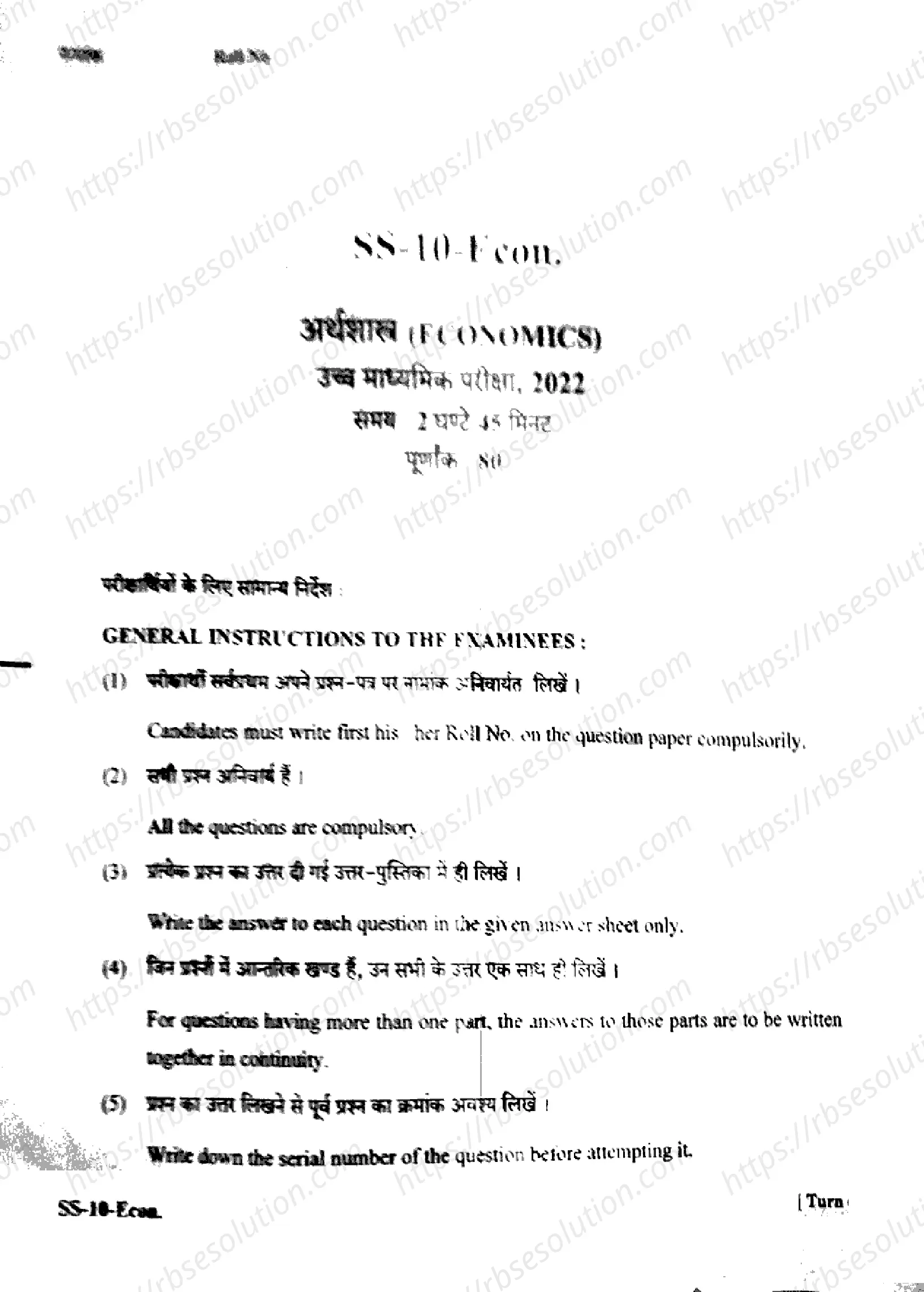


Rajasthan Board Class 12th Economics-SS-10-2022 2022 solved Previous Year Question Papers
उच्च माध्यमिक परीक्षा, 2022
अर्थशास्त्र (Economics)
SS-30-Fese
परीक्षार्थियों के लिए सामान्य निर्देश
GENERAL INSTRUCTIONS TO THE EXAMINEES:
- परीक्षार्थी अपने प्रश्न-पत्र पर रोल नंबर अनिवार्यतः लिखें।
Candidates must write his/her Roll No. on the question paper compulsorily. - सभी प्रश्न अनिवार्य हैं।
All the questions are compulsory. - प्रत्येक प्रश्न का उत्तर दी गई उत्तर-पुस्तिका में ही लिखें।
Write the answer to each question in the given answer sheet only. - जिन प्रश्नों में एक से अधिक खण्ड हैं, उन सभी के उत्तर एक साथ ही लिखें।
For questions having more than one part, the answers to those parts are to be written together in continuity. - उत्तर लिखने से पूर्व प्रश्न का क्रमांक अवश्य लिखें।
Write down the serial number of the question before attempting it.
प्रश्न-पत्र (Question Paper)
निर्देश: प्रश्न-पत्र में किसी भी प्रकार की त्रुटि / अशुद्धि होने पर उसे सही माना जाएगा। यदि प्रश्न-पत्र के किसी भी संस्करण में कोई त्रुटि है, तो उसे सही माना जाएगा।
Instruction: If there is any kind of error in the question paper, it shall be considered correct. In case of any error in any version of the question paper, it shall be considered correct.
(7) प्रश्न क्रमांक 7 से 23 में आंतरिक विकल्प है। किसी एक विकल्प को हल कीजिए।
Question Nos. 7 to 23 have the internal choice. Solve any one option.
SECTION — A
1. बहुविकल्पी प्रश्न / Multiple Choice Questions
-
(i) 'द जनरल थ्योरी ऑफ एम्प्लॉयमेंट, इंटरेस्ट एंड मनी' पुस्तक के लेखक है:
The author of the book ‘The General Theory of Employment, Interest and Money’ is:
- (अ) एडम स्मिथ / Adam Smith
- (ब) अल्फ्रेड मार्शल / Alfred Marshall
- (स) जॉन मेनार्ड कीन्स / John Maynard Keynes
- (द) पॉल सैम्युअलसन / Paul Samuelson
व्याख्या: यह पुस्तक 1936 में प्रकाशित हुई थी और इसे आधुनिक व्यापक आर्थिक सिद्धांत का आधार माना जाता है।
-
(ii) मानवीय श्रम का पारिश्रमिक है:
The remuneration of human labour is:
- (अ) लगान / Rent
- (ब) ब्याज / Interest
- (स) मजदूरी / Wage
- (द) लाभ / Profit
व्याख्या: श्रम का पारिश्रमिक मजदूरी है, जो श्रमिक को उसकी सेवाओं के बदले दी जाती है।
-
(iii) एक समयावधि में मापी जाने वाली मात्रा है:
A quantity measured over a period of time is:
- (अ) स्टॉक / Stock
- (ब) प्रवाह / Flow
- (स) मूल्यह्रास / Depreciation
- (द) धन / Wealth
व्याख्या: प्रवाह चर (जैसे आय, व्यय) एक समय अवधि में मापे जाते हैं, जबकि स्टॉक चर (जैसे धन) एक निश्चित बिंदु पर मापे जाते हैं।
SS-30-Econ.
(iv) भारत में करेंसी निर्गमित करने वाली संस्था है |
The institution issuing currency in India is:
- Bank of India
- State Bank of India
- Union Bank of India
- Reserve Bank of India
Explanation: The Reserve Bank of India (RBI) is the sole authority for issuing currency notes in India, except for the one-rupee note which is issued by the Ministry of Finance.
(v) संव्यवहार के लिए सबसे तरल और आसान है
The most liquid and easiest for transactions is:
- M₁
- M₂
- M₃
- M₄
Explanation: M₄ includes all components of money supply (currency, demand deposits, time deposits with banks, and post office savings deposits), making it the broadest measure and most liquid for transactions.
(vi) भारत में वित्तीय वर्ष की अवधि है
The period of Financial Year in India is:
- 1 January to 31 December
- 1 March to 30 April
- 1 April to 31 March
- 1 July to 30 June
Explanation: In India, the financial year runs from 1 April to 31 March of the following year, as per government accounting practices.
(vii) सभी महत्त्वपूर्ण निर्णय सरकार द्वारा किये जाने वाली अर्थव्यवस्था कहलाती है
The economy in which all important economic decisions are made by the government, is called:
- Capitalist Economy
- Centrally Planned Economy
- Mixed Economy
- Market Economy
Explanation: In a centrally planned economy (also called a command economy), the government makes all major economic decisions regarding production, distribution, and pricing, as opposed to market or capitalist economies where private entities play a larger role.
(viii) सीमांत उपयोगिता की गणना का सूत्र है
The formula of calculating Marginal Utility
- MUn = TUn – TUn-1
- MUn = TUn + TUn-1
- MUn = TUn – TUn-1
- MUn = TUn + TUn+1
Correct Answer: (A) MUn = TUn – TUn-1
Marginal utility is the additional utility derived from consuming one more unit of a commodity. It is calculated as the difference between total utility of the current unit and total utility of the previous unit.
(ix) माँग फलन है
The Demand function is
- X = f(K)
- X = f(L)
- X = f(P)
- X = f(Q)
Correct Answer: (C) X = f(P)
Demand function shows the relationship between quantity demanded (X) and its determinants, primarily price (P). The general form is X = f(P), where P is the price of the commodity.
(x) पैमाने के प्रतिफल का संबंध है
Returns to scale is related with
- Very short run period
- Short run period
- Very long run period
- Long run period
Correct Answer: (D) Long run period
Returns to scale refers to the change in output when all inputs are changed in the same proportion. This concept applies only in the long run when all factors of production are variable.
(xi) औसत उत्पाद वक्र का आकार होता है
The shape of Average Product curve is
- U shaped
- Inverse U shaped
- Horizontal
- Vertical
Correct Answer: (B) Inverse U shaped
The Average Product (AP) curve initially rises due to increasing returns to the variable factor, reaches a maximum, and then declines due to diminishing returns. This gives it an inverse U-shape (bell-shaped).
प्रश्न 1 (बहुविकल्पीय प्रश्न)
कुल परिवर्ती लागत शून्य होती है
- जब निर्गत अधिकतम होता है।
- जब निर्गत न्यूनतम होता है।
- जब निर्गत शून्य होता है।
- जब निर्गत स्थिर होता है।
Total Variable Cost is zero
- when the output is highest.
- when the output is lowest.
- when the output is zero.
- when the output is constant.
व्याख्या: कुल परिवर्ती लागत (TVC) उत्पादन के साथ बदलती है। जब उत्पादन (निर्गत) शून्य होता है, तो कोई परिवर्ती लागत नहीं लगती, इसलिए TVC शून्य होती है।
प्रश्न 2: रिक्त स्थान की पूर्ति कीजिए
- जब कोई देश विश्व के अन्य देशों से वस्तुएँ खरीदता है तो उसे आयात कहते हैं।
When a country buys goods from other countries of the world, it is called import. - मुद्रा विनिमय का एक सर्वमान्य माध्यम है।
Money is a common medium of exchange. - गैर-योजनागत व्यय का प्रमुख मद ब्याज भुगतान है।
The main item of non-plan expenditure is interest payment. - संसाधनों की कमी चयन की समस्या को जन्म देती है।
Scarcity of resources give rise to the problem of choice. - सभी उपभोक्ताओं की सम्मिलित माँग का जोड़ बाजार माँग होती है।
The market demand is the total demand of all the consumers. - उत्पादन फलन आगतों और निर्गतों के मध्य संबंध को दर्शाता है।
Production function shows the relationship between inputs and outputs.
प्रश्न 3: निम्न प्रश्नों के उत्तर 20-20 शब्दों में दीजिए
(i) पूँजीवादी अर्थव्यवस्था की कोई एक विशेषता लिखिए।
उत्तर: पूँजीवादी अर्थव्यवस्था में निजी संपत्ति का अधिकार होता है, जहाँ व्यक्ति अपनी संपत्ति का स्वामी होता है और उसका उपयोग कर सकता है।
Answer: In a capitalist economy, there is the right to private property, where individuals own and can use their property.
(ii) राष्ट्रीय प्रयोज्य आय को स्पष्ट कीजिए।
उत्तर: राष्ट्रीय प्रयोज्य आय वह आय है जो देश के निवासी उपभोग और बचत पर खर्च कर सकते हैं। यह सकल राष्ट्रीय आय में शुद्ध अंतर्राष्ट्रीय अंतरण जोड़कर प्राप्त की जाती है।
Answer: National Disposable Income is the income that residents of a country can spend on consumption and saving. It is obtained by adding net international transfers to Gross National Income.
प्रश्न (ii)
एक फर्म एक वर्ष में ₹ 100 मूल्य की वस्तु का उत्पादन करती है। उस वर्ष में ₹ 40 की मध्यवर्ती वस्तु का उपयोग किया जाता है तो फर्म का सकल मूल्यवर्धित परिकलित कीजिए।
A firm produces goods of worth ₹ 100 in a year. In that year intermediate goods of worth ₹ 40 is used. Calculate the gross value added.
हल: सकल मूल्यवर्धित = उत्पादन का मूल्य – मध्यवर्ती वस्तुओं का मूल्य = ₹ 100 – ₹ 40 = ₹ 60।
Solution: Gross Value Added = Value of Output – Value of Intermediate Goods = ₹ 100 – ₹ 40 = ₹ 60.
प्रश्न (viii)
आपका व्यावसायिक बैंक में बचत खाता है तो इस खाते में जमा राशि कौन सी जमा कहलाएगी?
If you have a savings account in a commercial bank, what type of deposit is called the deposit in this account?
उत्तर: इसे माँग जमा (Demand Deposit) कहा जाता है, क्योंकि इसे माँगने पर तुरंत निकाला जा सकता है।
Answer: It is called a Demand Deposit, as it can be withdrawn on demand.
प्रश्न (ix)
बैंक दर क्या है? समझाइए।
What is Bank rate? Explain.
उत्तर: बैंक दर वह ब्याज दर है जिस पर केंद्रीय बैंक (RBI) वाणिज्यिक बैंकों को दीर्घकालिक ऋण प्रदान करता है। यह मौद्रिक नीति का एक उपकरण है, जिसके द्वारा केंद्रीय बैंक अर्थव्यवस्था में मुद्रा आपूर्ति को नियंत्रित करता है। बैंक दर बढ़ाने पर ऋण महँगा हो जाता है, जिससे मुद्रा आपूर्ति घटती है, और इसे घटाने पर ऋण सस्ता हो जाता है, जिससे मुद्रा आपूर्ति बढ़ती है।
Answer: Bank rate is the interest rate at which the central bank (RBI) provides long-term loans to commercial banks. It is a monetary policy tool used to control money supply. An increase in bank rate makes loans expensive, reducing money supply, while a decrease makes loans cheaper, increasing money supply.
प्रश्न (x)
संतुलित बजट को परिभाषित कीजिए।
Define Balanced Budget.
उत्तर: संतुलित बजट वह स्थिति है जब सरकार का कुल प्रत्याशित व्यय उसकी कुल प्रत्याशित आय (करों और अन्य स्रोतों से) के बराबर होता है। इसमें न तो कोई बचत होती है और न ही कोई घाटा।
Answer: A balanced budget is a situation where the government's total estimated expenditure equals its total estimated revenue (from taxes and other sources). There is neither surplus nor deficit.
प्रश्न (xi)
सरकारी बजट का कोई एक उद्देश्य बताइए।
State any one objective of government budget.
उत्तर: सरकारी बजट का एक उद्देश्य आय और धन का पुनर्वितरण (Redistribution of Income and Wealth) करना है, जिससे आर्थिक असमानता को कम किया जा सके।
Answer: One objective of the government budget is Redistribution of Income and Wealth to reduce economic inequality.
प्रश्न (xii)
अर्थव्यवस्था के उत्पादन संभावना सेट से क्या आशय है?
What is meant by production possibility set of an economy?
उत्तर: उत्पादन संभावना सेट (Production Possibility Set) उन सभी संभावित वस्तुओं के संयोजनों का समूह है जो किसी अर्थव्यवस्था में दिए गए संसाधनों और तकनीक से उत्पादित किए जा सकते हैं। यह उत्पादन संभावना वक्र (PPC) के अंतर्गत आने वाले सभी बिंदुओं को दर्शाता है।
Answer: The production possibility set is the set of all possible combinations of goods that can be produced in an economy with given resources and technology. It includes all points inside and on the Production Possibility Curve (PPC).
प्रश्न (xiii)
यदि केलों की कीमतें 40 प्रतिशत बढ़ती है तो केलों की माँग 20 प्रतिशत घट जाती है, तो माँग की कीमत लोच क्या होगी?
If the price of bananas increases by 40 percent and the demand for bananas decreases by 20 percent, what will be the price elasticity of demand?
हल: माँग की कीमत लोच (Ed) = (माँग में प्रतिशत परिवर्तन) / (कीमत में प्रतिशत परिवर्तन) = (-20%) / (40%) = -0.5। चूँकि माँग में कमी आई है, ऋणात्मक चिह्न लगता है। लोच का निरपेक्ष मान 0.5 है, जो 1 से कम है, अतः माँग बेलोचदार (inelastic) है।
Solution: Price Elasticity of Demand (Ed) = (% Change in Quantity Demanded) / (% Change in Price) = (-20%) / (40%) = -0.5. The absolute value is 0.5, which is less than 1, so demand is inelastic.
प्रश्न (xiv)
अल्पकाल क्या है?
What is short-run period?
उत्तर: अल्पकाल (Short-run) वह समयावधि है जिसमें कम से कम एक उत्पादन का साधन (जैसे पूँजी, भूमि) स्थिर (fixed) रहता है, जबकि अन्य साधनों (जैसे श्रम) को बदला जा सकता है। इस अवधि में फर्म अपनी उत्पादन क्षमता नहीं बदल सकती, केवल उत्पादन की मात्रा में परिवर्तन कर सकती है।
Answer: The short-run is a time period in which at least one factor of production (e.g., capital, land) is fixed, while other factors (e.g., labor) can be varied. In this period, a firm cannot change its production capacity, only the level of output.
प्रश्न (xv)
सीमांत उत्पाद की गणना का सूत्र लिखिए।
Write the formula to calculate marginal product.
उत्तर: सीमांत उत्पाद (MP) = कुल उत्पाद में परिवर्तन / परिवर्ती साधन की मात्रा में परिवर्तन। सूत्र: MP = ΔTP / ΔL, जहाँ ΔTP कुल उत्पाद में परिवर्तन और ΔL श्रम (या अन्य परिवर्ती साधन) की मात्रा में परिवर्तन है।
Answer: Marginal Product (MP) = Change in Total Product / Change in Variable Input. Formula: MP = ΔTP / ΔL, where ΔTP is change in total product and ΔL is change in labor (or other variable input).
प्रश्न (xvi)
पूर्ण प्रतिस्पर्धात्मक बाजार का कोई एक लक्षण लिखिए।
Write any one feature of a perfectly competitive market.
उत्तर: पूर्ण प्रतिस्पर्धात्मक बाजार का एक लक्षण है बड़ी संख्या में क्रेता और विक्रेता (Large number of buyers and sellers), जिससे कोई भी व्यक्तिगत क्रेता या विक्रेता बाजार मूल्य को प्रभावित नहीं कर सकता।
Answer: One feature of a perfectly competitive market is a large number of buyers and sellers, so no individual buyer or seller can influence the market price.
खण्ड-ब / SECTION -B
प्रश्नों के उत्तर 30-40 शब्दों में दीजिए :
Answer the following questions in 30-40 words :
4. उपभोक्ता वस्तुओं तथा पूँजीगत वस्तुओं के प्रत्येक के कोई दो उदाहरण दीजिए ।
Give any two examples each of consumer goods and capital goods.
उपभोक्ता वस्तुएँ (Consumer Goods): (i) खाद्यान्न (Food grains), (ii) वस्त्र (Clothing).
पूँजीगत वस्तुएँ (Capital Goods): (i) मशीनरी (Machinery), (ii) कारखाना भवन (Factory building).
5. सकल राष्ट्रीय उत्पाद एवं सकल घरेलू उत्पाद की अवधारणाओं को समझाइए ।
Explain the concepts of Gross National Product and Gross Domestic Product.
सकल घरेलू उत्पाद (GDP): किसी देश की भौगोलिक सीमाओं के भीतर एक वर्ष में उत्पादित सभी अंतिम वस्तुओं एवं सेवाओं का कुल मौद्रिक मूल्य GDP कहलाता है।
सकल राष्ट्रीय उत्पाद (GNP): किसी देश के सामान्य निवासियों द्वारा एक वर्ष में उत्पादित सभी अंतिम वस्तुओं एवं सेवाओं का कुल मौद्रिक मूल्य GNP कहलाता है। GNP = GDP + विदेशों से शुद्ध साधन आय।
6. व्यावसायिक बैंकों के किन्हीं दो मुख्य कार्यों का वर्णन कीजिए ।
Describe any two main functions of Commercial Banks.
प्राथमिक कार्य: (i) जमा स्वीकार करना (बचत, चालू, सावधि जमा), (ii) ऋण प्रदान करना (अधिविकर्ष, नकद ऋण, बिलों का भुगतान)।
गौण कार्य: (i) ग्राहकों की ओर से भुगतान करना, (ii) विपत्रों का संग्रह करना, (iii) लॉकर सुविधा प्रदान करना।
7. पूँजीगत प्राप्तियों की किन्हीं दो मदों का उल्लेख कीजिए ।
Mention any two items of capital receipts.
(i) सरकार द्वारा लिया गया ऋण (Borrowings), (ii) विनिवेश से प्राप्त आय (Disinvestment proceeds).
8. सार्वजनिक वस्तुओं की कोई दो विशेषताएँ लिखिए ।
Write any two features of public goods.
(i) गैर-प्रतिद्वंद्विता (Non-rivalry): एक व्यक्ति द्वारा उपभोग से दूसरे के उपभोग में कमी नहीं होती। (ii) गैर-बहिष्करणीयता (Non-excludability): किसी को भी इसके उपभोग से वंचित नहीं किया जा सकता।
9. प्रत्यक्ष कर एवं अप्रत्यक्ष कर के प्रत्येक के दो उदाहरण लिखिए ।
Write two examples each of the direct taxes and indirect taxes.
प्रत्यक्ष कर (Direct Taxes): (i) आयकर (Income Tax), (ii) निगम कर (Corporate Tax).
अप्रत्यक्ष कर (Indirect Taxes): (i) वस्तु एवं सेवा कर (GST), (ii) उत्पाद शुल्क (Excise Duty).
10. राजस्व घाटे की गणना कैसे की जाती है ?
How revenue deficit is calculated ?
राजस्व घाटा = राजस्व प्राप्तियाँ – राजस्व व्यय। यह सरकार की आय और व्यय के बीच के अंतर को दर्शाता है, जो सरकार की बचत की कमी को इंगित करता है।
11. अर्थव्यवस्था की कोई दो केन्द्रीय समस्याएँ लिखिए ।
Write any two central problems of an economy.
(i) क्या उत्पादन करें (What to produce): संसाधनों की कमी के कारण यह तय करना कि कौन सी वस्तुएँ और कितनी मात्रा में उत्पादित की जाएँ। (ii) कैसे उत्पादन करें (How to produce): उत्पादन की किस तकनीक (श्रम प्रधान या पूँजी प्रधान) का उपयोग किया जाए।
12. पूरक और स्थानापन्न वस्तुओं को उदाहरण की सहायता से समझाइए ।
Explain complementary and substitute goods with an example.
पूरक वस्तुएँ (Complementary Goods): वे वस्तुएँ जिनका उपयोग एक साथ किया जाता है। उदाहरण: कार और पेट्रोल। एक की कीमत बढ़ने पर दूसरे की माँग घटती है।
स्थानापन्न वस्तुएँ (Substitute Goods): वे वस्तुएँ जो एक-दूसरे का स्थान ले सकती हैं। उदाहरण: चाय और कॉफी। एक की कीमत बढ़ने पर दूसरे की माँग बढ़ती है।
3. अनधिमान वक्र का एक रेखाचित्र बनाइए |
Draw a diagram of an indifference curve.
Solution: An indifference curve is a graphical representation showing different combinations of two goods (e.g., Good X and Good Y) that give a consumer the same level of satisfaction. It is typically downward sloping and convex to the origin.
(Diagram: A downward-sloping convex curve labeled IC, with Good X on the horizontal axis and Good Y on the vertical axis.)
4. कुल स्थिर लागत वक्र का आकार कैसा होता है? कोई एक कारण दीजिए |
What is the shape of Total Fixed Cost Curve? Give any one reason.
Solution: The Total Fixed Cost (TFC) curve is a horizontal straight line parallel to the X-axis (output axis).
Reason: Fixed costs (like rent, insurance, or salaries) do not change with the level of output in the short run. They remain constant regardless of whether production is zero or at full capacity.
5. औसत संप्राप्ति अवधारणा की व्याख्या कीजिए |
Discuss the concept of Average Revenue.
Solution: Average Revenue (AR) is the revenue earned per unit of output sold. It is calculated by dividing Total Revenue (TR) by the quantity (Q) of output sold: AR = TR / Q. In a perfectly competitive market, AR equals the price of the product and remains constant. In imperfect markets, AR declines as output increases. AR is also known as the demand curve for the firm's product.
6. बाजार पूर्ति का आशय स्पष्ट कीजिए |
Explain the meaning of Market Supply.
Solution: Market Supply refers to the total quantity of a good or service that all producers (firms) in a market are willing and able to sell at different prices during a given period of time. It is the horizontal summation of all individual firm supplies at each price level. Market supply is influenced by factors like price of the good, number of firms, technology, and input costs.
SECTION - C
निम्न प्रश्नों के उत्तर 60-80 शब्दों में दीजिए :
Answer the following questions in 60-80 words -
7. “सकल घरेलू उत्पाद बढ़ने के साथ कल्याण में वृद्धि नहीं होती ।" इस कथन के संदर्भ में किन्हीं दो कारणों की व्याख्या कीजिए |
“Welfare does not increase with the increase in Gross Domestic Product.” Discuss any two reasons with reference to the statement.
Solution: The statement is true because GDP growth does not always reflect an increase in overall welfare. Two reasons are:
- Unequal Distribution of Income: GDP may rise due to increased production, but if the benefits are concentrated among a few rich people, the majority may not experience improved welfare. For example, if only the top 10% get richer, poverty and inequality may persist.
- Negative Externalities: GDP growth can come from activities that harm the environment or health, such as pollution from factories. While GDP increases, the quality of life may decline due to health costs and environmental damage, reducing actual welfare.
अथवा / OR
निम्न समंकों की सहायता से राष्ट्रीय आय (NNPFC) की गणना कीजिए :
Calculate National Income (NNPFC) with the help of the following data:
- (i) बाजार कीमत पर सकल राष्ट्रीय उत्पाद (GNPMP) = ₹ 1,000 करोड़
- (ii) मूल्यह्रास (Depreciation) = ₹ 200 करोड़
- (iii) अप्रत्यक्ष कर (Indirect Tax) = ₹ 50 करोड़
- (iv) अनुदान (Subsidies) = ₹ 250 करोड़
Solution: National Income (NNPFC) is calculated as follows:
Step 1: Calculate NNPMP (Net National Product at Market Price):
NNPMP = GNPMP - Depreciation
NNPMP = ₹ 1,000 करोड़ - ₹ 200 करोड़ = ₹ 800 करोड़
Step 2: Convert NNPMP to NNPFC (Net National Product at Factor Cost):
NNPFC = NNPMP - Indirect Taxes + Subsidies
NNPFC = ₹ 800 करोड़ - ₹ 50 करोड़ + ₹ 250 करोड़ = ₹ 1,000 करोड़
Answer: National Income (NNPFC) = ₹ 1,000 करोड़.
प्रश्न 18 (a): राष्ट्रीय आय (NNPFC) की गणना
निम्नलिखित आंकड़ों की सहायता से राष्ट्रीय आय (NNPFC) की गणना कीजिए:
- सकल राष्ट्रीय उत्पाद बाजार मूल्य पर (GNPMP) = ₹ 2,000 करोड़
- मूल्य ह्रास (Depreciation) = ₹ 200 करोड़
- अप्रत्यक्ष कर (Indirect Taxes) = ₹ 250 करोड़
- सब्सिडी (Subsidy) = ₹ 250 करोड़
हल:
सूत्र: NNPFC = GNPMP – मूल्य ह्रास – (अप्रत्यक्ष कर – सब्सिडी)
चरण 1: NNPMP = GNPMP – मूल्य ह्रास
NNPMP = ₹ 2,000 करोड़ – ₹ 200 करोड़ = ₹ 1,800 करोड़
चरण 2: शुद्ध अप्रत्यक्ष कर = अप्रत्यक्ष कर – सब्सिडी
शुद्ध अप्रत्यक्ष कर = ₹ 250 करोड़ – ₹ 250 करोड़ = ₹ 0 करोड़
चरण 3: NNPFC = NNPMP – शुद्ध अप्रत्यक्ष कर
NNPFC = ₹ 1,800 करोड़ – ₹ 0 करोड़ = ₹ 1,800 करोड़
उत्तर: राष्ट्रीय आय (NNPFC) = ₹ 1,800 करोड़
प्रश्न 18 (b): केंद्रीय बैंक के कार्य
केंद्रीय बैंक के किन्हीं तीन कार्यों का वर्णन कीजिए।
(3 अंक)
उत्तर: केंद्रीय बैंक (जैसे भारत में RBI) के तीन प्रमुख कार्य निम्नलिखित हैं:
- नोट निर्गमन (Issue of Currency): केंद्रीय बैंक को देश में मुद्रा (करेंसी नोट) जारी करने का एकाधिकार होता है। यह सुनिश्चित करता है कि मुद्रा की आपूर्ति अर्थव्यवस्था की आवश्यकताओं के अनुसार हो और मुद्रा की सुरक्षा बनी रहे।
- सरकार का बैंकर (Banker to the Government): केंद्रीय बैंक केंद्र और राज्य सरकारों के लिए बैंकर, एजेंट और सलाहकार के रूप में कार्य करता है। यह सरकार के खाते रखता है, सरकार की ओर से भुगतान करता है और सरकार को ऋण देता है।
- बैंकों का बैंक (Banker's Bank): केंद्रीय बैंक वाणिज्यिक बैंकों के लिए अंतिम ऋणदाता (Lender of Last Resort) के रूप में कार्य करता है। यह बैंकों को नकदी संकट के समय ऋण देता है और उनके नकद आरक्षित अनुपात (CRR) को नियंत्रित करता है।
प्रश्न 18 (b) वैकल्पिक: मुद्रा पूर्ति नियंत्रण के उपकरण
मुद्रा पूर्ति के नियंत्रण के किन्हीं तीन उपकरणों को समझाइए।
(3 अंक)
उत्तर: केंद्रीय बैंक द्वारा मुद्रा पूर्ति को नियंत्रित करने के तीन प्रमुख उपकरण निम्नलिखित हैं:
- बैंक दर (Bank Rate): यह वह दर है जिस पर केंद्रीय बैंक वाणिज्यिक बैंकों को ऋण देता है। बैंक दर बढ़ाने पर बैंकों के लिए ऋण महंगा हो जाता है, जिससे वे कम ऋण देते हैं और मुद्रा पूर्ति कम हो जाती है।
- नकद आरक्षित अनुपात (CRR): यह वह अनुपात है जो वाणिज्यिक बैंकों को अपनी कुल जमा राशि का एक निश्चित प्रतिशत केंद्रीय बैंक के पास नकद रखना होता है। CRR बढ़ाने पर बैंकों के पास ऋण देने के लिए कम धन बचता है, जिससे मुद्रा पूर्ति कम हो जाती है।
- खुले बाजार की क्रियाएँ (Open Market Operations): केंद्रीय बैंक बाजार में सरकारी प्रतिभूतियाँ (बॉन्ड) खरीदता या बेचता है। जब वह बॉन्ड बेचता है, तो बैंकों से नकदी निकल जाती है और मुद्रा पूर्ति कम हो जाती है। जब वह बॉन्ड खरीदता है, तो बैंकों को नकदी मिलती है और मुद्रा पूर्ति बढ़ जाती है।
प्रश्न 19: व्यष्टि अर्थशास्त्र एवं समष्टि अर्थशास्त्र
व्यष्टि अर्थशास्त्र एवं समष्टि अर्थशास्त्र को संक्षेप में समझाइए।
(4 अंक)
उत्तर:
व्यष्टि अर्थशास्त्र (Micro-Economics): यह अर्थशास्त्र की वह शाखा है जो व्यक्तिगत आर्थिक इकाइयों जैसे उपभोक्ता, फर्म, उद्योग आदि के आर्थिक व्यवहार का अध्ययन करती है। यह मूल्य निर्धारण, माँग और पूर्ति, उपभोक्ता व्यवहार, उत्पादन लागत आदि जैसे विषयों पर ध्यान केंद्रित करती है। इसका मुख्य सिद्धांत "कीमत सिद्धांत" (Price Theory) है।
समष्टि अर्थशास्त्र (Macro-Economics): यह अर्थशास्त्र की वह शाखा है जो संपूर्ण अर्थव्यवस्था का समग्र रूप से अध्ययन करती है। यह राष्ट्रीय आय, कुल रोजगार, सामान्य मूल्य स्तर, मुद्रास्फीति, बेरोजगारी, आयात-निर्यात आदि जैसे समग्र चरों का विश्लेषण करती है। इसका मुख्य सिद्धांत "आय और रोजगार सिद्धांत" (Theory of Income and Employment) है।
प्रश्न 19 वैकल्पिक: सकारात्मक एवं आदर्शक आर्थिक विश्लेषण में अंतर
सकारात्मक आर्थिक विश्लेषण तथा आदर्शक आर्थिक विश्लेषण के मध्य अंतर स्पष्ट कीजिए।
(4 अंक)
उत्तर: सकारात्मक और आदर्शक आर्थिक विश्लेषण में निम्नलिखित अंतर हैं:
| आधार | सकारात्मक आर्थिक विश्लेषण | आदर्शक आर्थिक विश्लेषण |
|---|---|---|
| अर्थ | यह आर्थिक घटनाओं का वस्तुनिष्ठ और तथ्यात्मक विवरण प्रस्तुत करता है। यह "क्या है" (What is) पर आधारित होता है। | यह आर्थिक घटनाओं के बारे में मूल्य निर्णय और सुझाव देता है। यह "क्या होना चाहिए" (What ought to be) पर आधारित होता है। |
| प्रकृति | वैज्ञानिक और तटस्थ (Neutral) | मूल्य-आधारित और व्यक्तिपरक (Subjective) |
| उदाहरण | "भारत में बेरोजगारी दर 7% है।" | "सरकार को बेरोजगारी कम करने के लिए नीतियाँ बनानी चाहिए।" |
| परीक्षण | इसे तथ्यों और आंकड़ों से सत्यापित किया जा सकता है। | इसे तथ्यों से सत्यापित नहीं किया जा सकता, यह नैतिक मूल्यों पर निर्भर करता है। |
प्रश्न 20: पूर्ति की कीमत लोच की गणना
एक वस्तु की कीमत ₹ 10 है और पूर्ति 100 इकाइयाँ है। यदि कीमत बढ़कर ₹ 12 हो जाती है और पूर्ति बढ़कर 120 इकाइयाँ हो जाती है, तो पूर्ति की कीमत लोच ज्ञात कीजिए।
(4 अंक)
हल:
दिया गया है:
- प्रारंभिक कीमत (P) = ₹ 10
- प्रारंभिक पूर्ति (Q) = 100 इकाइयाँ
- नई कीमत (P₁) = ₹ 12
- नई पूर्ति (Q₁) = 120 इकाइयाँ
सूत्र: पूर्ति की कीमत लोच (Es) = (ΔQ / Q) / (ΔP / P)
जहाँ, ΔQ = पूर्ति में परिवर्तन = Q₁ – Q = 120 – 100 = 20 इकाइयाँ हल: पूर्ण प्रतिस्पर्धी बाजार में कीमत स्थिर (₹10 प्रति इकाई) होती है। कुल आय (TR) = कीमत × मात्रा, तथा सीमांत आय (MR) = TR में परिवर्तन / मात्रा में परिवर्तन। स्पष्टीकरण: पूर्ण प्रतिस्पर्धा में MR = कीमत = ₹10 स्थिर रहता है। TR = मात्रा × ₹10 से बढ़ता है। निम्न प्रश्नों के उत्तर 80-250 शब्दों में दीजिए। उत्तर: साख सृजन (Credit Creation) बैंकों द्वारा जमा राशि के आधार पर ऋण देने की प्रक्रिया है। इसकी दो प्रमुख सीमाएँ निम्नलिखित हैं: अन्य सीमाएँ: बैंक की ऋण नीति, बाजार में माँग, और आर्थिक स्थितियाँ भी साख सृजन को प्रभावित करती हैं। उत्तर: मुद्रा पूर्ति (Money Supply) किसी अर्थव्यवस्था में प्रचलन में मुद्रा की कुल मात्रा है। भारतीय रिज़र्व बैंक (RBI) द्वारा मुद्रा पूर्ति के चार प्रमुख माप (M1, M2, M3, M4) निम्नलिखित हैं: स्पष्टीकरण: M1 और M2 का उपयोग अल्पकालिक तरलता मापने के लिए, जबकि M3 और M4 का उपयोग दीर्घकालिक मुद्रा आपूर्ति और आर्थिक नीति निर्धारण में किया जाता है। Explain Average Fixed Cost and Average Variable Cost with the help of diagrams. औसत स्थिर लागत (Average Fixed Cost - AFC): यह कुल स्थिर लागत को उत्पादन की कुल इकाइयों से विभाजित करने पर प्राप्त होती है। स्थिर लागत (जैसे किराया, ब्याज) उत्पादन के स्तर के साथ नहीं बदलती, इसलिए जैसे-जैसे उत्पादन बढ़ता है, AFC घटती जाती है। AFC वक्र एक आयताकार अतिपरवलय (Rectangular Hyperbola) के आकार का होता है, जो मूल बिंदु की ओर झुकता है लेकिन कभी भी X-अक्ष को स्पर्श नहीं करता। औसत परिवर्ती लागत (Average Variable Cost - AVC): यह कुल परिवर्ती लागत को उत्पादन की कुल इकाइयों से विभाजित करने पर प्राप्त होती है। परिवर्ती लागत (जैसे कच्चा माल, मजदूरी) उत्पादन के साथ बदलती है। AVC वक्र प्रारंभ में घटता है, फिर एक न्यूनतम बिंदु पर पहुँचता है, और उसके बाद बढ़ने लगता है। यह 'U' आकार का होता है, जो परिवर्ती अनुपातों के नियम (Law of Variable Proportions) को दर्शाता है। (रेखाचित्र में X-अक्ष पर उत्पादन (Output) और Y-अक्ष पर लागत (Cost) दर्शाई गई है।) निष्कर्ष: AFC हमेशा घटती है, जबकि AVC पहले घटती है, फिर बढ़ती है। दोनों वक्र मिलकर अल्पकालीन लागत विश्लेषण में सहायक होते हैं।
ΔP = कीमत में परिवर्तन = P₁ – P = ₹ 12 – ₹
प्रश्न: पूर्ण प्रतिस्पर्धी बाजार में एक वस्तु की कीमत ₹10 प्रति इकाई है तो दी गई तालिका में कुल आय एवं सीमांत आय की गणना कीजिए।
बेची गई मात्रा (इकाई)
कुल आय (₹)
सीमांत आय (₹)
0
0
–
1
10
10
2
20
10
3
30
10
खण्ड-द (Section - D)
24. साख सृजन की किन्हीं दो सीमाओं को समझाइए।
अथवा / OR
मुद्रा पूर्ति के चार प्रमुख माप समझाइए।
स्थिर लागत तथा औसत परिवर्ती लागत की रेखाचित्रों की सहायता से व्याख्या कीजिए।
व्याख्या (Explanation):
रेखाचित्र (Diagram):