
RBSE Class 12th 2023 English-SS-02-2023 Previous Year Papers
English-SS-02-2023 from the 2023 exam year is part of the Class 12th previous year papers archive on RBSE Solution. Many learners start here after finishing the textbook to see how questions were actually framed on the Rajasthan Board of Secondary Education (RBSE) paper.
Treat this question paper as a mock under gentle timing first, then as a marking exercise the second time. The introduction on this page is written only for this subject-and-year pair, not copied from other pages.
Bookmark the link if you coach juniors — the layout stays stable for search engines and classroom sharing.
Paper details
Quick reference for this previous year papers page — confirm board, class, and year & subject before you study.
| Board | RBSE |
|---|---|
| Class | Class 12th |
| Exam year | 2023 |
| Subject | English-SS-02-2023 |
| Resource type | Previous Year Papers |
| Category | RBSE Previous Year Question Papers |
| Website | RBSE Solution |
The table summarises this Previous Year Papers resource. Confirm RBSE, Class 12th, year 2023, and subject English-SS-02-2023 before studying.
RBSE Solution organises previous year papers so each URL carries chapter-specific guidance — better for students and for search engines than one generic paragraph for the whole class.
How to practise with this question paper
Stage one: read the English-SS-02-2023 question paper from 2023 without a timer and highlight command words — explain, prove, calculate, discuss. Stage two: attempt selected questions closed-book. Stage three: compare with solutions or teacher feedback.
Previous Year Papers work best when you log mistakes by topic, not only by question number. That log becomes your revision index before pre-boards.
RBSE Class 12th 2023 English-SS-02-2023
Scroll through the Previous Year Papers pages for English-SS-02-2023 (2023).
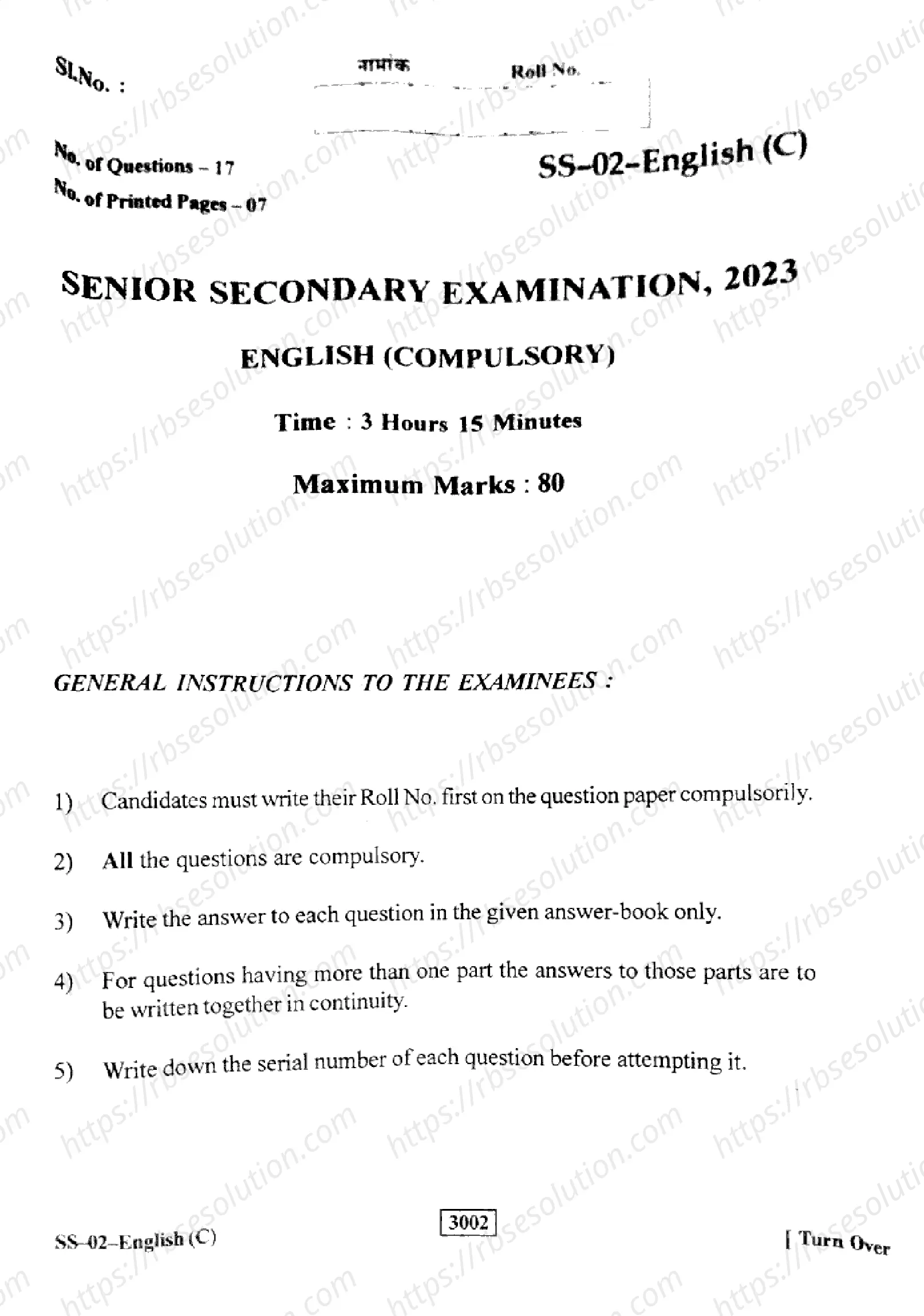


Rajasthan Board Class 12th English-SS-02-2023 2023 solved Previous Year Question Papers
SENIOR SECONDARY EXAMINATION, 2023
ENGLISH (COMPULSORY)
Time: 3 Hours 5 Minutes | Maximum Marks: 80
No. of Questions: 17 | No. of Printed Pages: 07
Code: SS-02-English (C)
GENERAL INSTRUCTIONS TO THE EXAMINEES:
- Candidates must write their Roll No. first on the question paper compulsorily.
- All the questions are compulsory.
- Write the answer to each question in the given answer-book only.
- For questions having more than one part the answers to those parts are to be written together in continuity.
- Write down the serial number of each question before attempting it.
[3002] | Turn Over
SECTION-A
Read the following passage carefully and answer the questions that follow: [9]
There was another Indian with the Professor and his troupe who took no part in the strongman acts but spent the entire time digging a shallow trench about ten feet long and two or three feet wide. By the time Professor had finished his act, this trench had been filled with red-hot coals from the cook-house. There was no funny business about this fire-trench either — we gathered around it and the heat from it was intense. This Indian, rather an elderly gentleman, then stood at one end of the trench, splashed water from a nearby bucket over his bare feet, and then proceeded to walk over the red-hot coals along the whole length of the trench. It was an incredible spectacle — we could see the low flames from the red-hot coals licking around his bare feet as he slowly walked to the end of the trench. When he reached it, as if not satisfied, he turned around and walked back the same way. He then squatted down on the ground, gestured to his feet, and invited us all to inspect them. We did, and there was not so much as a blister anywhere to be seen. I had pushed forward through the crowd to get a closer look at this amazing character's feet, and as I knelt down beside him I felt something thrust into my hand. It was a handkerchief, and it was then that I recognised him.
He had looked at me once, briefly, as he passed the handkerchief to me, but when I went to speak to him he looked away again so I kept my mouth shut. If he wanted to pretend that he didn't understand English then, that was all right by me. Obviously it amused him to listen to the comments of the admiring crowd gathered around him. The Professor by now had recovered from his encounter with the five-ton truck and he came over to say in halting English that the fire-walker would take a volunteer with him across the fire-trench. This, of course, produced a big laugh, but I didn't join in. I knew then that I was going across the fire-trench, although the very thought of it made me go ice cold with fear.
Questions:
-
What size was the trench?
The trench was about ten feet long and two or three feet wide.
-
What did the elderly person do before walking over the red-hot coals?
He stood at one end of the trench, splashed water from a nearby bucket over his bare feet, and then proceeded to walk over the red-hot coals.
-
What harm was caused to the elderly gentleman by this action?
No harm was caused to him; there was not so much as a blister anywhere on his feet.
-
When did the narrator recognise the man?
The narrator recognised the man when he felt something thrust into his hand — a handkerchief — as he knelt down beside him to inspect his feet.
-
What did the crowd do to amuse the man?
The crowd made admiring comments, which amused the man as he listened to them.
-
Who was heading the troupe?
The Professor was heading the troupe.
SS—02-English (C) 3002
Passage
For three days Inspector Robinson had been completely in the dark. A man had been found unconscious in the car park of the Swan Hotel. He had been robbed and his car had been stolen. The police had no idea of his identity until at last the man was able to tell them who he was and what had happened. He was also able to give them a description of the man, which the police sent to all the newspapers.
The next day Inspector Robinson got a message to say that the man had been seen in a small sea-side town. Inspector Robinson immediately went there. When he reached the police-station, the inspector in charge had a second message for him. The owner of a small restaurant on the seafront had just telephoned. According to him, a person like the wanted man was having dinner in his restaurant.
The police at once rushed round to the restaurant. Two policemen stayed outside the front entrance, while Inspector Robinson and another man entered through the kitchen. Very excited, the owner of the restaurant showed Inspector Robinson the man he had been watching. He was sitting at a corner table, reading a newspaper. Without doubt it was the right man.
Inspector Robinson did not want to disturb the other people in the restaurant. He let the man finish his meal. Then, as he left the restaurant, Inspector Robinson followed him into the street and arrested him.
Questions
-
Inspector Robinson had been completely in the dark. The underlined phrase means
- (A) happy
- (B) curious
- (C) confusion
- (D) unhappy
Explanation: The phrase "in the dark" means being unaware or confused about something. In the passage, Inspector Robinson had no information about the man's identity, so he was in a state of confusion.
-
The robbed man was found unconscious in
- (A) hotel
- (B) the room
- (C) car park
- (D) the middle of the road
Explanation: The passage states: "A man had been found unconscious in the car park of the Swan Hotel."
-
The police gave the description to the
- (A) manager
- (B) newspapers
- (C) man
- (D) inspector in charge
Explanation: The passage says: "He was also able to give them a description of the man, which the police sent to all the newspapers."
Vocabulary
Find out the word from the passage which means:
- not very deep: shallow (implied from context; the passage does not contain this word directly, but it is a common vocabulary item)
- scene: place (the passage uses "car park", "restaurant", "street" as scenes)
- opposite of fluent: hesitant or broken (not directly in passage; likely a separate vocabulary exercise)
Section – A
-
The restaurant owner found ‘the wanted man’ at
- the sea-side
- the village
- the car park
- the dining table of his restaurant
Explanation: The story mentions that the restaurant owner found the wanted man sitting at a dining table in his restaurant.
-
Inspector Robinson entered the restaurant through
- the kitchen
- the front side
- the corridor
- the backyard
Explanation: Inspector Robinson entered the restaurant through the backyard to avoid being noticed.
-
Inspector arrested ‘the wanted man’
- at the corner table
- at the kitchen gate
- into the street
- in the car park
Explanation: The arrest took place in the car park after the wanted man tried to escape.
Section – B
3.
Notice
GSSS Rangpur
Eco-Club
Tree Plantation Camp
This is to inform all students that our Eco-Club is organizing a Tree Plantation Camp on 15th July 2023 in the school premises. The camp aims to promote environmental awareness and increase green cover. Interested students are requested to bring their own saplings and gardening tools. The camp will start at 9:00 AM and conclude by 12:00 PM. For registration, contact the undersigned or the Eco-Club teacher-in-charge.
Let us all contribute to a greener future!
Shubhi/Shubhash
Secretary, Eco-Club
OR
Advertisement
For Sale: Old Motorcycle
I, Rakhi/Rakesh, wish to sell my well-maintained old motorcycle (Model: Hero Honda, Year: 2018, Colour: Black). The bike is in excellent condition with a valid registration and insurance. It has been regularly serviced and runs smoothly. Price negotiable. Interested buyers may contact at 9876543210 or email rakhirakesh@email.com. Viewing can be arranged on weekends.
Rakhi/Rakesh
4.
Report: Miserable Conditions at Local Hospital
By Geeta/Gopal
I recently visited the nearby government hospital in our locality and was shocked to see the deplorable conditions there. The waiting area was overcrowded, with patients sitting on the floor due to lack of benches. The washrooms were filthy and lacked basic hygiene. Many patients complained of not receiving timely medical attention. The medicine supply was inadequate, and the staff seemed overworked and indifferent. Such conditions are unacceptable for a healthcare facility. I urge the concerned authorities to take immediate action to improve the infrastructure, sanitation, and patient care services. The public deserves better.
Geeta/Gopal
OR
Translation into Hindi:
जब मैं वहाँ पहुँचा तो एक बारह वर्ष की लड़की के अलावा कोई दिखाई नहीं दिया। उसकी आँखों पर पट्टी बँधी हुई थी और एक छोटा लड़का, जो उससे लगभग चार वर्ष छोटा था, उसे सावधानी से फूलों की क्यारियों के बीच ले जा रहा था। वह रुकी, और ऐसा लगा कि उसने पूछा कि कौन आया है। वह उसे मेरा वर्णन कर रहा था। फिर वे आगे बढ़ गए।
मिस बीम बिल्कुल वैसी ही थीं जैसी मैंने उम्मीद की थी – अधेड़ उम्र की, पूर्ण अधिकार वाली, फिर भी दयालु और समझदार। उनके बाल सफ़ेद होने लगे थे, और उनका शरीर कुछ मोटा था जो घर की याद में तड़पते बच्चे को सांत्वना देने वाला लगता था। मैंने उनसे उनकी शिक्षण विधियों के बारे में कुछ प्रश्न पूछे, जिनके बारे में मैंने सुना था कि वे सरल हैं।
5. Write a business letter to Messers Prashant and Company, New Delhi stating that the sports items supplied by their company were not of good quality, so the payments will be made only after replacement. Sign yourself as head clerk of Global School. [6]
OR
You are Amita/Amit. Write a job application for the post of a clerk with your resume.
SECTION - C
6. Join the following sentences using the connectives given in brackets: (2×1=2)
- Vipin sold the painting. He painted it overnight. (Which)
- She put off the lights. The children had slept. (When)
Answers:
- Vipin sold the painting which he painted overnight.
- She put off the lights when the children had slept.
7. Combine each set of sentences into one sentence as directed: (2×1=2)
- Sushil was punished. Sushil was fined. (Compound sentence)
- The earth is round. Everyone knows it. (Complex sentence)
Answers:
- Sushil was punished and fined. (Compound sentence)
- Everyone knows that the earth is round. (Complex sentence)
8. Fill in the blanks by choosing words given in brackets: [4×1=4]
- Richtributes are paid ___ the great men. (for/to/beyond)
- The feminine world has created a huge revolution ___ the fashion arena. (up/in/on)
- Priyanka opted for mathematics group. She ___ with her decision. (gets out/gets on/gets along)
- I must ___ my visit till next week. (put out/put off)
Answers:
- Richtributes are paid to the great men.
- The feminine world has created a huge revolution in the fashion arena.
- Priyanka opted for mathematics group. She gets on with her decision.
- I must put off my visit till next week.
SS—02—English (Cc) 3002 [ Turn Over
SECTION - D
I used every way I knew to overcome this fear, but it held me firmly in its grip. Finally, one October, I decided to get an instructor and learn to swim. I went to a pool and practiced five days a week, an hour each day. The instructor put a belt around me. A rope attached to the belt went through a pulley that ran on an overhead cable. He held on to the end of the rope, and we went back and forth, back and forth across the pool, hour after hour, day after day, week after week. On each trip across the pool a bit of the panic seized me. Each time the instructor relaxed his hold on the rope and I went under, some of the old terror returned and my legs froze. It was three months before the tension began to slack. Then he taught me to put my face under water and exhale and to raise my nose and inhale. I repeated the exercise hundreds of times. Bit by bit I shed part of the panic that seized me when my head went under water.
Questions:
-
What was the narrator's fear?
The narrator's fear was of water and drowning. He was terrified of going under water, which caused panic and made his legs freeze.
-
What decision did the narrator take?
The narrator decided to get an instructor and learn to swim. He went to a pool and practiced five days a week, an hour each day.
-
What tip was given to the narrator?
The instructor taught the narrator to put his face under water and exhale, then raise his nose and inhale. This breathing technique helped him overcome his panic.
-
How long did the narrator take to slack his fear?
It took the narrator three months before the tension began to slack and he started to overcome his fear.
-
What is the opposite of 'exhale'?
The opposite of 'exhale' is inhale.
-
One word for "sudden uncontrollable fear" is ________.
The word is panic.
40. Answer the following questions in about 80 words: (1×4=4)
What different things did Franz notice in the school that day? (The Last Lesson)
On the day of the last lesson, Franz noticed several unusual things. The school was unusually quiet, and there was no noise from the students. The village elders, including the old Hauser and the former mayor, were sitting at the back of the classroom. M. Hamel was dressed in his formal green coat and frilled shirt. Most surprisingly, M. Hamel announced that this was the last French lesson, as German was to be taught from the next day. Franz also noticed that his teacher was emotional and spoke gently, without anger.
OR
What were the feelings of Edla and her father when they got the news about the peddler? (The Rattrap)
When Edla and her father received the news about the peddler, they had mixed feelings. Edla felt a deep sense of satisfaction and joy because her kindness had transformed the peddler. She was happy that he had returned the stolen money and left a note thanking her. Her father, the ironmaster, felt ashamed of his earlier harsh behavior towards the peddler. He realized that Edla's compassion had brought about a positive change in the man. Both were touched by the peddler's honesty and gratitude.
41. Answer the following questions in 20-25 words: (2×2=4)
-
Write down some qualities of Subbu. (Poets and Pancakes)
Subbu was a talented, loyal, and versatile person. He was a poet, actor, and writer who was always cheerful and helpful to everyone in the studio.
-
Who was Rajkumar Shukla? Why was he described as 'resolute'?
Rajkumar Shukla was a poor peasant from Champaran. He was described as 'resolute' because he persistently followed Gandhiji until he agreed to visit Champaran and help the indigo farmers.
42. Explain any one of the following stanzas with reference to context: (1×6=6)
i) 'Fishermen in the cold sea would not harm whales and the man gathering salt would look at his hurt hands.'
Reference to Context: This stanza is from the poem "Keeping Quiet" by Pablo Neruda. The poet appeals for universal peace and introspection.
Explanation: The poet imagines a world where even fishermen, who depend on the sea for their livelihood, would stop harming whales. Similarly, the salt gatherer, whose hands are injured from hard labor, would pause and look at his wounds. This suggests that if people take a moment of silence and reflection, they would realize the futility of violence and exploitation. The poet advocates for a moment of stillness to understand the pain we cause to others and to ourselves, promoting empathy and harmony.
OR
ii) "Aunt Jennifer's tigers prance across a screen, Bright topaz denizens of a world of green. They do not fear the men beneath the tree; They pace in sleek chivalric certainty."
Reference to Context: This stanza is from the poem "Aunt Jennifer's Tigers" by Adrienne Rich. It describes the embroidered tigers created by Aunt Jennifer on a screen.
Explanation: The tigers are depicted as bright, fearless, and majestic creatures. They prance confidently in a green world, unafraid of the men under the tree. Their "chivalric certainty" symbolizes freedom, strength, and independence—qualities that Aunt Jennifer herself lacks in her oppressive married life. The contrast between the vibrant, fearless tigers and Aunt Jennifer's timid, oppressed existence highlights her desire for liberation. The tigers represent her unfulfilled dreams and the courage she wishes she had.
Section C: Long Answer Questions (80 words each)
Question 3: What theme has been taken by the poet in ‘An Elementary School Classroom in a Slum’?
The poem 'An Elementary School Classroom in a Slum' by Stephen Spender highlights the theme of social inequality and the plight of underprivileged children. The poet contrasts the dull, cramped, and hopeless world of slum children with the bright, open world of opportunities they are denied. He criticizes the education system that fails to uplift them and calls for breaking the barriers of class and poverty, urging society to give these children a chance at a better life.
OR: Write a short summary of ‘My Mother at Sixty-six’.
In 'My Mother at Sixty-six', poet Kamala Das describes a poignant moment during a car ride to the airport. She notices her mother's aging face, pale and wan like a corpse, and feels a familiar ache of fear of losing her. To distract herself, she looks outside at the vibrant, young trees and children running. At the airport, she hides her pain behind a smile and bids farewell, realizing the inevitable reality of her mother's old age and mortality.
Section D: Short Answer Questions (20-25 words each)
Question 4 (i): ‘Oftwisted bones,’ what does this symbolize? (An Elementary School Classroom in a Slum)
It symbolizes the physical and mental deformities caused by poverty, malnutrition, and a life of deprivation in the slums.
Question 4 (ii): What beautiful things are depicted in the poem ‘A Thing of Beauty’?
The poem depicts beautiful things like the sun, the moon, trees, daffodils, clear streams, musk-rose blooms, and the tales of mighty heroes.
Section E: Long Answer Questions (80 words each)
Question 5: How was the hundredth tiger arranged for the Maharaja’s target? (The Tiger King)
To fulfill the prophecy of killing the hundredth tiger, the Dewan arranged a tiger from the Madras Zoo. He brought it to the forest and tied it outside the Maharaja's hunting area. The Maharaja shot at it, but the tiger only fainted from the bullet's impact. Thinking it was dead, the Maharaja left. Later, the tiger was actually killed by a hunter, but the king believed he had completed his target.
OR: How did Mr. Lamb motivate Derry? (On the Face of It)
Mr. Lamb motivated Derry by focusing on his abilities rather than his disability. He told Derry that everyone has limitations and that a burnt face does not define his worth. He encouraged Derry to look at the world positively, to engage with people, and to not let others' negative opinions stop him from living a full and happy life.
Section F: Short Answer Questions (20-25 words each)
Question 6 (i): Why were Dr. Sadao and his wife afraid? (The Enemy)
They were afraid because they were hiding an escaped American prisoner of war in their house, which was a treasonable act under Japanese law.
Question 6 (ii): What kind of person was Evans? (Evans Tries an O-Level)
Evans was a clever, cunning, and resourceful prisoner who meticulously planned and executed a daring escape from prison during his O-Level German exam.
Section G: Multiple Choice Questions
-
The astrologer vowed to cut off his tuft if
- he lied
- the hundredth tiger was killed
- books were false
- rewarded
Explanation: The astrologer had predicted that the hundredth tiger would kill the Maharaja, so he vowed to cut his tuft if that tiger was actually killed.
-
We must visit Antarctica if we want to study and examine the earth’s
- nature
- structure
- temperature
- present, past and future
Explanation: Antarctica's ice cores contain a record of the earth's climate history, allowing scientists to study its past, present, and future.
-
How long has Jack been telling stories to his daughter?
- 2 years
- 3 years
- 4 years
- 5 years
Explanation: In the story 'Should Wizard Hit Mommy?', Jack has been telling his daughter Jo bedtime stories for four years.
-
____ had an ugly face.
- Derry
- Lamb
- Joe
- Jack
Explanation: In 'On the Face of It', Derry's face was disfigured by acid, which made him feel that he had an ugly face.
-
What language exam was Evans appearing for?
- English
- French
- German
- Spanish
Explanation: In 'Evans Tries an O-Level', Evans was appearing for his O-Level German exam.
-
How was the narrator able to win many friends?
- watching market eagerly
- studying hard
- sleeping well
- standing first in class
Explanation: In 'The Last Lesson', the narrator Franz won many friends by eagerly watching the market and the activities outside the classroom.