
RBSE Class 12th 2025 English-SS-02-2025 Previous Year Papers
Class 12th students hunting authentic previous year papers for English-SS-02-2025 (2025) land here for a reason: the paper below matches how RBSE assessments are remembered from that year. RBSE Solution does not mix years on one page; each combination gets its own notes.
Skim the overview sections, then work through the scanned pages. Pair this practice with RBSE books and solutions when you need to relearn a concept a question exposed.
Paper details
Quick reference for this previous year papers page — confirm board, class, and year & subject before you study.
| Board | RBSE |
|---|---|
| Class | Class 12th |
| Exam year | 2025 |
| Subject | English-SS-02-2025 |
| Resource type | Previous Year Papers |
| Category | RBSE Previous Year Question Papers |
| Website | RBSE Solution |
The table summarises this Previous Year Papers resource. Confirm RBSE, Class 12th, year 2025, and subject English-SS-02-2025 before studying.
RBSE Solution organises previous year papers so each URL carries chapter-specific guidance — better for students and for search engines than one generic paragraph for the whole class.
How to practise with this question paper
Stage one: read the English-SS-02-2025 question paper from 2025 without a timer and highlight command words — explain, prove, calculate, discuss. Stage two: attempt selected questions closed-book. Stage three: compare with solutions or teacher feedback.
Previous Year Papers work best when you log mistakes by topic, not only by question number. That log becomes your revision index before pre-boards.
RBSE Class 12th 2025 English-SS-02-2025
Scroll through the Previous Year Papers pages for English-SS-02-2025 (2025).
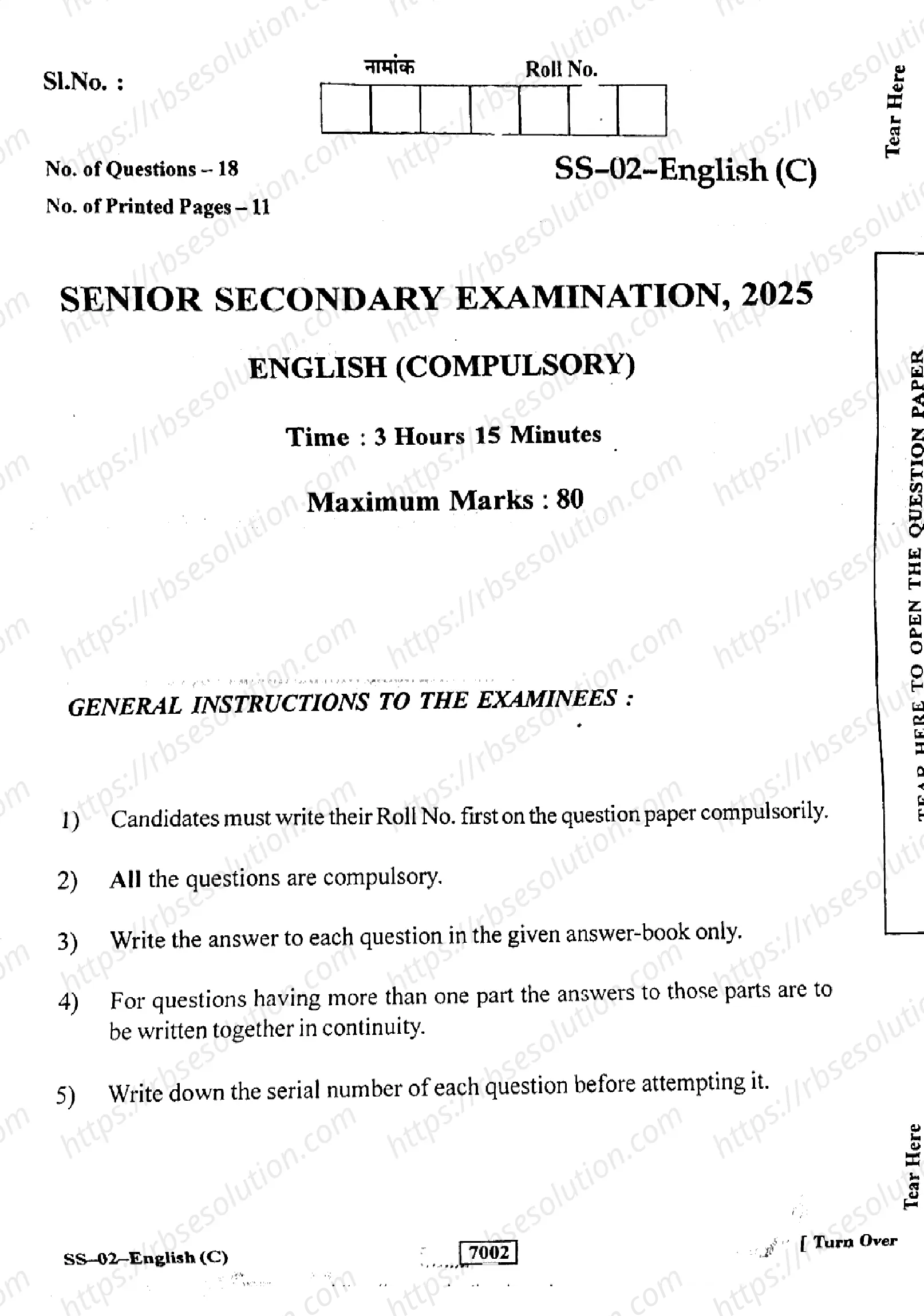


Rajasthan Board Class 12th English-SS-02-2025 2025 solved Previous Year Question Papers
SENIOR SECONDARY EXAMINATION, 2025
ENGLISH (COMPULSORY)
Time: 3 Hours 5 Minutes | Maximum Marks: 80
No. of Questions: 8 | No. of Printed Pages: 1
Roll No.: ____________________
GENERAL INSTRUCTIONS TO THE EXAMINEES:
- Candidates must write their Roll No. first on the question paper compulsorily.
- All the questions are compulsory.
- Write the answer to each question in the given answer-book only.
- For questions having more than one part, the answers to those parts are to be written together in continuity.
- Write down the serial number of each question before attempting it.
SS-02-English (C) [7002] | [Turn Over
SECTION-A
1. Read the following passage carefully and answer the questions that follow: [9×1=9]
The bus rolled in through the gates and crunched on the gravel. It was always the familiar crunch that told him they were in. They broke up and jumped out with their bags and boxes, and outside, as he stood waiting for the rest to come down, the morning hill air felt good and smelt cool, clean and fresh, and the birds were chirping in the row of trees that ran along the gravel way. When the last boy was out, the bus rolled out of the gates again and they crunched along the gravel toward the stone entry porch.
As they went in, someone observed, ‘Why, today’s Saturday! Always like Saturday because the next day is Sunday. Don’t you?’ He answered, ‘Yes!’. He thought, Saturday; no day like it. Even class on Saturday was not as bad as on other days and everyone, including the teacher, seemed happier with the prospect of the evening and the morrow.
For him, it was mainly the evening and fun at home with his mother – he had lost his father. On other days there was always homework to do and dinner to prepare. But on Saturday they both were free; he did only a little of the homework; and his mother finished cooking early. Saturday evening meant a lot to him. And then there was, of course, the matinee on Sunday, about the only excitement of a rather quiet day.
They passed the dining room. The boarders were at breakfast and they could hear the boys talking and the clatter of plates and knives, forks, spoons, cups and saucers. There was such a noise. ‘They’re having plantains this morning’, Peter said, creeping up to one of the entrances, ‘Hey, Whisky! Let’s have a plantain’, he called out to the boy sitting at the table nearest to him. ‘Whisky’ scowled, but on second thoughts threw him a skin. It looked so funny that all laughed.
Questions:
-
(i) Which was the familiar crunch?
The familiar crunch was the sound of the bus rolling on the gravel when it entered through the gates.
-
(ii) Who jumped out from the bus?
The boys (the students) jumped out from the bus with their bags and boxes.
Reading Comprehension
Passage 1 (Unseen)
Read the passage carefully and answer the questions that follow:
The habit of reading is one of the greatest resources of mankind; and we enjoy reading books that belong to us much more than if they are borrowed. A borrowed book is like a guest in the house; it must be treated with punctiliousness, with a certain considerate formality. You must see that it sustains no damage; it must not suffer while under your roof. You cannot leave it carelessly, you cannot mark it, you cannot turn down the pages, you cannot use it familiarly. And then, someday, although this is seldom done, you really ought to return it.
But your own books belong to you; you treat them with that affectionate intimacy that annihilates formality. Books are for use, not for show; you should own no book that you are afraid to mark up, or afraid to place on the table, wide open and face down. A good reason for marking favourite passages in books is that this practice enables you to remember more easily the significant sayings, to refer to them quickly, and then in later years, it is like visiting a forest where you once blazed a trail. You have the pleasure of going over the old ground, and recalling both the intellectual scenery and your own earlier self.
Questions:
-
Why did Sunday seem happier to everyone?
Note: This question does not relate to the given passage. The passage discusses the habit of reading and the difference between borrowed and owned books.
-
Who used to be free on Saturday?
Note: This question does not relate to the given passage.
-
What did Peter say?
Note: This question does not relate to the given passage.
-
About whom did the narrator state in this passage?
The narrator states about the reader and the relationship one has with books—both borrowed and owned.
-
Find out the word from the passage which is opposite in meaning to 'Yesterday'.
The word opposite in meaning to 'Yesterday' is "later years" (referring to future time).
-
Find out the word from the passage which is similar in meaning to 'Banana'.
There is no word in the passage that is similar in meaning to 'Banana'.
-
Find out the word from the passage which is similar in meaning to 'Primarily'.
The word similar in meaning to 'Primarily' is "greatest" (as in "one of the greatest resources").
Questions
- Which is one of the greatest resources of mankind? [2]
- What thing is like a guest in the house? [1]
- Is it good to mark the favourite passages? [4]
- What is the best of mural decorations? [1]
- How many books were in the narrator’s room? [1]
- How should a borrowed book be treated? [7]
SECTION - B
3. You are Mohit/Monika living in Jaipur. You are searching a groom for your sister. Draft an advertisement for a newspaper to advertise in classified column. [4]
Advertisement:
GROOM WANTED
Alliance invited for a smart, educated, beautiful girl, 25 years, B.Tech, working in a reputed company. Groom should be well-settled, handsome, and from a respectable family. Caste no bar. Contact: Mohit/Monika, Jaipur. Phone: 9XXXXXXXXX.
OR
You are Pawan/Pooja, a student of Class XII. Write your opinion in favour of ‘Women Education’.
Opinion in favour of Women Education:
Women education is the foundation of a progressive society. Educated women contribute to the economic growth of the nation, improve family health, and ensure better upbringing of children. They become independent and can make informed decisions. In today’s world, no country can achieve true development without educating its women. Therefore, I strongly support women education as it empowers half of the population and leads to a balanced and prosperous society.
4.
Write a report in about 100 words for the school magazine using the given hints and your experience:
“An Educational Tour to Jaipur”
Our school organised an educational tour to Jaipur on 15th October 2024, a bright Monday morning. We travelled by a comfortable bus, accompanied by 40 students and two teachers. Our guide, Mr. Sharma, was very knowledgeable. We visited the Hawa Mahal, City Palace, Jantar Mantar, and the Albert Hall Museum. The historical and architectural importance of these places was explained in detail. The trip was both fun and educational, giving us a practical understanding of our history and culture. It was a memorable experience for all of us.
OR
Write a paragraph in about 100 words:
“Benefits of Morning Walk”
A morning walk is a simple yet powerful exercise. It refreshes the mind and body. Walking in the fresh morning air improves blood circulation, strengthens the heart, and boosts immunity. It also helps in maintaining a healthy weight and reducing stress. The peaceful environment of the morning enhances mental clarity and positivity. Regular morning walk keeps us active throughout the day and promotes better sleep at night. It is a habit that costs nothing but gives immense health benefits. Everyone, young and old, should make it a part of their daily routine.
Write a letter to the Editor of a local daily newspaper to draw the attention of authorities about the street lights that are not in working condition for many days in your locality Ganesh Nagar, Jaipur.
To,
The Editor,
The Times of India,
Jaipur.
Subject: Non-functional street lights in Ganesh Nagar
Sir,
Through the columns of your esteemed newspaper, I wish to draw the attention of the concerned authorities towards the street lights in Ganesh Nagar, Jaipur. For the past many days, most of the street lights in our locality are not working. This has created a lot of inconvenience for the residents, especially for women and senior citizens who find it difficult to move around after dark. The darkness also increases the risk of accidents and theft. I request the municipal authorities to repair the street lights at the earliest.
Thanking you,
Yours faithfully,
Ravi Sharma
Ganesh Nagar, Jaipur
OR
Write a job application for the post of a manager in ‘Bal Vikas Samiti’ Jaipur, and attach your C.V.
To,
The Secretary,
Bal Vikas Samiti,
Jaipur.
Subject: Application for the post of Manager
Sir,
With reference to your advertisement published in Dainik Bhaskar, I wish to apply for the post of Manager in your esteemed organisation. I have completed my MBA in Human Resource Management and have three years of experience in managing teams and projects. I am confident that my skills and dedication will contribute to the growth of Bal Vikas Samiti. My CV is attached for your kind consideration.
Thanking you,
Yours faithfully,
Amit Singh
Jaipur
Curriculum Vitae
- Name: Amit Singh
- Father’s Name: Mr. Suresh Singh
- Date of Birth: 15th March 1995
- Educational Qualifications: MBA (HRM), B.Com
- Experience: 3 years as Assistant Manager in XYZ Pvt. Ltd.
- Skills: Leadership, Communication, Team Management
- Languages Known: Hindi, English
- Address: 123, Ganesh Nagar, Jaipur
SECTION-C
Join the following sentences using the word given in bracket:
I have found the pen. I lost the pen. (Which)
Answer: I have found the pen which I lost.
Combine set of sentences into one sentence as directed:
Night came on. The room grew dark. (Make a compound sentence)
Answer: Night came on and the room grew dark.
SECTION-D
8. Fill in the blanks by choosing the correct phrasal verbs given in the brackets:
- The burglars broke into the house. (broke into/broke down)
- He gets up early in the morning. (gets up/gets under)
- He put off his departure for a week. (put on/put off)
9. Fill in the blanks by choosing the correct conjunctions given in brackets:
- Birds fly and fish swim. (so/and)
- He was sleeping while I was reading a book. (while/as)
- Raju is not only an intelligent boy but also a good player. (as-as/not only-but also)
SECTION-D
20. Read the passage and answer the questions that follow:
Gandhi did not leave. Instead he proceeded to Motihari, the capital of Champaran. Several lawyers accompanied him. At the railway station, a vast multitude greeted Gandhi. He went to a house and using it as headquarters, continued his investigations. A report came in that a peasant had been maltreated in a nearby village. Gandhi decided to go and see; the next morning he started out on the back of an elephant. He had not proceeded far when the police superintendent's messenger overtook him and ordered him to return to town in his carriage.
Questions:
-
Capital of Champaran was:
- (A) Muzzafarpur
- (B) Calcutta
- (C) Motihari
- (D) Tirhut
Explanation: The passage clearly states, "Gandhi did not leave. Instead he proceeded to Motihari, the capital of Champaran." Hence, Motihari is the correct answer.
Multiple Choice Questions
-
Where did a vast multitude greet Gandhi?
- (A) at the village
- (B) at the railway station
- (C) at the house
- (D) at the headquarter
Explanation: The vast multitude greeted Gandhi at the railway station when he arrived.
-
Who had been maltreated?
- (A) a peasant
- (B) a lawyer
- (C) Gandhi
- (D) messenger
Explanation: A peasant had been maltreated, which led to Gandhi's involvement.
-
Who started out on the back of an elephant?
- (A) Messenger
- (B) A lawyer
- (C) Superintendent
- (D) Gandhi
Explanation: The Superintendent started out on the back of an elephant to meet Gandhi.
-
Which place Gandhi used as his headquarters?
- (A) railway station
- (B) a house
- (C) townhall
- (D) superintendent’s office
Explanation: Gandhi used the superintendent's office as his headquarters during the events.
-
Who ordered Gandhi to return to town?
- (A) Superintendent’s messenger
- (B) Lawyers
- (C) Villagers
- (D) Policeman
Explanation: The Superintendent's messenger ordered Gandhi to return to town.
Answer any one of the following questions in about 60 words. (3)
(The Last Lesson)
Describe M. Hamel.
M. Hamel was a dedicated and strict French teacher who had taught for 40 years. On the day of the last lesson, he was dressed in his fine Sunday clothes. He was patient, kind, and emotional. He regretted not teaching his students more sincerely and blamed everyone for neglecting their language. He wanted to teach them everything in one go. He was a true patriot who loved his language and country deeply.
OR
Describe the Rattrap seller. (The Rattrap)
The rattrap seller was a poor, homeless vagabond who wandered from place to place selling small rattraps made of wire. He was lonely and had a pessimistic view of the world, comparing it to a giant rattrap that tempts people with riches and comforts. Despite his poverty, he was kind-hearted and honest. He was transformed by the kindness of the ironmaster's daughter, Edla, who treated him with respect and compassion.
Answer the following questions in 20-30 words:
| Question | Answer |
|---|---|
| i) What did happen when the narrator started down a third time? (Deep Water) [2] |
When the narrator went down a third time, he was completely exhausted and had given up all hope. He saw a ring of light above him and thought he would drown. However, his legs hit something solid, and he pushed himself up to the surface. |
| ii) What was Saheb's full name and what was the meaning of his name? (Lost Spring) [2] |
Saheb's full name was Saheb-e-Alam, which means "Lord of the Universe." Ironically, he was a poor ragpicker who had no home or proper food, living a life completely opposite to the meaning of his name. |
Explain any one of the following stanzas with reference to the context: [5]
Stanza 1
The little old house was out with a little new shed
In front at the edge of the road where the traffic sped
A roadside stand that too pathetically pled,
It would not be fair to say for a dole of bread,
But for some of the money, the cash, whose flow supports
The flower of cities from sinking and withering faint.
Reference: These lines are from the poem "A Roadside Stand" by Robert Frost.
Context: The poet describes a poor farmer's family who has set up a small roadside stand near their old house, hoping to sell their farm produce to passing city people.
Explanation: The little old house has a new shed in front, right at the edge of the road where traffic speeds by. The roadside stand is described as "pathetically pled" because it desperately appeals for customers. The poet clarifies that the family is not begging for bread (charity) but wants to earn money through honest trade. They need cash to survive, just as cities need money from rural areas to flourish. The poet criticizes the urban exploitation of rural people who are ignored by the city dwellers speeding past.
OR
Stanza 2
Perhaps the Earth can teach us
as when everything seems dead
and later proves to be alive.
Now I'll count up to twelve
and you keep quiet and I will go.
Reference: These lines are from the poem "Keeping Quiet" by Pablo Neruda.
Context: The poet urges humanity to pause and be silent for a moment to introspect and understand the value of life and peace.
Explanation: The poet suggests that we can learn from the Earth. Even in winter, when everything appears dead and lifeless, the Earth later proves to be alive with new growth in spring. This teaches us that apparent stillness or silence does not mean death; it can be a period of renewal and preparation. The poet then says he will count up to twelve (representing hours or months) and asks everyone to keep quiet. He will then go, implying that this moment of silence should be a voluntary, peaceful act that can lead to a better understanding of ourselves and the world.
4. Answer the following questions in about 60 words : [3]
Write the theme of the poem ‘My Mother at Sixty-Six’.
The poem 'My Mother at Sixty-Six' by Kamala Das explores the theme of aging and the fear of losing a parent. The poet realizes her mother's old age and frailty during a car ride to the airport. She compares her mother's pale, wan face to a corpse, evoking a sense of helplessness and sorrow. Despite the pain, she tries to hide her emotions and smiles, showing the universal human struggle to accept the inevitable passage of time and the loss of loved ones.
OR
Write the theme of the poem ‘A Roadside Stand’.
The poem 'A Roadside Stand' by Robert Frost highlights the plight of poor, rural people who set up small roadside stands to earn a living. It criticizes the indifference of city dwellers and the wealthy, who pass by without stopping to help. The poet sympathizes with the helplessness of the villagers, who are exploited and ignored by a society that prioritizes progress over humanity. The theme is the harsh reality of economic inequality and the lack of compassion for the underprivileged.
5. Answer the following questions in about 20-30 words :
i) List the things of beauty mentioned in the poem. (A Thing of Beauty) [2]
The things of beauty mentioned are the sun, the moon, trees old and young, daffodils, clear streams, musk-rose blooms, and the tales of mighty heroes. These provide joy and solace to the human soul.
ii) Why were Aunt Jennifer's fingers fluttering? (Aunt Jennifer's Tigers) [2]
Aunt Jennifer's fingers were fluttering because she was old and weak, and also because she was nervous and oppressed by her domineering husband. The weight of her wedding ring symbolized the burden of her unhappy marriage.
6. Answer the following questions in about 60 words : [3]
Why did the narrator imagine the third level? (The Third Level)
The narrator, Charley, imagined the third level at Grand Central Station as an escape from the stress and anxiety of modern life. He was overwhelmed by the pressures of the contemporary world, including war threats and insecurity. The third level represented a peaceful, simpler time in the past (1894). It was a psychological refuge, a product of his desire to find a world free from tension and fear.
OR
Why did the narrator fall about with laughter? (We too are human beings / Memories of Childhood)
The narrator (Zitkala-Sa) fell about with laughter when she saw the other Native American children being forced to have their long hair cut. The scene of them being shingled like prisoners seemed absurd and funny to her at first. However, her laughter soon turned to fear when she realized she would be next, and she hid under a bed to avoid the same fate.
7. Answer the following questions in about 20-30 words :
i) Why did Derry want to go to meet Mr. Lamb second time? (On The Face of It) [2]
Derry wanted to meet Mr. Lamb again because he felt accepted and understood by him. Mr. Lamb's positive attitude and encouragement gave Derry confidence and made him feel that his burnt face did not define him. He wanted to experience that sense of belonging again.
ii) Do you agree with Sadao's act? Explain. (The Enemy) [2]
Yes, I agree with Sadao's act. As a doctor, his first duty was to save a life, regardless of nationality. He showed humanity and compassion by treating the American prisoner of war, even though it was risky. His act highlights that universal human values should transcend war and national boundaries.
Choose the correct alternative:
-
Who was Louisa?
- (A) Narrator’s wife
- (B) Sam’s wife
- (C) Garfield’s wife
- (D) None
Correct Answer: (B) Sam’s wife
Explanation: In the story, Louisa is the wife of Sam, the narrator's friend.
-
How many rings were sent to ‘Duraisani’?
- (A) 40
- (B) 50
- (C) 60
- (D) 30
Correct Answer: (C) 60
Explanation: According to the text, sixty rings were sent to Duraisani.
-
For how many years Gondwana thrived?
- (A) 656 million
- (B) 500 million
- (C) 600 million
- (D) 550 million
Correct Answer: (A) 656 million
Explanation: Gondwana, the ancient supercontinent, existed for about 656 million years.
-
The name of the Russian research vessel was:
- (A) Academic Shockalsky
- (B) Ecademic Shokalsky
- (C) Akademik Shokalskiy
- (D) None
Correct Answer: (C) Akademik Shokalskiy
Explanation: The Russian research vessel mentioned in the text is the Akademik Shokalskiy.
-
What was the full name of Sadao?
- (A) Dr. Sadao
- (B) Dr. Sadao Honi
- (C) Dr. Sadao Hoki
- (D) Dr. Sadao Hanki
Correct Answer: (C) Dr. Sadao Hoki
Explanation: The full name of the Japanese surgeon in the story is Dr. Sadao Hoki.
Page 10 of 11
Multiple Choice Questions
-
Hanna’s baby boy was nearly:
- (A) three years old
- (B) three weeks old
- (C) three days old
- (D) three months old
Explanation: In the story, Hanna’s baby boy is described as being nearly three months old.
-
Who forbade Derry to go to the garden again?
- (A) Mr. Lamb
- (B) Derry’s father
- (C) Derry’s uncle
- (D) Derry’s mother
Explanation: Derry’s mother forbade him to go to the garden again because she was worried about his safety and the influence of Mr. Lamb.
-
Who was Judewin?
- (A) Bala’s friend
- (B) Zitkala-Sa’s friend
- (C) Bala’s mother
- (D) Zitkala’s mother
Explanation: Judewin was Zitkala-Sa’s friend who helped her understand the ways of the boarding school.
-
What is ‘Vadais’?
- (A) a song
- (B) a story
- (C) an eating stuff
- (D) a man
Explanation: ‘Vadais’ refers to a type of food item (an eating stuff) in the context of the lesson.