
RBSE Class 12th 2026 HALF-YEARLY-BUSINESS-STUDIES-1225 Previous Year Papers
HALF-YEARLY-BUSINESS-STUDIES-1225 from the 2026 exam year is part of the Class 12th previous year papers archive on RBSE Solution. Many learners start here after finishing the textbook to see how questions were actually framed on the Rajasthan Board of Secondary Education (RBSE) paper.
Treat this question paper as a mock under gentle timing first, then as a marking exercise the second time. The introduction on this page is written only for this subject-and-year pair, not copied from other pages.
Bookmark the link if you coach juniors — the layout stays stable for search engines and classroom sharing.
Paper details
Quick reference for this previous year papers page — confirm board, class, and year & subject before you study.
| Board | RBSE |
|---|---|
| Class | Class 12th |
| Exam year | 2026 |
| Subject | HALF-YEARLY-BUSINESS-STUDIES-1225 |
| Resource type | Previous Year Papers |
| Category | RBSE Previous Year Question Papers |
| Website | RBSE Solution |
The table summarises this Previous Year Papers resource. Confirm RBSE, Class 12th, year 2026, and subject HALF-YEARLY-BUSINESS-STUDIES-1225 before studying.
RBSE Solution organises previous year papers so each URL carries chapter-specific guidance — better for students and for search engines than one generic paragraph for the whole class.
Turning 2026 papers into insight
One HALF-YEARLY-BUSINESS-STUDIES-1225 paper reveals style; several from the same year reveal pattern. After this page, open sibling subjects listed below to see whether marks cluster in certain units.
Keep rough work dated in your notebook. Examiners in Class 12th expect clear numbering even in practice sessions.
RBSE Class 12th 2026 HALF-YEARLY-BUSINESS-STUDIES-1225
Scroll through the Previous Year Papers pages for HALF-YEARLY-BUSINESS-STUDIES-1225 (2026).
Rajasthan Board Class 12th HALF-YEARLY-BUSINESS-STUDIES-1225 2026 solved Previous Year Question Papers
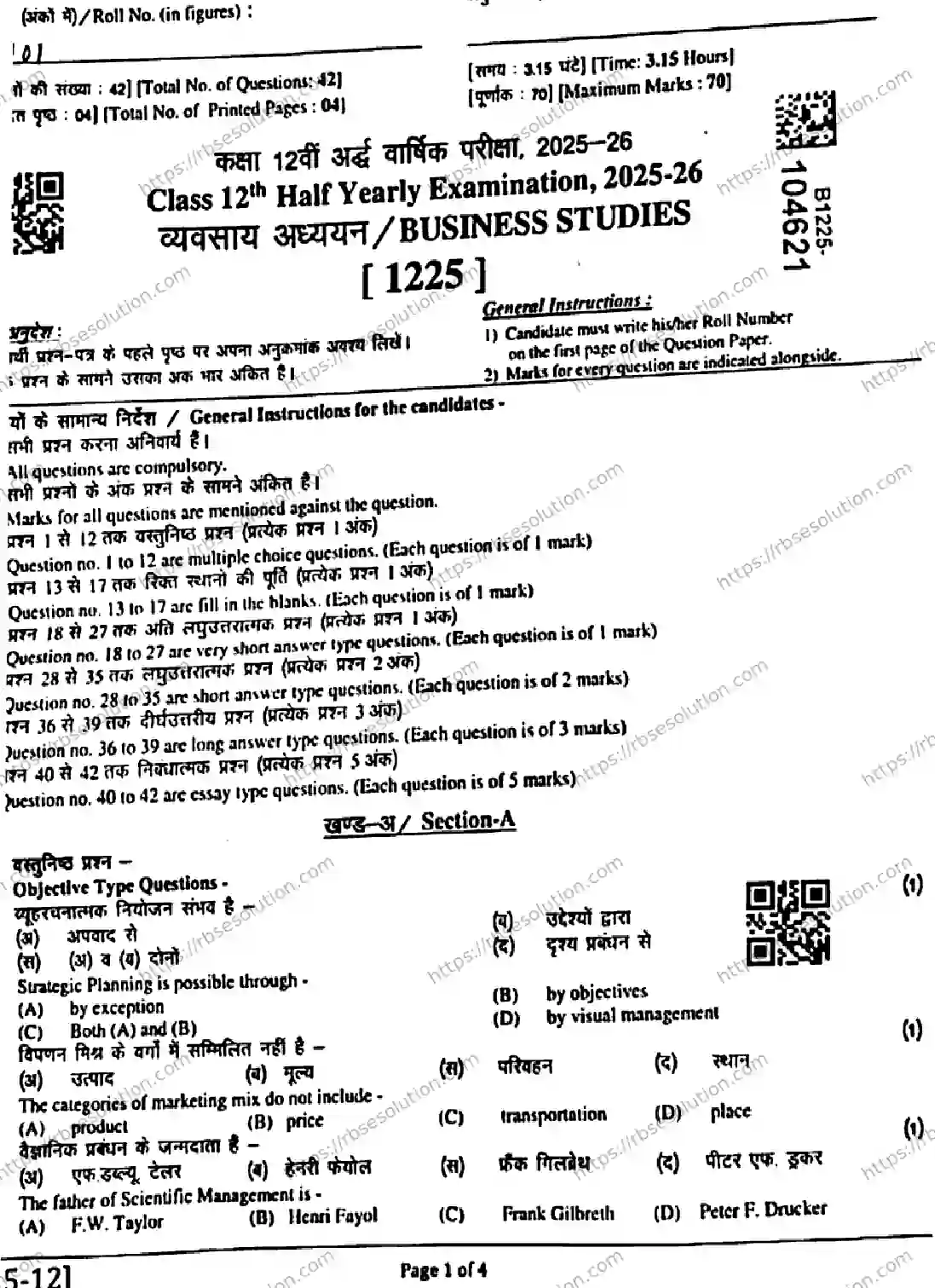
कक्षा 12वीं अर्द्ध वार्षिक परीक्षा, 2025-26
Class 12th Half Yearly Examination, 2025-26
व्यवसाय अध्ययन / BUSINESS STUDIES [0225]
Roll No. (in figures): _______________ Total No. of Questions: 42 Time: 3.45 Hours Total No. of Printed Pages: 04 Maximum Marks: 70
सामान्य निर्देश / General Instructions for the candidates:
- सभी प्रश्न करना अनिवार्य हैं। / All questions are compulsory.
- सभी प्रश्नों के अंक प्रश्न के सामने अंकित हैं। / Marks for all questions are mentioned against the question.
- प्रश्न 1 से 17 तक वस्तुनिष्ठ प्रश्न (प्रत्येक प्रश्न 1 अंक) / Question no. 1 to 17 are objective type questions. (Each question is of 1 mark)
- प्रश्न 18 से 27 तक अति लघुउत्तरात्मक प्रश्न (प्रत्येक प्रश्न 1 अंक) / Question no. 18 to 27 are very short answer type questions. (Each question is of 1 mark)
- प्रश्न 28 से 35 तक लघुउत्तरात्मक प्रश्न (प्रत्येक प्रश्न 2 अंक) / Question no. 28 to 35 are short answer type questions. (Each question is of 2 marks)
- प्रश्न 36 से 39 तक दीर्घउत्तरीय प्रश्न (प्रत्येक प्रश्न 3 अंक) / Question no. 36 to 39 are long answer type questions. (Each question is of 3 marks)
- प्रश्न 40 से 42 तक निबंधात्मक प्रश्न (प्रत्येक प्रश्न 5 अंक) / Question no. 40 to 42 are essay type questions. (Each question is of 5 marks)
खण्ड-अ / Section-A
Objective Type Questions
-
सामरिक (स्ट्रैटेजिक) नियोजन संभव है –
(अ) अपवाद द्वारा (ब) उद्देश्यों द्वारा (स) (अ) व (ब) दोनों (द) दृश्य प्रबंधन सेStrategic Planning is possible through –
(A) Management by Exception (B) Management by Objectives (C) Both (A) and (B) (D) Management by Sightसही उत्तर / Correct Answer: (स) (अ) व (ब) दोनों / (C) Both (A) and (B)
व्याख्या: सामरिक नियोजन में अपवाद द्वारा प्रबंधन (Management by Exception) और उद्देश्यों द्वारा प्रबंधन (Management by Objectives) दोनों का उपयोग किया जा सकता है।
-
विपणन मिश्र के वर्गों में सम्मिलित नहीं है –
(अ) उत्पाद (ब) मूल्य (स) परिवहन (द) स्थानThe categories of marketing mix do not include –
(A) Product (B) Price (C) Transportation (D) Placeसही उत्तर / Correct Answer: (स) परिवहन / (C) Transportation
व्याख्या: विपणन मिश्र के चार मुख्य वर्ग हैं: उत्पाद (Product), मूल्य (Price), स्थान (Place), और प्रचार (Promotion)। परिवहन (Transportation) इसमें शामिल नहीं है, बल्कि यह स्थान (Place) का एक भाग हो सकता है।
-
वैज्ञानिक प्रबंधन के जन्मदाता हैं –
(अ) एफ.डब्ल्यू. टेलर (ब) हेनरी फेयोल (स) फ्रैंक गिलब्रेथ (द) पीटर एफ. ड्रकरThe father of Scientific Management is –
(A) F.W. Taylor (B) Henri Fayol (C) Frank Gilbreth (D) Peter F. Druckerसही उत्तर / Correct Answer: (अ) एफ.डब्ल्यू. टेलर / (A) F.W. Taylor
व्याख्या: एफ.डब्ल्यू. टेलर (F.W. Taylor) को वैज्ञानिक प्रबंधन (Scientific Management) का जनक माना जाता है। उन्होंने कार्य कुशलता बढ़ाने के लिए वैज्ञानिक सिद्धांतों का प्रतिपादन किया।
c.47] Page 1 of 4
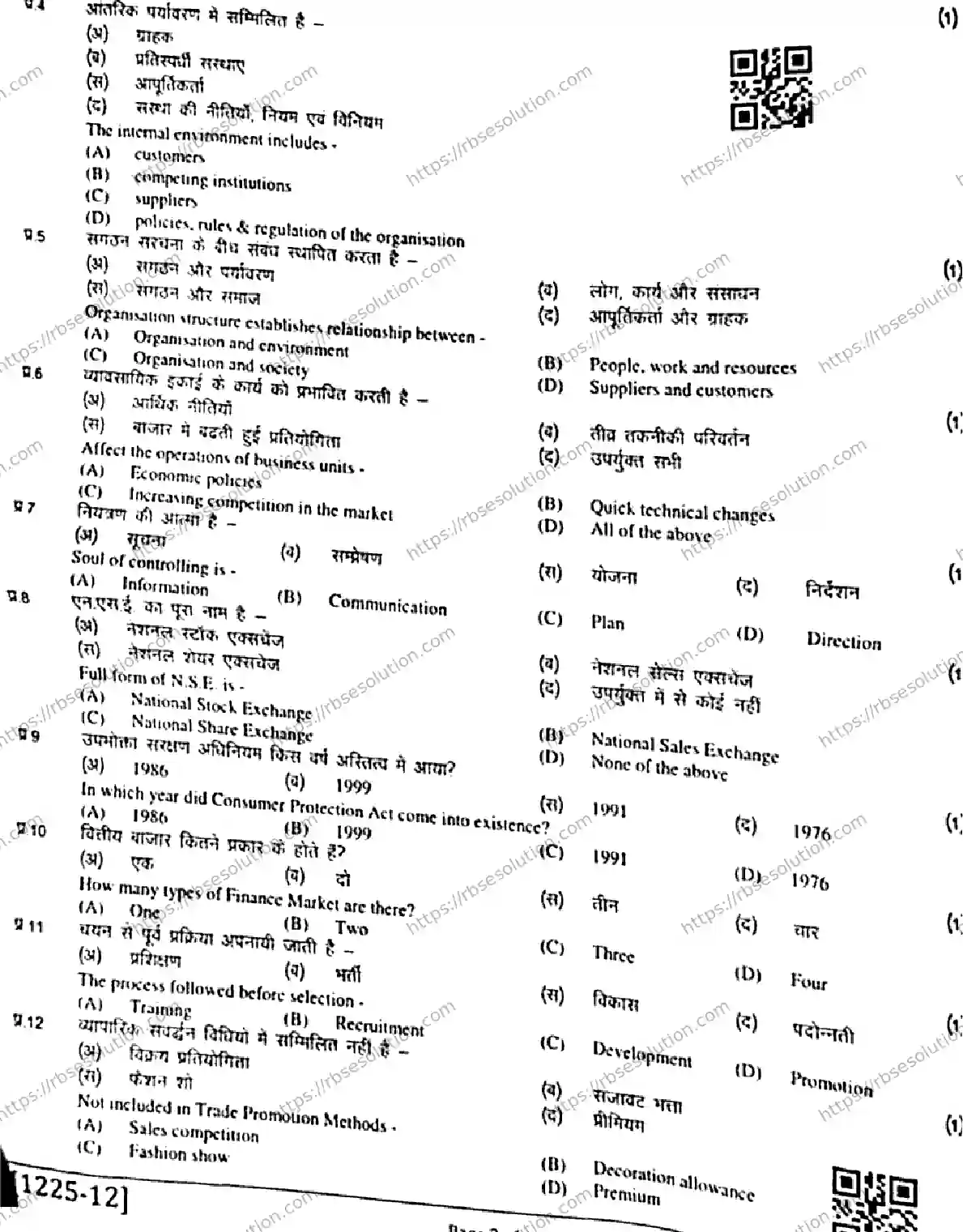
आतंरिक पर्यावरण में सम्मिलित है -
The internal environment includes -
- (अ) ग्राहक / Customers
- (ब) प्रतिस्पर्धी संस्थाएँ / Competing institutions
- (स) आपूर्तिकर्ता / Suppliers
- (द) संगठन की नीतियों, नियम एवं विनियम / Policies, rules & regulation of the Organisation
सही उत्तर: (द) संगठन की नीतियों, नियम एवं विनियम
व्याख्या: आंतरिक पर्यावरण में वे कारक शामिल होते हैं जो संगठन के नियंत्रण में होते हैं, जैसे नीतियां, नियम, संसाधन आदि। ग्राहक, प्रतिस्पर्धी और आपूर्तिकर्ता बाह्य पर्यावरण के भाग हैं।
संगठन संरचना संबंध स्थापित करती है -
Organisation structure establishes relationship between -
- (अ) संगठन और पर्यावरण / Organisation and environment
- (ब) लोग, कार्य और संसाधन / People, work and resources
- (स) संगठन और समाज / Organisation and society
- (द) आपूर्तिकर्ता और ग्राहक / Suppliers and customers
सही उत्तर: (ब) लोग, कार्य और संसाधन
व्याख्या: संगठन संरचना लोगों, उनके कार्यों और संसाधनों के बीच संबंध स्थापित करती है ताकि कार्य कुशलतापूर्वक पूरे हो सकें।
व्यावसायिक इकाई के कार्य को प्रभावित करती है -
Affect the operations of business units -
- (अ) आर्थिक नीतियाँ / Economic policies
- (ब) तीव्र तकनीकी परिवर्तन / Quick technical changes
- (स) बाजार में बढ़ती हुई प्रतियोगिता / Increasing competition in the market
- (द) उपर्युक्त सभी / All of the above
सही उत्तर: (द) उपर्युक्त सभी
व्याख्या: आर्थिक नीतियाँ, तकनीकी परिवर्तन और बाजार प्रतियोगिता सभी बाह्य कारक हैं जो व्यावसायिक इकाई के संचालन को प्रभावित करते हैं।
नियंत्रण की आत्मा है -
Soul of controlling is -
- (अ) सूचना / Information
- (ब) संचार / Communication
- (स) योजना / Plan
- (द) निर्देशन / Direction
सही उत्तर: (ब) संचार
व्याख्या: नियंत्रण प्रक्रिया में संचार आवश्यक है क्योंकि इसके माध्यम से मानकों, वास्तविक प्रदर्शन और सुधारात्मक कार्रवाई की जानकारी प्रवाहित होती है।
एनएसई का पूरा नाम है -
Full form of NSE is -
- (अ) नेशनल स्टॉक एक्सचेंज / National Stock Exchange
- (ब) नेशनल सेल्स एक्सचेंज / National Sales Exchange
- (स) नेशनल शेयर एक्सचेंज / National Share Exchange
- (द) उपर्युक्त में से कोई नहीं / None of the above
सही उत्तर: (अ) नेशनल स्टॉक एक्सचेंज
व्याख्या: NSE का पूरा नाम National Stock Exchange (नेशनल स्टॉक एक्सचेंज) है, जो भारत का प्रमुख शेयर बाजार है।
उपभोक्ता संरक्षण अधिनियम किस वर्ष अस्तित्व में आया?
In which year did Consumer Protection Act come into existence?
- (अ) 1986
- (ब) 1999
- (स) 1991
- (द) 1997
सही उत्तर: (अ) 1986
व्याख्या: उपभोक्ता संरक्षण अधिनियम 1986 में लागू हुआ था, जिसे बाद में 2019 में नए अधिनियम द्वारा प्रतिस्थापित किया गया।
वित्तीय बाजार कितने प्रकार के होते हैं?
How many types of Financial Market are there?
- (अ) एक / One
- (ब) दो / Two
- (स) तीन / Three
- (द) चार / Four
सही उत्तर: (ब) दो
व्याख्या: वित्तीय बाजार दो प्रकार के होते हैं - मुद्रा बाजार (Money Market) और पूंजी बाजार (Capital Market)।
चयन से पूर्व प्रक्रिया अपनायी जाती है -
The process followed before selection -
- (अ) प्रशिक्षण / Training
- (ब) भर्ती / Recruitment
- (स) विकास / Development
- (द) पदोन्नति / Promotion
सही उत्तर: (ब) भर्ती
व्याख्या: चयन प्रक्रिया से पहले भर्ती (Recruitment) की जाती है, जिसमें आवेदकों को आकर्षित किया जाता है। चयन उसके बाद होता है।
व्यापारिक प्रोत्साहन विधियों में सम्मिलित नहीं है -
Not included in Trade Promotion Methods -
- (अ) विक्रय प्रतियोगिता / Sales Competition
- (ब) सजावट भत्ता / Decoration Allowance
- (स) फैशन शो / Fashion Show
- (द) प्रीमियम / Premium
सही उत्तर: (स) फैशन शो
व्याख्या: फैशन शो एक विज्ञापन या प्रचार विधि है, जबकि विक्रय प्रतियोगिता, सजावट भत्ता और प्रीमियम व्यापारिक प्रोत्साहन (Sales Promotion) के अंतर्गत आते हैं।
खण्ड-अ / Section-A
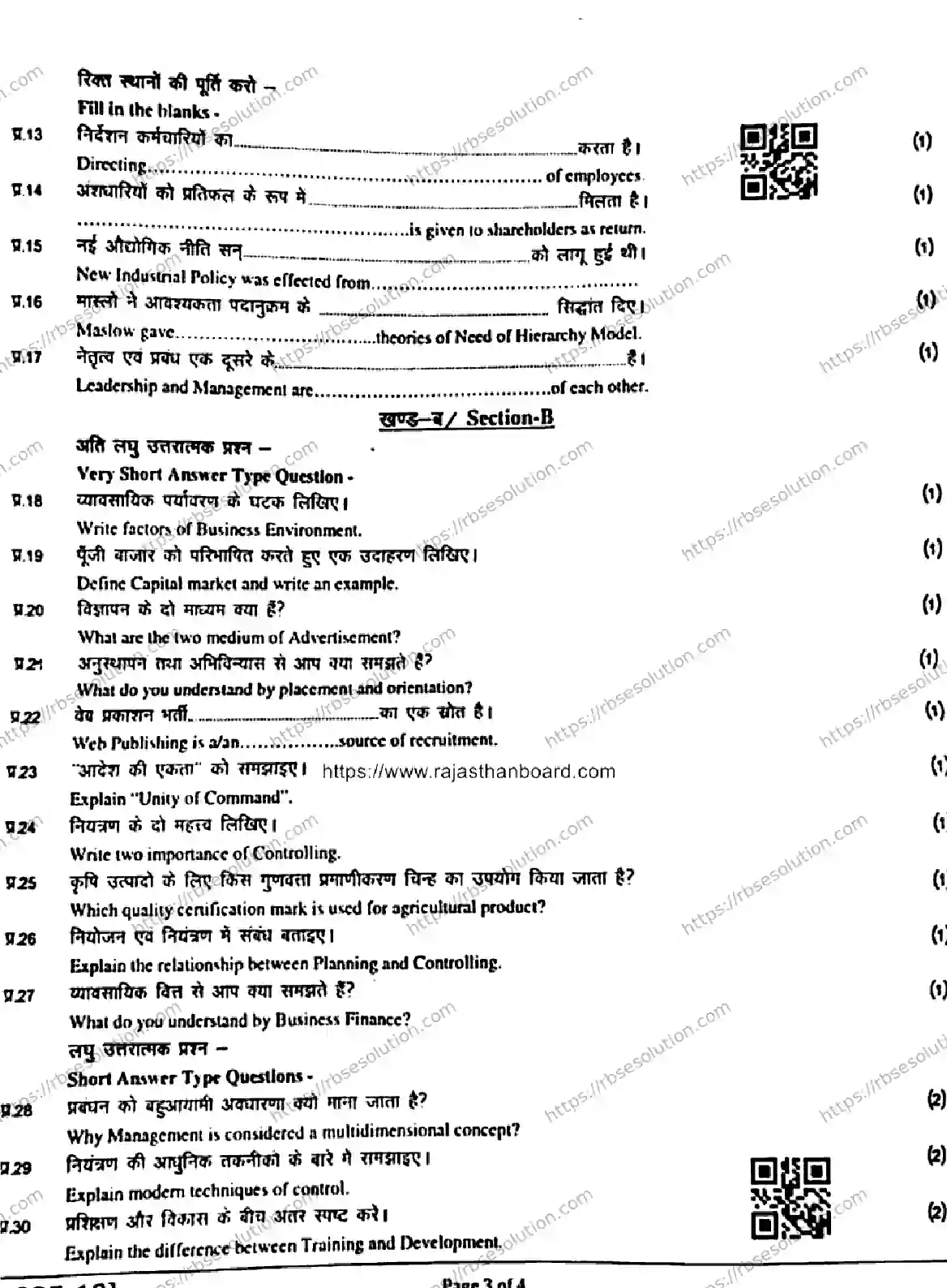
रिक्त स्थानों की पूर्ति करो — Fill in the blanks:
- नई औद्योगिक नीति ______ से प्रभावी हुई।
New Industrial Policy was effected from ______. - मास्लो के अनुसार आवश्यकता ______ है।
According to Maslow, need is ______. - नेतृत्व एवं प्रबंध एक दूसरे ______ हैं।
Leadership and Management are ______.
खण्ड-ब / Section-B
अति लघु उत्तरात्मक प्रश्न — Very Short Answer Type Questions:
-
व्यावसायिक पर्यावरण के घटक लिखिए।
Write factors of Business Environment.उत्तर: व्यावसायिक पर्यावरण के घटक हैं — आर्थिक पर्यावरण, सामाजिक-सांस्कृतिक पर्यावरण, राजनीतिक-कानूनी पर्यावरण, तकनीकी पर्यावरण, और प्राकृतिक पर्यावरण।
Answer: Factors of Business Environment include Economic Environment, Social-Cultural Environment, Political-Legal Environment, Technological Environment, and Natural Environment.
-
पूँजी बाजार को परिभाषित करते हुए एक उदाहरण लिखिए।
Define Capital market and write an example.उत्तर: पूँजी बाजार वह बाजार है जहाँ दीर्घकालिक वित्तीय साधनों (जैसे शेयर, डिबेंचर) का क्रय-विक्रय होता है। उदाहरण: स्टॉक एक्सचेंज (जैसे BSE, NSE)।
Answer: Capital market is a market where long-term financial instruments (like shares, debentures) are bought and sold. Example: Stock Exchange (e.g., BSE, NSE).
-
विज्ञापन के दो माध्यम क्या हैं?
What are the two mediums of Advertisement?उत्तर: विज्ञापन के दो माध्यम हैं — (1) प्रिंट माध्यम (समाचार पत्र, पत्रिकाएँ) और (2) इलेक्ट्रॉनिक माध्यम (टेलीविजन, रेडियो, इंटरनेट)।
Answer: Two mediums of advertisement are: (1) Print media (newspapers, magazines) and (2) Electronic media (television, radio, internet).
-
अनुस्थापन तथा अभिविन्यास से आप क्या समझते हैं?
What do you understand by placement and orientation?उत्तर: अनुस्थापन (Placement) का अर्थ है कर्मचारी को उसकी योग्यता के अनुसार उपयुक्त पद पर नियुक्त करना। अभिविन्यास (Orientation) का अर्थ है नए कर्मचारी को संगठन, उसके नियमों और कार्य संस्कृति से परिचित कराना।
Answer: Placement means assigning an employee to a suitable position based on their qualifications. Orientation means introducing a new employee to the organization, its rules, and work culture.
-
वेब प्रकाशन एक ______ है।
Web Publishing is a/an ______.उत्तर: वेब प्रकाशन एक डिजिटल माध्यम है। (Web Publishing is a digital medium.)
-
"आदेश की एकता" को समझाइए।
Explain "Unity of Command".उत्तर: आदेश की एकता का सिद्धांत कहता है कि प्रत्येक कर्मचारी को केवल एक ही बॉस से आदेश प्राप्त करना चाहिए। इससे भ्रम और संघर्ष से बचा जा सकता है।
Answer: Unity of Command principle states that each employee should receive orders from only one boss. This avoids confusion and conflict.
-
नियंत्रण के दो महत्त्व लिखिए।
Write two importance of Controlling.उत्तर: (1) यह लक्ष्य प्राप्ति में सहायक होता है। (2) यह संसाधनों के कुशल उपयोग को सुनिश्चित करता है।
Answer: (1) It helps in achieving goals. (2) It ensures efficient use of resources.
-
कृषि उत्पादों के लिए किस गुणवत्ता प्रमाणीकरण चिन्ह का उपयोग किया जाता है?
Which quality certification mark is used for agricultural products?उत्तर: कृषि उत्पादों के लिए "AGMARK" (एगमार्क) गुणवत्ता प्रमाणीकरण चिन्ह का उपयोग किया जाता है।
Answer: "AGMARK" quality certification mark is used for agricultural products.
-
नियोजन एवं नियंत्रण में संबंध बताइए।
Explain the relationship between Planning and Controlling.उत्तर: नियोजन और नियंत्रण एक-दूसरे से जुड़े हुए हैं। नियोजन लक्ष्य निर्धारित करता है और नियंत्रण यह सुनिश्चित करता है कि कार्य उन लक्ष्यों के अनुसार हो रहा है। नियंत्रण के बिना नियोजन अधूरा है और नियोजन के बिना नियंत्रण का कोई आधार नहीं है।
Answer: Planning and Controlling are interrelated. Planning sets goals and Controlling ensures that work is happening according to those goals. Without Controlling, Planning is incomplete, and without Planning, Controlling has no basis.
-
व्यावसायिक वित्त से आप क्या समझते हैं?
What do you understand by Business Finance?उत्तर: व्यावसायिक वित्त का अर्थ है व्यवसाय की आवश्यकताओं को पूरा करने के लिए धन जुटाना और उसका प्रबंधन करना। इसमें पूँजी निवेश, कार्यशील पूँजी प्रबंधन और वित्तीय नियोजन शामिल है।
Answer: Business Finance means raising and managing money to meet business needs. It includes capital investment, working capital management, and financial planning.
लघु उत्तरात्मक प्रश्न — Short Answer Type Questions:
-
प्रबंधन को बहुआयामी अवधारणा क्यों माना जाता है?
Why is Management considered a multidimensional concept?उत्तर: प्रबंधन को बहुआयामी अवधारणा माना जाता है क्योंकि यह एक साथ कई आयामों को शामिल करता है — कार्य प्रबंधन (उत्पादन, विपणन), लोगों का प्रबंधन (कर्मचारी, ग्राहक), और संचालन प्रबंधन (संसाधनों का उपयोग)। यह केवल एक कार्य नहीं बल्कि कई कार्यों का समूह है।
Answer: Management is considered a multidimensional concept because it simultaneously includes several dimensions — work management (production, marketing), people management (employees, customers), and operations management (resource utilization). It is not just one function but a group of many functions.
-
नियंत्रण की आधुनिक तकनीकों के बारे में समझाइए।
Explain modern techniques of control.उत्तर: नियंत्रण की आधुनिक तकनीकों में शामिल हैं — (1) प्रबंधकीय सूचना प्रणाली (MIS) — जो निर्णय लेने के लिए डेटा प्रदान करती है, (2) बजटीय नियंत्रण — जो वित्तीय योजनाओं की तुलना वास्तविक प्रदर्शन से करता है, (3) लाभ-लागत विश्लेषण, और (4) गुणवत्ता नियंत्रण तकनीकें जैसे कुल गुणवत्ता प्रबंधन (TQM)।
Answer: Modern techniques of control include: (1) Management Information System (MIS) — which provides data for decision-making, (2) Budgetary Control — which compares financial plans with actual performance, (3) Profit-Cost Analysis, and (4) Quality control techniques like Total Quality Management (TQM).
-
प्रशिक्षण और विकास के बीच अंतर स्पष्ट करें।
Explain the difference between Training and Development.उत्तर: प्रशिक्षण (Training) वर्तमान कार्य के लिए विशिष्ट कौशल सिखाने पर केंद्रित है, जबकि विकास (Development) भविष्य की भूमिकाओं के लिए समग्र क्षमता बढ़ाने पर केंद्रित है। प्रशिक्षण अल्पकालिक होता है, विकास दीर्घकालिक। प्रशिक्षण में कार्य-विशिष्ट कौशल सिखाए जाते हैं, विकास में नेतृत्व, निर्णय लेने जैसे सामान्य कौशल विकसित किए जाते हैं।
Answer: Training focuses on teaching specific skills for the current job, while Development focuses on enhancing overall capability for future roles. Training is short-term, Development is long-term. Training teaches job-specific skills, Development develops general skills like leadership, decision-making.
खण्ड-ब / Section-B
लघु उत्तरीय प्रश्न - Short Answer Type Questions
-
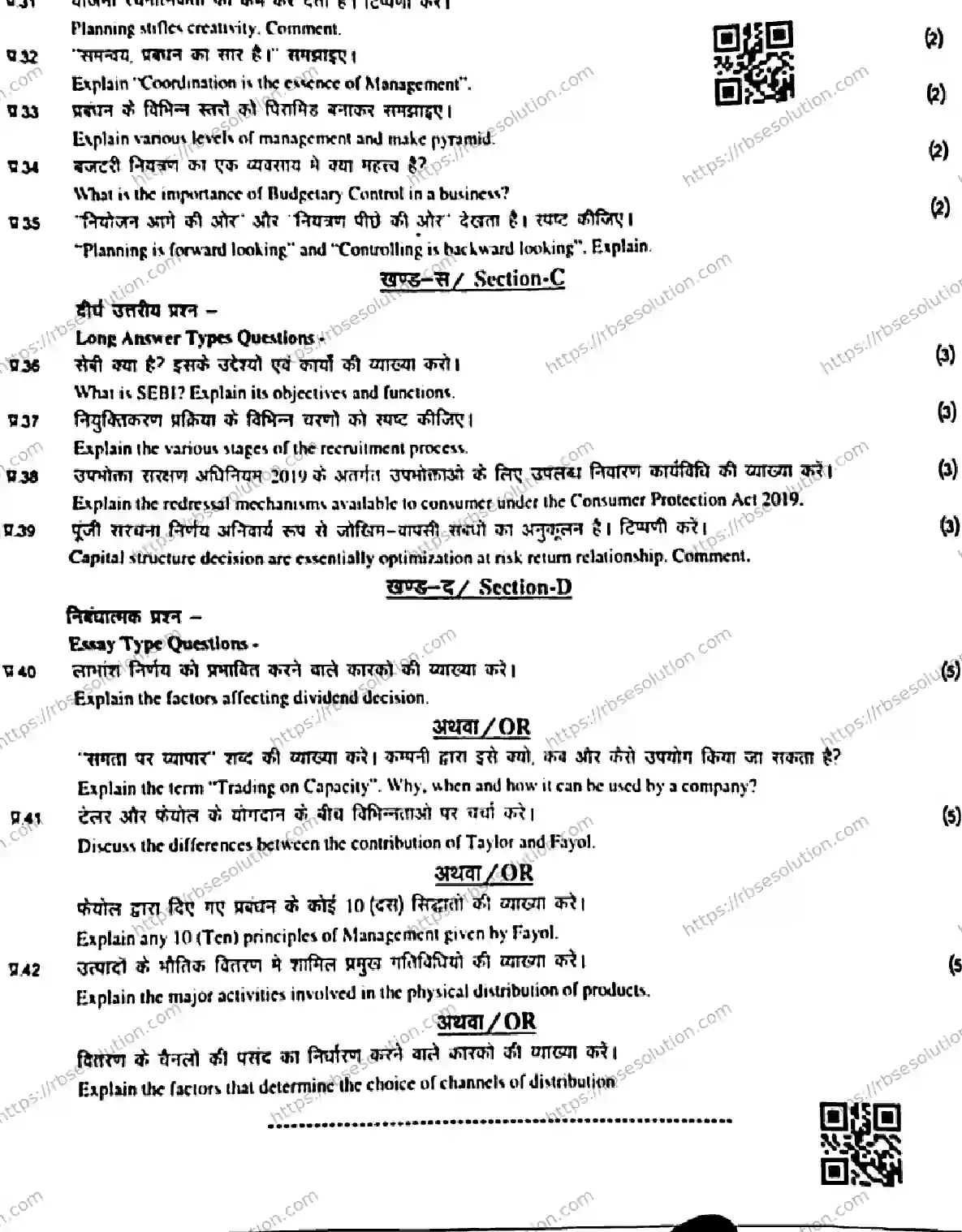
"Planning stifles creativity." Comment.
यह कथन आंशिक रूप से सत्य है। नियोजन एक पूर्व निर्धारित ढांचा प्रदान करता है, जो कभी-कभी रचनात्मकता को सीमित कर सकता है क्योंकि कर्मचारी निर्धारित योजना से हटकर कुछ नया करने में संकोच करते हैं। हालांकि, अच्छा नियोजन लचीला होता है और नवाचार के लिए स्थान छोड़ता है, जिससे यह रचनात्मकता को पूरी तरह से नहीं मारता बल्कि उसे एक दिशा प्रदान करता है।
-
"समन्वय, प्रबंधन का सार है।" समझाइए।
समन्वय प्रबंधन का सार है क्योंकि यह सभी प्रबंधकीय कार्यों (नियोजन, संगठन, निर्देशन, नियंत्रण) को एक सूत्र में बांधता है। यह विभिन्न विभागों और कर्मचारियों के प्रयासों में एकरूपता लाता है, संसाधनों का कुशल उपयोग सुनिश्चित करता है, और संगठनात्मक लक्ष्यों की प्राप्ति में सहायता करता है। बिना समन्वय के, प्रबंधन के सभी कार्य अलग-अलग दिशाओं में काम करेंगे और अप्रभावी होंगे।
-
Explain "Coordination is the essence of Management".
Coordination is the essence of management because it integrates all managerial functions (planning, organizing, staffing, directing, controlling) into a unified whole. It ensures harmony among individual efforts, facilitates efficient resource utilization, and helps achieve organizational goals smoothly. Without coordination, management functions would operate in silos, leading to conflicts and inefficiency.
-
प्रबंध के विभिन्न स्तरों को पिरामिड बनाकर समझाइए।
प्रबंध के तीन स्तर होते हैं, जिन्हें पिरामिड के रूप में दर्शाया जा सकता है:
- उच्च स्तरीय प्रबंध (शीर्ष): बोर्ड ऑफ डायरेक्टर्स, CEO - दीर्घकालिक योजना और नीति निर्धारण।
- मध्य स्तरीय प्रबंध: विभागाध्यक्ष, शाखा प्रबंधक - उच्च प्रबंधन की नीतियों को लागू करना और निचले स्तर का समन्वय करना।
- निम्न स्तरीय प्रबंध (पर्यवेक्षी): फोरमैन, पर्यवेक्षक - श्रमिकों की देखरेख और दैनिक कार्यों का निष्पादन।
पिरामिड का आकार दर्शाता है कि उच्च स्तर पर कम लोग होते हैं और निम्न स्तर पर अधिक।
-
Explain various levels of management and make pyramid.
The three levels of management can be represented as a pyramid:
- Top Level Management: Board of Directors, CEO - responsible for strategic planning and policy formulation.
- Middle Level Management: Department heads, Branch managers - implement policies and coordinate activities.
- Lower Level Management (Supervisory): Foremen, Supervisors - oversee workers and daily operations.
The pyramid shape indicates fewer people at the top and more at the bottom.
-
व्यवसाय में बजटीय नियंत्रण का क्या महत्त्व है?
बजटीय नियंत्रण का व्यवसाय में निम्नलिखित महत्त्व है:
- यह संसाधनों के कुशल आवंटन में सहायता करता है।
- यह लागत पर नियंत्रण रखने और अनावश्यक खर्चों को कम करने में मदद करता है।
- यह प्रदर्शन का मूल्यांकन करने का एक मानक प्रदान करता है।
- यह भविष्य के लिए बेहतर योजना बनाने में सहायक होता है।
- यह विभिन्न विभागों के बीच समन्वय स्थापित करता है।
-
What is the importance of Budgetary Control in a business?
The importance of budgetary control in a business includes:
- It helps in efficient allocation of resources.
- It aids in controlling costs and reducing unnecessary expenses.
- It provides a standard for evaluating performance.
- It helps in better planning for the future.
- It promotes coordination among different departments.
-
"नियोजन आगे की ओर देखता है" और "नियंत्रण पीछे की ओर देखता है"। व्याख्या कीजिए।
यह कथन नियोजन और नियंत्रण के बीच के संबंध को दर्शाता है। नियोजन भविष्योन्मुखी है क्योंकि इसमें भविष्य के लिए लक्ष्य निर्धारित करना और उन्हें प्राप्त करने के तरीके तय करना शामिल है। दूसरी ओर, नियंत्रण पिछले प्रदर्शन का मूल्यांकन करता है, वास्तविक परिणामों की तुलना मानकों से करता है, और विचलन को ठीक करने के लिए सुधारात्मक कार्रवाई करता है। इस प्रकार, नियोजन भविष्य की ओर देखता है जबकि नियंत्रण अतीत की ओर।
-
"Planning is forward looking" and "Controlling is backward looking". Explain.
This statement highlights the relationship between planning and controlling. Planning is forward-looking as it involves setting future goals and determining the means to achieve them. Controlling, on the other hand, is backward-looking as it evaluates past performance, compares actual results with standards, and takes corrective actions for deviations. Thus, planning looks ahead while controlling looks back.
खण्ड-स / Section-C
दीर्घ उत्तरीय प्रश्न - Long Answer Type Questions
-
सेबी क्या है? इसके उद्देश्य एवं कार्यों की व्याख्या करो।
सेबी (SEBI): भारतीय प्रतिभूति और विनिमय बोर्ड (Securities and Exchange Board of India) एक वैधानिक नियामक निकाय है जो भारत में प्रतिभूति बाजार (शेयर बाजार) को विनियमित करने के लिए स्थापित किया गया था। इसकी स्थापना 1992 में हुई थी।
उद्देश्य:
- निवेशकों के हितों की रक्षा करना।
- प्रतिभूति बाजार के विकास को बढ़ावा देना।
- बाजार को विनियमित करना और अनुशासित बनाना।
कार्य:
- स्टॉक एक्सचेंजों और मध्यस्थों (ब्रोकर, डीलर) का पंजीकरण और विनियमन।
- निवेशकों को शिक्षित करना और धोखाधड़ी को रोकना।
- अंदरूनी व्यापार (Insider Trading) पर रोक लगाना।
- कंपनियों द्वारा सार्वजनिक निर्गमों (IPO) के लिए दिशानिर्देश जारी करना।
- बाजार की निगरानी करना और नियमों का उल्लंघन करने वालों के खिलाफ कार्रवाई करना।
-
What is SEBI? Explain its objectives and functions.
SEBI (Securities and Exchange Board of India): It is a statutory regulatory body established in 1992 to regulate the securities market in India.
Objectives:
- To protect the interests of investors.
- To promote the development of the securities market.
- To regulate the market and ensure discipline.
Functions:
- Registration and regulation of stock exchanges and intermediaries (brokers, dealers).
- Educating investors and preventing fraud.
- Prohibiting insider trading.
- Issuing guidelines for public issues (IPOs) by companies.
- Monitoring the market and taking action against violators.
-
नियुक्तिकरण प्रक्रिया के विभिन्न चरणों को स्पष्ट कीजिए।
नियुक्तिकरण (Recruitment) प्रक्रिया के विभिन्न चरण निम्नलिखित हैं:
- रिक्तियों की पहचान: विभिन्न विभागों से रिक्त पदों की आवश्यकता का पता लगाना।
- कार्य विश्लेषण और विवरण: रिक्त पद के लिए आवश्यक कार्यों और योग्यताओं का निर्धारण।
- भर्ती स्रोतों का चयन: आंतरिक (स्थानांतरण, पदोन्नति) या बाह्य (विज्ञापन, कैंपस प्लेसमेंट) स्रोतों का निर्णय।
- आवेदन आमंत्रित करना: विज्ञापन या अन्य माध्यमों से आवेदन मांगना।
- आवेदनों की जांच: प्राप्त आवेदनों को आवश्यक योग्यताओं के आधार पर छांटना।
- साक्षात्कार और परीक्षण: शॉर्टलिस्ट किए गए उम्मीदवारों का साक्षात्कार और विभिन्न परीक्षण लेना।
- अंतिम चयन और नियुक्ति पत्र: उपयुक्त उम्मीदवार का चयन कर उसे नियुक्ति पत्र जारी करना।
-
Explain the various stages of the recruitment process.
The various stages of the recruitment process are:
- Identifying Vacancies: Determining the need for new employees in various departments.
- Job Analysis and Description: Defining the duties and qualifications required for the position.
- Selecting Recruitment Sources: Deciding between internal (transfer, promotion) or external (advertisement, campus placement) sources.
- Inviting Applications: Soliciting applications through advertisements or other means.
- Screening Applications: Reviewing applications based on required qualifications.
- Interviews and Tests: Conducting interviews and various tests for shortlisted candidates.
- Final Selection and Offer Letter: Selecting the suitable candidate and issuing an appointment letter.
-
उपभोक्ता संरक्षण अधिनियम 2019 के अंतर्गत उपभोक्ताओं के लिए उपलब्ध निवारण कार्यविधि की व्याख्या करें।
उपभोक्ता संरक्षण अधिनियम, 2019 के अंतर्गत उपभोक्ताओं के लिए त्रिस्तरीय निवारण कार्यविधि उपलब्ध है:
- जिला उपभोक्ता विवाद निवारण आयोग (DCDRC): 1 करोड़ रुपये तक के दावों के लिए।
- राज्य उपभोक्ता विवाद निवारण आयोग (SCDRC): 1 करोड़ से 10 करोड़ रुपये तक के दावों के लिए।
- राष्ट्रीय उपभोक्ता विवाद निवारण आयोग (NCDRC): 10 करोड़ रुपये से अधिक के दावों के लिए।