
RBSE Class 8th 2017 Mathematics-UP-09-2017 Previous Year Papers
You opened the RBSE Class 8th 2017 Mathematics-UP-09-2017 Previous Year Papers page — a focused place to read the real previous year question paper for that subject and year. RBSE Solution keeps exam-year sets together so you can practise the same cycle your seniors faced.
Previous year papers reward patience: read instructions, note mark distribution, then attempt questions before peeking at solutions elsewhere on the site. This URL always loads the same free previous year papers content for Mathematics-UP-09-2017 (2017).
Use the details table to confirm class and year, then scroll to the paper images or PDF below. More subjects from 2017 are linked later on this page.
Paper details
Quick reference for this previous year papers page — confirm board, class, and year & subject before you study.
| Board | RBSE |
|---|---|
| Class | Class 8th |
| Exam year | 2017 |
| Subject | Mathematics-UP-09-2017 |
| Resource type | Previous Year Papers |
| Category | RBSE Previous Year Question Papers |
| Website | RBSE Solution |
The table summarises this Previous Year Papers resource. Confirm RBSE, Class 8th, year 2017, and subject Mathematics-UP-09-2017 before studying.
RBSE Solution organises previous year papers so each URL carries chapter-specific guidance — better for students and for search engines than one generic paragraph for the whole class.
How to practise with this question paper
Stage one: read the Mathematics-UP-09-2017 question paper from 2017 without a timer and highlight command words — explain, prove, calculate, discuss. Stage two: attempt selected questions closed-book. Stage three: compare with solutions or teacher feedback.
Previous Year Papers work best when you log mistakes by topic, not only by question number. That log becomes your revision index before pre-boards.
RBSE Class 8th 2017 Mathematics-UP-09-2017
Scroll through the Previous Year Papers pages for Mathematics-UP-09-2017 (2017).
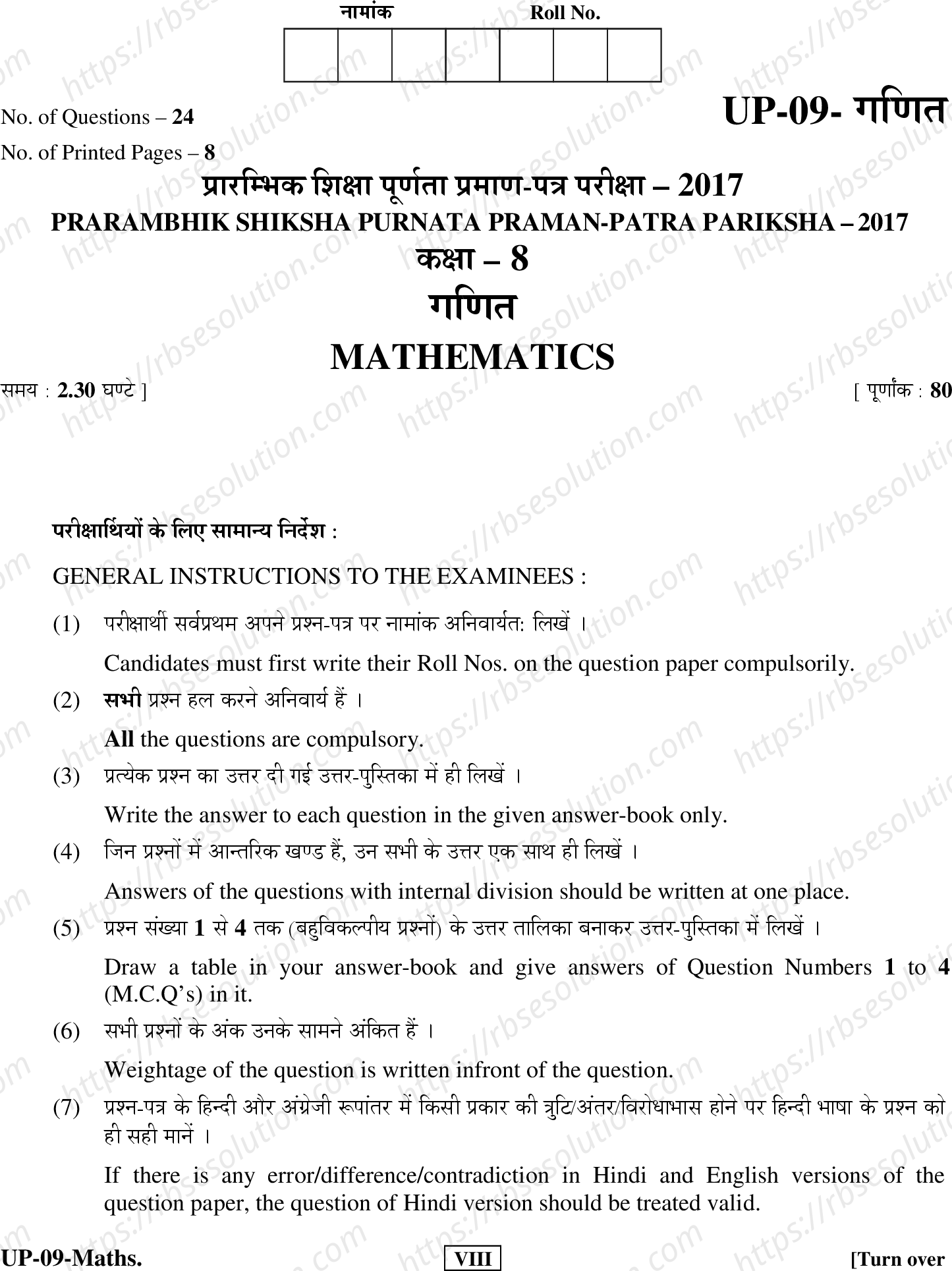


Rajasthan Board Class 8th Mathematics-UP-09-2017 2017 solved Previous Year Question Papers
प्रारम्भिक शिक्षा पूर्णता प्रमाण-पत्र परीक्षा – 2017
PRARAMBHIK SHIKSHA PURNATA PRAMAN-PATRA PARIKSHA – 2017
गणित / MATHEMATICS
समय : 2.30 घण्टे | पूर्णांक : 80
No. of Questions — 24 | No. of Printed Pages — 8
परीक्षार्थियों के लिए सामान्य निर्देश :
GENERAL INSTRUCTIONS TO THE EXAMINEES :
- परीक्षार्थी सर्वप्रथम अपने प्रश्न-पत्र पर नामांक अनिवार्यतः लिखें।
Candidates must first write their Roll Nos. on the question paper compulsorily. - सभी प्रश्न हल करने अनिवार्य हैं।
All the questions are compulsory. - प्रत्येक प्रश्न का उत्तर दी गई उत्तर-पुस्तिका में ही लिखें।
Write the answer to each question in the given answer-book only. - जिन प्रश्नों में आन्तरिक खण्ड हैं, उन सभी के उत्तर एक साथ ही लिखें।
Answers of the questions with internal division should be written at one place. - प्रश्न संख्या 4 तक (बहुविकल्पीय प्रश्नों) के उत्तर तालिका बनाकर उत्तर-पुस्तिका में लिखें।
Draw a table in your answer-book and give answers of Question Numbers 1 to 4 (M.C.Q’s) in it. - सभी प्रश्नों के अंक उनके सामने अंकित हैं।
Weightage of the question is written in front of the question. - प्रश्न-पत्र के हिन्दी और अंग्रेजी रूपांतर में किसी प्रकार की त्रुटि/अंतर/विरोधाभास होने पर हिन्दी भाषा के प्रश्न को ही सही मानें।
If there is any error/difference/contradiction in Hindi and English versions of the question paper, the question of Hindi version should be treated valid.
UP-09-Maths. VIII [Turn over
प्रश्न पत्र – गणित (UP-09-Maths) – पृष्ठ 2
बहुविकल्पीय प्रश्न (MCQs)
प्रश्न 1. 7 का घन है –
- (अ) 49
- (ब) 243
- (स) 343
- (द) 21
The cube of 7 is –
- (a) 49
- (b) 243
- (c) 343
- (d) 21
सही उत्तर: (स) / (c) 343
व्याख्या: 7 का घन = 7 × 7 × 7 = 343.
प्रश्न 2. व्यंजक a² + 2ab + b² के गुणनखंड हैं –
- (अ) (a + b)(a – b)
- (ब) (a + b)²
- (स) (a – b)²
- (द) (a² + b²)²
The factors of expression a² + 2ab + b² are –
- (a) (a + b)(a – b)
- (b) (a + b)²
- (c) (a – b)²
- (d) (a² + b²)²
सही उत्तर: (ब) / (b) (a + b)²
व्याख्या: a² + 2ab + b² = (a + b)² (सर्वसमिका).
प्रश्न 3. घन में किनारों की संख्या होती है –
- (अ) 8
- (ब) 12
- (स) 6
- (द) 4
Number of edges in a cube are –
- (a) 8
- (b) 12
- (c) 6
- (d) 4
सही उत्तर: (ब) / (b) 12
व्याख्या: एक घन में 12 किनारे होते हैं.
प्रश्न 4. बिंदु (3, 0) स्थित है –
- (अ) x-अक्ष पर
- (ब) प्रथम चतुर्थांश में
- (स) y-अक्ष पर
- (द) द्वितीय चतुर्थांश में
The point (3, 0) lies –
- (a) on x-axis
- (b) in first quadrant
- (c) on y-axis
- (d) in second quadrant
सही उत्तर: (अ) / (a) x-अक्ष पर (on x-axis)
व्याख्या: बिंदु (3, 0) में y-निर्देशांक 0 है, अतः यह x-अक्ष पर स्थित है.
लघु उत्तरीय प्रश्न
प्रश्न 5. मान ज्ञात कीजिए : (i) 3² × 3³ (ii) (5²)³
Evaluate (i) 3² × 3³ (ii) (5²)³
हल:
(i) 3² × 3³ = 3(2+3) = 3⁵ = 243
(ii) (5²)³ = 5(2×3) = 5⁶ = 15625
6. एक राजकीय विद्यालय में पर्यावरण पखवाड़े के अन्तर्गत रोपे गये पौधों में 25% नीम के पौधे लगाये गये । यदि लगाये गए कुल पौधे 80 हैं तो नीम के पौधों की संख्या कितनी है ?
In a Government school 25% Neem plants were sown during environment pakwara (fort night). If there are 80 plants in total then how many Neem plants are there ?
हल: कुल पौधे = 80, नीम के पौधों का प्रतिशत = 25%
नीम के पौधों की संख्या = 80 का 25% = 80 × (25/100) = 80 × 0.25 = 20
उत्तर: नीम के पौधों की संख्या 20 है।
7. गुणनफल ज्ञात कीजिए : (3x + 5) (5x - 3)
Find the product : (3x + 5) (5x - 3)
हल: (3x + 5)(5x - 3) = 3x(5x - 3) + 5(5x - 3)
= 15x² - 9x + 25x - 15
= 15x² + 16x - 15
उत्तर: गुणनफल = 15x² + 16x - 15
8. एक अद्वितीय वर्ग की रचना के लिए आवश्यक कोई दो स्थितियाँ लिखिए ।
Write any two necessary conditions for constructing a unique square.
उत्तर: एक अद्वितीय वर्ग की रचना के लिए निम्नलिखित दो स्थितियाँ आवश्यक हैं:
- वर्ग की एक भुजा की लंबाई ज्ञात होनी चाहिए।
- वर्ग का एक विकर्ण ज्ञात होना चाहिए।
9. एक त्रिभुजाकार प्रिज्म में किनारों तथा फलकों की संख्या लिखिए ।
Write number of edges and faces in a triangular prism.
उत्तर: त्रिभुजाकार प्रिज्म में:
- किनारों (edges) की संख्या = 9
- फलकों (faces) की संख्या = 5
10. एक पासे को फेंकने पर सम संख्या आने की प्रायिकता ज्ञात कीजिए ।
Find the probability of getting an even number when a dice is thrown.
हल: एक पासे पर कुल संभावित परिणाम = 6 (1, 2, 3, 4, 5, 6)
सम संख्याएँ = 2, 4, 6 (कुल 3)
प्रायिकता = अनुकूल परिणामों की संख्या / कुल संभावित परिणाम = 3/6 = 1/2
उत्तर: सम संख्या आने की प्रायिकता = 1/2
11. 3/7 तथा −4/7 के योग को −2/7 तथा 4/7 के योग से घटाइये ।
Subtract the sum of 3/7 and −4/7 from the sum of −2/7 and 4/7.
हल: पहला योग = 3/7 + (−4/7) = 3−4/7 = −1/7
दूसरा योग = −2/7 + 4/7 = −2+4/7 = 2/7
अब, दूसरे योग में से पहला योग घटाने पर: 2/7 − (−1/7) = 2/7 + 1/7 = 3/7
उत्तर: 3/7
12. निम्न संख्याओं को 3 व 9 से विभाज्यता की जाँच कीजिए : (i) 839 (ii) 236637
Test the divisibility of following numbers by 3 and 9: (i) 839 (ii) 236637
हल:
(i) 839: अंकों का योग = 8 + 3 + 9 = 20
- 20, 3 से विभाज्य नहीं है, अतः 839, 3 से विभाज्य नहीं है।
- 20, 9 से विभाज्य नहीं है, अतः 839, 9 से विभाज्य नहीं है।
(ii) 236637: अंकों का योग = 2 + 3 + 6 + 6 + 3 + 7 = 27
- 27, 3 से विभाज्य है (27 ÷ 3 = 9), अतः 236637, 3 से विभाज्य है।
- 27, 9 से विभाज्य है (27 ÷ 9 = 3), अतः 236637, 9 से विभाज्य है।
13. अर्ध्वतिर्यग्भ्याम् विधि से गुणा कीजिए : 426 × 35
Multiply by Urdhwtirygbhyaam method : 426 × 35
हल (अर्ध्वतिर्यग्भ्याम् विधि):
चरण 1: इकाई अंक: 6 × 5 = 30 → 0 लिखें, 3 हासिल
चरण 2: दहाई अंक (तिर्यक): (2 × 5) + (6 × 3) = 10 + 18 = 28, हासिल 3 जोड़ें: 28 + 3 = 31 → 1 लिखें, 3 हासिल
चरण 3: सैकड़ा अंक (तिर्यक): (4 × 5) + (2 × 3) = 20 + 6 = 26, हासिल 3 जोड़ें: 26 + 3 = 29 → 9 लिखें, 2 हासिल
चरण 4: हजार अंक: 4 × 3 = 12, हासिल 2 जोड़ें: 12 + 2 = 14 → 14 लिखें
अतः गुणनफल = 14910
उत्तर: 426 × 35 = 14910
अथवा / OR
निखिलम सूत्र का उपयोग कर गुणा कीजिए : 22 × 23
Multiply by using Nikhilam formula : 22 × 23
हल (निखिलम सूत्र):
आधार = 20 (निकटतम दहाई)
22 का आधार से विचलन = +2
23 का आधार से विचलन = +3
चरण 1: दाईं ओर: 2 × 3 = 6
चरण 2: बाईं ओर: 22 + 3 = 25 (या 23 + 2 = 25)
चरण 3: बाईं ओर को आधार से गुणा करें: 25 × 20 = 500
चरण 4: जोड़ें: 500 + 6 = 506
उत्तर: 22 × 23 = 506
प्रश्न 4
सर्वसमिका a² – b² = (a + b)(a – b) का उपयोग करते हुए गुणनफल ज्ञात कीजिए –
Using identity a² – b² = (a + b)(a – b) find the product –
-
(i) (2a + 7)(2a – 7)
यहाँ a = 2a और b = 7 है। सर्वसमिका a² – b² = (a + b)(a – b) का उपयोग करने पर:
(2a + 7)(2a – 7) = (2a)² – (7)² = 4a² – 49
उत्तर: 4a² – 49
-
(ii) (p² + q²)(p² – q²)
यहाँ a = p² और b = q² है। सर्वसमिका a² – b² = (a + b)(a – b) का उपयोग करने पर:
(p² + q²)(p² – q²) = (p²)² – (q²)² = p⁴ – q⁴
उत्तर: p⁴ – q⁴
प्रश्न 5
दिए गये समान्तरचतुर्भुज ABCD में x तथा y का मान ज्ञात कीजिए।
Find the values of x and y from given parallelogram ABCD.
D (5y – 6) C
| |
| |
6 cm (3x + 1) cm
| |
| |
A B
24 cm
हल: समान्तरचतुर्भुज में सम्मुख भुजाएँ बराबर होती हैं।
AB = CD और AD = BC
AB = 24 cm, CD = (3x + 1) cm
⇒ 3x + 1 = 24
⇒ 3x = 23
⇒ x = 23/3
AD = 6 cm, BC = (5y – 6) cm
⇒ 5y – 6 = 6
⇒ 5y = 12
⇒ y = 12/5
उत्तर: x = 23/3, y = 12/5
प्रश्न 6
दिए गये चित्र में ABCD एक समलम्बचतुर्भुज है जिसमें AB || DC तथा DA ⟂ AB है। यदि AB = 3 cm, AD = 8 cm तथा CD = 7 cm है, तो समलम्बचतुर्भुज का क्षेत्रफल ज्ञात कीजिए।
In given figure ABCD is a trapezium in which AB || DC and DA ⟂ AB. If AB = 3 cm, AD = 8 cm and CD = 7 cm, then find area of trapezium.
D C
| |
| |
8 cm |
| |
| |
A B
3 cm
हल: समलम्बचतुर्भुज का क्षेत्रफल = ½ × (समान्तर भुजाओं का योग) × ऊँचाई
यहाँ समान्तर भुजाएँ AB और CD हैं।
AB = 3 cm, CD = 7 cm
ऊँचाई AD = 8 cm (क्योंकि DA ⟂ AB)
क्षेत्रफल = ½ × (3 + 7) × 8
= ½ × 10 × 8
= 5 × 8
= 40 वर्ग सेमी
उत्तर: समलम्बचतुर्भुज का क्षेत्रफल = 40 cm²
प्रश्न 7
(i) सार्वगुणनखंड द्वारा गुणनखंड कीजिए : p²qr + pq²r + pqr²
Factorize by common factor method : p²qr + pq²r + pqr²
हल:
p²qr + pq²r + pqr² = pqr(p + q + r)
सार्व गुणनखंड pqr है।
(ii) बहुपद 8m³ + 6m² + 2m को 3m से भाग दीजिए।
Divide the polynomial 8m³ + 6m² + 2m by 3m.
हल:
(8m³ + 6m² + 2m) ÷ 3m = (8m³/3m) + (6m²/3m) + (2m/3m)
= (8/3)m² + 2m + (2/3)
अतः भागफल = (8/3)m² + 2m + (2/3)
प्रश्न 8
एक परिमेय संख्या का हर उसके अंश से 5 अधिक है। यदि अंश तथा हर में 2 जोड़ दिया जाये तो हमें ½ प्राप्त होता है। परिमेय संख्या ज्ञात कीजिए।
Denominator of a rational number exceeds its numerator by 5. If 2 is added to its numerator and denominator then we get ½. Find the rational number.
हल:
माना अंश = x, तब हर = x + 5
प्रश्नानुसार: (x + 2) / (x + 5 + 2) = ½
⇒ (x + 2) / (x + 7) = ½
⇒ 2(x + 2) = x + 7
⇒ 2x + 4 = x + 7
⇒ 2x - x = 7 - 4
⇒ x = 3
अतः अंश = 3, हर = 3 + 5 = 8
अभीष्ट परिमेय संख्या = 3/8
प्रश्न 9
उपयुक्त विकल्प चुनकर रिक्त स्थान की पूर्ति कीजिए।
Fill in the blanks choosing the right option.
-
(i) ऐसा चतुर्भुज जिसमें आसन्न भुजाओं के दो जोड़े समान माप के होते हैं, ______ कहलाता है। (समान्तरचतुर्भुज/पतंग)
A quadrilateral which has two pairs of equal adjacent sides is called ______ (parallelogram/kite)
उत्तर: पतंग (kite)
स्पष्टीकरण: पतंग में आसन्न भुजाओं के दो जोड़े बराबर होते हैं, जबकि समान्तरचतुर्भुज में सम्मुख भुजाएँ बराबर होती हैं।
-
(ii) वे बहुभुज जिनके सभी विकर्ण अभ्यंतर में होते हैं, ______ बहुभुज कहलाते हैं। (उत्तल/अवतल)
Those polygons whose all diagonals are in the interior, are called ______ (convex/concave)
उत्तर: उत्तल (convex)
स्पष्टीकरण: उत्तल बहुभुज में सभी विकर्ण अंदर की ओर होते हैं, जबकि अवतल में कुछ विकर्ण बाहर होते हैं।
-
(iii) बहुभुज के सभी बहिष्कोणों का योग ______ होता है। (80°/360°)
Sum of all exterior angles of a polygon is ______ (80°/360°)
उत्तर: 360°
स्पष्टीकरण: किसी भी बहुभुज के सभी बहिष्कोणों का योग सदैव 360° होता है।
-
(iv) ______ के विकर्ण परस्पर लम्बवत् होते हैं। (समान्तरचतुर्भुज/समचतुर्भुज)
Diagonals are perpendicular in ______ (parallelogram/rhombus)
उत्तर: समचतुर्भुज (rhombus)
स्पष्टीकरण: समचतुर्भुज के विकर्ण एक-दूसरे को समकोण पर काटते हैं, जबकि समान्तरचतुर्भुज में ऐसा आवश्यक नहीं है।
प्रश्न 20
नीचे दिए गए पाई-चार्ट में वाहन चालकों की विभिन्न गलतियों को दर्शाया गया है। पाई-चार्ट की सहायता से निम्नलिखित प्रश्नों के उत्तर दीजिए:
पाई-चार्ट (विवरण)
- यातायात नियमों की अवहेलना करना – 30%
- खतरनाक तरीके से वाहन चलाना – 25%
- वाहन तेज गति से चलाना – 20%
- शराब पीकर वाहन चलाना – 15%
- अन्य कारण – 10%
-
(i) यातायात नियमों की अवहेलना करने पर कितने प्रतिशत दुर्घटनाएँ हुईं?
उत्तर: 30% दुर्घटनाएँ यातायात नियमों की अवहेलना करने पर हुईं।
-
(ii) खतरनाक तरीके से वाहन चलाने से कितने प्रतिशत दुर्घटनाएँ हुईं?
उत्तर: 25% दुर्घटनाएँ खतरनाक तरीके से वाहन चलाने से हुईं।
-
(iii) सबसे ज्यादा दुर्घटनाएँ वाहन चालक की किस गलती से होती हैं?
उत्तर: सबसे ज्यादा दुर्घटनाएँ यातायात नियमों की अवहेलना करने से होती हैं (30%)।
-
(iv) न्यूनतम दुर्घटनाएँ वाहन चालक की किस गलती से होती हैं?
उत्तर: न्यूनतम दुर्घटनाएँ अन्य कारणों से होती हैं (10%)।
Question 20 (English)
Various mistakes of automobile drivers are shown in the following pie-chart. With the help of pie-chart answer the following questions:
Pie-chart (Details)
- Breaking traffic rules – 30%
- Driving dangerously – 25%
- Driving fast – 20%
- Drink & Drive – 15%
- Other reasons – 10%
-
(i) Percentage of accidents due to disobedience of traffic rules?
Answer: 30% accidents occur due to disobedience of traffic rules.
-
(ii) Percentage of accidents due to driving dangerously?
Answer: 25% accidents occur due to driving dangerously.
-
(iii) Due to which mistake of automobile driver maximum accidents take place?
Answer: Maximum accidents take place due to breaking traffic rules (30%).
-
(iv) Due to which mistake of automobile driver minimum accidents take place?
Answer: Minimum accidents take place due to other reasons (10%).
प्रश्न 21
नवल ने एक राष्ट्रीयकृत बैंक से ₹84,000 का ऋण 10% वार्षिक दर से 1½ वर्ष के लिए लिया। नवल द्वारा 1½ वर्ष पश्चात् भुगतान किये जाने वाले कुल चक्रवृद्धि ब्याज की गणना कीजिए, यदि ब्याज अर्धवार्षिक देय है।
Naval borrowed ₹84,000 from a nationalized bank for 1½ years at the rate of 10% per annum. Compute the total compound interest payable by Naval after 1½ years, if the interest is compounded half yearly.
हल:
मूलधन (P) = ₹84,000
वार्षिक दर (R) = 10%
समय (T) = 1½ वर्ष = 3/2 वर्ष
ब्याज अर्धवार्षिक देय है, अतः:
- दर (r) = 10% / 2 = 5% प्रति अर्धवर्ष
- समय (n) = 1½ × 2 = 3 अर्धवर्ष
चक्रवृद्धि मिश्रधन (A) = P (1 + r/100)n
A = 84000 (1 + 5/100)3
A = 84000 (1.05)3
A = 84000 × 1.157625
A = ₹97,240.50
चक्रवृद्धि ब्याज (CI) = A - P = 97240.50 - 84000 = ₹13,240.50
अतः नवल द्वारा 1½ वर्ष बाद देय कुल चक्रवृद्धि ब्याज ₹13,240.50 है।
अथवा
राहुल ने एक स्कूटर 25% की हानि से ₹8,750 में बेचा। स्कूटर का क्रय मूल्य ज्ञात कीजिए।
Rahul sold a scooter for ₹8,750 at a loss of 25%. Find the cost price of the scooter.
हल:
विक्रय मूल्य (SP) = ₹8,750
हानि प्रतिशत = 25%
माना क्रय मूल्य (CP) = ₹100
हानि = 25% = ₹25
विक्रय मूल्य = 100 - 25 = ₹75
जब SP = ₹75, तब CP = ₹100
जब SP = ₹1, तब CP = 100/75
जब SP = ₹8,750, तब CP = (100/75) × 8750
CP = (100 × 8750) / 75
CP = 875000 / 75
CP = ₹11,666.67
अतः स्कूटर का क्रय मूल्य ₹11,666.67 है।
प्रश्न 22
एक बेलन की त्रिज्या 7 cm तथा ऊँचाई 10 cm है। बेलन का वक्र पृष्ठीय क्षेत्रफल तथा आयतन ज्ञात कीजिए। (π = 22/7 का उपयोग करें)
The radius of a cylinder is 7 cm and its height is 10 cm. Find the curved surface area and volume of the cylinder. (use π = 22/7)
हल:
दिया है: त्रिज्या (r) = 7 cm, ऊँचाई (h) = 10 cm, π = 22/7
वक्र पृष्ठीय क्षेत्रफल (CSA) = 2πrh
CSA = 2 × (22/7) × 7 × 10
CSA = 2 × 22 × 10
CSA = 440 cm²
आयतन (V) = πr²h
V = (22/7) × 7 × 7 × 10
V = 22 × 7 × 10
V = 1540 cm³
अतः बेलन का वक्र पृष्ठीय क्षेत्रफल 440 cm² और आयतन 1540 cm³ है।
अथवा
दिये गये खेत का क्षेत्रफल ज्ञात कीजिए। सभी माप मीटर में हैं।
Find the area of the given field. All measurements are in metres.
हल:
दिए गए चित्र में खेत को विभिन्न त्रिभुजों और चतुर्भुजों में विभाजित किया गया है। सभी माप मीटर में हैं।
खेत का क्षेत्रफल = ΔDHC का क्षेत्रफल + समलंब चतुर्भुज HCGI का क्षेत्रफल + ΔGCI का क्षेत्रफल + ΔFIB का क्षेत्रफल + समलंब चतुर्भुज FIAE का क्षेत्रफल + ΔAEF का क्षेत्रफल
प्रत्येक भाग का क्षेत्रफल ज्ञात करके जोड़ने पर कुल क्षेत्रफल प्राप्त होता है।
(चूंकि चित्र में सभी माप स्पष्ट नहीं हैं, अतः सटीक मान देने के लिए पूर्ण आंकड़ों की आवश्यकता है।)
प्रश्न 23
एक वर्ग ABCD की रचना कीजिए जिसका विकर्ण BD = 5.6 cm है।
Construct a square ABCD, given that diagonal BD = 5.6 cm.
रचना के चरण (Steps of Construction):
- सर्वप्रथम विकर्ण BD = 5.6 cm का एक रेखाखंड खींचिए।
- BD का लंब समद्विभाजक खींचिए जो BD को O पर काटता है।
- O को केंद्र मानकर, BD के आधे (2.8 cm) त्रिज्या लेकर एक वृत्त खींचिए जो लंब समद्विभाजक को A और C पर काटता है।
- AB, BC, CD और DA को मिलाइए।
- ABCD अभीष्ट वर्ग है।
स्पष्टीकरण: वर्ग के विकर्ण परस्पर समद्विभाजित करते हैं और 90° पर काटते हैं। इसलिए, विकर्ण BD का लंब समद्विभाजक खींचकर और उस पर समान दूरी पर बिंदु A और C अंकित करके वर्ग प्राप्त होता है।
प्रश्न 24
निम्न तालिका के अनुसार समय और साधारण ब्याज के मध्य आलेख खींचिए:
| समय (Time) | 1 वर्ष (1 year) | 2 वर्ष (2 year) | 3 वर्ष (3 year) | 4 वर्ष (4 year) |
|---|---|---|---|---|
| साधारण ब्याज (₹ में) Simple Interest (in ₹) |
50 | 100 | 150 | 200 |
According to the following table, draw the graph between time and simple interest.
आलेख खींचने के चरण (Steps to draw the graph):
- X-अक्ष पर समय (वर्षों में) और Y-अक्ष पर साधारण ब्याज (₹ में) लीजिए।
- उपयुक्त पैमाना चुनिए: X-अक्ष पर 1 वर्ष = 1 cm, Y-अक्ष पर ₹50 = 1 cm।
- बिंदु अंकित कीजिए: (1, 50), (2, 100), (3, 150), (4, 200)
- इन बिंदुओं को एक सीधी रेखा से मिलाइए।
- यह रेखा मूल बिंदु (0,0) से होकर जाती है, जो दर्शाता है कि समय और साधारण ब्याज के बीच सीधा समानुपात है।
स्पष्टीकरण: साधारण ब्याज समय के सीधे अनुपात में बढ़ता है, इसलिए आलेख एक सरल रेखा होगी जो मूल बिंदु से गुजरती है।