
RBSE Class 8th 2020 Social Science (Half Yearly)-2020 Previous Year Papers
Class 8th students hunting authentic previous year papers for Social Science (Half Yearly)-2020 (2020) land here for a reason: the paper below matches how RBSE assessments are remembered from that year. RBSE Solution does not mix years on one page; each combination gets its own notes.
Skim the overview sections, then work through the scanned pages. Pair this practice with RBSE books and solutions when you need to relearn a concept a question exposed.
Paper details
Quick reference for this previous year papers page — confirm board, class, and year & subject before you study.
| Board | RBSE |
|---|---|
| Class | Class 8th |
| Exam year | 2020 |
| Subject | Social Science (Half Yearly)-2020 |
| Resource type | Previous Year Papers |
| Category | RBSE Previous Year Question Papers |
| Website | RBSE Solution |
The table summarises this Previous Year Papers resource. Confirm RBSE, Class 8th, year 2020, and subject Social Science (Half Yearly)-2020 before studying.
RBSE Solution organises previous year papers so each URL carries chapter-specific guidance — better for students and for search engines than one generic paragraph for the whole class.
How to practise with this question paper
Stage one: read the Social Science (Half Yearly)-2020 question paper from 2020 without a timer and highlight command words — explain, prove, calculate, discuss. Stage two: attempt selected questions closed-book. Stage three: compare with solutions or teacher feedback.
Previous Year Papers work best when you log mistakes by topic, not only by question number. That log becomes your revision index before pre-boards.
RBSE Class 8th 2020 Social Science (Half Yearly)-2020
Scroll through the Previous Year Papers pages for Social Science (Half Yearly)-2020 (2020).
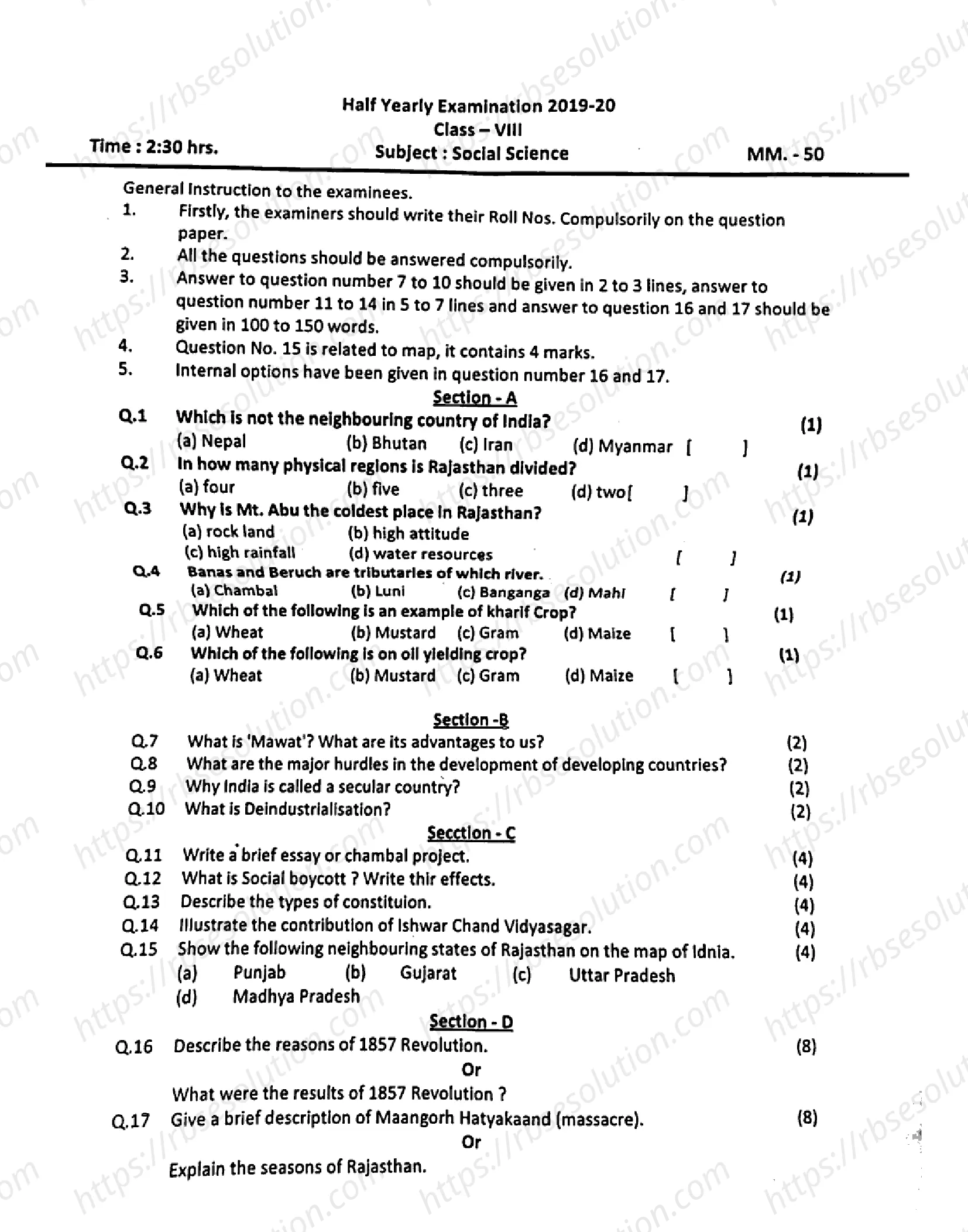
Rajasthan Board Class 8th Social Science (Half Yearly)-2020 2020 solved Previous Year Question Papers
Half Yearly Examination 2019-20
Class — VIII
MM: 50
Time: 2:30 hrs. Subject: Social Science
General Instructions to the Examinees
- Firstly, the examiners should write their Roll Nos. compulsorily on the question paper.
- All the questions should be answered compulsorily.
- Answer to question number 7 to 10 should be given in 2 to 3 lines, answer to question number 1 to 4 in 5 to 7 lines and answer to question 6 and 7 should be given in 100 to 150 words.
- Question No. 5 is related to map, it contains 4 marks.
- Internal options have been given in question number 6 and 7.
Section-A
Q.1 Which is not the neighbouring country of India? (2)
- Nepal
- Bhutan
- Iran
- Myanmar
Explanation: Iran is not a neighbouring country of India. India shares land borders with Pakistan, Afghanistan, China, Nepal, Bhutan, Bangladesh, and Myanmar.
Q.2 In how many physical regions is Rajasthan divided? (2)
- four
- five
- three
- two
Explanation: Rajasthan is divided into five physical regions: the Western Desert, the Aravalli Range, the Eastern Plains, the South-Eastern Plateau, and the North-Eastern Sandy Plain.
Q.3 Why is Mt. Abu the coldest place in Rajasthan? (2)
- rock land
- high altitude
- high rainfall
- water resources
Explanation: Mount Abu is the coldest place in Rajasthan due to its high altitude (about 1,220 metres above sea level), which results in lower temperatures compared to the surrounding plains.
Q.4 Banas and Berach are tributaries of which river? (2)
- Chambal
- Luni
- Banganga
- Mahi
Explanation: The Banas and Berach rivers are major tributaries of the Chambal River, which flows through Rajasthan and Madhya Pradesh.
Q.5 Which of the following is an example of kharif crop? (2)
- Wheat
- Mustard
- Gram
- Maize
Explanation: Maize is a kharif crop, sown in the rainy season (June–July) and harvested in autumn. Wheat, mustard, and gram are rabi crops.
Q.6 Which of the following is an oil yielding crop? (4)
- Wheat
- Mustard
- Gram
- Maize
Explanation: Mustard is an oilseed crop from which edible oil is extracted. Wheat, gram, and maize are not primarily grown for oil.
Section-B
Q.7 What is ‘Mawat’? What are its advantages to us? (2)
Answer: Mawat refers to the local term for the monsoon winds or rainfall in Rajasthan. Its advantages include providing essential water for agriculture, replenishing groundwater, supporting livestock, and maintaining the ecological balance in the arid region.
Q.8 What are the major hurdles in the development of developing countries? (2)
Answer: Major hurdles include poverty, lack of education and skilled workforce, inadequate infrastructure, political instability, corruption, high population growth, and limited access to capital and technology.
Q.9 Why is India called a secular country? (2)
Answer: India is called a secular country because its Constitution guarantees freedom of religion to all citizens, treats all religions equally, and does not have an official state religion. The state remains neutral in religious matters.
Q.10 What is Deindustrialisation? (2)
Answer: Deindustrialisation refers to the decline in the industrial sector of a country or region, often due to competition, technological changes, or policy shifts, leading to reduced manufacturing output and employment.
Section-C
Q.11 Write a brief essay on Chambal Project. (4)
Answer: The Chambal Project is a major multipurpose river valley project on the Chambal River, jointly undertaken by Rajasthan and Madhya Pradesh. It includes the construction of the Gandhi Sagar Dam, Rana Pratap Sagar Dam, and Jawahar Sagar Dam. The project provides irrigation to large areas in both states, generates hydroelectricity, and helps in flood control. It has significantly boosted agriculture and economic development in the region.
Q.12 What is Social boycott? Write its effects. (4)
Answer: Social boycott is a practice where a community or group isolates an individual or family by refusing social interaction, trade, or services. Its effects include psychological trauma, economic hardship, loss of dignity, and social exclusion. It can also lead to migration and long-term damage to community harmony.
Q.13 Describe the types of constitution. (4)
Answer: Constitutions are mainly of two types: (1) Written Constitution – a single document that contains all laws and principles, e.g., India, USA. (2) Unwritten Constitution – based on customs, traditions, and statutes, e.g., UK. Additionally, constitutions can be flexible (easy to amend) or rigid (difficult to amend).
Q.14 Illustrate the contribution of Ishwar Chandra Vidyasagar. (4)
Answer: Ishwar Chandra Vidyasagar was a great social reformer and educator. He contributed significantly to women's education, campaigned for widow remarriage, and worked to abolish child marriage. He also simplified the Bengali alphabet and promoted modern education. His efforts led to the Widow Remarriage Act of 1856.
Q.15 Show the following neighbouring states of Rajasthan on the map of India. (4)
- (a) Punjab
- (b) Gujarat
- (c) Uttar Pradesh
- (d) Madhya Pradesh
Answer: (Map-based question – students should mark these states on an outline map of India. Punjab lies to the north, Gujarat to the southwest, Uttar Pradesh to the northeast, and Madhya Pradesh to the east of Rajasthan.)
Section-D
Q.16 Describe the reasons of 1857 Revolution. (8)
Answer: The 1857 Revolution, also known as the First War of Indian Independence, had several causes:
- Political: Doctrine of Lapse, annexation of states, and disrespect to Mughal emperor.
- Economic: Heavy taxes, destruction of traditional industries, and economic exploitation.
- Social: Interference in social customs, missionary activities, and racial discrimination.
- Military: Greased cartridges issue (using cow and pig fat), low pay, and poor conditions for sepoys.
- Immediate: The introduction of Enfield rifles with greased cartridges sparked the revolt.
These factors combined led to widespread rebellion across northern and central India.
OR
Q.16 What were the results of 1857 Revolution? (8)
Answer: The results of the 1857 Revolution were significant:
- End of East India Company's rule; India came under direct British Crown (Queen Victoria).
- The British government took over administration (Government of India Act 1858).
- Reorganisation of the British Indian army to reduce Indian soldiers' proportion.
- Policy of divide and rule was strengthened.
- Promises of non-interference in religious and social matters.
- Increased racial bitterness and suspicion between British and Indians.
- It inspired future freedom struggles and nationalist movements.
Q.17 Give a brief description of Jallianwala Bagh Hatyakand (massacre). (8)
Answer: The Jallianwala Bagh massacre occurred on April 13, 1919, in Amritsar, Punjab. On Baisakhi day, a large unarmed crowd had gathered in Jallianwala Bagh to protest the arrest of leaders and the Rowlatt Act. General Dyer ordered troops to open fire without warning, killing hundreds and injuring thousands. The massacre shocked the nation and world, leading to widespread condemnation and strengthening the Indian independence movement.
OR
Q.17 Explain the seasons of Rajasthan. (8)