
RBSE Class 8th 2026 HALF-YEARLY-MATHEMATICS-011225 Previous Year Papers
HALF-YEARLY-MATHEMATICS-011225 from the 2026 exam year is part of the Class 8th previous year papers archive on RBSE Solution. Many learners start here after finishing the textbook to see how questions were actually framed on the Rajasthan Board of Secondary Education (RBSE) paper.
Treat this question paper as a mock under gentle timing first, then as a marking exercise the second time. The introduction on this page is written only for this subject-and-year pair, not copied from other pages.
Bookmark the link if you coach juniors — the layout stays stable for search engines and classroom sharing.
Paper details
Quick reference for this previous year papers page — confirm board, class, and year & subject before you study.
| Board | RBSE |
|---|---|
| Class | Class 8th |
| Exam year | 2026 |
| Subject | HALF-YEARLY-MATHEMATICS-011225 |
| Resource type | Previous Year Papers |
| Category | RBSE Previous Year Question Papers |
| Website | RBSE Solution |
The table summarises this Previous Year Papers resource. Confirm RBSE, Class 8th, year 2026, and subject HALF-YEARLY-MATHEMATICS-011225 before studying.
RBSE Solution organises previous year papers so each URL carries chapter-specific guidance — better for students and for search engines than one generic paragraph for the whole class.
Turning 2026 papers into insight
One HALF-YEARLY-MATHEMATICS-011225 paper reveals style; several from the same year reveal pattern. After this page, open sibling subjects listed below to see whether marks cluster in certain units.
Keep rough work dated in your notebook. Examiners in Class 8th expect clear numbering even in practice sessions.
RBSE Class 8th 2026 HALF-YEARLY-MATHEMATICS-011225
Scroll through the Previous Year Papers pages for HALF-YEARLY-MATHEMATICS-011225 (2026).
Rajasthan Board Class 8th HALF-YEARLY-MATHEMATICS-011225 2026 solved Previous Year Question Papers
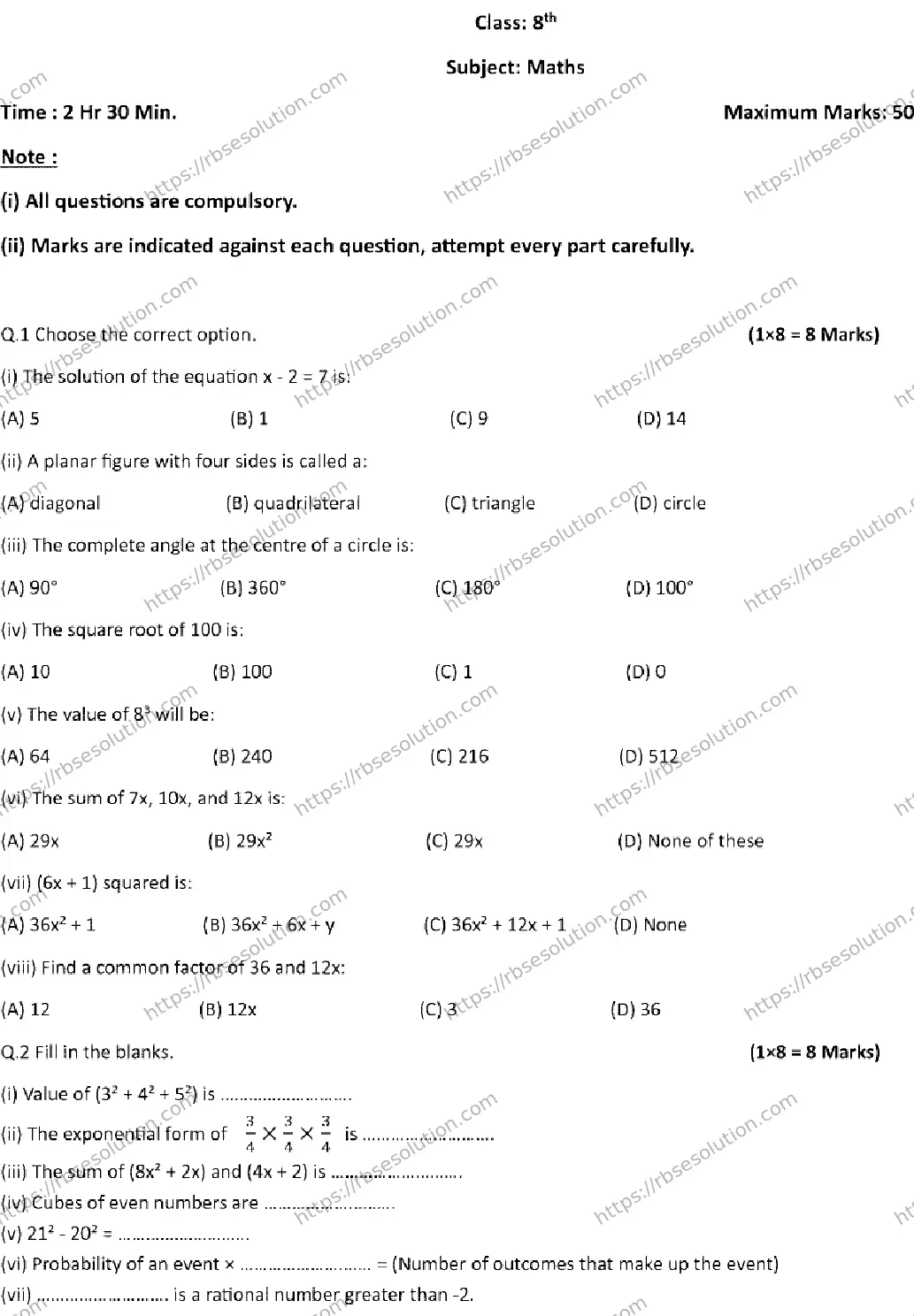
Class: 8th
Subject: Maths
Time: 2 Hr 30 Min. Maximum Marks: 50
Note:
- All questions are compulsory.
- Marks are indicated against each question, attempt every part carefully.
Q.1 Choose the correct option. (1 × 8 = 8 Marks)
-
The solution of the equation x - 2 = 7 is:
- (A) 5
- (B) 7
- (C) 9
- (D) 14
Explanation: x - 2 = 7 ⇒ x = 7 + 2 = 9.
-
A planar figure with four sides is called a:
- (A) diagonal
- (B) quadrilateral
- (C) triangle
- (D) circle
Explanation: A quadrilateral is a polygon with four sides.
-
The complete angle at the centre of a circle is:
- (A) 90°
- (B) 360°
- (C) 480°
- (D) 200°
Explanation: A full circle measures 360° at the centre.
-
The square root of 100 is:
- (A) 20
- (B) 10
- (C) 100
- (D) 1000
Explanation: √100 = 10 because 10 × 10 = 100.
-
The value of 8² will be:
- (A) 64
- (B) 240
- (C) 26
- (D) 522
Explanation: 8² = 8 × 8 = 64.
-
The sum of 7x, 10x, and 12x is:
- (A) 29x
- (B) 29x²
- (C) 29
- (D) None of these
Explanation: 7x + 10x + 12x = (7+10+12)x = 29x.
-
(6x + 2) squared is:
- (A) 36x² + 4
- (B) 36x² + 6x + 4
- (C) 36x² + 24x + 4
- (D) None
Explanation: (6x + 2)² = (6x)² + 2(6x)(2) + 2² = 36x² + 24x + 4.
-
Find a common factor of 36 and 2x:
- (A) 2
- (B) 2x
- (C) 3
- (D) 36
Explanation: 36 = 2 × 18 and 2x = 2 × x, so common factor is 2.
Q.2 Fill in the blanks. (1 × 8 = 8 Marks)
-
Value of (3² + 4² + 5²) is 50.
Solution: 3² = 9, 4² = 16, 5² = 25. Sum = 9 + 16 + 25 = 50. -
The exponential form of z × z × z × z is z⁴.
Solution: z multiplied by itself 4 times is written as z⁴. -
The sum of (8x² + 2x) and (4x + 2) is 8x² + 6x + 2.
Solution: (8x² + 2x) + (4x + 2) = 8x² + (2x + 4x) + 2 = 8x² + 6x + 2. -
Cubes of even numbers are even.
Solution: Even numbers are divisible by 2, so their cubes are also divisible by 2, hence even. -
2⁴ = 4² = 16.
Solution: 2⁴ = 2 × 2 × 2 × 2 = 16 and 4² = 4 × 4 = 16. -
Probability of an event = (Number of outcomes that make up the event) / (Total number of possible outcomes).
Solution: Probability = (Favourable outcomes) / (Total outcomes). -
-1 is a rational number greater than -2.
Solution: -1 is a rational number (since it can be written as -1/1) and -1 > -2.
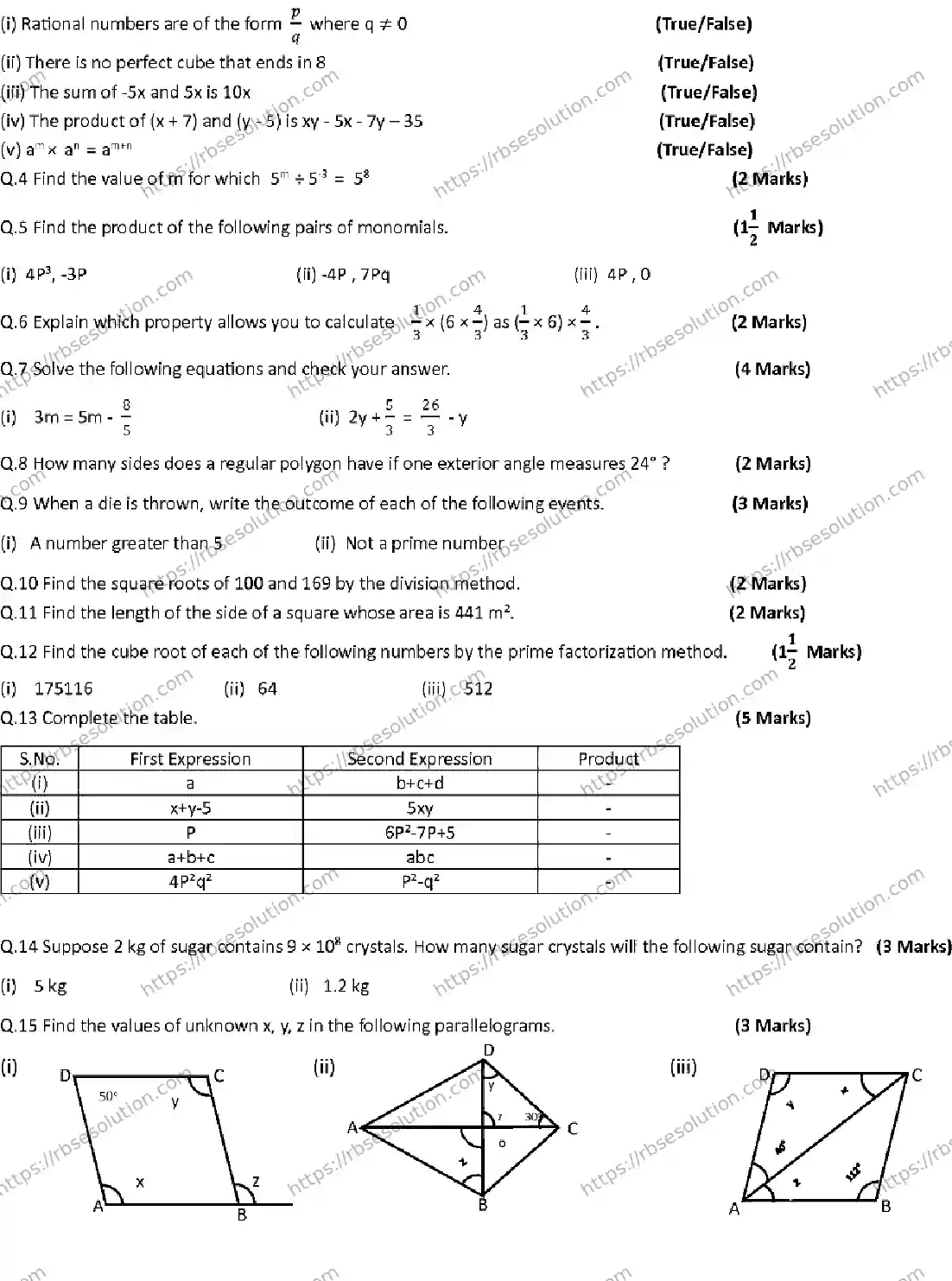
Question (i) to (v) – True/False
- Rational numbers are of the form p/q where q ≠ 0. True
- There is no perfect cube that ends in 8. False (e.g., 2³ = 8, 12³ = 1728)
- The sum of -5x and 5x is 10x. False (sum is 0)
- The product of (x + 7) and (y – 5) is xy – 5x – 7y – 35. False (correct product: xy – 5x + 7y – 35)
- aᵐ × aⁿ = aᵐ⁺ⁿ. True
Q.4 Find the value of n for which 5ⁿ + 5³ = 5³ (2 Marks)
Solution:
Given: 5ⁿ + 5³ = 5³
Subtract 5³ from both sides: 5ⁿ = 5³ – 5³ = 0
Since 5ⁿ = 0 has no solution for any real n (5ⁿ is always positive), the equation has no solution.
Answer: No value of n satisfies the equation.
Q.5 Find the product of the following pairs of monomials (2 Marks)
- (–3p) × (–3p) = 9p²
- (–a²) × (7pq) = –7a²pq
- (4) × (0) = 0
Q.6 Explain which property allows you to calculate (6 × ⅓) × 3 as 6 × (⅓ × 3) (2 Marks)
Answer: The Associative Property of Multiplication allows us to regroup the factors without changing the product. So (6 × ⅓) × 3 = 6 × (⅓ × 3).
Q.7 Solve the following equations and check your answer (4 Marks)
- 3m = 5m – 8
3m – 5m = –8 → –2m = –8 → m = 4
Check: LHS = 3×4 = 12; RHS = 5×4 – 8 = 20 – 8 = 12. ✓ - 2y + 3 = 7
2y = 7 – 3 = 4 → y = 2
Check: LHS = 2×2 + 3 = 4 + 3 = 7 = RHS. ✓
Q.8 How many sides does a regular polygon have if one exterior angle measures 24°? (2 Marks)
Solution: Sum of exterior angles of any polygon = 360°. For a regular polygon, each exterior angle = 360°/n.
Given: 360°/n = 24° → n = 360/24 = 15
Answer: The polygon has 15 sides.
Q.9 When a die is thrown, write the outcome of each of the following events (3 Marks)
- A number greater than 5: {6}
- Not a prime number: {1, 4, 6} (since prime numbers on a die are 2, 3, 5)
Q.10 Find the square roots of 200 and 69 by the division method (2 Marks)
Square root of 200: √200 = 14.142 (approx.)
Square root of 69: √69 = 8.306 (approx.)
Q.11 Find the length of the side of a square whose area is 44 m² (2 Marks)
Solution: Area of square = side² = 44 m²
Side = √44 = √(4 × 11) = 2√11 m ≈ 6.633 m
Answer: Side length = 2√11 m (approx. 6.63 m)
Q.12 Find the cube root of each of the following numbers by the prime factorization method (4 Marks)
- 475376: Prime factorization: 475376 = 2⁴ × 11 × 37 × 73 (not a perfect cube; cube root ≈ 78.0)
- 64: 64 = 2⁶ → cube root = 2² = 4
- 522: 522 = 2 × 3² × 29 (not a perfect cube; cube root ≈ 8.05)
Q.13 Complete the table (5 Marks)
| S.No. | First Expression | Second Expression | Product |
|---|---|---|---|
| (i) | 3 | b + c + d | 3b + 3c + 3d |
| (ii) | x + y – 5 | 5xy | 5x²y + 5xy² – 25xy |
| (iii) | p | 6p² – 7p + 5 | 6p³ – 7p² + 5p |
| (iv) | a + b + c | abc | a²bc + ab²c + abc² |
| (v) | 2pq | 6p²q | 12p³q² |
Q.14 Suppose 2 kg of sugar contains 9 × 10⁶ crystals. How many sugar crystals will the following sugar contain? (3 Marks)
- 5 kg: Crystals in 1 kg = (9 × 10⁶)/2 = 4.5 × 10⁶. So in 5 kg = 5 × 4.5 × 10⁶ = 22.5 × 10⁶ = 2.25 × 10⁷ crystals.
- 1.2 kg: Crystals = 1.2 × 4.5 × 10⁶ = 5.4 × 10⁶ crystals.
Q.15 Find the values of unknown x, y, z in the following parallelograms (3 Marks)
Note: The diagram is not fully clear from the text. In a parallelogram, opposite angles are equal and adjacent angles are supplementary (sum to 180°). If one angle is given as 70°, then:
x = 70° (opposite angle), y = 110° (adjacent), z = 110° (opposite to y).
Answer: x = 70°, y = 110°, z = 110° (assuming standard parallelogram with one angle 70°).