
RBSE Class 9th 2017 Maths-APS-910-E-2017 Previous Year Papers
Maths-APS-910-E-2017 from the 2017 exam year is part of the Class 9th previous year papers archive on RBSE Solution. Many learners start here after finishing the textbook to see how questions were actually framed on the Rajasthan Board of Secondary Education (RBSE) paper.
Treat this question paper as a mock under gentle timing first, then as a marking exercise the second time. The introduction on this page is written only for this subject-and-year pair, not copied from other pages.
Bookmark the link if you coach juniors — the layout stays stable for search engines and classroom sharing.
Paper details
Quick reference for this previous year papers page — confirm board, class, and year & subject before you study.
| Board | RBSE |
|---|---|
| Class | Class 9th |
| Exam year | 2017 |
| Subject | Maths-APS-910-E-2017 |
| Resource type | Previous Year Papers |
| Category | RBSE Previous Year Question Papers |
| Website | RBSE Solution |
The table summarises this Previous Year Papers resource. Confirm RBSE, Class 9th, year 2017, and subject Maths-APS-910-E-2017 before studying.
RBSE Solution organises previous year papers so each URL carries chapter-specific guidance — better for students and for search engines than one generic paragraph for the whole class.
How to practise with this question paper
Stage one: read the Maths-APS-910-E-2017 question paper from 2017 without a timer and highlight command words — explain, prove, calculate, discuss. Stage two: attempt selected questions closed-book. Stage three: compare with solutions or teacher feedback.
Previous Year Papers work best when you log mistakes by topic, not only by question number. That log becomes your revision index before pre-boards.
RBSE Class 9th 2017 Maths-APS-910-E-2017
Scroll through the Previous Year Papers pages for Maths-APS-910-E-2017 (2017).
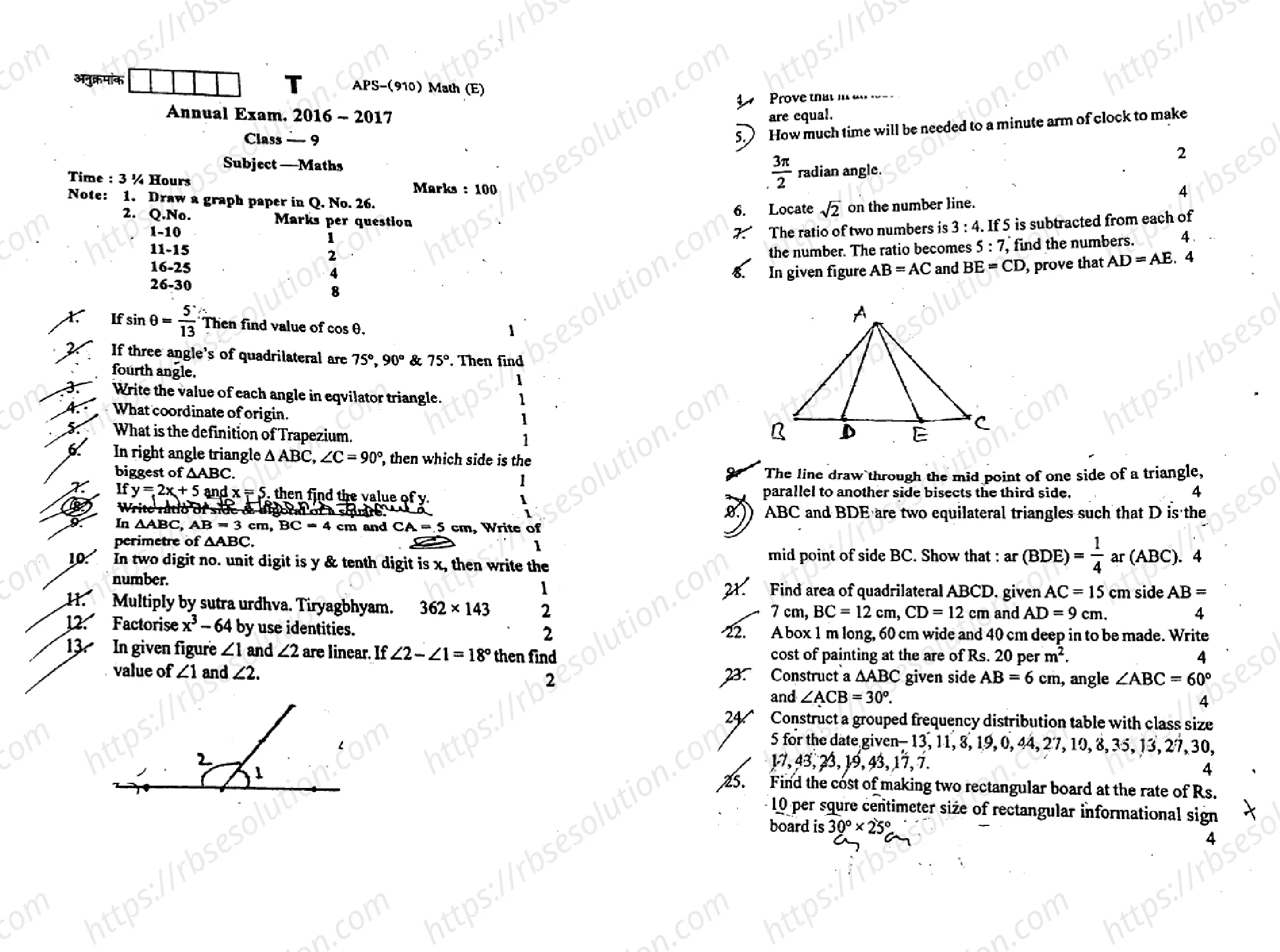

Rajasthan Board Class 9th Maths-APS-910-E-2017 2017 solved Previous Year Question Papers
Annual Exam, 2016 – 2017
Class – 9
Subject – Maths
Time: 3 Hours
Marks: 100
Note: Draw a graph paper in Q. No. 26.
Section A (1 mark each)
-
If sin θ = 4/5, then find the value of cos θ.
Solution: Using identity sin²θ + cos²θ = 1, cos²θ = 1 - (16/25) = 9/25, so cos θ = 3/5.
-
If three angles of a quadrilateral are 75°, 90° and 75°, then find the fourth angle.
Solution: Sum of angles in a quadrilateral = 360°. Fourth angle = 360° - (75° + 90° + 75°) = 360° - 240° = 120°.
-
Write the value of each angle in an equilateral triangle.
Solution: Each angle in an equilateral triangle is 60°.
-
What are the coordinates of the origin?
Solution: The coordinates of the origin are (0, 0).
-
What is the definition of a trapezium?
Solution: A trapezium is a quadrilateral with at least one pair of parallel sides.
-
In right-angled triangle ABC, ∠B = 90°, which side is the longest?
Solution: The side opposite the right angle (hypotenuse) is the longest. Here, side AC is the longest.
-
If y = 2x + 5 and x = 5, then find the value of y.
Solution: y = 2(5) + 5 = 10 + 5 = 15.
-
In ΔABC, AB = 3 cm, BC = 4 cm, and CA = 5 cm. Write the perimeter of ΔABC.
Solution: Perimeter = 3 + 4 + 5 = 12 cm.
-
In a two-digit number, the unit digit is y and the tens digit is x. Write the number.
Solution: The number is 10x + y.
Section B (2 marks each)
-
Multiply by sutra Urdhva Tiryagbhyam: 362 × 43.
Solution: Using Urdhva Tiryagbhyam (vertically and crosswise):
362 × 43 = (3×4) | (3×3 + 6×4) | (6×3 + 2×4) | (2×3) = 12 | (9+24) | (18+8) | 6 = 12 | 33 | 26 | 6 = 15566. -
Factorise x³ - 64 using identities.
Solution: Using identity a³ - b³ = (a - b)(a² + ab + b²): x³ - 64 = x³ - 4³ = (x - 4)(x² + 4x + 16).
-
In the given figure, ∠1 and ∠2 are linear. If ∠2 - ∠1 = 67°, then find the values of ∠1 and ∠2.
Solution: Linear pair means ∠1 + ∠2 = 180°. Given ∠2 - ∠1 = 67°. Adding: 2∠2 = 247°, so ∠2 = 123.5°. Then ∠1 = 180° - 123.5° = 56.5°.
-
Prove that 1 unit = 90°.
Solution: In angle measurement, 1 right angle = 90°. So 1 unit (right angle) = 90°.
-
How much time will be needed for the minute arm of a clock to make a 3π/2 radian angle?
Solution: 3π/2 radians = 270°. Minute hand moves 360° in 60 minutes, so 270° takes (270/360) × 60 = 45 minutes.
-
Locate √7 on the number line.
Solution: Draw a number line. Mark 0 and 1. Construct a right triangle with base 2 and height √3 (since 2² + (√3)² = 7). The hypotenuse is √7. Use compass to mark √7 on the number line.
Section C (3 marks each)
-
The ratio of two numbers is 3:4. If 5 is subtracted from each, the ratio becomes 5:7. Find the numbers.
Solution: Let numbers be 3x and 4x. After subtracting 5: (3x - 5)/(4x - 5) = 5/7. Cross-multiply: 7(3x - 5) = 5(4x - 5) → 21x - 35 = 20x - 25 → x = 10. Numbers are 30 and 40.
-
In the given figure, AB = AC and BE = CD. Prove that ΔABE ≅ ΔACD.
Solution: In ΔABE and ΔACD: AB = AC (given), BE = CD (given), and ∠ABE = ∠ACD (angles opposite equal sides in isosceles triangle). So by SAS congruence, ΔABE ≅ ΔACD.
-
The line drawn through the midpoint of one side of a triangle, parallel to another side, bisects the third side.
Solution: In ΔABC, let D be midpoint of AB. Draw DE ∥ BC meeting AC at E. By basic proportionality theorem, AD/DB = AE/EC. Since AD = DB, AE = EC, so E is midpoint of AC. Hence proved.
-
ABC and BDE are two equilateral triangles such that D is the midpoint of side BC. Show that ar(BDE) = 1/4 ar(ABC).
Solution: Let side of ΔABC = a. Then side of ΔBDE = a/2 (since D is midpoint). Area of equilateral triangle = (√3/4) × side². So ar(ABC) = (√3/4)a², ar(BDE) = (√3/4)(a/2)² = (√3/4)(a²/4) = (1/4) × (√3/4)a² = (1/4) ar(ABC).
-
Find the area of quadrilateral ABCD, given AC = 5 cm, AB = 7 cm, BC = 12 cm, CD = 12 cm, and AD = 9 cm.
Solution: Divide quadrilateral into two triangles by diagonal AC. For ΔABC: sides 7, 12, 5. Using Heron's formula: s = (7+12+5)/2 = 12, area = √[12(12-7)(12-12)(12-5)] = √[12×5×0×7] = 0 (invalid triangle). Check: 7+5=12, so ΔABC is degenerate. For ΔADC: sides 9, 12, 5. s = (9+12+5)/2 = 13, area = √[13(13-9)(13-12)(13-5)] = √[13×4×1×8] = √416 ≈ 20.4 cm². Total area ≈ 20.4 cm².
-
A box 1 m long, 60 cm wide, and 40 cm deep is to be made. Find the cost of painting at the rate of Rs. 20 per m².
Solution: Dimensions in meters: length = 1 m, width = 0.6 m, depth = 0.4 m. Surface area = 2(lb + bh + hl) = 2(1×0.6 + 0.6×0.4 + 0.4×1) = 2(0.6 + 0.24 + 0.4) = 2×1.24 = 2.48 m². Cost = 2.48 × 20 = Rs. 49.60.
-
Construct ΔABC given side AB = 6 cm, ∠ABC = 60°, and ∠ACB = 30°.
Solution: Steps: (1) Draw AB = 6 cm. (2) At B, draw angle 60°. (3) At C (on line from B), angle sum gives ∠BAC = 90°. (4) At A, draw angle 90° to meet line from B at C. (5) Triangle ABC is formed.
-
Construct a grouped frequency distribution table with class size 5 for the data: 3, 1, 8, 8, 0, 44, 27, 9, 8, 35, 33, 27, 30, 4, 43, 94, 99, 43, 77, 7.
Solution: Range: 0 to 99. Class intervals (size 5): 0-4, 5-9, 10-14, ..., 95-99. Frequency: 0-4: 3 (0,3,1,4), 5-9: 5 (8,8,9,8,7), 10-14: 0, 15-19: 0, 20-24: 0, 25-29: 2 (27,27), 30-34: 2 (33,30), 35-39: 1 (35), 40-44: 3 (44,43,43), 45-49: 0, ..., 75-79: 1 (77), 80-84: 0, 85-89: 0, 90-94: 1 (94), 95-99: 1 (99).
-
Find the cost of making two rectangular boards at the rate of Rs. 10 per square centimeter. Size of rectangular informational sign board is 25 cm × 9 cm.
Solution: Area of one board = 25 × 9 = 225 cm². Area of two boards = 2 × 225 = 450 cm². Cost = 450 × 10 = Rs. 4500.
Solved by Graph Method
Question 8: In the given figure, O is an interior point in a triangle. Prove that:
(BC + AB + AC) > (OA + OB + OC)
Solution:
In triangle OAB, by triangle inequality: OA + OB > AB
In triangle OBC: OB + OC > BC
In triangle OCA: OC + OA > AC
Adding all three inequalities:
(OA+OB) + (OB+OC) + (OC+OA) > AB + BC + AC
2(OA + OB + OC) > AB + BC + AC
Therefore, AB + BC + AC > OA + OB + OC
Hence proved.
Question (CBL 2 - Rat Bo to): AA SAD Y A
(Text unclear - possibly incomplete or misread)
Question (Q2Azq PRS): Construct a trapezium PQRS in which PQ ∥ RS, PQ = 6 cm, RS = 3 cm, PS = 3 cm and QR = 5 cm.
Solution:
Steps of Construction:
- Draw a line segment PQ = 6 cm.
- At point P, draw a ray making an angle (say 60° or any suitable angle) and cut PS = 3 cm.
- At point Q, draw a ray parallel to PS (since PQ ∥ RS, so angle at Q will be supplementary to angle at P).
- From point S, draw an arc of radius 3 cm (equal to RS) to cut the ray from Q at point R.
- Join QR and RS.
- PQRS is the required trapezium.
Note: The exact angle depends on the given measurements; ensure RS = 3 cm and QR = 5 cm.
Question: If ABCD is a quadrilateral, then prove that:
AB + BC + CD + DA > AC + BD
Solution:
In triangle ABC, by triangle inequality: AB + BC > AC
In triangle ADC: AD + DC > AC
Adding these two: AB + BC + AD + DC > 2AC
Similarly, in triangle ABD: AB + AD > BD
In triangle BCD: BC + CD > BD
Adding: AB + AD + BC + CD > 2BD
Now adding the two results:
2(AB + BC + CD + DA) > 2(AC + BD)
Therefore, AB + BC + CD + DA > AC + BD
Hence proved.