
RBSE Class 9th 2017 Social Science-APS-914-E-2017 Previous Year Papers
Social Science-APS-914-E-2017 from the 2017 exam year is part of the Class 9th previous year papers archive on RBSE Solution. Many learners start here after finishing the textbook to see how questions were actually framed on the Rajasthan Board of Secondary Education (RBSE) paper.
Treat this question paper as a mock under gentle timing first, then as a marking exercise the second time. The introduction on this page is written only for this subject-and-year pair, not copied from other pages.
Bookmark the link if you coach juniors — the layout stays stable for search engines and classroom sharing.
Paper details
Quick reference for this previous year papers page — confirm board, class, and year & subject before you study.
| Board | RBSE |
|---|---|
| Class | Class 9th |
| Exam year | 2017 |
| Subject | Social Science-APS-914-E-2017 |
| Resource type | Previous Year Papers |
| Category | RBSE Previous Year Question Papers |
| Website | RBSE Solution |
The table summarises this Previous Year Papers resource. Confirm RBSE, Class 9th, year 2017, and subject Social Science-APS-914-E-2017 before studying.
RBSE Solution organises previous year papers so each URL carries chapter-specific guidance — better for students and for search engines than one generic paragraph for the whole class.
How to practise with this question paper
Stage one: read the Social Science-APS-914-E-2017 question paper from 2017 without a timer and highlight command words — explain, prove, calculate, discuss. Stage two: attempt selected questions closed-book. Stage three: compare with solutions or teacher feedback.
Previous Year Papers work best when you log mistakes by topic, not only by question number. That log becomes your revision index before pre-boards.
RBSE Class 9th 2017 Social Science-APS-914-E-2017
Scroll through the Previous Year Papers pages for Social Science-APS-914-E-2017 (2017).
Rajasthan Board Class 9th Social Science-APS-914-E-2017 2017 solved Previous Year Question Papers
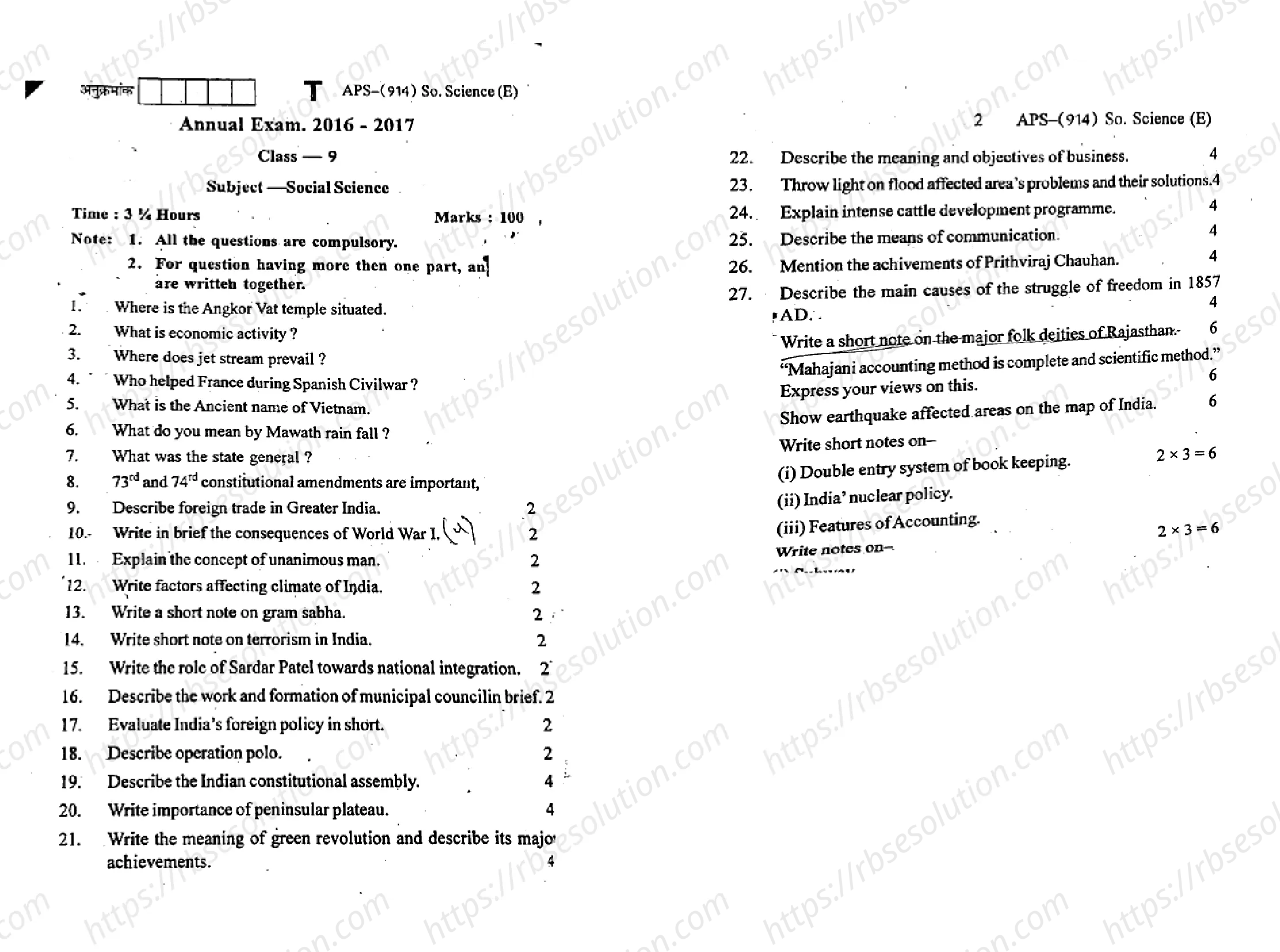
Annual Exam. 2016 - 2017
Class: 9
Subject: Social Science
Time: 3 Hours 15 Minutes
Marks: 100
Note:
- All the questions are compulsory.
- For questions having more than one part, all parts are to be answered together.
Section A (Very Short Answer Questions)
-
Where is the Angkor Vat temple situated?
Answer: Angkor Vat temple is situated in Cambodia (Siem Reap province).
-
What is economic activity?
Answer: Economic activity refers to any action that involves the production, distribution, or consumption of goods and services for monetary gain or to satisfy human wants.
-
Where does jet stream prevail?
Answer: Jet streams prevail in the upper atmosphere (troposphere), typically at altitudes between 7 to 12 km above the Earth's surface.
-
Who helped France during the Spanish Civil War?
Answer: France, along with other democratic nations, did not directly help the Spanish Republic due to the Non-Intervention Agreement. However, the Soviet Union and International Brigades helped the Republican side, while Nazi Germany and Fascist Italy helped Franco's Nationalists.
-
What is the ancient name of Vietnam?
Answer: The ancient name of Vietnam was Văn Lang (or later Đại Việt).
-
What do you mean by Mawsynram rainfall?
Answer: Mawsynram, located in Meghalaya, India, receives the highest average rainfall in the world due to the monsoon winds and its funnel-shaped valley. It is known for its extremely heavy and prolonged rainfall.
-
What was the State General?
Answer: The State General (Estates-General) was a legislative assembly in pre-revolutionary France, consisting of three estates: the clergy, the nobility, and the commoners.
-
73rd and 74th constitutional amendments are important. Why?
Answer: The 73rd and 74th Constitutional Amendments are important because they provided constitutional status to Panchayati Raj institutions (rural local self-government) and Urban Local Bodies (municipalities), strengthening grassroots democracy in India.
Section B (Short Answer Questions)
-
Describe foreign trade in Greater India.
Answer: Greater India refers to the historical influence of Indian culture, trade, and religion across Southeast Asia. Foreign trade in Greater India involved the exchange of spices, textiles, precious stones, and ideas (Buddhism, Hinduism) between India and regions like Java, Sumatra, Cambodia, and Thailand. Indian merchants established trading posts, and this led to cultural and political ties.
-
Write in brief the consequences of World War I.
Answer: Consequences of World War I include: massive loss of life and property, the fall of empires (Austro-Hungarian, Ottoman, German, Russian), the rise of new nations, the Treaty of Versailles, economic instability, the rise of fascism and communism, and the seeds for World War II.
-
Explain the concept of unanimous man.
Answer: The concept of "unanimous man" (likely referring to unanimous or universal man) is a philosophical idea that emphasizes the unity of humanity, where all individuals share common values, rights, and goals, transcending divisions of nationality, religion, or class.
-
Write factors affecting climate of India.
Answer: Factors affecting the climate of India include: latitude (tropical and subtropical), altitude, distance from the sea, monsoon winds, jet streams, the Himalayan mountain range (which blocks cold winds), and the Indian Ocean's influence.
-
Write a short note on Gram Sabha.
Answer: Gram Sabha is a village assembly consisting of all adult residents of a village. It is the foundation of the Panchayati Raj system, where villagers discuss and decide on local development issues, approve budgets, and monitor the work of the Gram Panchayat.
-
Write a short note on terrorism in India.
Answer: Terrorism in India refers to acts of violence by extremist groups to achieve political, religious, or ideological goals. It includes cross-border terrorism in Jammu and Kashmir, insurgencies in the Northeast, and Naxalite movements. India has implemented counter-terrorism measures and laws to combat this threat.
-
Write the role of Sardar Patel towards national integration.
Answer: Sardar Vallabhbhai Patel played a crucial role in national integration by persuading over 560 princely states to join the Indian Union after independence. His diplomatic and firm approach ensured a unified India, earning him the title "Iron Man of India."
-
Describe the work and formation of municipal council in brief.
Answer: A municipal council is formed in urban areas (towns and cities) through local elections. Its work includes providing basic services like water supply, sanitation, roads, street lighting, waste management, and maintaining public health and education facilities. It is headed by a chairperson or mayor.
-
Evaluate India’s foreign policy in short.
Answer: India's foreign policy is based on principles of non-alignment, peaceful coexistence (Panchsheel), respect for sovereignty, and promoting global peace. It focuses on strategic autonomy, economic diplomacy, and building strong ties with neighboring countries, major powers, and developing nations.
-
Describe Operation Polo.
Answer: Operation Polo was the code name for the Indian military action in September 1948 that led to the annexation of the princely state of Hyderabad into the Indian Union. It was a swift operation that ended the rule of the Nizam and integrated Hyderabad.
-
Describe the Indian Constitutional Assembly.
Answer: The Indian Constituent Assembly was formed in 1946 to draft the Constitution of India. It consisted of elected representatives from provinces and princely states. Dr. B.R. Ambedkar was the chairman of the Drafting Committee. The Assembly completed the Constitution on November 26, 1949, which came into effect on January 26, 1950.
-
Write importance of Peninsular Plateau.
Answer: The Peninsular Plateau is important because it is rich in minerals (iron, coal, manganese), supports agriculture (black soil for cotton), has major rivers (Godavari, Krishna), and is a source of forest resources. It also forms the oldest and most stable landmass of India.
-
Write the meaning of green revolution and describe its major achievements.
Answer: The Green Revolution refers to the introduction of high-yielding variety (HYV) seeds, chemical fertilizers, and modern irrigation techniques in the 1960s to increase food grain production. Major achievements include: self-sufficiency in food grains (especially wheat and rice), increased crop yields, reduced imports, and improved rural income.
Section C (Long Answer Questions)
-
Describe the meaning and objectives of business.
Answer: Business refers to any economic activity involving the production, purchase, sale, or exchange of goods and services with the aim of earning profit. Its objectives include: earning profit, satisfying customer needs, creating employment, contributing to economic growth, and ensuring social responsibility.
-
Throw light on flood affected area’s problems and their solutions.
Answer: Flood-affected areas face problems like loss of life and property, damage to crops and infrastructure, spread of waterborne diseases, displacement of people, and disruption of communication. Solutions include: building dams and embankments, improving drainage systems, afforestation, early warning systems, floodplain zoning, and providing relief and rehabilitation.
-
Explain intense cattle development programme.
Answer: The Intense Cattle Development Programme (ICDP) is a government initiative to improve cattle breeds through artificial insemination, better nutrition, disease control, and scientific management. It aims to increase milk production, enhance genetic quality, and support dairy farmers.
-
Describe the means of communication.
Answer: Means of communication include: postal services (letters, parcels), telecommunications (telephone, mobile, internet), mass media (radio, television, newspapers), and digital platforms (email, social media). They enable the exchange of information, ideas, and news across distances.
-
Mention the achievements of Prithviraj Chauhan.
Answer: Prithviraj Chauhan was a Rajput king of the Chauhan dynasty. His achievements include: defeating Muhammad Ghori in the First Battle of Tarain (1191), expanding his kingdom in North India, patronizing art and literature (e.g., poet Chand Bardai), and being a skilled warrior and administrator.
-
Describe the main causes of the struggle of freedom in 1857.
Answer: The main causes of the 1857 revolt include: political (Doctrine of Lapse, annexation of states), economic (heavy taxes, exploitation), social (interference in religious customs, introduction of new laws), military (greased cartridges issue), and immediate cause (the cartridge incident at Meerut).
-
Write a short note on the major folk deities of Rajasthan.
Answer: Major folk deities of Rajasthan include: Pabuji (a folk hero and protector of cattle), Tejaji (a snake god), Gogaji (a warrior saint), Ramdevji (a saint known for miracles), and Harbhoji (a folk deity). They are worshipped in local traditions and fairs.
-
“Mahajani accounting method is complete and scientific method.” Express your views on this.
Answer: The Mahajani accounting method is a traditional system used by Indian merchants. It is considered complete because it records all transactions systematically using a unique script and symbols. It is scientific as it follows principles of double-entry bookkeeping, maintains ledgers, and ensures accuracy. However, it lacks standardization and modern features, so it is being replaced by modern accounting.
-
Show earthquake affected areas on the map of India.
Answer: Earthquake-affected areas in India include: the Himalayan region (Jammu & Kashmir, Himachal Pradesh, Uttarakhand, Northeast India), the Indo-Gangetic plains, Gujarat (Bhuj), and parts of Maharashtra (Latur). These are seismically active zones.
Section D (Very Long Answer Questions)
-
Write short notes on—
-
Double entry system of book keeping.
Answer: The double entry system is a method of bookkeeping where every transaction has two aspects: debit and credit. It ensures that the accounting equation (Assets = Liabilities + Equity) remains balanced. It provides accuracy and helps in preparing financial statements.
-
India’s nuclear policy.
Answer: India's nuclear policy is based on "No First Use" (NFU) and credible minimum deterrence. India advocates for global nuclear disarmament and maintains a
-