
RBSE Class 9th 2026 ENGLISH-902 Previous Year Papers
You opened the RBSE Class 9th 2026 ENGLISH-902 Previous Year Papers page — a focused place to read the real previous year question paper for that subject and year. RBSE Solution keeps exam-year sets together so you can practise the same cycle your seniors faced.
Previous year papers reward patience: read instructions, note mark distribution, then attempt questions before peeking at solutions elsewhere on the site. This URL always loads the same free previous year papers content for ENGLISH-902 (2026).
Use the details table to confirm class and year, then scroll to the paper images or PDF below. More subjects from 2026 are linked later on this page.
Paper details
Quick reference for this previous year papers page — confirm board, class, and year & subject before you study.
| Board | RBSE |
|---|---|
| Class | Class 9th |
| Exam year | 2026 |
| Subject | ENGLISH-902 |
| Resource type | Previous Year Papers |
| Category | RBSE Previous Year Question Papers |
| Website | RBSE Solution |
The table summarises this Previous Year Papers resource. Confirm RBSE, Class 9th, year 2026, and subject ENGLISH-902 before studying.
RBSE Solution organises previous year papers so each URL carries chapter-specific guidance — better for students and for search engines than one generic paragraph for the whole class.
How to practise with this question paper
Stage one: read the ENGLISH-902 question paper from 2026 without a timer and highlight command words — explain, prove, calculate, discuss. Stage two: attempt selected questions closed-book. Stage three: compare with solutions or teacher feedback.
Previous Year Papers work best when you log mistakes by topic, not only by question number. That log becomes your revision index before pre-boards.
RBSE Class 9th 2026 ENGLISH-902
Scroll through the Previous Year Papers pages for ENGLISH-902 (2026).
Rajasthan Board Class 9th ENGLISH-902 2026 solved Previous Year Question Papers
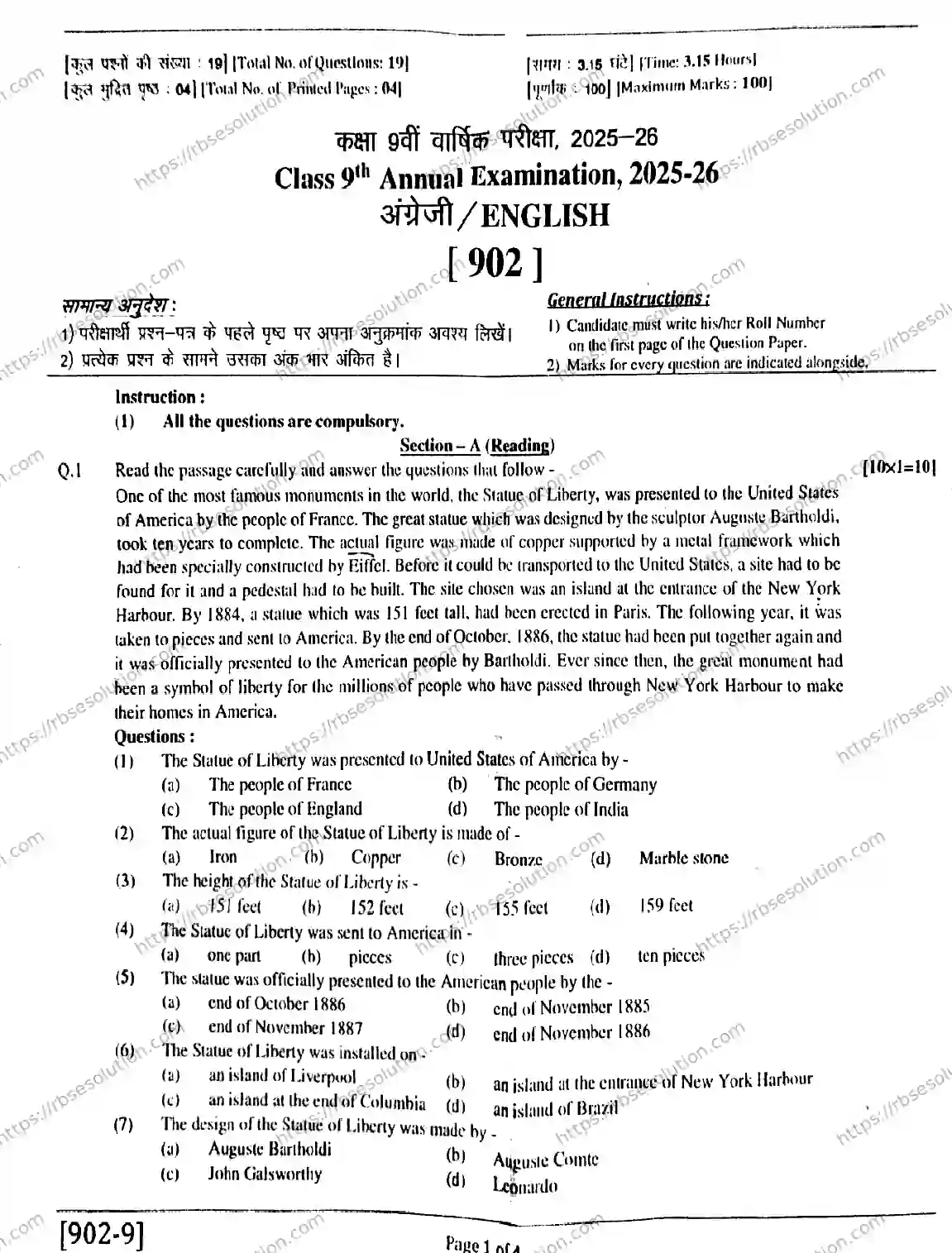
Class 9th Annual Examination, 2025-26
English / ENGLISH [902]
Total No. of Questions: 49 | Time: 3.15 Hours | Maximum Marks: 100
Total No. of Printed Pages: 04
सामान्य निर्देश / General Instructions:
- परीक्षार्थी प्रश्न-पत्र के पहले पृष्ठ पर अपना अनुक्रमांक अवश्य लिखें। / Candidate must write his/her Roll Number on the first page of the Question Paper.
- प्रत्येक प्रश्न के सामने उसका अंक-भार अंकित है। / Marks for every question are indicated alongside.
Instruction: (I) All the questions are compulsory.
Section - A (Reading)
Read the passage carefully and answer the questions that follow -
One of the most famous monuments in the world, the Statue of Liberty, was presented to the United States of America by the people of France. The great statue which was designed by the sculptor Auguste Bartholdi, took ten years to complete. The actual figure was made of copper supported by a metal framework which had been specially constructed by Eiffel. Before it could be transported to the United States, a site had to be found for it and a pedestal had to be built. The site chosen was an island at the entrance of the New York Harbour. By 1884, a statue which was 151 feet tall, had been erected in Paris. The following year, it was taken to pieces and sent to America. By the end of October, 1886, the statue had been put together again and it was officially presented to the American people by Bartholdi. Ever since then, the great monument had been a symbol of liberty for the millions of people who have passed through New York Harbour to make their homes in America.
Questions:
-
The Statue of Liberty was presented to United States of America by -
- The people of France
- The people of Germany
- The people of England
- The people of India
Correct Answer: (a) The people of France
Explanation: The passage states, "the Statue of Liberty, was presented to the United States of America by the people of France."
-
The actual figure of the Statue of Liberty is made of -
- Iron
- Copper
- Bronze
- Marble stone
Correct Answer: (b) Copper
Explanation: The passage mentions, "The actual figure was made of copper supported by a metal framework."
-
The height of the Statue of Liberty is -
- 151 feet
- 526 feet
- 560 feet
- 59 feet
Correct Answer: (a) 151 feet
Explanation: The passage says, "By 1884, a statue which was 151 feet tall, had been erected in Paris."
-
The Statue of Liberty was sent to America in -
- one part
- pieces
- three pieces
- ten pieces
Correct Answer: (b) pieces
Explanation: The passage states, "it was taken to pieces and sent to America."
-
The statue was officially presented to the American people by the -
- end of October 1886
- end of November 1885
- end of November 1887
- end of November 1886
Correct Answer: (a) end of October 1886
Explanation: The passage mentions, "By the end of October, 1886, the statue had been put together again and it was officially presented to the American people by Bartholdi."
-
The Statue of Liberty was installed on -
- an island of Liverpool
- an island at the entrance of New York Harbour
- an island at the end of Columbia
- an island of Brazil
Correct Answer: (b) an island at the entrance of New York Harbour
Explanation: The passage says, "The site chosen was an island at the entrance of the New York Harbour."
-
The design of the Statue of Liberty was made by -
- Auguste Bartholdi
- Auguste Comte
- John Galsworthy
- Leonardo
Correct Answer: (a) Auguste Bartholdi
Explanation: The passage states, "the great statue which was designed by the sculptor Auguste Bartholdi."
Section - A (Reading)
Multiple Choice Questions
-
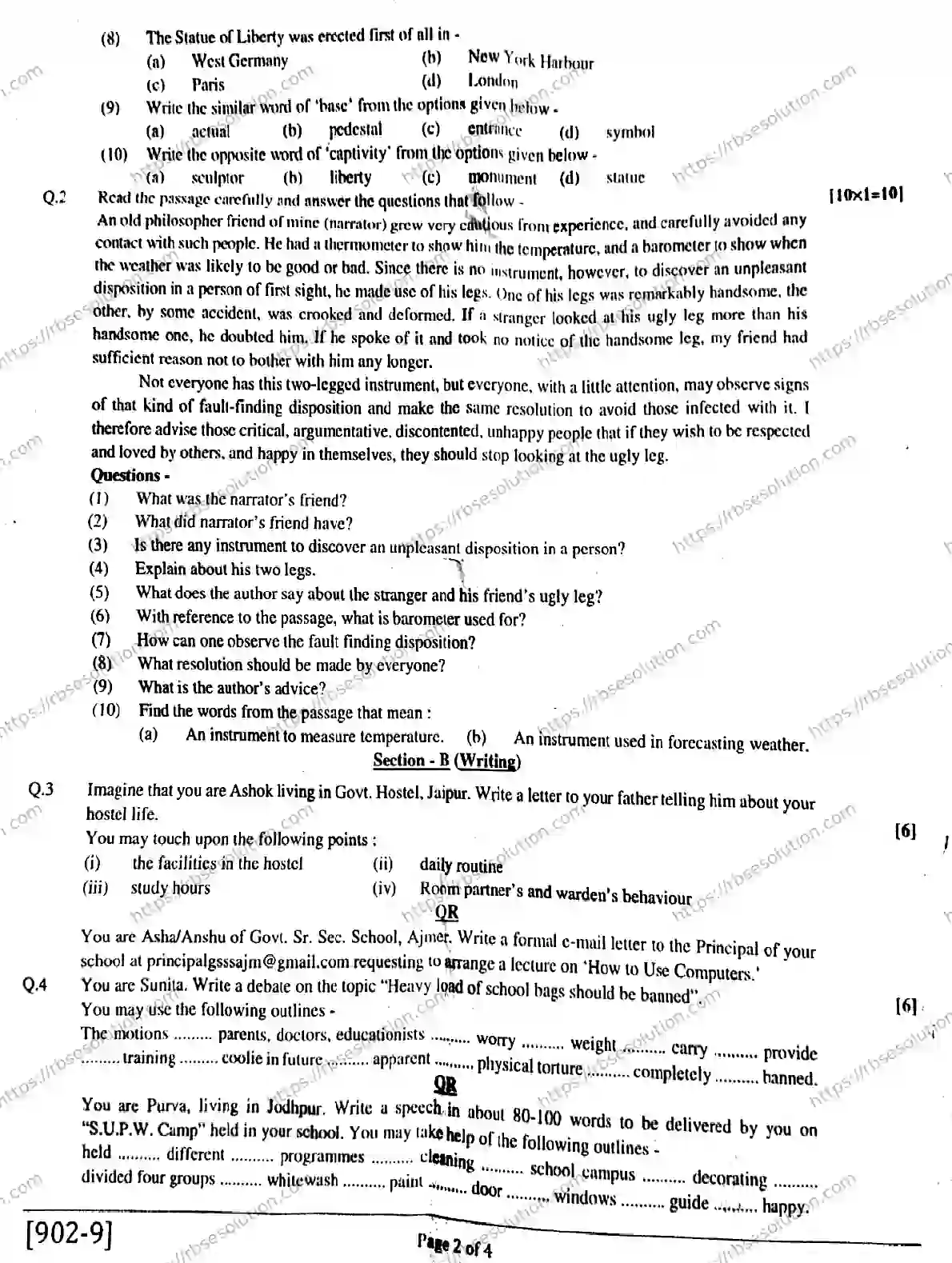
The Statue of Liberty was erected first of all in -
- (a) West Germany
- (b) New York Harbour
- (c) Paris
- (d) London
Correct Answer: (c) Paris
Explanation: The Statue of Liberty was originally erected in Paris, France, before being disassembled and shipped to New York Harbour.
-
Write the similar word of ‘base’ from the options given below -
- (a) actual
- (b) pedestal
- (c) entrance
- (d) सजत
Correct Answer: (b) pedestal
Explanation: 'Pedestal' is a synonym for 'base', meaning the supporting structure at the bottom.
-
Write the opposite word of ‘captivity’ from the options given below -
- (a) sculptor
- (b) liberty
- (c) monument
- (d) statue
Correct Answer: (b) liberty
Explanation: 'Liberty' means freedom, which is the opposite of 'captivity' (being confined or imprisoned).
Passage Based Questions
Read the passage carefully and answer the questions that follow -
An old philosopher friend of mine (narrator) grew very cautious from experience, and carefully avoided any contact with such people. He had a thermometer to show him the temperature, and a barometer to show when the weather was likely to be good or bad. Since there is no instrument, however, to discover an unpleasant disposition in a person at first sight, he made use of his legs. One of his legs was remarkably handsome, the other, by some accident, was crooked and deformed. If a stranger looked at his ugly leg more than his handsome one, he doubted him. If he spoke of it and took no notice of the handsome leg, my friend had sufficient reason not to bother with him any longer.
Not everyone has this two-legged instrument, but everyone, with a little attention, may observe signs of that kind of fault-finding disposition and make the same resolution to avoid those infected with it. I therefore advise those critical, argumentative, discontented, unhappy people that if they wish to be respected and loved by others, and happy in themselves, they should stop looking at the ugly leg.
-
Who was the narrator's friend?
The narrator's friend was an old philosopher.
-
What did narrator's friend have?
He had a thermometer to measure temperature and a barometer to predict weather. He also had two legs - one handsome and one crooked.
-
Is there any instrument to discover an unpleasant disposition in a person?
No, there is no instrument to discover an unpleasant disposition in a person at first sight.
-
Explain about his two legs.
One of his legs was remarkably handsome, while the other, due to some accident, was crooked and deformed.
-
What does the author say about the stranger and his friend's ugly leg?
If a stranger looked at the ugly leg more than the handsome one, the friend doubted him. If the stranger spoke about the ugly leg and ignored the handsome one, the friend would not bother with him any longer.
-
With reference to the passage, what is barometer used for?
A barometer is used to show when the weather is likely to be good or bad.
-
How can one observe the fault finding disposition?
With a little attention, everyone may observe signs of fault-finding disposition in people.
-
What resolution should be made by everyone?
Everyone should make a resolution to avoid those infected with a fault-finding disposition.
-
What is the author's advice?
The author advises critical, argumentative, discontented, and unhappy people that if they wish to be respected and loved by others, and be happy in themselves, they should stop looking at the ugly leg (i.e., stop focusing on faults).
-
Find the words from the passage that mean:
- An instrument to measure temperature.
- An instrument used in forecasting weather.
(a) Thermometer
(b) Barometer
Section - B (Writing)
Letter Writing
Imagine that you are Ashok living in Govt. Hostel, Jaipur. Write a letter to your father telling him about your hostel life.
You may touch upon the following points:
- (i) the facilities in the hostel
- (ii) daily routine
- (iii) study hours
- (iv) Room partner's and warden's behaviour
Govt. Hostel, Jaipur
Date: [Current Date]
Dear Father,
I hope this letter finds you in good health. I am doing well here in the hostel. I wanted to share with you about my hostel life.
The hostel facilities are quite good. We have clean rooms, proper electricity, and water supply. The mess provides nutritious food three times a day. There is also a common room with a television and newspapers.
My daily routine is well-organized. I wake up at 6:00 AM, freshen up, and go for a morning walk. After breakfast, I attend school from 8:00 AM to 2:00 PM. In the afternoon, I rest for a while and then study from 4:00 PM to 6:00 PM. After dinner, I study again from 7:00 PM to 9:30 PM.
My room partner is very cooperative and helpful. We share our books and help each other with studies. The warden is strict but kind. He ensures discipline and takes care of our needs.
Please convey my regards to mother and love to younger sister. Take care of your health.
Your loving son,
Ashok
OR
You are Asha/Anshu of Govt. Sr. Sec. School, Ajmer. Write a formal e-mail letter to the Principal of your school at principalgsssajm@gmail.com requesting to arrange a lecture on 'How to Use Computers'.
To: principalgsssajm@gmail.com
Subject: Request to Arrange a Lecture on 'How to Use Computers'
Respected Principal,
I am Asha/Anshu, a student of Class 9th in your school. I am writing this email to respectfully request you to arrange a lecture on the topic 'How to Use Computers' for the students of our school.
In today's digital age, computer knowledge is essential for everyone. Many students in our school are not fully aware of how to operate computers effectively. A lecture by an expert will help us understand the basics of computers, their uses, and their importance in education and career.
I request you to kindly consider this proposal and arrange the lecture at your earliest convenience. We will be grateful for this opportunity.
Thanking you,
Yours obediently,
Asha/Anshu
Class 9th
Govt. Sr. Sec. School, Ajmer
Debate Writing
You are Sunita. Write a debate on the topic "Heavy load of school bags should be banned".
You may use the following outlines:
- The motions ......... parents, doctors, educationists
- er training ......... Coolie in future iss... apparent
- sical ("0 ,......... completely .
- aR y
- + provide
- .. banned.
Debate: "Heavy load of school bags should be banned"
Good morning, respected judges, teachers, and dear friends. I, Sunita, stand here today to speak in favor of the motion that the heavy load of school bags should be banned.
Parents, doctors, and educationists are all concerned about this issue. Children as young as 6-7 years carry bags weighing 5-6 kilograms. This heavy load causes physical problems like back pain, shoulder strain, and posture issues. Doctors warn that this can lead to permanent spinal damage.
Moreover, carrying such heavy bags makes children tired before they even reach school. They cannot concentrate on studies properly. Some children even become like coolies, carrying loads instead of enjoying their childhood.
The government has already issued guidelines limiting the weight of school bags, but these are not followed properly. Schools should provide lockers, use digital books, and follow a timetable that reduces the number of books needed daily.
In conclusion, I strongly support the motion that heavy school bags should be banned completely. It is essential for the physical and mental well-being of our children. Thank you.
Speech Writing
You are Purva, living in Jodhpur. Write a speech in about 80-100 words to be delivered by you on "S.U.P.W. Camp" held in your school. You may take help of the following outlines:
- held .......... different Programmes .......... cleaning ...
- divided four group: . Whitewash .......... pail
- School. campus ...
Speech on "S.U.P.W. Camp"
Good morning, respected Principal, teachers, and dear friends. I, Purva, am here to share my experience of the S.U.P.W. Camp held in our school.
The camp was organized last week with different programmes. We were divided into four groups. Each group was assigned different tasks like cleaning the school campus, whitewashing the walls, planting trees, and painting the classrooms.
We worked with great enthusiasm. The cleaning group swept the grounds and removed garbage. The whitewashing group made the walls look fresh and clean. The gardening group planted saplings and watered them.
This camp taught us the value of hard work and teamwork. It was a wonderful experience that helped us understand the importance of keeping our school clean and beautiful. Thank you.
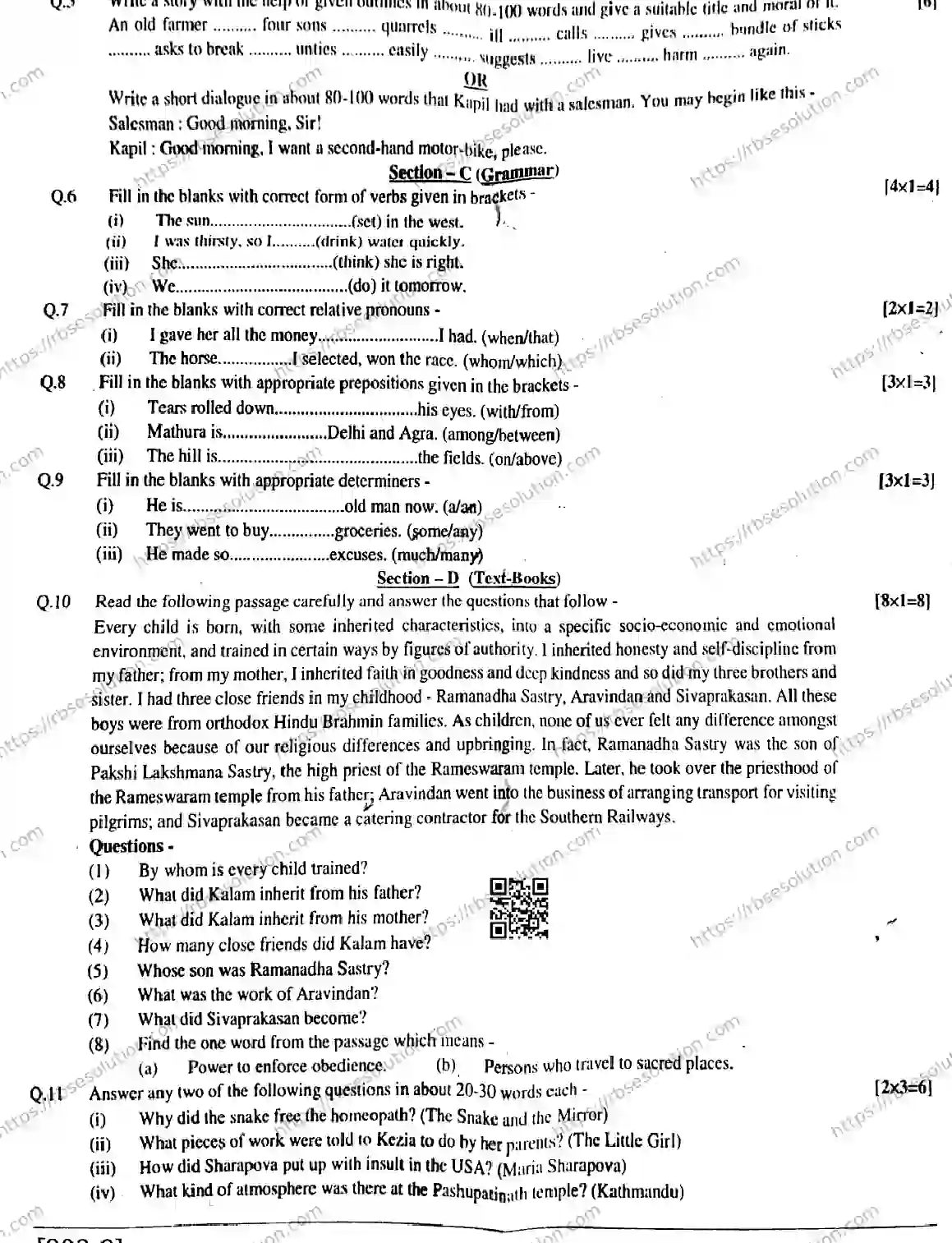
Section - C (Grammar)
Fill in the blanks with correct form of verbs given in brackets:
- The sun sets in the west. (set)
- I was thirsty, so I drank water quickly. (drink)
- She thinks she is right. (think)
- We will do it tomorrow. (do)
Fill in the blanks with correct relative pronouns:
- I gave her all the money that I had. (when/that)
- The horse which I selected won the race. (whom/which)
Fill in the blanks with appropriate prepositions given in the brackets:
- Tears rolled down from his eyes. (with/from)
- Mathura is between Delhi and Agra. (among/between)
- The hill is above the fields. (on/above)
Fill in the blanks with appropriate determiners:
- He is an old man now. (a/an)
- They went to buy some groceries. (some/any)
- He made so many excuses. (much/many)
Section - D (Text-Books)
Read the following passage carefully and answer the questions that follow:
Every child is born with some inherited characteristics, into a specific socio-economic and emotional environment, and trained in certain ways by figures of authority. I inherited honesty and self-discipline from my father; from my mother, I inherited faith in goodness and deep kindness and so did my three brothers and sister. I had three close friends in my childhood - Ramanadha Sastry, Aravindan and Sivaprakasan. All these boys were from orthodox Hindu Brahmin families. As children, none of us ever felt any difference amongst ourselves because of our religious differences and upbringing. In fact, Ramanadha Sastry was the son of Pakshi Lakshmana Sastry, the high priest of the Rameswaram temple. Later, he took over the priesthood of the Rameswaram temple from his father. Aravindan went into the business of arranging transport for visiting pilgrims; and Sivaprakasan became a catering contractor for the Southern Railways.
Questions:
- By whom is every child trained?
Every child is trained by figures of authority.
- What did Kalam inherit from his father?
Kalam inherited honesty and self-discipline from his father.
- What did Kalam inherit from his mother?
Kalam inherited faith in goodness and deep kindness from his mother.
- How many close friends did Kalam have?
Kalam had three close friends in his childhood.
- Whose son was Ramanadha Sastry?
Ramanadha Sastry was the son of Pakshi Lakshmana Sastry, the high priest of the Rameswaram temple.
- What was the work of Aravindan?
Aravindan went into the business of arranging transport for visiting pilgrims.
- What did Sivaprakasan become?
Sivaprakasan became a catering contractor for the Southern Railways.
- Find the one word from the passage which means:
- (a) Power to enforce obedience: Authority
- (b) Persons who travel to sacred places: Pilgrims
Answer any two of the following questions in about 20-30 words each:
- Why did the snake free the homeopath? (The Snake and the Mirror)
The snake freed the homeopath because it was more interested in its own reflection in the mirror than in harming him. It slithered away after seeing itself.
- What pieces of work were told to Kezia to do by her parents? (The Little Girl)
Kezia was told to do small tasks like bringing her father's slippers, sewing buttons, and keeping quiet while her parents rested. She was also expected to be obedient.
- How did Sharapova put up with insult in the USA? (Maria Sharapova)
Sharapova faced insults and discrimination in the USA due to her Russian accent. She endured it with patience and determination, focusing on her tennis training and goals.
- What kind of atmosphere was there at the Pashupatinath temple? (Kathmandu)
The atmosphere at the Pashupatinath temple was chaotic and crowded, with priests, devotees, beggars, and animals all present. There was a sense of religious fervor mixed with confusion.
Section C: Literature (Continued)
Q.13
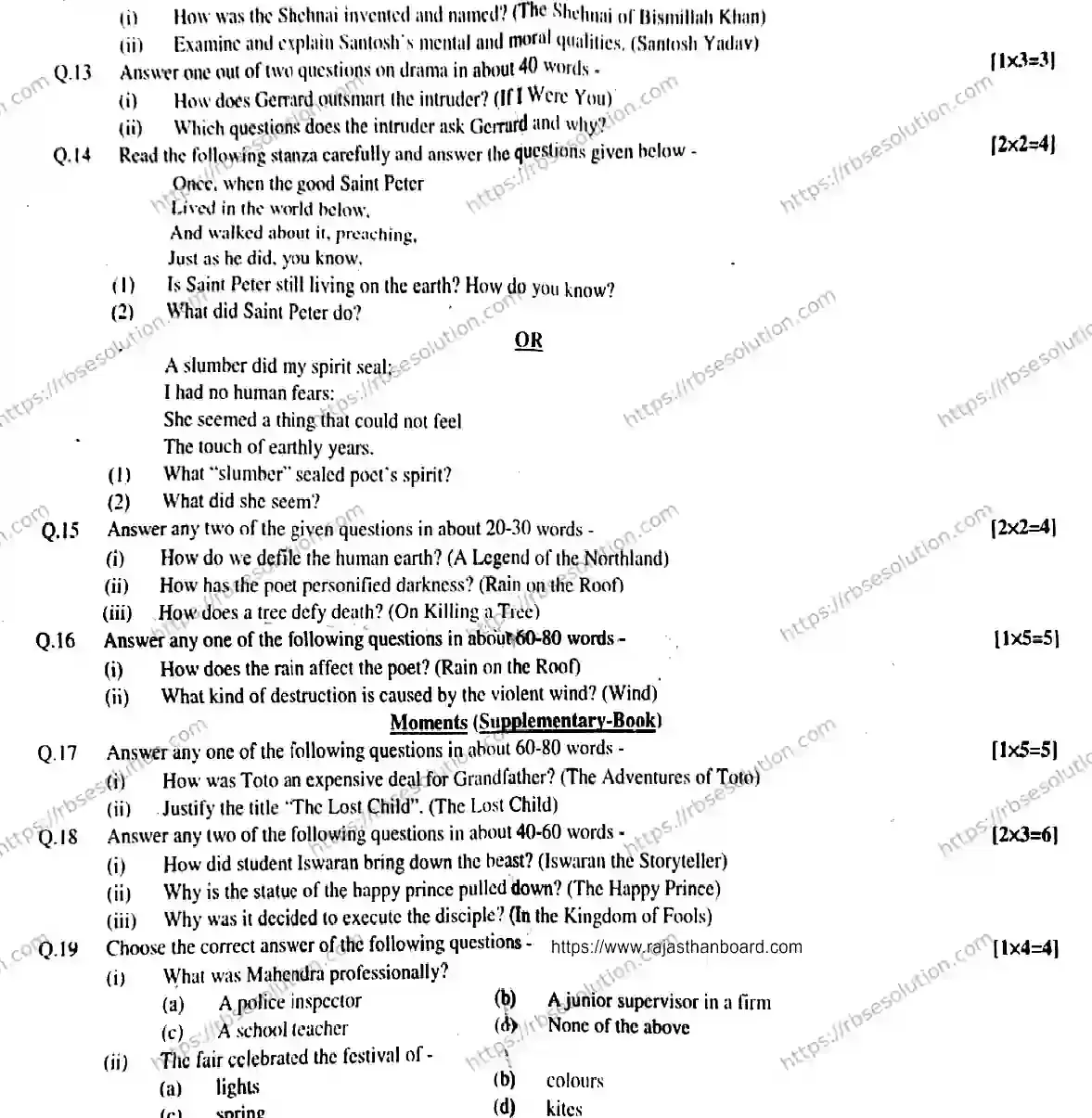
Answer one out of two questions on drama in about 40 words:
-
(i) How does Gerrard outsmart the intruder? (If I Were You)
Gerrard outsmarts the intruder by staying calm and using his wit. He pretends to be a criminal himself, claiming he has a record and must flee. He tricks the intruder into believing they are similar, then locks him in a cupboard when the intruder hesitates.
-
(ii) Which questions does the intruder ask Gerrard and why?
The intruder asks Gerrard about his identity, his profession, and his plans. He asks these questions to confirm if Gerrard is the person he wants to kill and to gather information to impersonate him successfully.
Q.14
Read the following stanza carefully and answer the questions given below:
Once, when the good Saint Peter
Lived in the world below,
And walked about it, preaching,
Just as he you know
- (1) Is Saint Peter still living on the earth? How do you know?
No, Saint Peter is not still living on the earth. The stanza says "once, when the good Saint Peter lived in the world below," indicating that he lived there in the past but no longer does.
- (2) What did Saint Peter do?
Saint Peter walked about the earth, preaching to people.
OR
A slumber did my spirit seal;
I had no human fears:
She seemed a thing that could not feel
The touch of earthly years.
- (1) What "slumber" sealed the poet's spirit?
The "slumber" refers to a state of unawareness or deep sleep that made the poet forget the reality of death and human fears.
- (2) What did she seem?
She seemed like a thing that could not feel the touch of earthly years, meaning she appeared immortal and unaffected by time.
Q.15
Answer any two of the given questions in about 20-30 words:
-
(i) How do we defile the human earth? (A Legend of the Northland)
We defile the human earth by being selfish, greedy, and unkind to others. We forget to share and help those in need, which corrupts the goodness of the earth.
-
(ii) How has the poet personified darkness? (Rain on the Roof)
The poet personifies darkness as a "sad" and "melancholy" presence that brings memories and emotions. It is described as a shadow that accompanies the rain.
-
(iii) How does a tree defy death? (On Killing a Tree)
A tree defies death by growing from its roots even after being cut. It takes time and effort to kill a tree completely because its roots hold life.
Q.16
Answer any one of the following questions in about 60-80 words:
-
(i) How does the rain affect the poet? (Rain on the Roof)
The rain affects the poet deeply by bringing back sweet memories of his childhood. When the rain falls on the roof, it creates a soothing sound that makes him feel nostalgic. He remembers his mother and the love she gave him. The rain also brings a sense of peace and comfort, helping him forget his worries and connect with his past.
-
(ii) What kind of destruction is caused by the violent wind? (Wind)
The violent wind causes great destruction by breaking doors, windows, and weak structures. It tears down houses, uproots trees, and scatters everything in its path. The wind also destroys crops and causes chaos. The poet advises us to be strong and build sturdy homes to withstand the wind's fury, as it only harms the weak.
Q.17
Moments (Supplementary Book)
Answer any one of the following questions in about 60-80 words:
-
(i) How was Toto an expensive deal for Grandfather? (The Adventures of Toto)
Toto was an expensive deal for Grandfather because he caused a lot of damage. He tore clothes, broke dishes, and destroyed things in the house. He also bit people and created trouble. Grandfather had to pay for the damages and eventually had to sell Toto back to the tonga driver because he could not afford to keep him anymore.
-
(ii) Justify the title "The Lost Child". (The Lost Child)
The title "The Lost Child" is justified because the story is about a child who gets lost in a fair. The child is fascinated by various attractions like toys, sweets, and rides, but when he realizes his parents are missing, he becomes frightened and cries. The story focuses on the child's feelings of loss and his desperate search for his parents, making the title appropriate.
Q.18
Answer any two of the following questions in about 40-60 words:
-
(i) How did student Iswaran bring down the beast? (Iswaran the Storyteller)
Iswaran brought down the beast by using his wit and courage. He pretended to be a hunter and used a stick to fight the beast. He told a dramatic story about how he defeated a wild animal, which impressed everyone. His storytelling skills made the event seem heroic and exciting.
-
(ii) Why is the statue of the happy prince pulled down? (The Happy Prince)
The statue of the Happy Prince is pulled down because it has become shabby and ugly. All its gold and jewels have been given away to the poor by the swallow. The mayor and town councilors decide to remove it as it no longer looks beautiful and is considered an eyesore.
-
(iii) Why was it decided to execute the disciple? (In the Kingdom of Fools)
It was decided to execute the disciple because the king and minister wanted to punish someone for a crime. The disciple was chosen because he was a stranger and no one would object. The foolish king believed that executing an innocent person would satisfy the law and set an example.
Q.19
Choose the correct answer of the following questions:
-
(i) What was Mahendra professionally?
- (a) A police inspector
- (b) A junior supervisor in a firm ✓ Correct
- (c) A school teacher
- (d) None of the above
Explanation: Mahendra was a junior supervisor in a firm, as mentioned in the story "Iswaran the Storyteller."
-
(ii) The fair celebrated the festival of:
- (a) lights
- (b) colours ✓ Correct
- (c) लाला (lala)
- (d) kites
Explanation: The fair celebrated the festival of colours, which is Holi, as described in the story "The Lost Child."