
RBSE Class 9th 2026 HALF-YEARLY-ENGLISH-902-211125 Previous Year Papers
You opened the RBSE Class 9th 2026 HALF-YEARLY-ENGLISH-902-211125 Previous Year Papers page — a focused place to read the real previous year question paper for that subject and year. RBSE Solution keeps exam-year sets together so you can practise the same cycle your seniors faced.
Previous year papers reward patience: read instructions, note mark distribution, then attempt questions before peeking at solutions elsewhere on the site. This URL always loads the same free previous year papers content for HALF-YEARLY-ENGLISH-902-211125 (2026).
Use the details table to confirm class and year, then scroll to the paper images or PDF below. More subjects from 2026 are linked later on this page.
Paper details
Quick reference for this previous year papers page — confirm board, class, and year & subject before you study.
| Board | RBSE |
|---|---|
| Class | Class 9th |
| Exam year | 2026 |
| Subject | HALF-YEARLY-ENGLISH-902-211125 |
| Resource type | Previous Year Papers |
| Category | RBSE Previous Year Question Papers |
| Website | RBSE Solution |
The table summarises this Previous Year Papers resource. Confirm RBSE, Class 9th, year 2026, and subject HALF-YEARLY-ENGLISH-902-211125 before studying.
RBSE Solution organises previous year papers so each URL carries chapter-specific guidance — better for students and for search engines than one generic paragraph for the whole class.
Turning 2026 papers into insight
One HALF-YEARLY-ENGLISH-902-211125 paper reveals style; several from the same year reveal pattern. After this page, open sibling subjects listed below to see whether marks cluster in certain units.
Keep rough work dated in your notebook. Examiners in Class 9th expect clear numbering even in practice sessions.
RBSE Class 9th 2026 HALF-YEARLY-ENGLISH-902-211125
Scroll through the Previous Year Papers pages for HALF-YEARLY-ENGLISH-902-211125 (2026).
Rajasthan Board Class 9th HALF-YEARLY-ENGLISH-902-211125 2026 solved Previous Year Question Papers
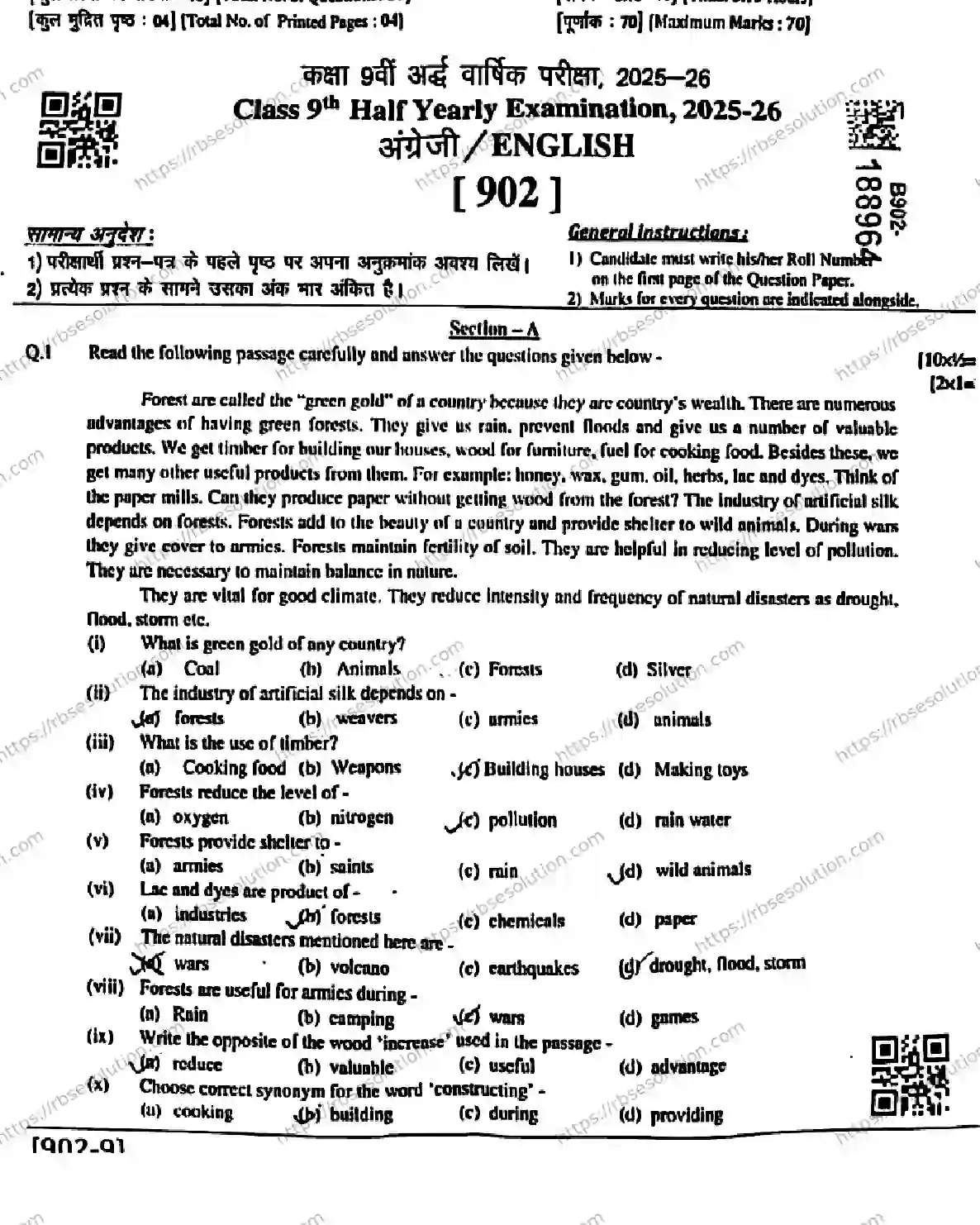
Class 9th Half Yearly Examination, 2025-26
ENGLISH [902]
General Instructions:
- Candidates must write his/her Roll Number on the first page of the Question Paper.
- Marks for every question are indicated alongside.
Section—A
Q1. Read the following passage carefully and answer the questions given below – (20×½=10)
Forests are called the “green gold” of a country because they are a country's wealth. There are numerous advantages of having green forests. They give us rain, prevent floods and give us a number of valuable products. We get timber for building our houses, wood for furniture, fuel for cooking food. Besides these, we get many other useful products from them. For example: honey, wax, gum, oil, herbs, lac and dyes. Think of the paper mills. Can they produce paper without getting wood from the forest? The industry of artificial silk depends on forests. Forests add to the beauty of a country and provide shelter to wild animals. During wars they give cover to armies. Forests maintain fertility of soil. They are helpful in reducing level of pollution. They are necessary to maintain balance in nature.
They are vital for good climate. They reduce intensity and frequency of natural disasters as drought, flood, storm etc.
-
(i) What is green gold of any country?
- Coal
- Animals
- Forests
- Silver
Explanation: The passage clearly states that forests are called the “green gold” of a country.
-
(ii) The industry of artificial silk depends on –
- forests
- weavers
- armies
- animals
Explanation: The passage mentions that the industry of artificial silk depends on forests.
-
(iii) What is the use of timber?
- Cooking food
- Weapons
- Building houses
- Making toys
Explanation: The passage says we get timber for building our houses.
-
(iv) Forests reduce the level of –
- oxygen
- nitrogen
- pollution
- rain water
Explanation: The passage states that forests are helpful in reducing the level of pollution.
-
(v) Forests provide shelter to –
- armies
- saints
- rain
- wild animals
Explanation: The passage says forests provide shelter to wild animals.
-
(vi) Lac and dyes are products of –
- industries
- forests
- chemicals
- paper
Explanation: The passage lists lac and dyes as products obtained from forests.
-
(vii) The natural disasters mentioned here are –
- wars
- volcano
- earthquakes
- drought, flood, storm
Explanation: The passage mentions drought, flood, and storm as natural disasters.
-
(viii) Forests are useful for armies during –
- Rain
- camping
- wars
- games
Explanation: The passage says during wars forests give cover to armies.
-
(ix) Write the opposite of the word ‘increase’ used in the passage –
- reduce
- rain
- plant
- advantage
Explanation: The opposite of 'increase' is 'reduce', which is used in the passage.
-
(x) Choose the correct synonym for the word ‘constructing’ –
- cooking
- building
- during
- providing
Explanation: 'Constructing' means 'building', as used in the passage for building houses.
Section – A (Reading)
Read the following passage carefully and answer the questions given below:
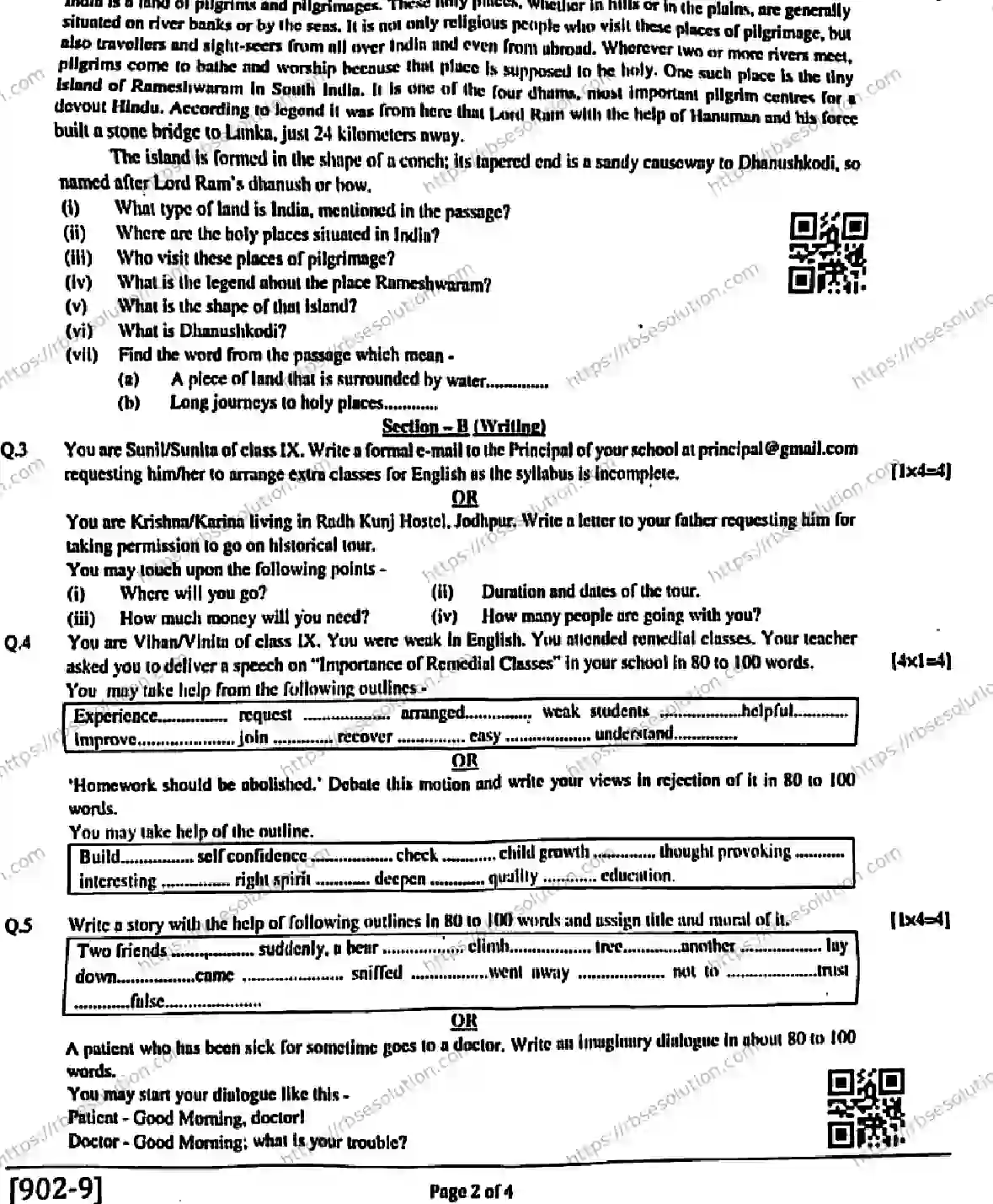
India is a land of pilgrimage. These holy places are situated on river banks or by the sea. It is not only religious people who visit these places but also travellers and sight-seers from all over India and even from abroad. Wherever we go, pilgrims come to bathe and worship because that place is supposed to be holy. One such place is the beautiful island of Rameswaram in South India. It is one of the four dhams, most important pilgrimage centres for a devout Hindu. According to legend, it was from here that Lord Ram with the help of Hanuman and his force built a stone bridge to Lanka, just 24 kilometers away.
The island is formed in the shape of a conch; its tapered end is a sandy causeway to Dhanushkodi, so named after Lord Ram's dhanush or bow.
-
(i) What type of land is India, mentioned in the passage?
India is a land of pilgrimage.
-
(ii) Where are the holy places situated in India?
The holy places are situated on river banks or by the sea.
-
(iii) Who visit these places of pilgrimage?
Religious people, travellers, and sight-seers from all over India and abroad visit these places.
-
(iv) What is the legend about the place Rameswaram?
According to legend, it was from Rameswaram that Lord Ram, with the help of Hanuman and his force, built a stone bridge to Lanka, which is just 24 kilometers away.
-
(v) What is the shape of that island?
The island is formed in the shape of a conch.
-
(vi) What is Dhanushkodi?
Dhanushkodi is a sandy causeway at the tapered end of the island, named after Lord Ram's dhanush (bow).
-
(vii) Find the word from the passage which means:
-
A place of land that is surrounded by water.
Island
-
Long journeys to holy places.
Pilgrimage
-
Section – B (Writing)
4. You are Sunil/Sunita of class IX. Write a formal e-mail to the Principal of your school at principal@gmail.com requesting him/her to arrange extra classes for English as the syllabus is incomplete. (4 marks)
To: principal@gmail.com
Subject: Request for Extra English Classes
Respected Principal,
I am Sunil/Sunita, a student of class IX in your school. I humbly request you to arrange extra classes for English. Due to various reasons, our English syllabus is still incomplete, and we are worried about our preparation for the upcoming exams. Extra classes will help us complete the syllabus and perform better. I hope you will consider my request.
Thanking you,
Yours obediently,
Sunil/Sunita
Class IX
OR
You are Krishna/Karina living in Radh Kunj Hostel, Jodhpur. Write a letter to your father requesting him for taking permission to go on a historical tour. (You may touch upon the following points: (i) Where will you go? (ii) Duration and dates of the tour. (iii) How much money will you need? (iv) How many people are going with you?)
Radh Kunj Hostel
Jodhpur
Date: ________
Dear Father,
I hope you are doing well. I am writing to seek your permission to go on a historical tour organized by our school. We will be visiting Jaipur and Agra to see historical monuments like the Hawa Mahal, Amer Fort, and the Taj Mahal. The tour is scheduled from 15th to 20th of next month, lasting six days. I will need around ₹3000 for the trip. There are 20 students and 2 teachers going with us. Please grant me permission and send the required amount. I will be very careful and follow all instructions.
Your loving son/daughter,
Krishna/Karina
5. You are Vihan/Vinita of class IX. You were weak in English. You attended remedial classes. Your teacher asked you to deliver a speech on “Importance of Remedial Classes” in your school in 80 to 100 words. (You may take help from the following outlines: Experience... Request... Improvement... Joy)
Speech on Importance of Remedial Classes
Good morning to my respected teachers and dear friends. Today, I want to share my experience about remedial classes. I was very weak in English and often felt left behind. My teacher requested me to join the remedial classes. There, I received extra attention and practice. Slowly, I saw improvement in my grammar and writing skills. Now, I feel joy and confidence in my studies. Remedial classes are a boon for students like me. I request all students who are struggling to join them. Thank you.
6. ‘Homework should be abolished.’ Debate this motion and write your views in rejection of it in 80 to 100 words. (You may take help of the outline: Boring... Interesting... Right spirit... Revision)
Views Against the Motion: Homework Should Not Be Abolished
I strongly reject the motion that homework should be abolished. Some students find homework boring, but when done in the right spirit, it becomes interesting. Homework helps us revise what we learned in class and strengthens our understanding. It teaches us discipline and time management. Without homework, we may forget important concepts. Therefore, homework is essential for our academic growth and should not be abolished.
7. Write a story with the help of the following outlines in 80 to 100 words: Two friends... Suddenly, a bear... Gown... Come... Nest... Shout... Rescue
The Two Friends and the Bear
Two friends were walking through a forest. Suddenly, a big bear appeared. One friend quickly climbed a tree and hid. The other friend could not climb. He lay down on the ground and pretended to be dead. The bear came near him, sniffed his gown, and then left, thinking he was dead. The friend in the tree came down and asked, “What did the bear whisper in your ear?” The other friend replied, “It said, ‘Never trust a friend who leaves you in danger.’” They both learned a lesson about true friendship.
OR
A patient who has been sick for some time goes to a doctor. Write an imaginary dialogue in about 80 to 100 words. (You may start your dialogue like this: Patient – Good Morning, doctor! Doctor – Good Morning; what is your trouble?)
Dialogue between a Patient and a Doctor
Patient: Good Morning, doctor!
Doctor: Good Morning; what is your trouble?
Patient: I have been suffering from a fever and cough for the past week. I also feel weak and have no appetite.
Doctor: Let me check your temperature and listen to your chest. (After examination) You have a mild infection. I will prescribe some medicines. Take them regularly and drink warm water. Rest for a few days.
Patient: Thank you, doctor. I will follow your advice.
Doctor: You are welcome. Get well soon.
Section-C
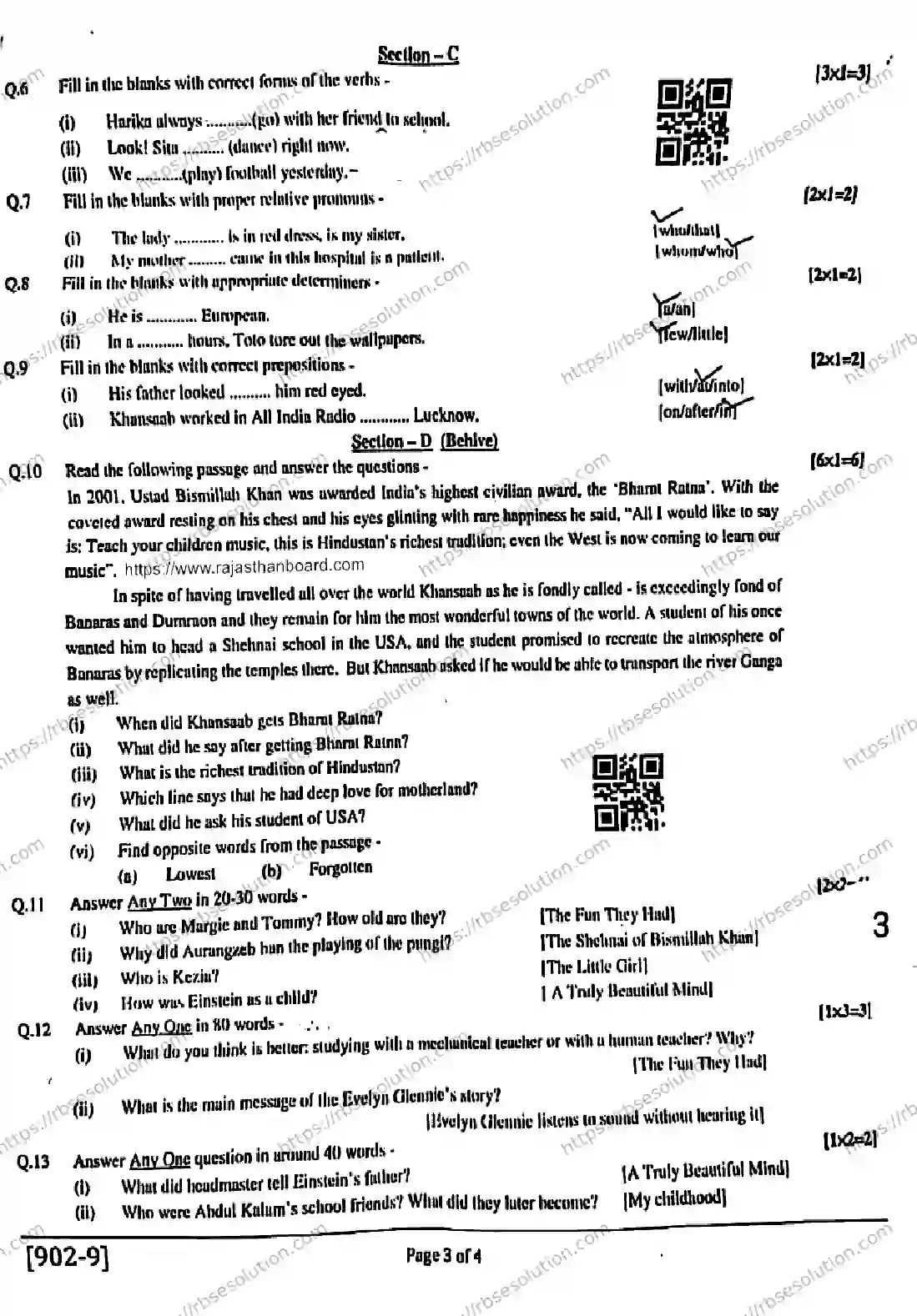
Fill in the blanks with correct forms of the verbs:
- Ela goes with her friend to school.
- Look! She is dancing right now.
- We played football yesterday.
- Harika always plays.
Fill in the blanks with proper relative pronouns:
- The lily which is in red area is my sister.
- My mother who came to this hospital is a Patel.
Fill in the blanks with appropriate determiners:
- He is a European.
- In a few hours, Tolo tore out the wallpapers.
Fill in the blanks with correct prepositions:
- His father looked at him red-eyed.
- Khansaab worked in All India Radio at Lucknow.
Section-D (Beehive)
Read the following passage and answer the questions:
In 2001, Ustad Bismillah Khan was awarded India's highest civilian award, the "Bharat Ratna". With the coveted award resting on his chest and his eyes glinting with rare happiness he said, "All I would like to say is: Teach your children music, this is Hindustan's richest tradition; even the West is now coming to learn our music."
In spite of having travelled all over the world, Khansaab as he is fondly called - is exceedingly fond of Banaras and Dumraon and they remain for him the most wonderful towns of the world. A student of his once wanted him to head a Shehnai school in the USA, and the student promised to recreate the atmosphere of Banaras by replicating the temples there. But Khansaab asked if he would be able to transport the river Ganga as well.
- When did Khansaab get Bharat Ratna?
Khansaab got the Bharat Ratna in 2001.
- What did he say after getting Bharat Ratna?
He said, "Teach your children music, this is Hindustan's richest tradition; even the West is now coming to learn our music."
- What is the richest tradition of Hindustan?
Music is the richest tradition of Hindustan.
- Which line says that he had deep love for motherland?
The line "he is exceedingly fond of Banaras and Dumraon and they remain for him the most wonderful towns of the world" shows his deep love for his motherland.
- What did he ask his student of USA?
He asked his student if he would be able to transport the river Ganga as well.
- Find opposite words from the passage:
- (a) Lowest – Highest
- (b) Forgotten – Remembered
Answer Any Two in 20-30 words:
- Who are Margie and Tommy? How old are they? [The Fun They Had]
Margie and Tommy are children living in the future. Margie is eleven years old and Tommy is thirteen years old.
- Why did Aurangzeb ban the playing of the pungi? [The Shehnai of Bismillah Khan]
Aurangzeb banned the playing of the pungi because it had a shrill and unpleasant sound. He did not like its loud, harsh tone.
- Who is Kezia? [The Little Girl]
Kezia is a little girl who is afraid of her strict father. She tries to please him but often gets scolded.
- How was Einstein as a child? [A Truly Beautiful Mind]
Einstein was a slow learner as a child. He did not speak until age two and was considered different from other children.
Answer Any One in 80 words:
- What do you think is better: studying with a mechanical teacher or with a human teacher? Why? [The Fun They Had]
A human teacher is better than a mechanical teacher. Human teachers can understand students' feelings, adapt to their needs, and provide personal attention. They can explain concepts in different ways and encourage creativity. Mechanical teachers are rigid and cannot show emotions or care. Human teachers also help in social development and make learning enjoyable through interaction. Therefore, studying with a human teacher is more effective and meaningful.
- What is the main message of Evelyn Glennie's story? [Evelyn Glennie Listens to Sound Without Hearing It]
The main message of Evelyn Glennie's story is that determination and hard work can overcome any disability. Despite being deaf, Evelyn became a world-famous percussionist. She learned to feel music through her body. Her story teaches us that physical limitations cannot stop us if we have passion and perseverance. It inspires us to follow our dreams and never give up.
Answer Any One question in 40 words:
- What did headmaster tell Einstein's father? [A Truly Beautiful Mind]
The headmaster told Einstein's father that Einstein would never amount to anything in life. He said that Einstein was not fit for school and suggested that he should leave.
- Who were Abdul Kalam's school friends? What did they later become? [My Childhood]
Abdul Kalam's school friends were Ramanadha Sastry, Aravindan, and Sivaprakasan. Ramanadha Sastry became a priest, Aravindan became a transport businessman, and Sivaprakasan became a catering contractor.
Section: Poetry
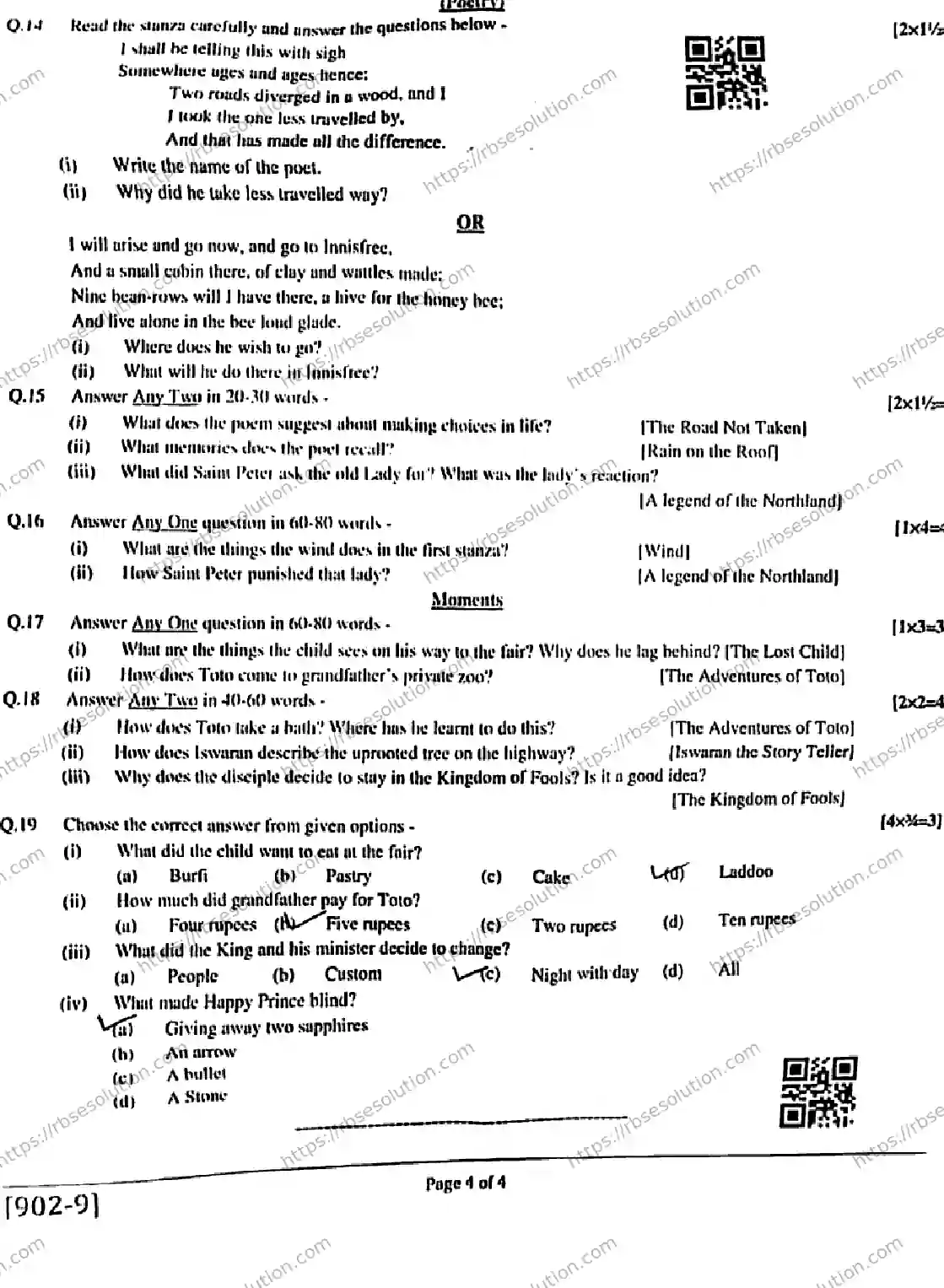
Q.1 Read the stanza carefully and answer the questions below – [2×1=2]
I shall be telling this with a sigh
Somewhere ages and ages hence:
Two roads diverged in a wood, and I—
I took the one less travelled by,
And that has made all the difference.
(i) Write the name of the poet.
Answer: The poet is Robert Frost.
(ii) Why did he take the less travelled way?
Answer: He took the less travelled road because it was grassy and wanted wear, and he wanted to make a unique choice that would make a difference in his life.
I will arise and go now, and go to Innisfree,
And a small cabin there, of clay and wattles made:
Nine bean-rows will I have there, a hive for the honey bee;
And live alone in the bee-loud glade.
(i) Where does he wish to go?
Answer: He wishes to go to Innisfree.
(ii) What will he do there in Innisfree?
Answer: He will build a small cabin of clay and wattles, have nine bean-rows, a hive for honey bees, and live alone in the bee-loud glade.
Answer Any Two in 20-30 words – [2×1=2]
(i) What does the poem suggest about making choices in life? (The Road Not Taken)
Answer: The poem suggests that choices in life are significant and the path we choose, especially the less common one, can make a great difference in our future.
(ii) Where does the rain come from? (Rain on the Roof)
Answer: The rain comes from the dark clouds in the sky. It falls on the roof and creates a soothing sound that brings back memories.
(iii) What did Saint Peter ask the old lady for? What was the lady's reaction? (A Legend of the Northland)
Answer: Saint Peter asked the old lady for a single cake from her baking. The lady was greedy and made smaller and smaller cakes but refused to give any, so Saint Peter punished her.
Answer Any One question in 60-80 words – [1×3=3]
(i) What are the things the wind does in the first stanza? (Wind)
Answer: In the first stanza, the wind is described as strong and destructive. It breaks the shutters of windows, scatters the papers, throws down books from the shelf, tears pages, and brings rain. The wind is shown as a powerful force that disrupts everything in its path, making a mess and causing chaos. The poet asks the wind to come softly and not to cause so much damage.
(ii) How did Saint Peter punish that lady? (A Legend of the Northland)
Answer: Saint Peter punished the greedy old lady by turning her into a woodpecker. She was forced to bore into hard wood to get her food, living alone in the forest. This punishment was fitting because she was selfish and refused to share even a small cake with the hungry saint. The transformation taught her a lesson about greed and kindness.
Section: Moments
Answer Any One question in 60-80 words – [1×3=3]
(i) What does the child see on his way to the fair? Why does he lag behind? (The Lost Child)
Answer: On his way to the fair, the child sees many attractive things: toys, sweets like burfi and gulab jamun, a flower seller, balloons, and a snake charmer. He lags behind because he is fascinated by each new thing and wants to stop and look at them. His parents have to call him repeatedly to keep him moving. His curiosity and desire for these attractions make him slow down and fall behind.
(ii) How does Toto come to grandfather's private zoo? (The Adventures of Toto)
Answer: Grandfather bought Toto from a tonga driver for five rupees. The tonga driver kept Toto with his monkey, but the monkey was tied to a feeding trough. Grandfather felt sorry for Toto and decided to bring him home. He added Toto to his private collection of animals, which included a tortoise, a pair of rabbits, a tame squirrel, and a goat.
Answer Any Two in 40-60 words – [2×2=4]
(i) How does Toto take a bath? Where has he learnt to do this? (The Adventures of Toto)
Answer: Toto takes a bath by testing the water temperature with his hand first. Then he steps into the tub and rubs soap over himself. He uses his hands or a brush to scrub. He learned this by watching the narrator's grandmother and other family members bathe. He imitated their actions carefully.
(ii) How does Iswaran describe the uprooted tree on the highway? (Iswaran the Storyteller)
Answer: Iswaran described the uprooted tree as a huge, fallen beast lying across the highway. He said it looked like a giant serpent or a monster that had been struck down. His description was dramatic and imaginative, making the simple event sound like an exciting adventure. He added many details to make the story more interesting.
(iii) Why does the disciple decide to stay in the Kingdom of Fools? Is it a good idea? (The Kingdom of Fools)
Answer: The disciple decided to stay in the Kingdom of Fools because everything was very cheap and he could live comfortably with little money. However, it was not a good idea because the kingdom was ruled by foolish people who made irrational decisions. Staying there was risky as the disciple could face danger or injustice at any time due to the foolish laws.
Choose the correct answer from given options – [4×½=2]
-
What did the child want to eat at the fair?
- (a) Burfi
- (b) Pastry
- (c) Cake
- (d) Laddu (Luddoo)
Correct Answer: (d) Laddu – The child wanted to eat laddu at the fair.
-
How much did grandfather pay for Toto?
- (a) Four rupees
- (b) Five rupees
- (c) Two rupees
- (d) Ten rupees
Correct Answer: (d) Ten rupees – Grandfather paid ten rupees for Toto.
-
What did the King and his minister decide to change?
- (a) People
- (b) Custom
- (c) Night with day
- (d) All
Correct Answer: (d) All – The King and his minister decided to change everything, including people, customs, and night with day.
-
What made Happy Prince blind?
- (a) Giving away his sapphires
- (b) An arrow
- (c) A bullet
- (d) A stone
Correct Answer: (d) A stone – The Happy Prince became blind when a stone was thrown at him.